Quickcncs Blog

Precision CNC sourcing review for product manufacturing information and semantic GD&T
CAD/CAM Software

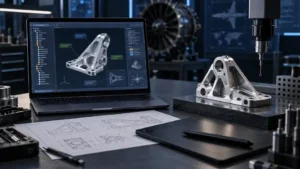
STEP AP242 PMI: CAD Preflight Checks Before CNC Production Release

STEP AP242 can carry much more than a part’s visible shape. Depending on the authoring system, export options, protocol edition, and receiving application, an AP242 file may transmit precise geometry, assembly structure, names, colors, saved views, and product manufacturing information (PMI) such as dimensions, tolerances, datums, and surface requirements. That

Read More »
Precision CNC sourcing review for alloy designation and temper or heat-treatment condition
Certificate

Material Grade, Temper, and Condition Callouts Before a CNC RFQ

“Aluminum,” “stainless,” or “PEEK” is not a complete material requirement for a CNC quotation. A useful CNC RFQ material callout identifies the grade, metallurgical or polymer condition, product form, governing specification, required evidence, and rules for substitution. Those details influence stock availability, mechanical properties, residual stress, cutting behavior, dimensional stability,

Read More »
Precision CNC sourcing review for title-block control and units and projection
CAD/CAM Software

2D Production Drawing Completeness: Preflight Checks Before Sending a CNC RFQ

A 3D model can show a machine shop what the part looks like, but it rarely tells the whole manufacturing and inspection story. A quote-ready 2D production drawing establishes the controlled requirements that are difficult, ambiguous, or inappropriate to infer from CAD alone: tolerances, datums, threads, surface texture, material condition,

Read More »
Precision CNC sourcing review for neutral CAD exchange and solid-body integrity
CAD/CAM Software

STEP vs Parasolid for CNC RFQs: Which CAD Format Should You Send?

When a machine shop asks for a 3D model, the practical question is not which file extension is “best” in the abstract. The question is which file the supplier can import without changing geometry, losing product structure, or misunderstanding the released revision. For most CNC RFQs, STEP is the safest

Read More »
CNC Machining

Aerospace CNC Machining: How Do You Meet Tight Tolerance Requirements?

You design a robotic joint. It looks perfect on screen. Then the part comes back off by a hair, and the whole assembly binds. In aerospace, that tiny gap can mean failure. I know this pain well. Aerospace CNC machining meets tight tolerance requirements by combining multi-axis equipment, thermal control,

Read More »
CNC Machining

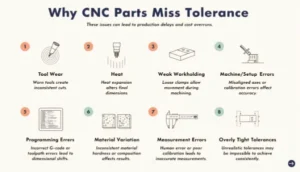
Why CNC Parts Don’t Meet Tolerance: 8 Common Reasons

You order a precision part. It arrives. Then your inspection report shows the dimensions are off. Now your project stalls, money is wasted, and you have no idea what went wrong on the shop floor. CNC parts miss tolerance for a few predictable reasons: tool wear, heat, weak workholding, machine

Read More »
CNC Machining

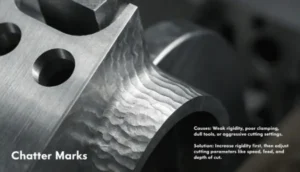
Chatter Marks in CNC Machining: Causes and How to Prevent Them

Have you ever looked at a freshly machined part and seen ugly wavy lines on the surface? Those are chatter marks. They ruin good parts, waste material, and cost you time. The good news? You can stop them. Chatter marks are surface ripples caused by vibration between the cutting tool

Read More »

🛠️ Get Your Custom Machined Parts — Quick Quote Available!

Wait! Don’t Leave Without Your Free CNC Quote!

Please send your requirements now — get a fast, no-obligation quote within 12 hours.