
CNC milling removes material with rotating tools and is best for prismatic parts, controlled faces, pockets, bores and complex surfaces. The practical route depends on tool access, workholding, datum transfer, wall stiffness, material and the number of orientations.
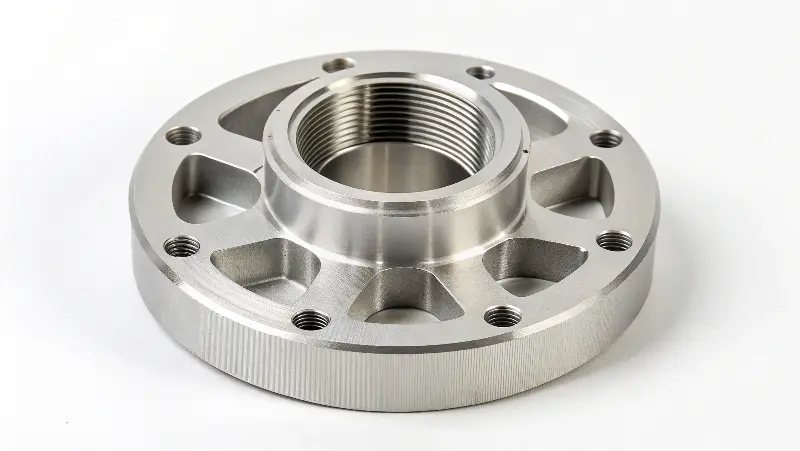
Three-axis machining is efficient when features can be reached from a small number of orthogonal setups. A rotary fourth axis suits indexed radial features. 3+2 positions the part for rigid cutting on several faces. Simultaneous five-axis is reserved for geometry requiring coordinated motion or continuously changing tool orientation.
A single site-wide “maximum size” is misleading. Travel, table load, tool reach, spindle capability and workholding all limit the usable envelope. Likewise, tolerance must be reviewed by feature and measurement method. Confirm the exact part size and drawing with the RFQ.
Related engineering guidance: follow the CNC workflow from drawing to inspection and review grade-specific stainless-steel machining risks.
Provide controlled 3D and 2D data, material and condition, quantity, finish, critical characteristics, inspection documentation and target delivery. State any approved alternatives or supplier restrictions.
Tolerance is reviewed by feature against size, geometry, material, setup, process sequence and measurement. The quotation records assumptions; it does not extend one tight value to every dimension.
Selected dimensional reports, first-article records or material documents can be included when the required scope and format are stated before quotation.
Not necessarily. Machine ownership and partner-supported processes are distinguished during capability confirmation where they affect confidentiality, quality or delivery.
Upload the model, drawing and project requirements through the Request a Quote form. Complete RFQs are targeted for review within one business day, subject to complexity and clarification.
Content reviewed for manufacturing accuracy by the QuickCNCs engineering coordination team. Updated August 29, 2026.