
Five-axis machining is justified when part access, datum continuity or surface orientation cannot be handled efficiently with conventional setups. It is not a guarantee that every dimension will hold an extreme tolerance; tool reach, thermal stability, material and inspection still govern the result.
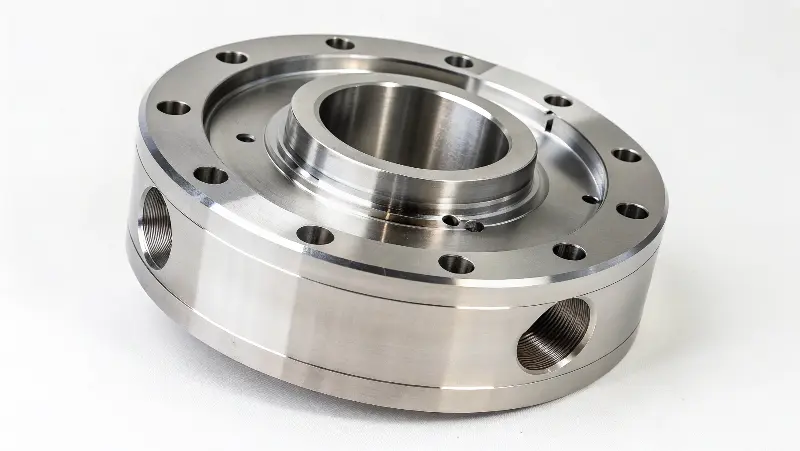
Indexed 3+2 machining positions the workpiece and then cuts with fixed rotary axes, often giving good rigidity for multi-face features. Simultaneous five-axis moves rotary and linear axes together for sculpted surfaces, swarf cutting or changing tool orientation along the path. The simpler method is preferred when it meets the drawing.
Programming, collision control, tooling and machine time can make five-axis more expensive. Critical features may require CMM inspection with a defined alignment. Provide an accurate 3D model, a 2D drawing, datum scheme, finish requirements and target quantity for a defensible quotation.
Provide controlled 3D and 2D data, material and condition, quantity, finish, critical characteristics, inspection documentation and target delivery. State any approved alternatives or supplier restrictions.
Tolerance is reviewed by feature against size, geometry, material, setup, process sequence and measurement. The quotation records assumptions; it does not extend one tight value to every dimension.
Selected dimensional reports, first-article records or material documents can be included when the required scope and format are stated before quotation.
Not necessarily. Machine ownership and partner-supported processes are distinguished during capability confirmation where they affect confidentiality, quality or delivery.
Upload the model, drawing and project requirements through the Request a Quote form. Complete RFQs are targeted for review within one business day, subject to complexity and clarification.
Content reviewed for manufacturing accuracy by the QuickCNCs engineering coordination team. Updated August 29, 2026.