
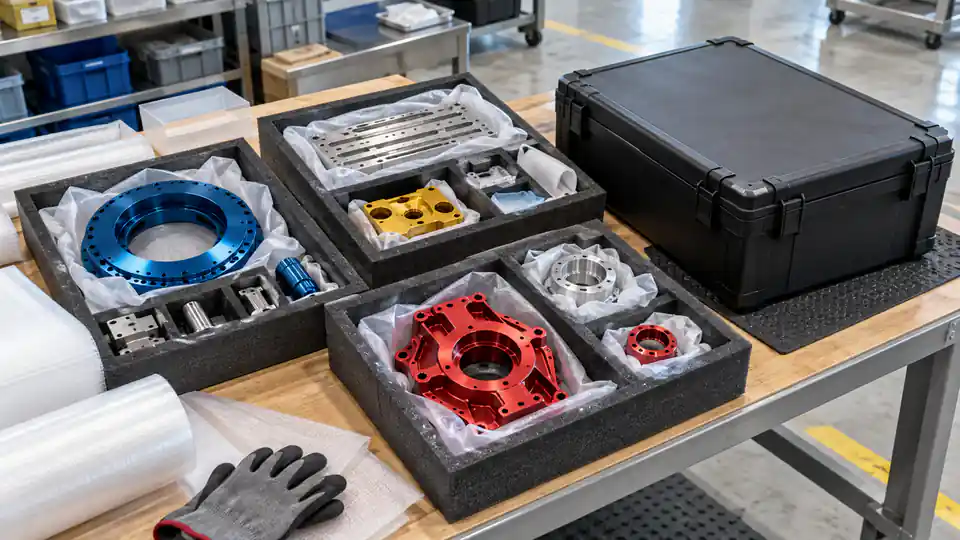
A CNC part is not complete when final inspection ends. It must reach the correct receiving location on the promised date with its accepted dimensions, surface, cleanliness, identification, and records intact. Vague RFQ language such as “standard packaging” or “delivery included” leaves suppliers to guess about corrosion protection, individual wrapping, customs documents, shipping terms, and the point at which transit risk changes hands.
This CNC RFQ delivery packaging guide explains how buyers should specify dates, ship-to data, packaging, labels, preservation, transport testing, international terms, and shipment records before requesting a quotation. The goal is not to prescribe a box design for every order. It is to define the product state and logistics boundary clearly enough that suppliers can protect it and quote comparable scope.
Define the Required Delivery Event
“Delivery date” can mean completion at the machine shop, availability for pickup, carrier handoff, arrival at a port, customs clearance, arrival at the buyer’s dock, or acceptance after receiving inspection. State the required event and location.
Record:
- requested date and time zone;
- named delivery location and dock hours;
- whether partial deliveries are allowed;
- quantity required at each milestone;
- carrier or service restrictions;
- documentation needed before dispatch;
- appointment or advance-shipping-notice requirements;
- holiday, shutdown, and receiving-calendar constraints.
If the schedule has prototype, validation, and production phases, list each separately. A supplier may be able to ship five development pieces quickly while the balance depends on material, finishing, or first-article approval.
Distinguish Lead Time from Transit Time
Manufacturing lead time includes clarification, material procurement, programming, tooling, machining, outside processing, inspection, approval, and packing. Transit time begins at the contractual handoff point and depends on mode, route, customs, and service level.
Ask the supplier for a milestone plan rather than a single number. It should identify customer-dependent gates such as drawing clarification, color-sample approval, first-article review, or deviation disposition. A promised ship date is not achievable if the purchase order leaves those decisions open.
For international work, allow time for export preparation, pickup, consolidation, terminal handling, linehaul, import clearance, and final delivery. Do not hide an urgent production need behind an ordinary service assumption.
Use Complete Ship-To Data
A complete destination record prevents address correction, customs delay, and delivery to the wrong building. Include:
- legal company or consignee name;
- street address, building, unit, dock, and postal code;
- country and region;
- receiving contact, phone, and email;
- opening hours and appointment rules;
- purchase-order and project references;
- carrier account when applicable;
- tax, importer, broker, or registration information as required;
- special site-security or vehicle requirements;
- alternate contact for exceptions.
Do not place critical instructions only in an email signature. Put the controlled ship-to data on the purchase order or approved logistics instruction and assign a revision or effective date.
Select the Delivery Term and Named Place
For international sales, Incoterms® rules help allocate tasks, costs, and risks between buyer and seller. The U.S. International Trade Administration notes that the rules address matters such as carriage, insurance, customs formalities, delivery, and the point at which risk passes. They do not define every sales condition.
State the selected rule, the exact named place or port, and the version, for example “FCA [named facility], Incoterms® 2020.” A term without a named place is incomplete. Confirm separately:
- title transfer if relevant;
- payment terms;
- required insurance beyond the rule;
- broker and importer-of-record roles;
- duties, taxes, tariffs, and fees;
- required documents;
- packaging performance and labeling;
- responsibility for abnormal storage or inspection.
Use trade and legal specialists for the actual transaction. Do not select a term solely because it was used on a prior order.
Describe the Part’s Vulnerabilities
Packaging design begins with the part. Identify what must be protected:
- precision surfaces, datums, sealing lands, and bearing fits;
- cosmetic faces and coated finishes;
- sharp edges, thin walls, long shafts, and delicate threads;
- cleanliness or particle limits;
- corrosion-sensitive materials;
- residual fluids or moisture restrictions;
- magnets, electronics, or special materials;
- heavy or awkward centers of gravity;
- matched sets and assembly orientation.
A heavy steel block and a thin anodized housing need different restraint. A bag that prevents dust may trap moisture. Oil that protects carbon steel may contaminate a vacuum component. Define the accepted state and let packaging engineering select compatible materials.
Separate Part Protection from the Shipping Container
Use a layered design:
| Layer | Purpose | Typical decisions |
|---|---|---|
| Surface protection | Prevent direct abrasion, contamination, or corrosion | Clean wrap, cap, approved film, VCI, desiccant |
| Unit protection | Isolate one part or matched set | Bag, sleeve, divider, formed insert |
| Cushioning and restraint | Limit shock, vibration, and movement | Foam, blocking, bracing, suspension |
| Shipping container | Carry handling and stacking loads | Carton, reusable tote, crate, case |
| Unit load | Consolidate containers for movement | Pallet, straps, stretch wrap, edge boards |
Each layer should be compatible with the part and destination. Foam can abrade a polished face, cardboard fibers can violate clean requirements, and adhesive film can leave residue. Confirm compatibility rather than assuming a common material is harmless.
Prevent Part-to-Part Contact
Precision parts should not collide during ordinary handling and transport. Use individual cavities, separators, caps, or controlled nesting. Restrain the contents so shaking the container does not allow metal-to-metal movement.
Keep protective materials away from sharp edges that can cut them. Support a part at robust, noncritical zones and distribute loads so thin walls are not permanently deformed. For tall stacks, calculate the load on the bottom layer and consider creep of cushioning during storage.
If parts are designed to nest, prove that contact occurs only at permitted surfaces and that operators can separate them without tools that damage edges.
Protect Cosmetic and Coated Surfaces
Final appearance can be damaged by rubbing, fingerprints, trapped grit, adhesive transfer, moisture, or contact with incompatible paper and foam. Inspect and clean the part before protection is applied.
Define which faces cannot contact packaging. Use nonabrasive separators and ensure the part cannot migrate during vibration. Protective film should be approved for the coating, storage duration, and temperature; some adhesives become difficult to remove or leave an outline.
If visual inspection occurs at receiving, make the surface accessible without destructive unpacking. State whether film should remain until assembly and provide removal instructions.
Control Corrosion During Storage and Transit
Corrosion risk depends on material, finish, cleanliness, humidity, salt exposure, temperature cycling, packaging permeability, and storage time. Select oil, vapor corrosion inhibitor, desiccant, barrier bag, or dry packaging based on that environment.
The preservation method must be compatible with the next operation. A heavy rust preventive may protect steel but add cleaning work before bonding, painting, vacuum service, or assembly. State whether parts must arrive dry and residue-free.
For barrier packaging, define bag material, seal, desiccant quantity or humidity indicator where needed, and maximum time before use. Ensure that wet parts are not sealed. Identify re-preservation instructions for a package opened during customs or receiving inspection.
Preserve Cleanliness
For cleanroom, fluid, medical, optical, semiconductor, or vacuum-related components, packaging is part of the validated cleaning process. Define the environment after cleaning, handling materials, glove rules, bag layers, purge, seal, caps, and label placement.
Use approved low-shedding materials. Do not put loose paper or particulate foam inside the clean barrier. Cap ports and protect internal passages without leaving fibers or adhesive. If double bagging is required, define which layer is removed at each controlled boundary.
Record cleaning status, date, lot, and shelf-life or re-clean requirement. A clear bag does not prove that the internal surface meets a cleanliness specification.
Protect Threads, Ports, and Internal Passages
Use caps, plugs, sleeves, or fixtures that do not damage threads or contaminate passages. Identify whether protective items are reusable, conductive, cleanroom-compatible, or detectable if accidentally left in place.
Avoid installing metal plugs so tightly that removal damages a port. For sealed fluid components, clarify whether shipment contains test fluid, inhibitor, inert gas, or dry air and what the receiver must do before assembly.
Count and list temporary protective components where foreign-object risk matters. A cap inventory on the packing record can support receiving and assembly.
Package Matched Sets and Serialized Parts
If components are lapped, selected, balanced, or qualified as a set, package and label them together. Show assembly position and orientation without marking a prohibited surface. Do not let warehouse repacking separate the set.
For serialized parts, the exterior and interior records should identify serials in each container. Barcodes or data-matrix marks can reduce manual error when they are tied to the purchase and inspection system.
Use controlled labels that remain legible through expected humidity, abrasion, and temperature. Removable labels on parts must not leave damaging residue.
Specify Container and Pallet Requirements
State maximum package mass, dimensions, stack height, pallet style, forklift access, lifting points, and restrictions on wood or other materials. International wood packaging may require applicable phytosanitary treatment and marking; confirm destination rules with logistics specialists.
Heavy parts need engineered blocking and bracing. The crate, fasteners, base, and lifting method must withstand expected handling. Mark center of gravity and lift points where needed. Do not rely on a carton label to control an unstable load.
For reusable packaging, define ownership, return flow, inspection, cleaning, repair, and replacement. Confirm that a worn insert cannot place a precision face against a hard container wall.
Validate Packaging Against the Distribution Route
Distribution hazards can include shock, vibration, compression, low pressure, temperature, humidity, rain, and repeated handling. ASTM D4169 provides a structured practice for evaluating shipping units against representative distribution sequences; ISTA procedures similarly support preshipment performance testing.
Select a test based on the actual product, container, route, mode, mass, and consequence. A parcel test is not automatically appropriate for a palletized ocean shipment. Laboratory testing does not replace correct material and pack-out specifications, and passing an excessive test may conceal unnecessary packaging cost.
Use production-intent parts or representative masses, final closures, labels, and pack quantities. After testing, inspect both package and product using defined criteria. Dimensional shifts, coating rub, trapped debris, and loose fasteners can matter even if the outer box remains intact.
Define Label Content
Exterior labels should support routing and receiving without exposing sensitive product information unnecessarily. The RFQ can require:
- ship-from and ship-to addresses;
- purchase-order and line number;
- part number and revision;
- quantity and unit of measure;
- lot, batch, and serial range;
- gross and net mass;
- container count, such as 1 of 3;
- handling, orientation, moisture, ESD, or stacking symbols;
- country of origin where required;
- expiration, clean status, or special storage condition;
- barcode or data format.
Keep regulatory and dangerous-goods labeling under qualified control. Do not copy markings from an unrelated shipment.
Prepare the Packing List
The packing list should match the physical contents and commercial documents. Include order, part, revision, description, quantity, serial or lot, container mapping, gross/net mass, dimensions, and documents enclosed or transmitted electronically.
If one shipment contains partial quantities or multiple revisions, identify them by container. A packing list saying “100 parts” is not enough when 60 are Revision B and 40 are an approved deviation.
Make the list accessible without exposing clean contents. Use an exterior document pouch or electronic advance copy as agreed.
Align Export and Customs Data
International shipments need accurate commodity description, classification, origin, value, and party information. The buyer and supplier should agree who provides and validates each field. Use customs, trade, and logistics professionals for the applicable countries and product.
Avoid vague descriptions such as “samples” or “metal parts” when a more accurate commercial description is required. Engineering descriptions, invoice descriptions, part numbers, quantities, and origin should be consistent across the shipment.
The RFQ should identify whether the supplier must provide certificates of origin, export licenses, preferential-origin statements, or other documents. Build their time and cost into the quotation.
Set the Advance Shipping Notice
An advance shipping notice lets the receiver prepare capacity and detect errors before arrival. Require it at a defined point, such as carrier pickup or a specified number of hours before delivery.
Include purchase order, part/revision, quantities, lot/serials, package count, weights/dimensions, carrier, tracking or airway-bill number, ship date, estimated arrival, and document links. Identify temperature, cleanroom, oversized-load, or inspection needs.
If information changes, require a corrected notice rather than an informal separate message.
Define Evidence of Shipment Condition
For high-value or sensitive hardware, use photos or data loggers only when they support a defined decision. Pack-out photos should identify the shipment and show layer sequence, restraint, labels, seal, and container condition without exposing unrelated confidential data.
Shock, tilt, humidity, or temperature indicators need placement, range, activation, and disposition rules. An activated indicator is a trigger for inspection, not automatic proof that the part is damaged. Likewise, a quiet indicator does not prove dimensional conformance.
Retain calibration and raw logger data when the acceptance decision relies on it.
Plan Receiving Inspection and Unpacking
The buyer should tell receiving how to inspect the package before opening, record damage, preserve carrier evidence, and move the part into the correct environment. Use safe lifting and opening instructions; nails, blades, and staples can damage parts.
For clean packages, define the sequence for exterior cleaning, bag removal, and transfer. For corrosion-protected parts, define removal or retention of preservative. For matched sets, verify identity before separation.
Record shortages, wrong revisions, packaging damage, water exposure, indicator activation, and visible part damage. Quarantine questionable items before they enter production.
Price Logistics Scope Transparently
Ask suppliers to separate or identify:
- unit and reusable packaging;
- preservation and clean packaging;
- crate or pallet design;
- qualification tests;
- labels and documentation;
- domestic pickup and export handling;
- freight, insurance, duties, and taxes according to the selected term;
- special delivery, appointment, or expedited service;
- return of reusable containers.
This prevents a low machining quote from becoming an expensive logistics change after award.
Control Changes to Packaging and Route
Treat an approved packaging design as a controlled production input. A substitute foam density, thinner bag, different cap, smaller carton, new pallet pattern, or alternate forwarder can change product protection. Define which changes need buyer notification or renewed testing and which remain within supplier authority.
Link the packaging instruction to part revision, pack quantity, and destination. A design that works for six parts by air may fail when twenty-four are stacked for ocean freight. When quantities or routes change, review load, restraint, moisture exposure, customs access, and handling equipment rather than copying the old pack note.
Retain pack-out records for damage investigations. They should identify material revisions, operator, date, container number, and any required photographs or logger IDs. Do not use photos as a substitute for a controlled instruction; their purpose is to show that the approved pack was actually applied.
If the supplier proposes a sustainability improvement, compare protection as well as material reduction. Reusable containers need return cleaning, condition inspection, ownership, and loss rules. Recycled or reduced-density materials need qualification where strength, shedding, moisture, or contamination matters.
Align Insurance and Claims Handling
The delivery term may allocate a responsibility to arrange insurance, but the commercial agreement should still define required coverage and claims cooperation. Confirm insured value, exclusions, deductible, named parties, and whether expedited replacement costs or only goods value are covered.
Before shipment, agree who documents package condition, who notifies the carrier, how quickly concealed damage must be reported, and which packaging must be retained. Receiving should photograph exterior condition, labels, seals, internal restraint, and part damage before discarding evidence.
A freight claim and a product nonconformance are related but separate. Contain the damaged lot and evaluate the part against engineering requirements even if the carrier accepts liability. Conversely, a crushed carton does not prove that a robust, restrained component is nonconforming. Use inspection evidence to make the product decision.
After a claim, review the complete chain: approved package, actual pack-out, carrier scans, route, transfer points, environmental records, receiving photographs, and measured product condition. Correct the weakest verified control. Adding more foam without understanding load transfer can increase pressure on thin walls, and changing carriers cannot correct an unrestrained part inside an intact crate.
Common RFQ Failures
“Delivery in four weeks”
State the delivery event, location, quantity, time zone, approval gates, and transit responsibility. Separate manufacturing and transport time.
“Export packaging required”
Define route, duration, climate, corrosion state, container, pallet, wood rules, labeling, and test needs. There is no single universal export package.
Parts are individually wrapped but still rub
Wrapping does not replace restraint. Prevent movement and part-to-part contact within the container.
Clean parts arrive with paper inside the inner bag
Define approved materials, bag layers, label location, and packing records. Train every pack-out operator.
Incoterm is shown without a place or version
Write the rule, exact named place, and version, then define issues the rule does not cover in the sales contract.
RFQ Delivery and Packaging Checklist
Before release, confirm that:
- the delivery event, date, location, and quantity are exact;
- partial shipments and milestones are stated;
- ship-to and receiving data are complete;
- delivery term, named place, and version are defined;
- the part’s precision, cosmetic, clean, and corrosion risks are identified;
- unit protection prevents movement and contact;
- preservation is compatible with the next operation;
- threads, ports, passages, and matched sets are protected;
- container, pallet, lift, stack, and mass limits are stated;
- qualification testing matches the distribution route;
- labels, packing list, customs data, and advance notice are specified;
- receiving and unpacking instructions preserve evidence and product state;
- the quotation identifies all logistics assumptions and costs.
Deliver the Accepted Part, Not Merely the Box
Packaging and delivery requirements translate the final inspection decision into an intact item at the receiving point. A quote-ready package identifies the vulnerabilities, distribution route, handoff, records, and unpacking conditions while leaving the supplier room to engineer an efficient solution.
Send the controlled 3D model and 2D drawing with quantities, destination, required date, surface and cleanliness conditions, packaging specification, and delivery term. QuickCNCs can review manufacturability and pack-out implications through CNC milling services and rapid prototyping. Submit the complete request through Request a Quote.
References
- ASTM D4169 — performance testing of shipping containers and systems against representative distribution hazards.
- ISTA: Getting Started with Design and Testing — selecting and using preshipment package tests.
- U.S. International Trade Administration: Know Your Incoterms — allocation of delivery tasks, costs, and risks in international transactions.