
You designed a perfect CNC part. The tolerances are tight. The fit is exact. Now one wrong finish choice can ruin all that work, adding thickness, hiding details, or wearing out fast. Picking the right coating matters more than most people think.
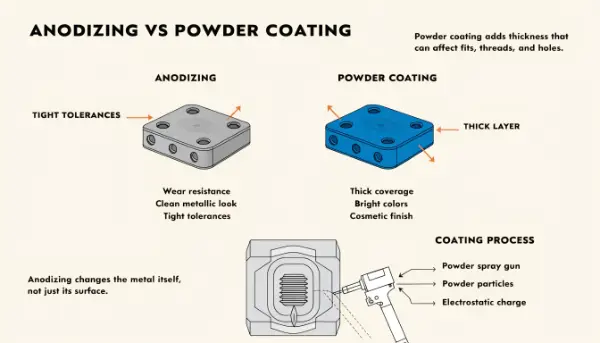
For CNC parts, anodizing is usually better when you need tight tolerances, wear resistance, and a clean metallic look. Powder coating is better when you want thick coverage, bright colors, and a cosmetic finish. Anodizing changes the metal itself. Powder coating adds a thicker layer that can affect fits, threads, and holes.
I have worked with both finishes for years on robotic and precision parts. Each one has a place. The trick is matching the finish to the job. Let me break down the real differences so you can choose with confidence.
Is powder coating better than anodizing?
A client once asked me to powder coat a precision aluminum joint. The colors looked amazing. But the threads stopped fitting. That thick layer caused real problems. The "better" finish was the wrong one.
Powder coating is not always better than anodizing. It depends on the part. Powder coating wins for color choice and hiding marks. Anodizing wins for tight tolerances, wear resistance, and heat dissipation. For most precision CNC parts, anodizing is the safer default. For large cosmetic parts, powder coating often makes more sense.
Where each finish shines
There is no single winner here. The right pick changes with your goal. Anodizing forms a thin oxide layer right on the metal surface. It keeps machined detail sharp and adds almost no thickness. That helps when fit really matters.
Powder coating sprays a dry powder, then bakes it into a hard shell. This layer is much thicker. It hides small scratches and tool marks. It also comes in many colors and gloss levels.
| Need | Better choice |
|---|---|
| Tight tolerances | Anodizing |
| Bright color variety | Powder coating |
| Hiding machining marks | Powder coating |
| Wear and scratch resistance | Anodizing |
| Heat-dissipating parts | Anodizing |
| Large cosmetic enclosures | Powder coating |
So the honest answer is simple. Neither one is "best" for every job. I always start with the function of the part. If it must fit tightly or shed heat, I lean toward anodizing. If it is a big visible cover and looks come first, powder coating wins. Think about the part’s job before the part’s color.
What is the 7/20 rule for anodizing?
Many engineers send me parts and forget about edges. Then they ask why the corners look thin or weak. The answer is often the 7/20 rule. Skip it, and your anodized finish may fail where you least expect.
The 7/20 rule for anodizing means inside corners should have at least a 7 mil radius, and outside corners need at least a 20 mil radius. This helps the anodized layer build evenly. Sharp corners cause thin or cracked coatings. Proper radii give a stronger, more uniform finish across the whole part.
Why corners matter so much
Anodizing grows from the metal surface outward. On flat faces, the layer builds nice and even. But sharp edges are a problem. The coating cannot wrap a knife-edge well. It ends up thin there. Thin spots wear fast and corrode early.
Here is how I think about the numbers:
| Corner type | Minimum radius | Reason |
|---|---|---|
| Inside corner | 7 mil (~0.18mm) | Lets oxide layer form without gaps |
| Outside corner | 20 mil (~0.5mm) | Stops thin, cracked edges |
When I design parts for anodizing, I add these radii early in the CAD stage. It costs nothing then. Fixing it later means re-machining. I tell my clients to round sharp edges on purpose. A small radius gives the finish room to grow strong.
This rule matters most for hard anodizing, where the layer is thicker. Robotic joints and wear surfaces need that strength. So I never treat the 7/20 rule as optional. It is a quiet detail that decides if your finish lasts years or fails in months. Plan for it before you cut metal.
What are the disadvantages of anodizing?
Anodizing looks great, but it is not magic. I have seen parts come back with visible tool marks because the surface was rough. Anodizing does not hide flaws. It can actually make them stand out more.
Anodizing has real drawbacks. It needs a smooth base, since it shows scratches and tool marks. It only works on aluminum and a few other metals. Color choices are limited compared to powder coating. Some anodized layers also offer less chemical resistance in very harsh environments than powder coating does.
The limits you should know
Anodizing is thin and precise. That is its strength, but also its weakness. Because the layer is so thin, it copies the surface below. Any tool mark, scratch, or rough spot stays visible. So you need clean machining and good prep first.
Here are the main downsides I watch for:
| Disadvantage | What it means for you |
|---|---|
| Shows imperfections | Surface must be smooth before treatment |
| Metal-limited | Works mainly on aluminum |
| Fewer colors | Less variety than powder coating |
| Harsh chemical limits | Can underperform in strong acids or bases |
| Color match issues | Batches may vary slightly in shade |
I once had a batch of parts where the color came out slightly different between runs. The customer noticed right away. Anodizing dye can shift a little from batch to batch. So for large color-matched sets, this is a risk.
Still, I do not avoid anodizing for these reasons. I just plan for them. I make sure the machining is clean. I set color expectations early. I check if the part will see harsh chemicals. Knowing the weak points lets me use anodizing where it truly fits. Every finish has a tradeoff. The key is choosing with open eyes.
Does anodizing make aluminium parts stronger?
People often think anodizing makes the whole part stronger. That is a common myth. The truth is more specific. Misunderstanding this can lead to wrong design choices for load-bearing parts.
Anodizing does not make the whole aluminum part stronger. It makes only the surface harder and tougher. The oxide layer resists wear, scratches, and corrosion much better than bare aluminum. But it does not change the core strength of the metal. The part can still bend or break under the same load.
Surface hardness vs part strength
Let me make this clear. Strength and surface hardness are two different things. Strength is how much load a part can take before it bends or breaks. That comes from the alloy and the part shape. Anodizing does not change that.
What anodizing does change is the surface. The oxide layer is very hard. It protects against scratches and wear. On parts that rub or slide, this matters a lot.
| Property | Does anodizing help? |
|---|---|
| Surface hardness | Yes, much harder |
| Wear resistance | Yes, big improvement |
| Corrosion resistance | Yes, strong gain |
| Core load strength | No real change |
| Fatigue life | Can slightly lower it |
Here is a detail many miss. Hard anodizing can slightly reduce fatigue strength. The brittle oxide layer can start tiny cracks under repeated stress. For my robotic parts that flex often, I keep this in mind. I use hard anodizing on wear surfaces, not on parts that bend a lot.
So I never pick anodizing just to make a part "stronger." I pick it to protect the surface. If I need more core strength, I change the alloy or the design. Match the right fix to the right problem.
Conclusion
Anodizing suits precise, wear-resistant CNC parts. Powder coating suits colorful, larger cosmetic parts. Match the finish to the part’s job, not just its looks.