
You need to machine a custom metal part. But you do not know which aluminum to choose. Picking the wrong metal can ruin your project and waste money. I will show you how to pick the right one.
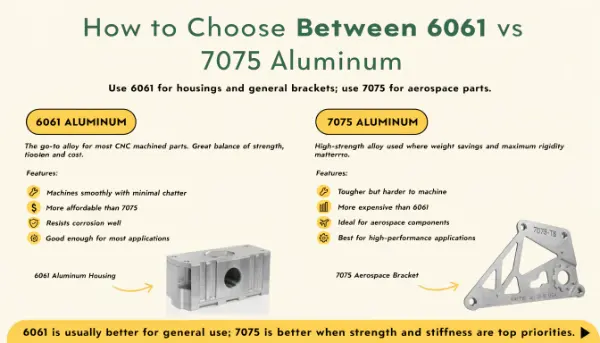
For precision parts, 6061 aluminum is usually better for general use because it is cheaper, easier to machine, and resists rust well. However, 7075 aluminum is better when strength and stiffness are your top priorities. Use 6061 for housings and general brackets. Use 7075 for aerospace parts.
Let us look at the details. We will see why one material might fit your needs better than the other.
How much stronger is 7075 vs 6061?
Your robotic arm needs to lift heavy weights. A weak part will break and stop the whole machine. You need high strength, but you do not know the exact difference between these two metals.
Aluminum 7075 is nearly twice as strong as aluminum 6061. The tensile strength of 7075-T6 is about 572 MPa, while 6061-T6 is about 310 MPa. This huge difference means 7075 can handle much heavier loads without bending or breaking. It is the best choice for high-stress applications.
At QuickCNCs, I see many engineers ask about strength. We need to break this down. Strength is not just one simple number. We have tensile strength and yield strength. Tensile strength is how hard you can pull the metal before it breaks. Yield strength is how hard you can pull it before it bends and stays bent.
Comparing the Numbers
Let us look at the exact numbers. The numbers show why 7075 is a beast.
| Property | Aluminum 6061-T6 | Aluminum 7075-T6 |
|---|---|---|
| Tensile Strength | 310 MPa | 572 MPa |
| Yield Strength | 276 MPa | 503 MPa |
| Fatigue Strength | 96 MPa | 159 MPa |
You can see 7075 is way stronger. When I work with clients making robot arms, they often need thin parts. But these parts must hold heavy loads. In these cases, 6061 will bend. Aluminum 7075 gives you the highest strength from the least amount of material. This is why aerospace and military projects use it so much.
Fatigue Resistance Matters
Another big thing is fatigue resistance. What is fatigue? Imagine you bend a paperclip back and forth. Soon, it breaks. That is fatigue. Machine parts go through this same repeated stress. Aluminum 7075 has higher fatigue resistance. It is much better for precision parts that go through repeated loading cycles over many years. If your part moves a lot and carries a load, 7075 is the clear winner. You get maximum performance in a loaded precision part.
What are the disadvantages of 7075 aluminum?
You might think 7075 is perfect because it is so strong. But using it everywhere is a big mistake. It can lead to cracked parts and bad surface finishes if you ignore its bad sides.
The main disadvantages of 7075 aluminum are its poor corrosion resistance, difficult weldability, and higher cost. It is also harder to machine and form than 6061. Because it is so hard, it does not bend easily and can crack if you try to form it into complex shapes.
We know 7075 is strong. But it has real limits. I always tell my clients to think carefully before they pick it. Let us look at the main problems you will face.
Corrosion Problems
First, 7075 has copper in it. Copper makes it strong, but copper also makes it rust faster. Aluminum 6061 resists rust much better. If your precision part works outside or near saltwater, 7075 will corrode quickly. Aluminum 6061 is much safer for harsh environments. Also, 6061 maintains better performance at lower temperatures. This makes 6061 suitable for cold environments.
Welding and Forming
Second, 7075 is very hard to weld. In fact, most people say you should never weld it. It cracks when it gets too hot. Aluminum 6061 is very easy to weld. If your project needs welded joints, you must use 6061. Also, 7075 is very stiff. It does not like to bend. If you need complex forming or bending, 6061 is the better choice because it is more ductile.
| Feature | Aluminum 7075 | Aluminum 6061 |
|---|---|---|
| Rust Resistance | Poor | Excellent |
| Weldability | Very Bad | Very Good |
| Bending | Hard | Easy |
| Cold Weather Use | Fair | Excellent |
Machining Speed
Finally, 7075 is harder on cutting tools. Because it is so hard, it can wear out CNC drill bits faster. We must slow down our machines when we cut 7075. This adds time to the job. Aluminum 6061 is a joy to cut. It is ideal for mass-produced precision parts that need tricky shapes.
How much is 6061 cheaper than 7075?
Budget overruns can kill a project. Choosing the wrong metal can double your material costs for no good reason. You need to know the price difference to stay under your budget.
Aluminum 6061 is usually 30% to 50% cheaper than aluminum 7075. The exact price difference depends on the market and the shape of the metal. 6061 is much more cost-effective. It is the best choice when you need to save money on mass-produced precision components.
Cost is a huge factor in manufacturing. In my ten years of global sourcing, price is always the first question I get. Let us break down the costs so you understand where your money goes.
The Raw Material Cost
The raw metal for 7075 is simply more expensive to make. It uses zinc and copper as main ingredients. It also needs special heat treatments to get its extreme strength. Aluminum 6061 uses magnesium and silicon. These are cheaper to mix and process.
| Cost Factor | Aluminum 6061 | Aluminum 7075 |
|---|---|---|
| Raw Material Price | Low | High (30-50% more) |
| Tool Wear | Low | High |
| Time to Machine | Fast | Slower |
| Anodizing Quality | Very Uniform | Sometimes patchy |
Hidden Manufacturing Costs
But the raw material is only part of the story. The time it takes to machine the part also costs money. Remember, 7075 is harder. We have to slow down the CNC machines. Slower machines mean fewer parts made per day. This raises the price per part. Also, 7075 wears out our cutting tools faster. We have to buy new tools more often. All these little things add up fast.
Another cost comes from finishing. Aluminum 6061 tends to anodize more uniformly. You get a nice cosmetic look easily. 7075 can look patchy when anodized. For most general-purpose machined parts, like simple housings, brackets, or fixtures, 6061 is the clear winner. It is produced economically at scale.
What is the strongest billet aluminum?
You need the absolute toughest material for an extreme project. A normal metal will fail under this crazy pressure. You want to know what the top choice is for maximum performance.
Aluminum 7075-T6 is widely considered the strongest common billet aluminum used in precision machining. It offers the highest tensile and yield strength among standard aluminum alloys. While there are specialty aerospace alloys that are slightly stronger, 7075 remains the strongest readily available billet option.
When people ask me for the strongest billet aluminum, the answer is almost always 7075. But we need to understand what "billet" means and why 7075 holds this title in the manufacturing world.
What is Billet Aluminum?
Billet means a solid block of metal. We put this block into a CNC machine and cut away the parts we do not want. Billet parts are very strong because the metal is solid. It has no hidden air bubbles. It is not poured into a mold like cast aluminum.
The King of Common Alloys
Among the common metal blocks we buy, 7075 is the king. It competes with some types of steel in terms of strength, but it weighs much less.
| Alloy Type | Strength Level | Common Use |
|---|---|---|
| Billet 6061 | Medium | Car parts, electronics |
| Billet 7075 | Very High | Airplanes, defense gear |
| Billet 2024 | High | Aircraft skins |
There are some super rare alloys, like 7068. These are technically stronger than 7075. But you cannot just buy them easily. They are very expensive and hard to find. For most projects, 7075-T6 is the strongest billet material you can actually buy and use without waiting months for special orders.
If your part is strength-limited and weight matters, this is your metal. I have helped many European robotic companies use 7075 for their main joints. These joints hold huge weights but need to move fast. The light weight and high strength of 7075 billet make it the best material for these loaded precision parts.
Conclusion
To sum up, use 6061 aluminum for cheap, easy machining and good rust resistance. Choose 7075 aluminum only when your part needs extreme strength and light weight.