
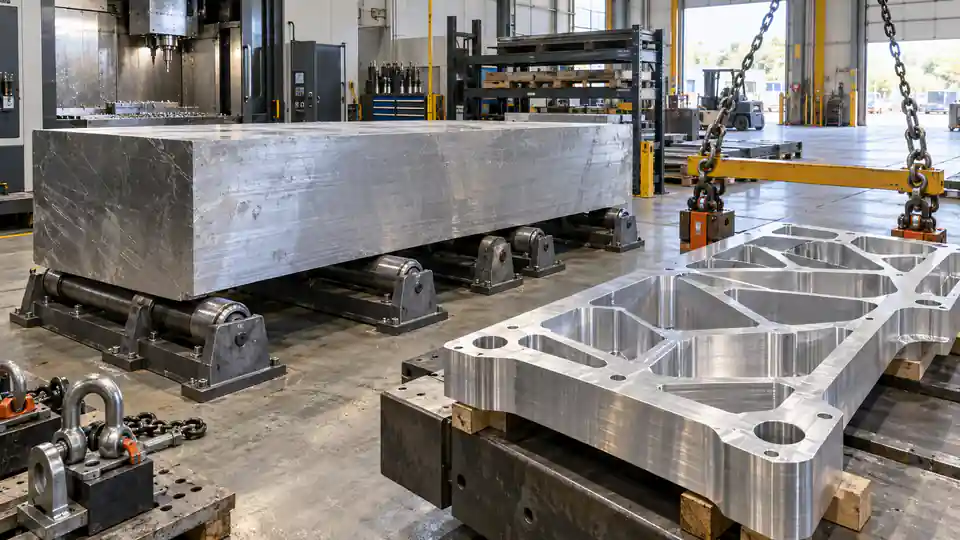
Raw material is not priced only by the mass left in the finished component. A supplier buys a stock shape large enough to cover the part envelope, saw allowance, cleanup, clamping, flatness, and any certified or directional requirements. When the next standard plate, bar, or billet size is much larger than the part, the purchased mass, machining time, and scrap exposure can dominate the quote.
This CNC billet size cost guide explains how oversize stock and custom billet cost develops, when a custom cut or near-net form is economical, and what information lets buyers compare material assumptions. The decision should preserve grade, temper, grain direction, certification, and finished-part integrity—not simply select the smallest-looking blank.
Distinguish Part Envelope from Starting Blank
The CAD bounding box is the minimum geometric envelope, not a purchase specification. The blank normally needs extra length for saw variation and facing, extra width for edge cleanup or clamping, and extra thickness to remove mill surface, achieve flatness, and allow machining on both faces.
A part measuring 248 × 98 × 22 mm may not come from a 250 × 100 × 25 mm blank if the plate has thickness tolerance, bow, damaged edges, or a required grain direction. The supplier should state the proposed blank and finished orientation.
Why Standard Stock Steps Create Cost Jumps
Mills, distributors, and service centers sell preferred plate thicknesses, bar diameters, widths, and lengths. If the part just exceeds an available size, the supplier may have to move to the next increment. A 102 mm-wide component may be cut from 125 mm or 150 mm bar rather than 100 mm bar.
The jump adds purchased volume and removal. It may also move the job to a larger saw, fixture, pallet, machine travel, or lifting method. Designers should ask about the local supply chain before freezing an envelope close to a standard-stock boundary.
Purchased Weight Versus Finished Weight
Material buy-to-fly ratio is the purchased blank mass divided by finished-part mass. A ratio of 4:1 means four kilograms are purchased for each kilogram shipped, before considering process scrap and minimum-order remnants. High ratios are common for deep pockets, thin frames, aerospace structures, and parts machined from round bar with large flats.
Weight alone does not determine cost. Chips may have recycling value, but they do not refund certification, freight, saw labor, inventory financing, or machine time. Different alloys also have different scrap segregation and recovery economics.
Calculate a Preliminary Blank
Start with the finished envelope and add explicit allowances:
Blank length = finished length + saw allowance + facing allowance
Blank width = finished width + edge cleanup + clamping allowance where needed
Blank thickness = finished thickness + top/bottom cleanup + stock flatness allowance
For cylindrical stock, diameter must cover the maximum radial envelope, runout, straightness, decarburization or scale removal, and chucking strategy. Confirm every allowance with the supplying machine shop; universal values are misleading.
A Material-Cost Example
Assume an aluminum housing finishes at 200 × 120 × 45 mm and weighs 2.8 kg after pockets. Route A uses a 210 × 130 × 50 mm cut plate blank weighing roughly 3.7 kg. Route B uses the distributor’s available 250 × 150 × 63.5 mm plate, weighing roughly 6.4 kg. Route B purchases about 2.7 kg more and removes substantially more material.
If a custom-cut plate is available with a cutting charge and lead time, compare the full landed cost, not only price per kilogram. A higher per-kilogram custom blank can lower total part cost by reducing chips, machine time, tool wear, and handling.
| Question | Standard oversize stock | Custom-cut billet | Near-net forging/casting/extrusion |
|---|---|---|---|
| Upfront tooling | Usually none | Usually none or cutting setup | Often significant |
| Minimum quantity | Low | Service-center minimum may apply | Often higher |
| Material lead time | Usually shortest | Depends on size and certification | Development plus production lead time |
| Removal volume | Can be high | Reduced around rectangular envelope | Potentially lowest |
| Property/certification risk | Familiar mill product | Must retain heat and specification identity | Requires route-specific qualification |
| Best fit | Prototype or flexible demand | Repeat low/medium volume | Stable higher volume or extreme buy-to-fly ratio |
Thickness Tolerance and Cleanup
Plate sold as 25 mm may have a permitted thickness range and local variation. If both finished faces must be machined to 24.8 mm with tight flatness and parallelism, 25 mm nominal stock may leave inadequate cleanup at thin areas. The supplier may choose thicker plate or precision-ground stock.
Ask whether the drawing requires removal of the as-rolled surface. A nonfunctional exterior may be allowed to remain mill finish, but certified dimensions, appearance, coating, fatigue, or sealing needs can require full cleanup.
Flatness and Bow Require Allowance
Wide plate can arrive bowed or develop movement when sawn. Clamping it flat and machining one side may release into a different shape after unclamping. Enough thickness is needed for stress-relief strategy, balanced facing, and final cleanup.
Precision-sawn or ground tooling plate can reduce initial variation, but it does not eliminate distortion from asymmetric material removal. For large plates, discuss intermediate relaxation, thermal stabilization, rough-and-finish scheduling, and final inspection support.
Saw Kerf and Cut-Length Allowance
A service center cannot normally extract blanks from a full length with zero loss. Saw kerf, squaring, end trim, and gripping remnants consume material. Small batch quantities may leave an offcut that cannot be assigned to another customer.
Quotes may charge each theoretical blank, a share of the parent plate, or the entire mill minimum. Ask how yield was nested and whether remnants remain buyer-owned, supplier-owned, or credited on repeats.
Clamping Tabs and Sacrificial Material
Some five-axis or thin-part processes leave extra stock for dovetail jaws, a carrier frame, bolt holes, vacuum sealing, or tabs. That material provides reliable location and tool access, then is removed in a final operation. Eliminating it from the CAD envelope does not eliminate its process value.
Invite the supplier to propose the holding method. Dedicated fixtures, adhesives, vacuum, or custom jaws may reduce blank size at sufficient quantity, but they add engineering and qualification cost.
Round Bar Can Be Wasteful for Prismatic Parts
A rectangular part machined from round bar must fit inside the available diameter. The diameter is set by the rectangle’s diagonal, not its width. Large corner sectors become chips. Round bar can still be economical when it is readily available, supports turning operations, or reduces setup complexity.
Compare rectangular plate, square bar, round bar, and extrusion based on landed material, route, and certification. Do not choose a shape solely from price per kilogram.
Rectangular Stock Can Be Wasteful for Turned Parts
Conversely, a flange or ring cut from plate may waste the corners of a square blank. Round bar, hollow tube, rolled ring, or waterjet-cut profile can reduce volume. Thick plate may be preferred for material properties, availability, or certification even when geometry favors a ring.
The supplier should state whether the blank is flame cut, waterjet cut, trepanned, forged, or sawn and how the affected edge is removed before final machining.
Hollow Stock and Tube
For parts with large bores, tube or hollow bar can avoid drilling and boring a solid core. The inner diameter, wall eccentricity, straightness, surface condition, and available grade must leave enough cleanup for the finished bore and outside diameter.
Certified mechanical tube may have different properties, tolerances, and test requirements from bar or plate. The drawing or purchase specification should permit the stock form rather than assuming all forms of the same alloy designation are interchangeable.
Custom Extrusion
An extrusion can place material near the final cross-section and dramatically reduce removal for long prismatic parts. It introduces die/tooling cost, minimum order, development lead time, cross-sectional tolerance, twist, straightness, surface, and seam or property considerations.
Extrusion is strongest when the cross-section repeats, volume is stable, and design allows cleanup. Preserve machining datums and enough stock on critical faces. Check grain flow and anisotropy against structural loads.
Forgings and Rolled Rings
Forgings can reduce buy-to-fly ratio and improve grain flow for heavily loaded parts. Rolled rings are useful for annular components that would otherwise remove a solid center. Both require tooling or process engineering, minimum quantities, qualified sources, and longer lead times.
Near-net forms are not automatically cheaper. Add die amortization, qualification, nondestructive testing, heat treatment, machining allowance, and yield. They become attractive when recurring material and machine savings exceed those costs.
Castings as a Near-Net Alternative
Castings can create cavities and complex outside geometry, leaving machining allowance on interfaces. They add pattern or mold tooling, porosity and shrinkage controls, draft, radii, wall rules, and inspection requirements. Material properties and design allowables differ from wrought stock.
Use a casting only after engineering approves the material route. A prototype machined from billet and a production casting should not share one drawing without clearly controlled variations and qualification.
Waterjet or Laser Profiles
Plate parts with irregular outlines can begin from nested waterjet, laser, or abrasive-cut profiles. This reduces peripheral roughing and improves parent-sheet yield. The heat-affected zone, taper, edge roughness, kerf, piercing marks, and positional allowance must be removed or accepted as appropriate.
For tight datum edges, leave a machining allowance and identify the cut edge as preform geometry. Compare profile-cutting cost with machine time saved and with the risk of distorted or poorly identified blanks.
Material Grade and Certification Limit Options
A common commercial alloy may be stocked in many sizes, while a certified aerospace, medical, pressure, or customer-specific specification may have limited forms and heats. Full heat-lot traceability can prevent mixing remnants and may require purchase of a mill minimum.
State grade, temper or condition, product form, governing specification, country or source restrictions, certification, testing, and traceability in the RFQ. A cheaper blank that cannot supply the required evidence is not an acceptable substitution.
Grain Direction and Orientation
Rolled plate properties and fracture behavior can vary with longitudinal, transverse, and short-transverse direction. Structural drawings may control grain direction relative to principal loads or critical features. Nesting parts in a rotated orientation to save material may violate that requirement.
Mark the required orientation in the model or drawing and on the saw traveler. For ambiguous geometry, include a datum or arrow. If grain direction is not functionally required, say so; unnecessary restrictions can reduce nesting yield.
Residual Stress and Symmetric Removal
Rolled, extruded, forged, and heat-treated stock contains residual stress. Removing a thick layer from one side can unbalance stress and distort the part. Oversize stock may be chosen to permit roughing both sides, relaxation, and final finishing.
Near-net stock can reduce removal but may introduce its own stress profile. Ask the supplier how the route controls movement: material condition, roughing sequence, thermal treatment, aging, fixturing, and inspection after unclamping.
Stock Surface Defects
Scale, decarburization, dents, scratches, corrosion, edge cracks, laps, seams, and handling damage can require cleanup. Ground or peeled bar may cost more but reduce uncertainty. Cosmetic parts may need protection from the beginning of the route.
Specify which surfaces may retain stock condition and which must clean up. If subsurface quality or ultrasonic testing is required, include the class and acceptance criteria.
Machine Envelope and Handling
An oversize blank can exceed the travel, spindle clearance, table load, vise capacity, bar feeder, chuck, or door opening of the preferred machine. It may require a larger, higher-rate machine even though the finished part would fit a smaller one.
Heavy blanks also need cranes, lifting points, safe fixtures, and slower manual handling. Reducing one blank dimension can sometimes return the job to a more productive machine class.
Material Removal Adds Cycle and Tool Cost
Extra volume requires roughing passes, coolant, chip evacuation, tools, and spindle energy. The cost depends on achievable removal rate, not only cubic volume. Deep stock around a pocket may force longer tools and slower cutting, while open perimeter stock can be removed efficiently.
Ask the supplier which blank surfaces drive time and whether a custom saw cut, profile cut, or alternate orientation changes the route. Quantify the nonrecurring and recurring effects separately.
Scrap Credit Is Limited
Clean, segregated chips have recycling value, but recovery varies by alloy, contamination, coolant, region, and market. A buyer should not assume chip credit equals the price of certified virgin material. Mixed or hazardous material can create disposal cost instead.
Clarify whether scrap value is included in the quoted price and who owns large usable remnants. The answer should be consistent across quantity options.
Minimum Orders and Inventory Risk
Custom billet dimensions may require a full plate, mill run, or service-center minimum. If the order uses only part of it, someone carries the remainder and risks a design revision. Buyers can purchase and consign material, authorize blanket releases, or accept a one-time material charge.
Document material ownership, storage, shelf or corrosion control, traceability, and disposition after cancellation or revision. Inventory planning can be more important than a small machining saving.
When Custom-Cut Billets Pay Off
Custom cuts are attractive when standard stock creates a large step in width or thickness, quantity supports efficient nesting, the service center can preserve certification, and reduced removal shortens a bottleneck cycle. They are also useful for large plates where machine travel and handling are sensitive to blank size.
They may not pay for a single prototype, uncertain design, readily machinable alloy, or size with long procurement time. Compare total landed and conversion cost across the planned life, not one unit price.
A Break-Even Calculation
Suppose custom cutting adds $18 per blank and a $300 programming or setup charge. It saves 12 minutes on a machine charged at $120 per hour, or $24 per part, plus $4 of tool and material value. Recurring saving is $28, net $10 per part after the cut premium. Break-even against the $300 charge is 30 parts.
This simplified example must include yield, scrap, freight, inspection, and inventory. If a revision occurs after ten pieces, the custom route may not recover its nonrecurring cost.
Compare Quotes on the Same Material Basis
Require each quote to identify alloy, specification, temper, product form, source restrictions, blank dimensions, purchased weight, quantity yield, certifications, and any assumed substitution. Separate raw material, custom cutting, freight, and surcharge where useful.
| Quote field | Supplier A | Supplier B | Review question |
|---|---|---|---|
| Starting form and size | Record value | Record value | Does it cover cleanup and workholding? |
| Certification/heat lot | Record scope | Record scope | Is required evidence included? |
| Parent-stock allocation | Per blank/full plate | Per blank/full plate | Who carries remnants? |
| Removal strategy | Solid roughing/profile cut | Record route | Which operations dominate time? |
| Grain direction | Controlled/not required | Controlled/not required | Does nesting preserve function? |
| Lead time | Record days | Record days | Is custom stock on the critical path? |
This table exposes different assumptions that a single total price hides.
Audit the Landed Material Scenario
For each option, extend the comparison from the distributor to the finished component. Add parent-stock price, cutting fees, certification charges, minimum-order allocation, inbound freight, receiving inspection, storage, and the value of unusable remnants. Then add the machine time, cutters, deburring, and inspection created by the blank. Subtract only a documented scrap credit.
Keep cash timing visible. A custom mill run may lower theoretical piece cost but require payment months before each finished release. If the customer owns excess stock, identify it physically by alloy, heat, specification, size, and remaining quantity; reconcile consumption after every batch.
Also test sensitivity to yield. One extra blank lost to a saw error or subsurface defect has a larger percentage effect on a ten-piece order than on a thousand-piece program. State whether the supplier’s price assumes replacement material is buyer risk or supplier risk. A defensible award compares the same delivered quantity, conformance evidence, and risk allocation—not merely the same nominal kilograms.
Record exchange-rate, metal-surcharge, and quotation-validity assumptions when material is purchased internationally. These commercial terms can outweigh a small geometric saving if the order is released after the supplier’s price window expires.
Design Changes to Review
- Move a nonfunctional envelope dimension below a standard-stock threshold.
- Add larger external radii compatible with profile cutting or forging.
- Open a pocket to permit a near-net or through-cut blank.
- Separate a large frame into qualified assembled pieces when function permits.
- Provide sacrificial clamping pads that can be nested efficiently.
- Standardize thickness across a part family.
- Permit an alternate product form after material-property review.
- Remove an unnecessary grain-direction restriction.
- Limit full cleanup to functional or cosmetic surfaces.
- Plan common parent-stock sizes across releases.
Any revision needs strength, fatigue, corrosion, assembly, and qualification approval.
What to Send in the RFQ
Provide the 3D model, controlled drawing, finished material condition, quantities, forecast or release pattern, critical dimensions, surface finish, special processes, inspection, and delivery. Identify material specification, product form, certification, grain direction, source restrictions, and whether remnants or consigned stock are acceptable.
Ask for at least two material scenarios when cost is sensitive: standard available stock and the supplier’s recommended custom or near-net alternative. Require price, lead time, minimum quantity, one-time cost, recurring saving, and qualification differences for each.
Buyer Checklist
- Compare the finished envelope with actual stocked sizes.
- Include saw, facing, cleanup, clamping, flatness, and distortion allowances.
- Confirm thickness tolerance and full-cleanup requirements.
- Record blank dimensions, purchased mass, and expected yield.
- Protect material specification, temper, product form, and heat-lot identity.
- State grain direction only when function requires it.
- Evaluate plate, bar, tube, cut profile, extrusion, forging, ring, and casting where allowed.
- Include material procurement, freight, conversion time, tooling, and inventory.
- Calculate break-even over realistic releases and revision risk.
- Confirm the blank fits the intended machine and handling plan.
- Define ownership and disposition of remnants.
- Approve substitutions before purchase, not after material arrives.
The Practical Sourcing Decision
Oversize material affects more than the raw-stock line. It changes removal time, tooling, machine selection, distortion, handling, scrap, lead time, and inventory. The correct blank is the smallest controlled form that safely supports cleanup, fixturing, properties, and certification for the selected route.
For prototypes, an available oversize blank often wins on speed and flexibility. For stable repeat demand or a high buy-to-fly ratio, custom cuts or near-net forms may reduce total cost even at a higher unit material price. To compare blank strategies for a real component, submit the 3D model, controlled drawing, material specification, quantities, and certification needs through Request a Quote.