
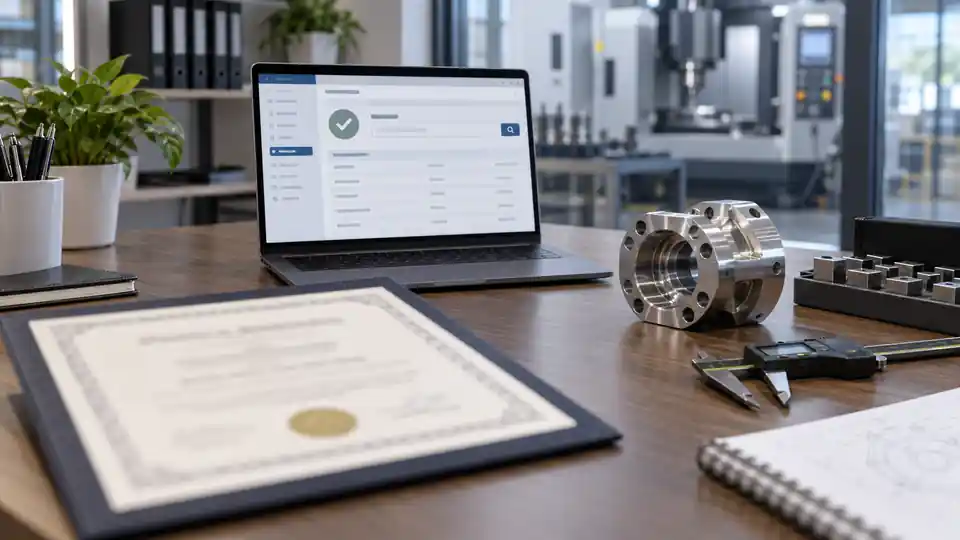
An ISO certificate can support supplier qualification, but a PDF alone does not prove that the company, site, or machining work in your RFQ is covered. Buyers should verify the legal entity, certified location, standard and edition, scope, certificate status, certification body, and accreditation chain. They should then decide what the certificate contributes to the sourcing decision—and what still requires a product- and process-specific audit.
This verify CNC supplier ISO certificate guide provides a repeatable path for checking a CNC machine shop’s management-system certification. It focuses on ISO 9001 and the same logic can support other accredited management-system certificates. Certification requirements are contractual: use the standard, customer clauses, and approval rules actually invoked for the program.
Understand What “ISO Certified” Means
ISO develops international standards but does not certify organizations. Independent certification bodies audit management systems and issue certificates. Accreditation bodies may, in turn, assess the competence and impartiality of those certification bodies.
The official ISO certification guidance explains this structure and recommends checking the certification body and accreditation. A supplier should therefore say “certified to ISO 9001:2015 by [certification body]” rather than “certified by ISO.” The latter is a verification warning.
Management-system certification indicates that a defined organization and scope have been assessed against the named standard. It is not a product certificate. It does not prove that every shipped component conforms, that every tolerance is achievable, or that every sub-tier source is approved.
Obtain the Complete Certificate
Ask for a legible copy containing every page and attachment. A cropped logo or screenshot is insufficient. Record the date you received it and the source—supplier portal, quality contact, certification-body database, or another controlled channel.
The document should normally show:
- certified organization’s legal name;
- address or addresses covered;
- standard and edition, such as ISO 9001:2015;
- scope of certification;
- certificate or registration number;
- initial certification, issue, and expiry dates as applicable;
- current status or revision;
- certification-body name, mark, and contact details;
- accreditation mark when certification is accredited;
- sites or appendices included; and
- authorized certificate approval or validation details.
Do not reject a certificate solely because its layout differs from another registrar’s template. Check whether the essential identity and status can be verified through authoritative sources.
Match the Legal Entity
Supplier brands, trading names, parent companies, factories, and export companies can differ. Compare the certified name with the entity on the quotation, purchase order, invoice, bank information, corporate registration, and manufacturing-site records.
A parent-company certificate does not automatically cover a subsidiary. A sales company certificate may not cover the factory. If the names differ, request the legal relationship and evidence that the ordered activity and site fall within the certificate.
Minor formatting differences, translated names, and suffixes require judgment. Record the original-language legal name and registration number where available. Do not “resolve” a mismatch only from a similar logo or email domain.
Contract manufacturer, broker, and factory
When the quoting company subcontracts machining, identify which organization holds the certificate. A certified broker may manage purchasing while an uncertified factory makes the parts. A certified factory may use an outside special processor. The buyer’s requirement must specify whether certification applies to the prime supplier, manufacturing site, critical subtiers, or a combination.
Draw the relationship explicitly: contracting entity → manufacturing site → special-process sources → inspection/release entity. Verify the relevant certificates separately.
Confirm the Manufacturing Site
Certificates are location-specific. Compare the address with the facility proposed for programming, machining, inspection, storage, and release. Check building number, industrial park, city, and country—not only the company name.
Multi-site certification often uses a main certificate plus an appendix listing covered locations and scopes. Obtain the appendix. Confirm that it was effective on the relevant date and that the site is not merely a sales office, warehouse, or headquarters.
If work will transfer between plants, determine whether every site is covered and whether customer approval is required. A future plan to add a location to the certificate is not current certification.
Read the Scope Word by Word
Scope is where an authentic certificate can still be irrelevant to the RFQ. It should describe activities and products included in the certified management system. Look for manufacturing, machining, precision components, assembly, inspection, or other applicable operations.
A scope limited to “sales and distribution of mechanical products” may not cover machining. “Manufacture of metal parts” may cover machining generally but not a separately located heat-treatment facility. A very broad scope deserves clarification about the actual audited activities.
Ask:
- Does the scope include manufacture or only trade/design?
- Does it cover the material and product family?
- Are assembly, finishing, testing, or distribution included if relevant?
- Are excluded activities important to the ordered work?
- Does the site appendix assign the right scope to this factory?
- Is the supplier claiming a sector-specific certification that is absent?
Do not rewrite the scope into a stronger claim. Preserve the exact wording in the supplier record.
Check the Standard and Edition
Verify the complete designation. ISO 9001, ISO 14001, ISO 45001, ISO 13485, IATF 16949, and AS9100 serve different purposes and have different sector or scheme rules. One cannot be substituted merely because it is “an ISO certificate.”
Check the edition and transition status. Standards are revised, and certification schemes set transition periods. A certificate issued to an obsolete edition may be legitimate during an approved transition or may no longer meet the contract. Verify current requirements with the scheme owner, certification body, or accreditation body.
As of the research date for this article, ISO’s page shows a new edition of ISO 9001 under publication in September 2026. Buyers should therefore avoid hard-coding assumptions about transition timing. Check the live ISO 9001 page and the applicable certification-scheme transition instructions at the time of qualification.
Verify Dates and Current Status
Read initial certification, last issue, surveillance or recertification information, and expiry. Date terminology differs, so do not assume every printed date has the same meaning.
An expiry date in the future does not by itself prove active status. Certificates can be suspended or withdrawn. A PDF can also be altered or remain in circulation after status changes. Verify against a live database or contact the certification body.
Record:
- date checked;
- source used;
- status shown;
- certificate number;
- organization and site;
- standard/scope; and
- screenshot or verification reference allowed by your policy.
Schedule re-verification before expiry and at risk-based intervals. Recheck after ownership, address, scope, certification-body, or major quality-system changes.
Use IAF CertSearch Appropriately
IAF CertSearch provides a global database for accredited management-system certifications. Its official FAQ describes searches by organization name or certificate number and displays certificate status, scope, certified locations, certification body, and accreditation body.
Search the exact certificate number first, then the legal name and location. Compare every result with the submitted document. A matching number with a different company, site, standard, or scope is not a match.
Absence from the database needs investigation, not an automatic accusation. The CertSearch guidance notes that a record may not have been added, may be restricted, or may need inquiry. Contact the named certification body and, when necessary, the accreditation body. Preserve the response.
Understand the database boundary
IAF CertSearch focuses on accredited management-system certification. It does not validate every product, person, calibration, laboratory, or inspection certificate. A failed search may also reflect a certificate outside that system. Verify using the authoritative route for the actual scheme.
Verify the Certification Body
Identify the organization that issued the certificate. Visit its official website using an independently found address rather than trusting a QR code or link embedded in a suspicious PDF. Search its certificate directory or contact it using published details.
Confirm:
- the body issued that certificate number;
- the client, sites, standard, scope, and status match;
- the body is authorized for the scheme and geography; and
- contact information and marks are genuine.
Look for altered names, misspellings, low-resolution logos, inconsistent fonts, impossible dates, copied signatures, and domains that imitate a recognized body. These are screening clues, not conclusive proof.
If a certification body confirms a certificate directly, retain the email or verification page with date and contact route. Do not rely indefinitely on a one-time check.
Check the Accreditation Chain
Accreditation provides independent confirmation of a certification body’s competence for defined activities, although ISO notes that accreditation is not compulsory and a non-accredited body is not automatically disreputable. The buyer’s contract may nevertheless require accredited certification.
Identify the accreditation body and mark. Verify that it recognizes the certification body for the standard/scheme and that the relevant relationship is active. If international recognition matters, check the applicable multilateral arrangement rather than assuming every logo has the same status.
The former International Accreditation Forum ceased operations on January 1, 2026, according to its legacy site, which directs users to Global Accreditation Cooperation Incorporated for current information. This transition makes live verification especially important. Follow current ISO guidance and the database/authority active when you conduct the check.
Verify Multi-Site and Remote Support Functions
A multi-site certificate may include centralized functions—quality management, purchasing, design, or sales—and manufacturing locations with different activities. Read the appendix and verify sampling or eligibility rules only if relevant to your qualification.
Confirm which site:
- receives customer requirements;
- controls engineering data;
- purchases material and outside processing;
- programs and machines the parts;
- performs final inspection;
- releases the shipment; and
- retains records.
If these functions span certified and non-certified sites, understand the boundary. The presence of a corporate certificate does not eliminate the need to audit handoffs.
Compare the Certificate With Public and Corporate Records
Use independent sources to corroborate identity and address: official corporate registries where accessible, supplier websites, certification-body listings, tax or registration records provided during onboarding, and site-audit evidence.
Differences may have innocent explanations, such as relocation or translation. Ask for the change history and updated certificate. A certificate showing an old address may remain valid temporarily under scheme rules, but the supplier should provide confirmation rather than expecting the buyer to infer coverage.
Check whether the web domain and contact people correspond to the certified entity. Free email addresses, newly registered look-alike domains, or payment instructions from a different company are broader onboarding risks and should be handled through the buyer’s fraud controls.
Do Not Confuse ISO 9001 With Product Approval
ISO 9001 certification does not verify a specific drawing, material heat, special process, measurement result, or shipment. Continue to require the records appropriate to the part:
- controlled model and drawing review;
- process and capacity evidence;
- material certificates and traceability;
- special-process approvals and certificates;
- first-article or dimensional inspection;
- gage/CMM suitability;
- nonconformance and change control; and
- Certificate of Conformance when invoked.
A supplier can hold a valid certificate and still lack the machine envelope, inspection access, process experience, or available capacity for your job. Conversely, a capable prototype supplier without required certification may be unacceptable for a contract that explicitly mandates it. Treat certification as one qualification input.
Risk-Based Supplier Audit After Verification
Once authenticity and scope are confirmed, test implementation. Select processes related to the proposed work and follow evidence through the system. Useful audit trails include:
- RFQ and contract review into the router and inspection plan;
- drawing revision receipt through obsolete-file withdrawal;
- purchased material through heat-lot traceability;
- approved sub-tier processing through incoming verification;
- calibration and measurement-system control;
- nonconformance through disposition and corrective action;
- employee qualification for a critical operation; and
- final inspection through shipment release.
Certification may allow you to reduce redundant system-level questioning, but it should not replace product-specific due diligence. Scale the onsite or remote audit to criticality, complexity, prior performance, and supply risk.
Check Whether the Certified Scope Matches the Quoted Route
Take the supplier’s proposed process route and annotate where each operation occurs. A typical machined component may pass through incoming-material control, sawing, milling or turning, deburring, heat treatment, grinding, coating, washing, dimensional inspection, document review, and final release. Mark the legal entity and address responsible for every step.
Then compare the route with the certificate and site appendix. If the scope covers machining and assembly at Site A but the quotation moves inspection and release to Site B, determine whether Site B is included and what its certified activities are. If coating is outsourced, verify the prime supplier’s controls and any customer approval of the processor; do not pretend the prime’s management-system certificate is the processor’s certificate.
This exercise also exposes a common commercial ambiguity: the supplier may quote through an export or sales entity while production is performed by another company. Certification of either organization can be relevant, but the buyer needs the contractual relationship, responsibility for conformity, and controlled transfer of requirements. Record the relationship in the approved-supplier file.
Use a result such as “certificate verified for legal entity and machining site; external anodizing controlled separately” rather than a blanket pass. The qualified boundary should be clear to procurement when it places the order.
Handle Gaps Without Inventing Assurance
A verification gap does not always mean fraud. New certificates may not yet appear in a database, company names may be transliterated differently, and databases can be incomplete. The correct response is a documented escalation path.
First, ask the supplier for the complete certificate and explanation. Second, contact the certification body through independently verified contact details. Third, check the accreditation body and current recognition information. Fourth, compare corporate and site records. Set a due date and keep the supplier’s approval status conditional until the evidence is resolved.
If the certificate is genuine but outside the required scope, decide whether an exception is commercially and technically acceptable. Options may include a customer-approved waiver, added source inspection, tighter incoming verification, a limited prototype order, or use of another qualified site. Those controls must be approved by the buyer’s authorized function; they do not change the certificate.
If the certificate is suspended, withdrawn, altered, or denied by the issuer, contain new awards and evaluate open orders. Notify affected internal owners and follow the organization’s supplier-nonconformance and fraud procedures. Preserve the submitted file, verification evidence, communications, and decision; do not edit the suspect artifact.
Certificate Verification Table
| Check | Acceptable evidence | Hold or escalation condition |
|---|---|---|
| Legal entity | Exact or documented legal match | Unexplained parent, broker, or trading-name mismatch |
| Manufacturing site | Address listed on certificate/appendix | Proposed factory absent or listed for another activity |
| Standard | Required designation and acceptable edition | Wrong standard, edition, or sector scheme |
| Scope | Machining/manufacturing activity relevant to RFQ | Scope limited to sales, distribution, or unrelated work |
| Number | Exact certificate ID across sources | Number missing, altered, or assigned elsewhere |
| Status | Active in authoritative live source | Suspended, withdrawn, expired, or unresolved |
| Certification body | Issuer confirms record | Unknown/look-alike issuer or no independent confirmation |
| Accreditation | Required chain verified for scheme | Mark/authorization inconsistent or outside scope |
| Dates | Issue/expiry/transition logically consistent | Impossible sequence or unsupported extension |
| Multi-site appendix | Correct site and scope listed | Missing appendix or ambiguous site role |
Red Flags in the Document
- claims that ISO itself issued the certificate;
- no legal company name or physical site;
- no certificate number;
- missing standard edition or scope;
- scope unrelated to machining;
- expiry changed without a new issue record;
- logos that cannot be matched to official sources;
- spelling or formatting inconsistencies around names and dates;
- QR code leading to a non-official or insecure domain;
- database record with different company or scope;
- certificate body denies the record;
- supplier refuses direct verification; or
- one factory uses another group’s certificate without listed coverage.
Do not publish an accusation based on appearance alone. Place qualification on hold, verify through authoritative channels, and document the conclusion.
Example Verification Record
A concise internal record can include:
- Supplier: legal name and vendor ID
- Proposed site: full address
- Certificate: number and file reference
- Standard/edition: exact designation
- Scope: exact text
- Status: active, suspended, withdrawn, expired, or unresolved
- Certification body: name and verification source
- Accreditation body: name and status source
- Database search: query, result, and date
- Entity/site/scope match: pass, exception, or hold
- Contract requirement: exact clause
- Follow-up: action, owner, due date
- Approval: buyer/quality authority and date
- Recheck date or trigger
This record is more useful than a folder containing only the supplier’s PDF because it preserves what was checked and why it was accepted.
Monitor After Approval
Certification status can change between supplier onboarding and the next purchase order. Track expiry and surveillance dates, and define how suppliers notify suspension, withdrawal, scope reduction, address change, or certification-body change.
For important suppliers, use database watch features where available or schedule periodic checks. Reverify before a new program if the original review is old. Connect status changes to the approved-supplier process: decide whether orders pause, additional inspection is required, a waiver is needed, or qualification is withdrawn.
Do not treat expiry as the only trigger. Major quality escapes, ownership changes, relocation, prolonged shutdown, or a move to another manufacturing site may justify a fresh review while the certificate still appears active.
Questions to Ask the Supplier
- Which legal entity and site will manufacture and release our parts?
- Where are those activities listed on the certificate and appendix?
- Which certification body issued it, and where can status be verified?
- Is certification accredited, and is accreditation required by our contract?
- What standard edition and transition plan apply?
- Which processes are outside the certified site?
- How are sub-tier providers controlled?
- How will you notify us of suspension, withdrawal, relocation, or scope change?
- Which product-specific evidence will accompany shipments?
- Who owns certificate maintenance and customer notification?
Answers should be supported by records. A polished sales response without an exact site, scope, and certificate identifier does not close the check.
Make the Qualification Decision Explicit
Conclude one of four states: verified and applicable; verified but only partly applicable; authentic but not contractually sufficient; or unresolved/invalid. Record the reason and any conditions. Do not collapse every outcome into “certificate on file.”
For a QuickCNCs supplier review or quotation, provide the required certification clause, controlled part definition, proposed manufacturing site, special-process approvals, and product evidence requirements. An ISO certificate can support confidence in the management system, but the award should still rest on verified scope, current status, technical capability, capacity, and part-specific controls.
Use the quality assurance page to define the part-specific evidence that certification cannot replace, then submit the exact site, scope, and contract flowdowns through Request a Quote.