Cross-drilled manifold quality is determined inside the passage network, where drill wander, burrs, chips, plugs, and unintended intersections may be hidden. This 5 axis manifold machining inspection checklist defines the evidence needed for passage location, deburring, cleaning, plug installation, and leak verification. The goal is a connected, clean, pressure-tight circuit whose acceptance method is known before the first hole is drilled.
The released passage map should remain with the drilling sequence, deburring route, cleaning record, plug specification, and test configuration. Together, those records let a later supplier or quality engineer identify where each hidden intersection was created and how its condition was accepted.
Map each requirement to a failure and a record
| Controlled input | Failure to prevent | Release evidence |
|---|---|---|
| Passage Intersection Location | a burr remains trapped at an inaccessible intersection | Sectioned Passage Map |
| Drill Wander And Breakthrough | drill drift reduces wall thickness | Borescope Or Validated Cleaning Evidence |
| Cross-Hole Burr Access | chips lodge behind a plug | Deburring Method Approval |
| Plug And Thread Sealing Design | port identification differs from the schematic | Plug Installation Record |
| Internal Cleanliness | seal damage occurs during assembly | Pressure-Decay Or Proof Test |
| Leak And Flow Test Boundary | a pressure test proves containment but not correct flow path | Port-To-Port Flow Confirmation |
Failure paths to diagnose before rework
- A Burr Remains Trapped At An Inaccessible Intersection: contain affected the manifold block parts, preserve the process state, compare passage intersection location with sectioned passage map, and decide whether correction needs design approval.
- Drill Drift Reduces Wall Thickness: contain affected the manifold block parts, preserve the process state, compare drill wander and breakthrough with borescope or validated cleaning evidence, and decide whether correction needs design approval.
- Chips Lodge Behind A Plug: contain affected the manifold block parts, preserve the process state, compare cross-hole burr access with deburring method approval, and decide whether correction needs design approval.
- Port Identification Differs From The Schematic: contain affected the manifold block parts, preserve the process state, compare plug and thread sealing design with plug installation record, and decide whether correction needs design approval.
- Seal Damage Occurs During Assembly: contain affected the manifold block parts, preserve the process state, compare internal cleanliness with pressure-decay or proof test, and decide whether correction needs design approval.
- A Pressure Test Proves Containment But Not Correct Flow Path: contain affected the manifold block parts, preserve the process state, compare leak and flow test boundary with port-to-port flow confirmation, and decide whether correction needs design approval.
Do not begin with rework instructions. Before correcting plug and thread sealing design, verify the indication is real, the measurement system resolves it, and the part was evaluated in the specified internal cleanliness state. For the manifold block, tool marks, temperature, clamping, fixturing, coating, cleaning, or test-fixture behavior can make a valid part appear nonconforming or conceal a real failure. Preserve the first internal cleanliness evidence before polishing, sorting, resizing, cleaning, or repeating the leak and flow test boundary test, because those actions can erase causation clues.
Manifold Release Conditions
For the manifold block, the release is complete when the functional requirement, proposed manufacturing route, inspection method, and change authority point to the same accepted condition. The core task is to design intersecting passages so drilling, plug installation, deburring, cleaning, and leak verification form one controlled route. At the supplier handoff, tie passage intersection location and drill wander and breakthrough to named surfaces, the evaluated process state, retained records, and the quoted quantity range. It should also identify what the supplier may optimize and what requires written buyer approval.
Failure containment around passage intersection location
Connect passage intersection location as an explicit drawing, process, or purchase requirement for the manifold block. Define the allowed result, measurement state, and relationship to drill wander and breakthrough. Where a standard or customer specification defines drill wander and breakthrough, the purchase package must identify its revision and precedence over conflicting cross-hole burr access notes. A screen image, email remark, or broad drawing note cannot be the sole authority for cross-hole burr access; record the approved interpretation before plug and thread sealing design programming begins.
The immediate failure path is that a burr remains trapped at an inaccessible intersection. Assess how plug and thread sealing design changes with internal cleanliness, leak and flow test boundary, thermal state, fixture or tool access, and the planned production quantity. Ask the supplier to distinguish the normal internal cleanliness route from any special control needed when leak and flow test boundary approaches its acceptance boundary. When leak and flow test boundary depends on a trial, coupon, first-off review, or concession, show that passage intersection location gate explicitly in both price and schedule.
Use sectioned passage map to close this part of the the manifold block decision. The passage intersection location record should carry part and revision identity, applicable lot or serial range, actual result, unit, method, date, and disposition for drill wander and breakthrough.
Drill Wander And Breakthrough through repeat production
Close drill wander and breakthrough as an explicit drawing, process, or purchase requirement for the manifold block. Define the allowed result, measurement state, and relationship to cross-hole burr access. For passage intersection location, name the controlling standard or customer specification, its revision, and its precedence over any conflicting drill wander and breakthrough instruction. Do not release drill wander and breakthrough from screen appearance or an informal email; place the approved cross-hole burr access interpretation in the controlled technical package before programming.
The immediate failure path is that drill drift reduces wall thickness. Review the material state and feature proportions for cross-hole burr access, then test how thermal condition, plug and thread sealing design, tool or fixture access, and quantity alter the risk. Require the quotation to distinguish the normal route for plug and thread sealing design from the extra control needed as internal cleanliness approaches its allowed limit. If internal cleanliness relies on a trial, coupon, first-off approval, or buyer concession, expose the leak and flow test boundary decision gate in both price and lead time.
Use borescope or validated cleaning evidence to close this part of the the manifold block decision. The retained leak and flow test boundary record needs part and revision identity, applicable lot or serial range, actual result and unit, method, date, and passage intersection location disposition.
Cross-Hole Burr Access in the design review
Establish cross-hole burr access as an explicit drawing, process, or purchase requirement for the manifold block. Define the allowed result, measurement state, and relationship to plug and thread sealing design. The immediate failure path is that chips lodge behind a plug.
Use deburring method approval to close this part of the the manifold block decision.
How this decision changes cost and lead time
For the manifold block, cost follows the work needed to control uncertainty. Price drill wander and breakthrough by separating engineering review, preparation, programming, tooling, machine time, outside processing, inspection, documentation, and the risk tied to cross-hole burr access. Lead time also depends on approvals, material availability, qualification, sub-tier queues, and the time required to stabilize or verify the final condition.
| Technical driver | Typical cost location | Buyer question |
|---|---|---|
| Passage Intersection Location | engineering and programming | Ask whether the charge is nonrecurring, per setup, per lot, or per piece. |
| Drill Wander And Breakthrough | material or process preparation | Ask whether the charge is nonrecurring, per setup, per lot, or per piece. |
| Cross-Hole Burr Access | machine and tooling time | Ask whether the charge is nonrecurring, per setup, per lot, or per piece. |
| Plug And Thread Sealing Design | inspection or testing | Ask whether the charge is nonrecurring, per setup, per lot, or per piece. |
| Internal Cleanliness | documentation and approval delay | Ask whether the charge is nonrecurring, per setup, per lot, or per piece. |
Compare quotations at the same quantity, revision, evidence scope, delivery point, and approval schedule. Separate nonrecurring work for cross-hole burr access—programs, fixtures, electrodes, gages, or first article—from recurring charges driven by plug and thread sealing design and lot size. For the manifold block, a higher hourly machine rate can still produce a lower total if it removes reclamping, tool changes, manual fitting, repeated inspection, or a high-risk secondary operation.
Inspection and evidence plan
| Evidence | Characteristic or condition | Decision supported |
|---|---|---|
| Sectioned Passage Map | Passage Intersection Location | Prevent or detect: a burr remains trapped at an inaccessible intersection |
| Borescope Or Validated Cleaning Evidence | Drill Wander And Breakthrough | Prevent or detect: drill drift reduces wall thickness |
| Deburring Method Approval | Cross-Hole Burr Access | Prevent or detect: chips lodge behind a plug |
| Plug Installation Record | Plug And Thread Sealing Design | Prevent or detect: port identification differs from the schematic |
| Pressure-Decay Or Proof Test | Internal Cleanliness | Prevent or detect: seal damage occurs during assembly |
| Port-To-Port Flow Confirmation | Leak And Flow Test Boundary | Prevent or detect: a pressure test proves containment but not correct flow path |
For the manifold block, the inspection method must have suitable access, resolution, calibration status, and uncertainty for the stated limit. Where internal cleanliness affects the result, define datum alignment, support, measurement force, temperature, filtering, sampling, and the final leak and flow test boundary process state. Instrument precision or calibration alone does not prove suitability for leak and flow test boundary; resolution, access, uncertainty, fixturing, and the passage intersection location acceptance rule must also fit.
Record actual values for passage intersection location whenever the release decision depends on magnitude, trend, or distance from the drill wander and breakthrough limit. A pass/fail result may suit a validated drill wander and breakthrough gage, but its record still needs revision, lot identity, method, date, criterion, and cross-hole burr access disposition. For repeat the manifold block orders, preserve the program, fixture, method revision, and approved baseline so changes remain visible.
Use an independent operator, instrument, fixture, method, or receiving check for high-consequence cross-hole burr access when the production setup could bias plug and thread sealing design. Independence can mean a separate instrument, operator, fixture, method, or receiving check; it does not always require duplicating the entire inspection.
Plug And Thread Sealing Design as a process constraint
Evaluate plug and thread sealing design as an explicit drawing, process, or purchase requirement for the manifold block. Define the allowed result, measurement state, and relationship to internal cleanliness. The immediate failure path is that port identification differs from the schematic.
Use plug installation record to close this part of the the manifold block decision.
Inspection logic for internal cleanliness
Verify internal cleanliness as an explicit drawing, process, or purchase requirement for the manifold block. Define the allowed result, measurement state, and relationship to leak and flow test boundary. The immediate failure path is that seal damage occurs during assembly.
Use pressure-decay or proof test to close this part of the the manifold block decision.
Leak And Flow Test Boundary and the supplier quotation
Control leak and flow test boundary as an explicit drawing, process, or purchase requirement for the manifold block. Define the allowed result, measurement state, and relationship to passage intersection location. The immediate failure path is that a pressure test proves containment but not correct flow path.
Use port-to-port flow confirmation to close this part of the the manifold block decision.
Manufacturing sequence and approval gates
- Passage Intersection Location: resolve passage intersection location before the route advances to drill wander and breakthrough; retain sectioned passage map at the applicable gate.
- Drill Wander And Breakthrough: resolve drill wander and breakthrough before the route advances to cross-hole burr access; retain borescope or validated cleaning evidence at the applicable gate.
- Cross-Hole Burr Access: resolve cross-hole burr access before the route advances to plug and thread sealing design; retain deburring method approval at the applicable gate.
- Plug And Thread Sealing Design: resolve plug and thread sealing design before the route advances to internal cleanliness; retain plug installation record at the applicable gate.
- Internal Cleanliness: resolve internal cleanliness before the route advances to leak and flow test boundary; retain pressure-decay or proof test at the applicable gate.
- Leak And Flow Test Boundary: resolve leak and flow test boundary before the route advances to passage intersection location; retain port-to-port flow confirmation at the applicable gate.
Sequence matters for the manifold block because a characteristic measured early may move during unclamping, heat treatment, coating, cleaning, assembly, or temperature stabilization. Identify whether each control is incoming, in-process, post-process, final, or functional. If leak and flow test boundary can be altered by the passage intersection location operation, recheck it afterward or document why the earlier drill wander and breakthrough result still represents the delivered part.
Supplier questions before award
- How will your proposed route control passage intersection location, and what sectioned passage map will show that a burr remains trapped at an inaccessible intersection did not escape?
- How will your proposed route control drill wander and breakthrough, and what borescope or validated cleaning evidence will show that drill drift reduces wall thickness did not escape?
- How will your proposed route control cross-hole burr access, and what deburring method approval will show that chips lodge behind a plug did not escape?
- How will your proposed route control plug and thread sealing design, and what plug installation record will show that port identification differs from the schematic did not escape?
- How will your proposed route control internal cleanliness, and what pressure-decay or proof test will show that seal damage occurs during assembly did not escape?
- How will your proposed route control leak and flow test boundary, and what port-to-port flow confirmation will show that a pressure test proves containment but not correct flow path did not escape?
Change control and repeat-order protection
After approval of the manifold block, retain the released files, supplier assumptions, tooling or fixture revision, material and process sources, measurement method, first-article results, deviations, and effective lot or serial range. Identify which changes require notification: machine family, stock source, heat treatment, special processor, cutting strategy at a critical feature, inspection program, gage, test fixture, software compensation, or packaging.
RFQ inputs that prevent scope gaps
- State hydraulic or pneumatic schematic for the manifold block, and link it to passage intersection location plus the expected sectioned passage map.
- State working and proof pressure for the manifold block, and link it to drill wander and breakthrough plus the expected borescope or validated cleaning evidence.
- State media compatibility for the manifold block, and link it to cross-hole burr access plus the expected deburring method approval.
- State plug and seal specification for the manifold block, and link it to plug and thread sealing design plus the expected plug installation record.
- State cleanliness requirement for the manifold block, and link it to internal cleanliness plus the expected pressure-decay or proof test.
- State required leak or flow record for the manifold block, and link it to leak and flow test boundary plus the expected port-to-port flow confirmation.
The passage intersection location RFQ must state prototype, first-article, and production quantities together with delivery point, approved substitutions, record format, retention, and drill wander and breakthrough change notification. Have the supplier classify every drill wander and breakthrough requirement as included, excluded, not applicable, or requiring clarification, with cross-hole burr access exceptions visible before award. For the manifold block, silence about passage intersection location should never be interpreted as approval.
Applicability, alternatives, and limits
Use the full control approach when the manifold block affects safety, sealing, regulated evidence, motion alignment, interchangeable fit, calibrated performance, vacuum or fluid containment, expensive finishing, or a supplier-transfer baseline. Increase the evidence for leak and flow test boundary when receiving cannot detect failure, downstream rework is impossible, or several organizations rely on the released passage intersection location data.
Treat the Passage Network as a Controlled System
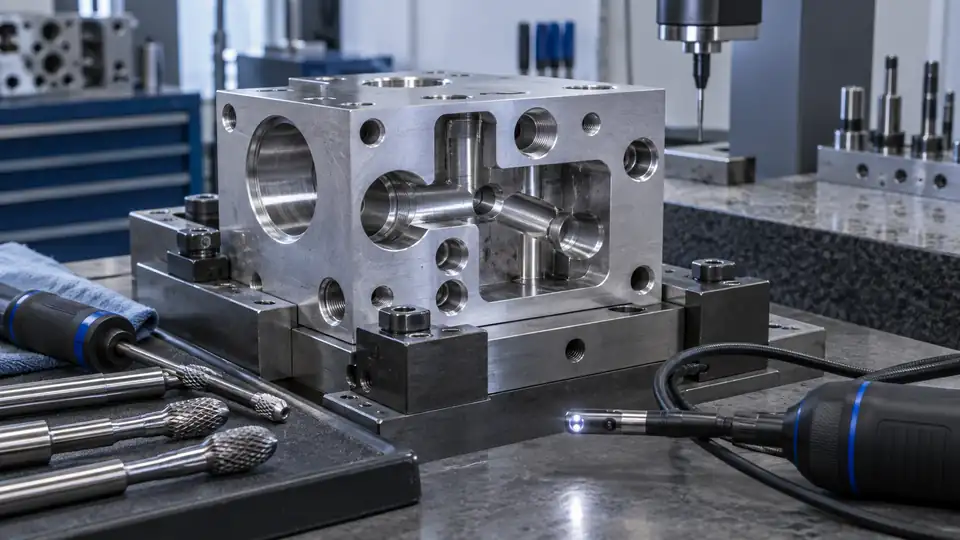
For a cross-drilled block, the important product is the connected internal network, not a collection of isolated holes. Every drilling operation can shift an intersection, raise a breakthrough burr, push chips into another branch, or damage a sealing thread. The model and drawing should therefore identify passage destinations, deliberate crossovers, forbidden wall breakthroughs, plugs, valves, and the final flow or pressure boundary.
Control intersection geometry and drill wander
Long drills follow material and can wander, especially after entering an angled or pre-existing bore. Specify minimum remaining wall and the functional intersection window rather than relying only on entry-hole position. Where the window is narrow, the process may need pilot drilling, drilling from both ends, gun drilling, an intermediate inspection, or a design change. A supplier should be able to show how the selected drill diameter, reach, and approach keep the passage connected without opening an unintended leak path.
Deburr what cannot be seen
An external edge-break note does not control internal cross-hole burrs. Name the affected intersections and define an acceptable condition: no loose or folded material, a bounded edge break, verified flow, or an approved visual method. Mechanical cross-hole tools, abrasive-flow processing, thermal deburring, chemical deburring, and manual lapping have different effects on sharp metering edges and cleanliness. The route must be compatible with the alloy, plugs, threads, and downstream cleaning requirements.
The RFQ package should include a labeled port map, drill depths, plug specifications, thread-seal method, cleanliness criterion, test medium, proof or leak pressure, dwell time, and allowed leakage. Request records that trace the test fixture and calibration to the lot. Before production release, section or borescope a representative qualification piece when inaccessible intersections carry high consequence. That evidence directly addresses burr and connectivity risk rather than substituting a generic final-inspection certificate.
Authoritative references
Internal Cleanliness evidence to include with the RFQ
The most relevant site references for this handoff are EDM and wire EDM services and CNC supplier process audit, particularly where leak and flow test boundary can change the accepted condition. The complementary references CNC machining services and CNC supplier process audit help the buyer verify the connected machining, material, finishing, inspection, or production assumptions for the manifold block.
Release the RFQ only after passage intersection location and leak and flow test boundary have owners, units, process states, and evidence expectations. Submit the controlled cross-hole burr access and plug and thread sealing design requirements through the QuickCNCs quotation page, requesting a response that separates included work, exceptions, nonrecurring charges, and approval holds. Keep the supplier’s answer with the revision so the next order can compare cross-hole burr access against the accepted baseline.