
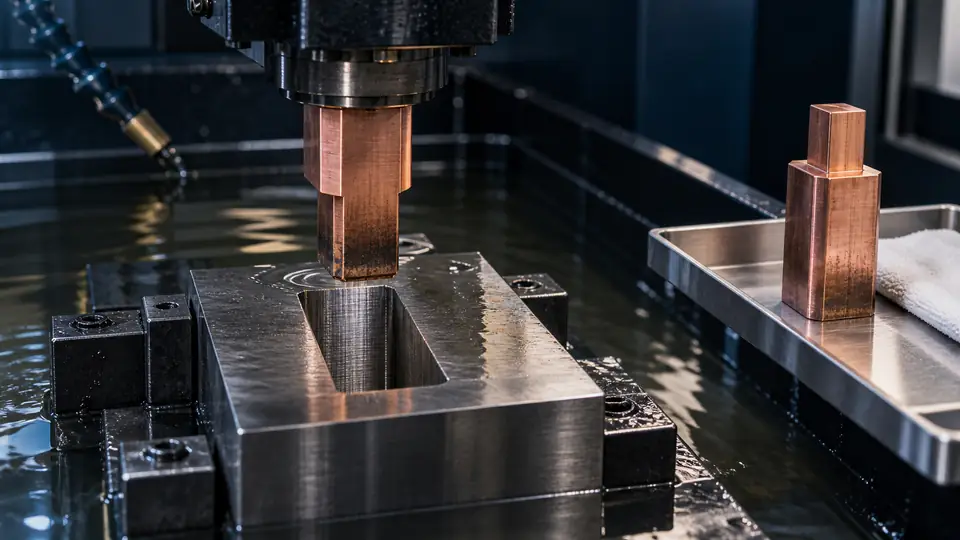
A blind EDM cavity can require several electrodes, burn stages, and flushing strategies even when its external dimensions look simple. Understanding sinker EDM blind cavity cost means separating electrode manufacture, roughing wear, finishing orbit, dielectric access, surface condition, and inspection. The quotation should reveal which geometry drives each electrode and how the deepest corners and ribs will be verified after the final burn.
the blind EDM cavity: The engineering boundary procurement must preserve
For the blind EDM cavity, the release is complete when the functional requirement, proposed manufacturing route, inspection method, and change authority point to the same accepted condition. The core task is to quote electrode design, rough and finish burns, flushing, wear compensation, and surface requirements as distinct work. It should also identify what the supplier may optimize and what requires written buyer approval.
Plan the route from stock to final evidence
- Electrode Count And Material: resolve electrode count and material before the route advances to roughing and finishing orbit; retain electrode register at the applicable gate.
- Roughing And Finishing Orbit: resolve roughing and finishing orbit before the route advances to cavity depth and aspect ratio; retain electrode inspection results at the applicable gate.
- Cavity Depth And Aspect Ratio: resolve cavity depth and aspect ratio before the route advances to flushing and debris escape; retain burn-parameter revision at the applicable gate.
- Flushing And Debris Escape: resolve flushing and debris escape before the route advances to electrode wear compensation; retain cavity depth and profile report at the applicable gate.
- Electrode Wear Compensation: resolve electrode wear compensation before the route advances to recast layer and surface texture; retain surface-texture measurement at the applicable gate.
- Recast Layer And Surface Texture: resolve recast layer and surface texture before the route advances to electrode count and material; retain final cleaning confirmation at the applicable gate.
Sequence matters for the blind EDM cavity because a characteristic measured early may move during unclamping, heat treatment, coating, cleaning, assembly, or temperature stabilization. Identify whether each control is incoming, in-process, post-process, final, or functional.
Acceptance records that can survive a repeat order
| Evidence | Characteristic or condition | Decision supported |
|---|---|---|
| Electrode Register | Electrode Count And Material | Prevent or detect: one electrode cannot hold both speed and final detail |
| Electrode Inspection Results | Roughing And Finishing Orbit | Prevent or detect: poor flushing causes unstable arcing |
| Burn-Parameter Revision | Cavity Depth And Aspect Ratio | Prevent or detect: wear changes rib thickness or corner form |
| Cavity Depth And Profile Report | Flushing And Debris Escape | Prevent or detect: deep regions burn tapered |
| Surface-Texture Measurement | Electrode Wear Compensation | Prevent or detect: surface requirements add several skim burns |
| Final Cleaning Confirmation | Recast Layer And Surface Texture | Prevent or detect: polishing removes critical geometry |
For the blind EDM cavity, the inspection method must have suitable access, resolution, calibration status, and uncertainty for the stated limit. Where electrode wear compensation affects the result, define datum alignment, support, measurement force, temperature, filtering, sampling, and the final recast layer and surface texture process state. Instrument precision or calibration alone does not prove suitability for recast layer and surface texture; resolution, access, uncertainty, fixturing, and the electrode count and material acceptance rule must also fit.
Record actual values for electrode count and material whenever the release decision depends on magnitude, trend, or distance from the roughing and finishing orbit limit. A pass/fail result may suit a validated roughing and finishing orbit gage, but its record still needs revision, lot identity, method, date, criterion, and cavity depth and aspect ratio disposition. For repeat the blind EDM cavity orders, preserve the program, fixture, method revision, and approved baseline so changes remain visible.
Use an independent operator, instrument, fixture, method, or receiving check for high-consequence cavity depth and aspect ratio when the production setup could bias flushing and debris escape. Independence can mean a separate instrument, operator, fixture, method, or receiving check; it does not always require duplicating the entire inspection.
Electrode Count And Material through repeat production
Close electrode count and material as an explicit drawing, process, or purchase requirement for the blind EDM cavity. Define the allowed result, measurement state, and relationship to roughing and finishing orbit. Where a standard or customer specification defines roughing and finishing orbit, the purchase package must identify its revision and precedence over conflicting cavity depth and aspect ratio notes. A screen image, email remark, or broad drawing note cannot be the sole authority for cavity depth and aspect ratio; record the approved interpretation before flushing and debris escape programming begins.
The immediate failure path is that one electrode cannot hold both speed and final detail. Assess how flushing and debris escape changes with electrode wear compensation, recast layer and surface texture, thermal state, fixture or tool access, and the planned production quantity. Ask the supplier to distinguish the normal electrode wear compensation route from any special control needed when recast layer and surface texture approaches its acceptance boundary. When recast layer and surface texture depends on a trial, coupon, first-off review, or concession, show that electrode count and material gate explicitly in both price and schedule.
Use electrode register to close this part of the the blind EDM cavity decision. The electrode count and material record should carry part and revision identity, applicable lot or serial range, actual result, unit, method, date, and disposition for roughing and finishing orbit.
Roughing And Finishing Orbit in the design review
Establish roughing and finishing orbit as an explicit drawing, process, or purchase requirement for the blind EDM cavity. Define the allowed result, measurement state, and relationship to cavity depth and aspect ratio. For electrode count and material, name the controlling standard or customer specification, its revision, and its precedence over any conflicting roughing and finishing orbit instruction. Do not release roughing and finishing orbit from screen appearance or an informal email; place the approved cavity depth and aspect ratio interpretation in the controlled technical package before programming.
The immediate failure path is that poor flushing causes unstable arcing. Review the material state and feature proportions for cavity depth and aspect ratio, then test how thermal condition, flushing and debris escape, tool or fixture access, and quantity alter the risk. Require the quotation to distinguish the normal route for flushing and debris escape from the extra control needed as electrode wear compensation approaches its allowed limit. If electrode wear compensation relies on a trial, coupon, first-off approval, or buyer concession, expose the recast layer and surface texture decision gate in both price and lead time.
Use electrode inspection results to close this part of the the blind EDM cavity decision. The retained recast layer and surface texture record needs part and revision identity, applicable lot or serial range, actual result and unit, method, date, and electrode count and material disposition.
Cavity Depth And Aspect Ratio as a process constraint
Evaluate cavity depth and aspect ratio as an explicit drawing, process, or purchase requirement for the blind EDM cavity. Define the allowed result, measurement state, and relationship to flushing and debris escape. The immediate failure path is that wear changes rib thickness or corner form.
Use burn-parameter revision to close this part of the the blind EDM cavity decision.
A condition-based review table
| Controlled input | Failure to prevent | Release evidence |
|---|---|---|
| Electrode Count And Material | one electrode cannot hold both speed and final detail | Electrode Register |
| Roughing And Finishing Orbit | poor flushing causes unstable arcing | Electrode Inspection Results |
| Cavity Depth And Aspect Ratio | wear changes rib thickness or corner form | Burn-Parameter Revision |
| Flushing And Debris Escape | deep regions burn tapered | Cavity Depth And Profile Report |
| Electrode Wear Compensation | surface requirements add several skim burns | Surface-Texture Measurement |
| Recast Layer And Surface Texture | polishing removes critical geometry | Final Cleaning Confirmation |
When tighter control is justified
Use the full control approach when the blind EDM cavity affects safety, sealing, regulated evidence, motion alignment, interchangeable fit, calibrated performance, vacuum or fluid containment, expensive finishing, or a supplier-transfer baseline. Increase the evidence for recast layer and surface texture when receiving cannot detect failure, downstream rework is impossible, or several organizations rely on the released electrode count and material data.
Inspection logic for flushing and debris escape
Verify flushing and debris escape as an explicit drawing, process, or purchase requirement for the blind EDM cavity. Define the allowed result, measurement state, and relationship to electrode wear compensation. The immediate failure path is that deep regions burn tapered.
Use cavity depth and profile report to close this part of the the blind EDM cavity decision.
Electrode Wear Compensation and the supplier quotation
Control electrode wear compensation as an explicit drawing, process, or purchase requirement for the blind EDM cavity. Define the allowed result, measurement state, and relationship to recast layer and surface texture. The immediate failure path is that surface requirements add several skim burns.
Use surface-texture measurement to close this part of the the blind EDM cavity decision.
Failure containment around recast layer and surface texture
Connect recast layer and surface texture as an explicit drawing, process, or purchase requirement for the blind EDM cavity. Define the allowed result, measurement state, and relationship to electrode count and material. The immediate failure path is that polishing removes critical geometry.
Use final cleaning confirmation to close this part of the the blind EDM cavity decision.
Containment logic for the most likely escapes
- One Electrode Cannot Hold Both Speed And Final Detail: contain affected the blind EDM cavity parts, preserve the process state, compare electrode count and material with electrode register, and decide whether correction needs design approval.
- Poor Flushing Causes Unstable Arcing: contain affected the blind EDM cavity parts, preserve the process state, compare roughing and finishing orbit with electrode inspection results, and decide whether correction needs design approval.
- Wear Changes Rib Thickness Or Corner Form: contain affected the blind EDM cavity parts, preserve the process state, compare cavity depth and aspect ratio with burn-parameter revision, and decide whether correction needs design approval.
- Deep Regions Burn Tapered: contain affected the blind EDM cavity parts, preserve the process state, compare flushing and debris escape with cavity depth and profile report, and decide whether correction needs design approval.
- Surface Requirements Add Several Skim Burns: contain affected the blind EDM cavity parts, preserve the process state, compare electrode wear compensation with surface-texture measurement, and decide whether correction needs design approval.
- Polishing Removes Critical Geometry: contain affected the blind EDM cavity parts, preserve the process state, compare recast layer and surface texture with final cleaning confirmation, and decide whether correction needs design approval.
Do not begin with rework instructions. Before correcting flushing and debris escape, verify the indication is real, the measurement system resolves it, and the part was evaluated in the specified electrode wear compensation state. For the blind EDM cavity, tool marks, temperature, clamping, fixturing, coating, cleaning, or test-fixture behavior can make a valid part appear nonconforming or conceal a real failure. Preserve the first electrode wear compensation evidence before polishing, sorting, resizing, cleaning, or repeating the recast layer and surface texture test, because those actions can erase causation clues.
Separate recurring cost from release cost
For the blind EDM cavity, cost follows the work needed to control uncertainty. Price roughing and finishing orbit by separating engineering review, preparation, programming, tooling, machine time, outside processing, inspection, documentation, and the risk tied to cavity depth and aspect ratio. Lead time also depends on approvals, material availability, qualification, sub-tier queues, and the time required to stabilize or verify the final condition.
| Technical driver | Typical cost location | Buyer question |
|---|---|---|
| Electrode Count And Material | engineering and programming | Ask whether the charge is nonrecurring, per setup, per lot, or per piece. |
| Roughing And Finishing Orbit | material or process preparation | Ask whether the charge is nonrecurring, per setup, per lot, or per piece. |
| Cavity Depth And Aspect Ratio | machine and tooling time | Ask whether the charge is nonrecurring, per setup, per lot, or per piece. |
| Flushing And Debris Escape | inspection or testing | Ask whether the charge is nonrecurring, per setup, per lot, or per piece. |
| Electrode Wear Compensation | documentation and approval delay | Ask whether the charge is nonrecurring, per setup, per lot, or per piece. |
Compare quotations at the same quantity, revision, evidence scope, delivery point, and approval schedule. Separate nonrecurring work for cavity depth and aspect ratio—programs, fixtures, electrodes, gages, or first article—from recurring charges driven by flushing and debris escape and lot size. For the blind EDM cavity, a higher hourly machine rate can still produce a lower total if it removes reclamping, tool changes, manual fitting, repeated inspection, or a high-risk secondary operation.
Information suppliers need before quoting
- State cavity surfaces requiring EDM for the blind EDM cavity, and link it to electrode count and material plus the expected electrode register.
- State material hardness and heat-treatment state for the blind EDM cavity, and link it to roughing and finishing orbit plus the expected electrode inspection results.
- State draft and corner radii for the blind EDM cavity, and link it to cavity depth and aspect ratio plus the expected burn-parameter revision.
- State surface-texture limits for the blind EDM cavity, and link it to flushing and debris escape plus the expected cavity depth and profile report.
- State polishing allowance for the blind EDM cavity, and link it to electrode wear compensation plus the expected surface-texture measurement.
- State electrode ownership and retention for the blind EDM cavity, and link it to recast layer and surface texture plus the expected final cleaning confirmation.
The electrode count and material RFQ must state prototype, first-article, and production quantities together with delivery point, approved substitutions, record format, retention, and roughing and finishing orbit change notification. Have the supplier classify every roughing and finishing orbit requirement as included, excluded, not applicable, or requiring clarification, with cavity depth and aspect ratio exceptions visible before award. For the blind EDM cavity, silence about electrode count and material should never be interpreted as approval.
Technical quote-review questions
- How will your proposed route control electrode count and material, and what electrode register will show that one electrode cannot hold both speed and final detail did not escape?
- How will your proposed route control roughing and finishing orbit, and what electrode inspection results will show that poor flushing causes unstable arcing did not escape?
- How will your proposed route control cavity depth and aspect ratio, and what burn-parameter revision will show that wear changes rib thickness or corner form did not escape?
- How will your proposed route control flushing and debris escape, and what cavity depth and profile report will show that deep regions burn tapered did not escape?
- How will your proposed route control electrode wear compensation, and what surface-texture measurement will show that surface requirements add several skim burns did not escape?
- How will your proposed route control recast layer and surface texture, and what final cleaning confirmation will show that polishing removes critical geometry did not escape?
Preserve the accepted route after first article
After approval of the blind EDM cavity, retain the released files, supplier assumptions, tooling or fixture revision, material and process sources, measurement method, first-article results, deviations, and effective lot or serial range. Identify which changes require notification: machine family, stock source, heat treatment, special processor, cutting strategy at a critical feature, inspection program, gage, test fixture, software compensation, or packaging.
Questions buyers often ask about the blind EDM cavity
Does the tightest dimension always control the route?
No. For the blind EDM cavity, access, process state, material behavior, evidence, or flushing and debris escape can control cost and risk even when another tolerance is numerically tighter. For sinker EDM Blind Cavities, review the relationship between flushing and debris escape, electrode wear compensation, and recast layer and surface texture before treating one dimension as the sole release criterion.
Can a supplier capability statement replace first-article evidence?
A general capability statement helps screen suppliers, but it does not prove the released the blind EDM cavity condition. A first article for electrode wear compensation should report the part-specific result, method, revision, and disposition that the buyer needs to approve recast layer and surface texture.
Should every production part receive the same inspection?
Not automatically. Set the recast layer and surface texture inspection frequency from risk, lot formation, stability, demonstrated capability, contract terms, and the consequence of a electrode count and material escape. Keep critical or regulatory controls outside a generic sampling shortcut unless the controlling requirement expressly permits it.
Build the EDM Quote Around Electrode Work, Not Only Burn Time
A deep blind cavity is usually controlled by electrode design and flushing before it is controlled by the machine’s advertised speed. Electrode count rises when roughing wear, finishing allowance, ribs, small radii, texture, and dimensional stability cannot be handled by one tool. The quotation should separate electrode material and manufacture, setup and location, rough burn, semi-finish, finish burn, orbit strategy, cleaning, and inspection.
Plan wear and undersize deliberately
The electrode is normally smaller than the required cavity by the intended spark gap, and orbital motion may create part of the final size. Roughing settings remove material quickly but produce a larger recast layer and greater wear. Finishing settings reduce gap and surface roughness but add time. Critical corners, narrow ribs, and deep features may need dedicated finish electrodes because wear changes both depth and form. Ask how many electrodes are assumed per cavity and which dimensions are controlled by electrode geometry versus orbit.
Give gas and debris a route out
Poor flushing causes unstable arcing, carbon buildup, local overburn, and tapered or pitted surfaces. Blind geometry can trap gas at the bottom, while very narrow ribs restrict dielectric exchange. Through-electrode flushing, suction, jump cycles, vent features, or a revised burn orientation may be required. The process plan should explain how debris leaves the deepest region without washing away a fragile detail.
The drawing should define cavity depth, bottom and vertical radii, draft, texture or roughness, allowable recast condition, critical shutoffs, and surfaces that may not be blended. If an EDM texture will be polished, state the final acceptance state so the supplier does not quote both operations to incompatible targets. For first article, use a depth-capable inspection method and report critical cavity dimensions as actuals. A surface replica or accessible roughness trace can support texture acceptance, but it should not be presented as proof of inaccessible three-dimensional form.
Authoritative references
Prepare the the blind EDM cavity sourcing handoff
Use the site’s surface grinding services reference to frame electrode count and material, then compare the part against CNC setup-count cost guide. The complementary references quality assurance and low-volume CNC machining help the buyer verify the connected machining, material, finishing, inspection, or production assumptions for the blind EDM cavity.
Package the model, drawing, lot quantity, final condition, and burn-parameter revision so the supplier can evaluate wear changes rib thickness or corner form without guessing. Submit the controlled cavity depth and aspect ratio and flushing and debris escape requirements through the QuickCNCs quotation page, requesting a response that separates included work, exceptions, nonrecurring charges, and approval holds. Use the returned assumption list to decide whether the proposed control of electrode wear compensation is acceptable before award.