
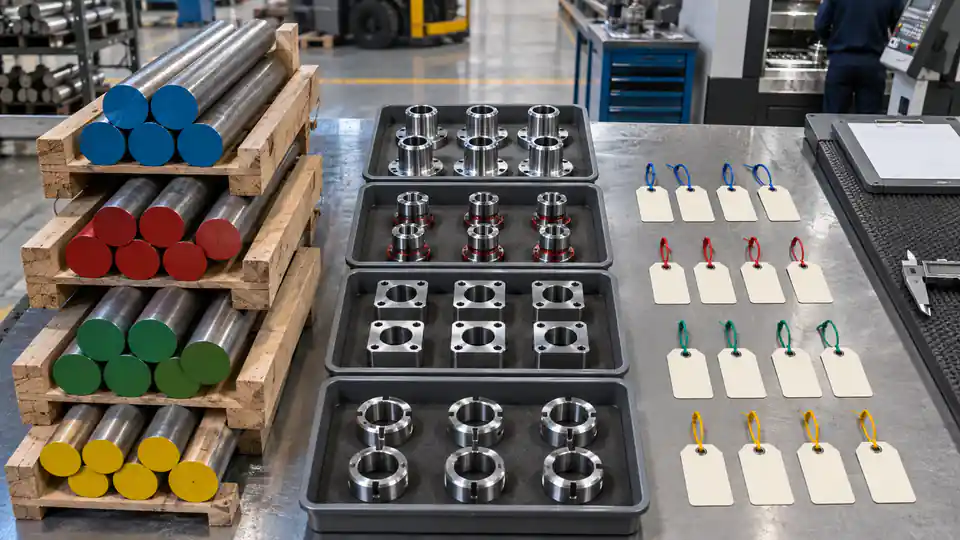
A material test report can connect a finished CNC part to the chemistry, mechanical properties, heat treatment, product form, and heat or melt identity of its source material. That connection is valuable only when the purchase requirement is clear and identity remains controlled through receiving, cutting, machining, outside processing, inspection, and shipment.
This material test report CNC parts guide explains what to request, how to review a mill certificate, how heat-lot traceability can be preserved, and which gaps require clarification. It does not turn a certificate into proof of every finished-part characteristic, and it does not replace the governing material specification or customer contract.
MTR, MTC, CMTR, and Certificate of Conformance
Terms vary by industry and supplier. Material test report (MTR), mill test certificate (MTC), and certified material test report (CMTR) often describe a document issued by a mill or authorized processor containing material identity and test results. A certificate of conformance (CoC) may only state that supplied material or parts conform to specified requirements.
Define the required document content instead of relying on the acronym. If actual chemistry, tensile, hardness, heat treatment, or test values are needed, say so. A generic distributor CoC is not equivalent to a mill report containing traceable test results.
The Heat or Melt Number
A heat number identifies a batch of metal produced under a defined melt or heat operation. It links the stock to mill records and reported chemistry. Product-specific identifiers may also include lot, slab, ingot, billet, coil, plate, bar, or forging numbers.
The exact traceability model depends on material and specification. Record the identifier as printed; do not shorten or reformat it in a way that loses uniqueness. If a service center splits stock, preserve both the original heat and the new piece or lot identity.
Product Form Matters
Plate, sheet, bar, tube, extrusion, forging, casting, and wire of the same alloy designation can follow different specifications, heat treatments, property directions, and test frequencies. A certificate for plate cannot automatically support a part purchased as forged stock.
The purchase order and MTR should agree on product form, size range, temper or condition, and applicable specification. Verify that the reported tests apply to the delivered form and thickness.
Material Specification and Revision
The MTR should identify the governing specification and any grade, class, type, condition, or supplementary requirement. Revision control can matter when limits change or customer contracts freeze an edition.
Compare the purchase order, drawing, approved material list, stock marking, packing list, and report. Resolve conflicting designations before cutting. Similar commercial names are not authorization to substitute.
Chemical Composition
Chemistry results usually list elements, measured values, and specification limits. Review units and whether values are heat analysis, product analysis, or another defined test. Confirm every required element is present, including residual or intentionally added elements where the specification controls them.
A “balance” entry or less-than value may be legitimate under the method, but missing columns, transposed units, impossible totals, or a grade name without results require review. Do not alter the mill report to make it fit the purchase requirement.
Mechanical Properties
Reports may include tensile strength, yield strength, elongation, reduction of area, hardness, impact, or other tests. Verify specimen orientation, test temperature, gauge length, thickness range, units, and acceptance limits under the specification.
Longitudinal, transverse, and short-transverse results are not interchangeable. If the finished component depends on a direction, link stock orientation and part nesting to that requirement.
Heat Treatment and Temper
The certificate may state solution heat treatment, aging, annealing, normalization, quench and temper, stress relief, or another condition. Check that the reported route and final temper match the order. Furnace charts or pyrometry records are separate evidence unless explicitly included.
Subsequent machining, welding, thermal stress relief, coating bake, or other exposure can affect the delivered condition. The MTR proves source material state at the reported stage, not every later property.
Special Tests and Supplementary Requirements
Ultrasonic inspection, cleanliness, grain size, corrosion tests, decarburization, inclusion rating, magnetic properties, conductivity, or fracture-related tests may be required for particular materials. These are not automatically included in a standard certificate.
State the test method, acceptance class, sampling, and report needed on the purchase order. Confirm that supplementary results identify the same heat, product, size, and specification.
Country, Mill, and Source Restrictions
Some contracts restrict country of melt, manufacture, or origin; require approved mills; or prohibit brokers and unapproved distributors. These commercial or regulatory requirements must be explicit. A mill logo alone may not establish the complete chain.
Request mill name and location, distributor identity, purchase chain, and declarations needed by the contract. Do not infer country of origin from the supplier’s address.
Distributor Certificates
A distributor may issue a packing list or CoC and attach the original mill report. Verify that the distributor document connects its item, quantity, size, and lot to the mill heat. Redaction must not remove information required to establish identity or compliance.
If stock was cut, processed, or heat treated by the distributor, obtain the relevant process evidence and new identification. The original MTR should remain legible and unaltered.
Receiving Inspection
Receiving should compare physical stock, markings, tags, dimensions, quantity, purchase order, packing list, and certificates. Inspect for damage, corrosion, mixed bundles, altered markings, or evidence that tags were transferred.
Quarantine stock when identity or documentation is uncertain. Do not place it into general inventory while waiting for clarification. Record who reviewed the documents and the disposition.
Positive Material Identification
PMI can screen alloy chemistry using X-ray fluorescence, optical emission spectroscopy, or other methods. Its capabilities and limitations differ: some instruments cannot measure light elements or carbon adequately, surface condition affects results, and calibration and operator competence matter.
PMI is not automatically a replacement for an MTR. It can confirm or challenge identity, support segregation, or meet a contract when the method and acceptance are specified. Link PMI results to the stock and heat record.
Stock Marking
Original mill or distributor markings may be ink, stencil, stamp, tag, barcode, or label. Before cutting removes the mark, transfer identity to each piece using a controlled method that does not damage the material or confuse part marking.
Marking method should consider corrosion, stress concentration, cosmetic requirements, heat treatment, cleanroom or vacuum service, and later finishing. When physical marking is impractical, use controlled containers, travelers, maps, or electronic identity with verified segregation.
Cutting and Remnant Control
Sawing one bar or plate into blanks creates new pieces that must remain linked to the original heat. The traveler should record parent stock ID, heat, cut quantity, blank identity, date, and operator or automated transaction. Remnants need the same control before return to inventory.
Do not rely on location alone. Racks move, labels detach, and similar alloys look identical. Periodic audits should trace a remnant back to receiving evidence.
One Part, One Heat Versus Mixed Heats
A purchase lot may contain material from multiple heats unless the order prohibits it. Decide whether one heat per part, one heat per shipment, or multiple identified heats are acceptable. Large machined assemblies may contain components from several heats.
When mixing is allowed, preserve which serial or quantity came from each heat. If serial-level traceability is not required, maintain a defined lot mapping sufficient for containment and recall.
Work Travelers and Electronic Records
The traveler connects material identity with operations, quantity, scrap, rework, and outside processing. Electronic systems can scan barcodes or heat numbers, but permissions, interfaces, backups, and revision rules must be controlled.
Avoid free-text re-entry where possible. Use verified master data and retain the original report. Audit trail should show corrections rather than overwriting history.
Outside Processing
Heat treatment, plating, anodizing, passivation, grinding, NDT, or other sub-tier operations must receive identified product and return it with identity intact. The purchase order should flow down material and traceability requirements, quantity, part revision, process specification, and required certificates.
Reconcile shipped and returned quantities, including samples or destructive tests. A sub-tier certificate for “customer parts” without part, revision, lot, quantity, and process details may be inadequate.
Scrap, Rework, and Replacement
When a blank is scrapped and replaced, the replacement may come from a different heat. Update the traveler and serial mapping; do not copy the original material reference forward automatically. Rework that removes a physical mark also needs identity protection.
Scrap should be segregated to prevent accidental return. For sensitive programs, record destruction or disposition and reconcile quantities.
Finished-Part Marking
Part number, revision, serial, lot, and heat may be marked on the finished component when drawing and contract require it. The mark must remain legible after finishing and should not harm strength, fatigue, sealing, cleanliness, or appearance.
If the part is too small or marking is prohibited, identify the bag, tray, or container and prevent commingling. Define the hierarchy between part-level and container-level identity.
Certificate Review Matrix
| Field | Compare against | Typical concern |
|---|---|---|
| Alloy/grade | Drawing and PO | Similar but unapproved designation |
| Specification/revision | Contract | Missing or wrong edition |
| Product form/size | PO and stock | Plate report used for bar |
| Heat/lot | Stock mark and traveler | Lost or retyped identity |
| Chemistry | Specification limits | Missing element or wrong units |
| Mechanical properties | Grade/condition/thickness | Wrong orientation or test range |
| Heat treatment/temper | Drawing and process route | Later exposure may change state |
| Mill/source | Approved-source rules | Distributor identity substituted for mill |
| Authorization/signature | Document requirements | Editable or incomplete record |
Use a controlled review checklist for recurring materials.
Detecting Suspicious Documents
Warning signs include inconsistent fonts, altered fields, cropped headers, mismatched heat numbers, impossible dates, units that do not match values, missing pages, repeated results across unrelated heats, or contact details that do not belong to the claimed mill. A clean PDF is not proof of authenticity.
Verify questionable reports through an approved distributor or mill contact using independent details. Preserve the suspect document and investigation trail. Do not accuse or edit; quarantine and escalate.
A Practical MTR Review Example
Assume the purchase order calls for 7075-T651 aluminum plate to a named specification, 38 mm thickness, with mill MTR and heat traceability. The receiver first checks that the physical plate and distributor packing list show the same heat and size. The reviewer then confirms that the report names plate—not bar or extrusion—states the required temper, and covers the relevant thickness range.
Chemistry is compared element by element with the specification limits. Tensile and yield results are checked with elongation, test direction, units, and any thickness-dependent minimums. The heat-treatment or temper statement, mill identity, report number, authorization, and pages are reviewed. If the MTR shows T6 rather than T651, or the mechanical tests apply to another thickness, the material remains on hold even if the alloy chemistry passes.
Finally, the traveler receives the exact heat number and a controlled stock ID. When the plate is sawn, every blank and remnant inherits that link. The completed part’s material record therefore points to both the supplier transaction and the original mill evidence.
Test Frequency Is Not Part-by-Part Testing
Material specifications define sampling and test frequency by heat, lot, product, size, or another population. One tensile result can represent a defined quantity of source material; it does not mean each finished CNC part was mechanically tested. State the correct evidence in customer-facing reports.
When a buyer requires a test beyond the source specification—such as a coupon from each parent plate—define coupon location, orientation, laboratory method, acceptance, traceability, and disposition. Destructive testing affects material yield and lead time. A test added after blanks are cut may be impossible to link or may consume an extra production piece.
Distributor and Mill Chain of Custody
Traceability through multiple distributors is credible when every transfer preserves original heat identity and the documents link quantities and product form. Request the minimum chain needed by contract. More invoices do not necessarily provide stronger technical proof if the physical identity was not controlled.
For drops or remnants, ask how the seller received, marked, stored, and cut the stock. A photocopied MTR without a transaction-specific link can be genuine yet unrelated to the delivered material. Approved-stock programs should periodically audit the warehouse process, not only collect PDFs.
Supplier or Mill Changes
A repeat part can receive the same nominal alloy from a different approved mill or product route. That change may affect machining response, residual stress, anodized appearance, grain direction, or qualification even when every MTR value meets minimums. Define notification requirements from product risk.
When a source change needs approval, require it before material purchase or cutting. Review specification, product form, temper, size, country restrictions, prior qualification, and any delta tests. Do not demand customer approval for ordinary heat changes if the contract only requires specification conformance; distinguish heat-to-heat traceability from controlled source changes.
Nonmetallic and Composite Material Records
Polymers, ceramics, elastomers, and composites use batch, resin lot, cure batch, sheet lot, or manufacturer certificate systems rather than metal heat numbers. Relevant evidence can include resin grade, filler, reinforcement orientation, cure state, shelf life, conditioning, flammability, biocompatibility, or lot test values.
Use the material manufacturer’s terminology and specification. Moisture conditioning and storage can change delivered properties after the certificate is issued. Preserve batch identity through cutting and machining just as with metal, while controlling expiry and environmental history where required.
If material is recertified or reprocessed, retain both records and the authorized basis connecting the new condition to the original batch.
Digital Certificates and Authenticity
Digital portals, QR codes, signatures, or verification numbers can improve authenticity, but links and credentials can expire. Save the controlled record and verification evidence according to retention rules. Restrict editing and preserve metadata where useful.
Scanned paper may be acceptable if legible and controlled. Define whether original electronic, certified copy, or supplier portal access is required.
Retention Period
Retention depends on contract, product life, regulation, quality system, and risk. Define the starting event, duration, format, readability, backups, and disposition. Ensure records can be retrieved by part, order, serial or lot, and heat.
Long retention needs migration planning so obsolete software does not make files unreadable. Protect confidential and personal information without redacting required technical evidence.
MTR Does Not Prove Finished Dimensions
The mill report supports source material requirements. It does not show that CNC dimensions, GD&T, surface finish, coating thickness, cleanliness, or assembly performance conform. Those need their own process and inspection evidence.
Likewise, a dimensional report cannot replace material identity. Keep evidence types linked but distinct.
MTR Does Not Prove Every Material Property
Only properties required and tested or certified under the governing specification are supported. Fatigue, fracture toughness, grain flow, corrosion, or elevated-temperature behavior cannot be inferred from a basic chemistry and tensile table unless the specification and qualification establish them.
Design authority owns material selection and allowables. Suppliers should not turn an MTR into a broader performance claim.
When a CoC Is Enough
For low-risk commercial parts, a supplier CoC may satisfy the purchase requirement when actual test results and heat traceability are unnecessary. Requiring full mill documents for every commodity can add administrative and minimum-order cost without changing the product decision.
Choose evidence from risk, regulation, customer flow-down, and failure consequence. Write the requirement before quotation so suppliers price the correct source.
When Full Heat Traceability Is Appropriate
Heat-level traceability is common where material properties affect safety, regulation, pressure, fatigue, high temperature, aerospace or medical qualification, or costly downstream assemblies. It also supports containment when a mill later reports a heat issue.
State whether traceability must be one-to-one at serial level, one-to-many at lot level, or retained only in supplier records. More granularity requires more marking and data control.
Cost and Lead-Time Effects
Traceable material can carry distributor minimums, mill-source restrictions, certificate fees, special storage, PMI, marking, documentation review, and record retention. One-heat requirements can reduce nesting and prevent use of certified remnants. Rush replacement after a document failure can delay the order.
Compare quotes only after normalizing grade, product form, source, certificates, traceability level, and testing. A lower material line may omit the required chain.
RFQ Language
Define alloy, grade, temper or condition, product form, specification and edition, approved sources, country restrictions, required MTR fields, special tests, lot mixing, part marking, retention, and documents delivered with shipment. Identify any customer portal or approval before cutting.
Ask suppliers to flag exceptions and proposed equivalents in writing. Silence should not count as approval to provide commercial material with a generic CoC.
Receiving and Release Checklist
- Match PO, drawing, stock, packing list, and certificate.
- Verify grade, specification, product form, size, and condition.
- Preserve the original heat or melt identifier exactly.
- Review chemistry, mechanical properties, units, orientation, and limits.
- Confirm supplementary tests and approved-source requirements.
- Quarantine missing, altered, or inconsistent documents.
- Transfer identity before cutting original markings away.
- Map blanks, remnants, parts, rework, and replacements to the heat.
- Reconcile quantities through outside processes.
- Mark finished parts or controlled containers as required.
- Retain authentic records in a retrievable format.
- Deliver the agreed MTR, CoC, and process certificates with the shipment.
Questions for the CNC Supplier
- Who reviews MTRs and what checklist is used?
- How is heat identity transferred from stock to blanks?
- Can certified remnants be used, and how are they controlled?
- How are multiple heats segregated and mapped to serials or lots?
- What happens when stock markings and documents disagree?
- Is PMI used, and what does the selected method actually detect?
- How do sub-tier processors preserve and return identity?
- How are replacement blanks and rework records updated?
- Which documents ship and which remain available on request?
- How long can records be retrieved after delivery?
The Practical Traceability Decision
Effective traceability is a continuous identity chain, not a PDF attached at the end. The chain begins with a precise material purchase requirement, continues through physical segregation and controlled transfers, and ends with a finished-part or lot record that points back to authentic source evidence.
Specify only the level the product requires, then verify every link. To review material-document and heat-lot requirements with a machining quote, submit the 3D model, controlled drawing, material specification, quantities, and required evidence through Request a Quote.