
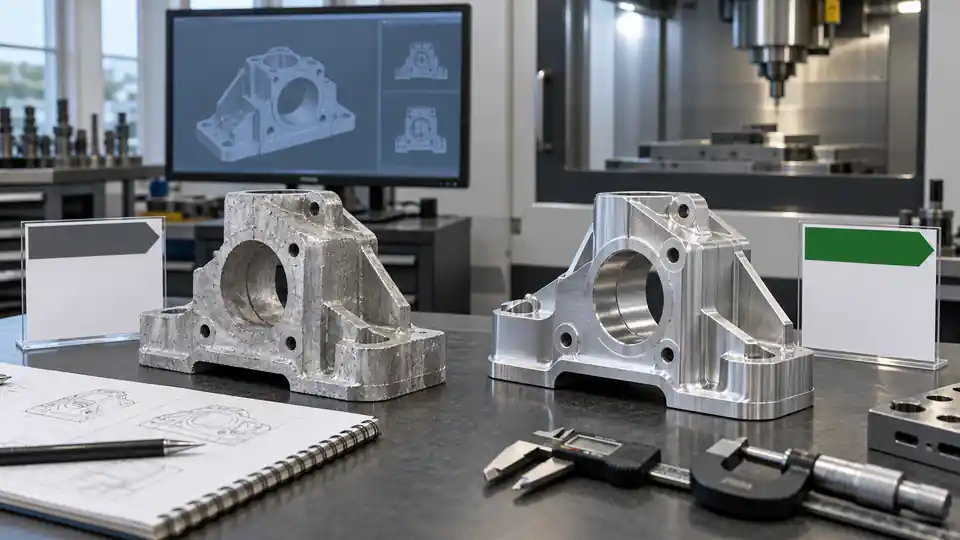
Proof-of-concept and engineering validation prototypes answer different questions. A POC asks whether a principle, mechanism, interface, or user interaction is worth pursuing. EVT asks whether a defined engineering design satisfies its inputs with representative materials, geometry, electronics, and interfaces. Treating both as “prototype parts” leads to unnecessary tolerance and documentation in one phase, then missing evidence in the next.
This POC vs EVT CNC prototype guide shows how to choose material, tolerances, inspection, quantity, process fidelity, and supplier involvement for each stage. Stage names vary between companies; define the decision and exit criteria rather than relying on the acronym alone.
Begin With the Decision, Not the Prototype Label
Write the question the build must answer in one sentence. Examples include:
- Can this linkage produce the required motion envelope?
- Is there enough stiffness to prevent optical misalignment?
- Will the thermal path keep a component below its limit?
- Does the proposed enclosure fit all interfaces and survive assembly?
- Can the design outputs meet the verified engineering inputs?
Then identify what evidence changes the next decision. A POC may need a video, force measurement, leak observation, or comparative test. EVT may require a controlled test report, full dimensional inspection, environmental test, and traceability.
If the team cannot state the decision, it will overbuild visible details and under-test the main risk.
What a Proof of Concept Is For
A POC isolates one or a few high-uncertainty assumptions. It can be physically crude if the crude representation preserves the phenomenon under investigation. The team may use substitute material, simplified geometry, manual adjustment, commercial components, or non-production assembly.
Good POC questions are narrow and falsifiable. “Does the product work?” is too broad. “Can a four-bar linkage achieve 120 degrees of travel without interference under the stated envelope?” is useful.
The POC should be fast enough to learn before the design accumulates detail. That does not mean careless. Critical dimensions still need control when they affect the experiment. The difference is that irrelevant production requirements can be relaxed intentionally.
POC deliverables
Typical outputs include:
- assumption and test objective;
- simplified CAD or sketch;
- explicitly accepted substitutions;
- prototype configuration and part identity;
- test setup and conditions;
- measured observations;
- limitations and anomalies;
- decision: continue, change, or stop; and
- next risks to retire.
A beautiful assembly without a recorded result is not a completed POC.
What EVT Is For
Engineering Validation Test usually evaluates a more mature design against engineering requirements. Geometry, materials, interfaces, and test conditions should be representative enough that results can support design decisions. EVT units are not automatically saleable production units, but uncontrolled substitutions can invalidate the evidence.
EVT often asks whether outputs meet inputs: dimensions, structural performance, sealing, thermal behavior, motion, electrical/mechanical interfaces, durability, environmental exposure, and safety-related functions. The verification plan should trace each test to a requirement.
For regulated products, formal definitions and controls may apply. FDA materials, for example, distinguish design verification—whether outputs meet inputs—from validation—whether the device meets user needs and intended uses. The FDA design-control training also emphasizes defined conditions and documented evidence. Use the rules for the actual industry; do not import medical-device requirements into an unrelated commercial prototype.
EVT deliverables
An EVT package may include:
- controlled design inputs and outputs;
- released model, drawing, BOM, and software/firmware build;
- configuration and serial identity;
- representative material and processes;
- verification protocol and acceptance criteria;
- dimensional and material/process records;
- test data and deviations;
- failure analysis and corrective changes;
- requirement traceability; and
- approval to proceed, repeat, or redesign.
POC and EVT Comparison
| Decision factor | Proof of concept | Engineering validation test |
|---|---|---|
| Main question | Does a principle or architecture deserve development? | Does the defined engineering design meet its inputs? |
| Design maturity | Early and incomplete | Controlled and substantially defined |
| Geometry | Simplified where not test-critical | Representative for verified requirements |
| Material | Substitute allowed if physics remain valid | Production-intent or technically justified equivalent |
| Tolerances | Only those needed for the experiment | Drawing-based and tied to function/test |
| Quantity | Minimum to observe and repeat key behavior | Enough for planned verification and variability |
| Manufacturing route | Fast, flexible, may be non-production | Representative where route affects performance |
| Inspection | Critical-to-test dimensions | Planned dimensional/material/process evidence |
| Changes during build | Expected, but recorded | Controlled through configuration/change process |
| Cosmetic finish | Usually secondary unless being tested | Representative when appearance or finish affects requirements |
| Documentation | Lean experiment record | Traceable verification package |
| Exit | Principle supported/rejected; risks updated | Requirements pass/fail; actions and next-stage approval |
Choose CNC Machining for the Right Reasons
CNC machining can serve both stages. It is valuable when the experiment needs material behavior, stiffness, thermal conductivity, precision interfaces, sealed passages, bearing fits, threads, or realistic assembly. It can also provide fast design iterations without hard tooling.
It may be unnecessary for a POC that only demonstrates hand clearance, rough motion, or visual scale. Additive fabrication, sheet material, extrusion, foam, or off-the-shelf parts may answer that question faster.
For EVT, CNC is often appropriate for housings, brackets, manifolds, joints, heat sinks, and precision frames. But machining a future molded part from solid stock does not reproduce molding knit lines, draft, residual stress, fiber orientation, texture, or production variation. State which evidence transfers and which must be repeated on production-intent tooling.
Define Material Fidelity
Material selection follows the phenomenon being tested. If the POC examines packaging or motion, a cheaper alloy or polymer may be acceptable. If it examines stiffness, fatigue, thermal expansion, corrosion, vacuum behavior, wear, sealing, or sterilization, substitution can change the result.
Create a material-fidelity note:
- production material and condition;
- prototype material and condition;
- property or behavior under test;
- known differences;
- expected direction and magnitude of effect where supportable;
- evidence needed before accepting the substitution; and
- tests that must be repeated later.
Do not call materials “equivalent” from a single property. Equal tensile strength does not imply equal modulus, density, thermal conductivity, corrosion resistance, machinability, or surface response.
Set Tolerances From the Experiment
Early prototypes are often burdened with a full production drawing before interfaces are understood. Conversely, vague POC dimensions can make a failed assembly impossible to interpret.
Classify dimensions:
- Test-critical: directly affect the hypothesis or measurement.
- Interface-critical: control fit with purchased parts or other prototypes.
- Assembly-supporting: need practical control to build and handle the unit.
- Noncritical for this build: can use a broader general tolerance.
Tighten only the first categories to the extent required. Identify datums that make test-critical measurements reproducible. Record actual values when performance will be correlated with geometry.
EVT drawings should represent mature design intent. Critical GD&T, fits, surfaces, and materials need measurable acceptance. If requirements are still moving during the build, control redlines and serial effectivity so test results remain tied to the configuration tested.
Plan Quantity From Learning and Risk
One POC can demonstrate that a mechanism moves; it cannot describe variation or reliability. Build enough units to distinguish a repeatable principle from an accidental success. When tests are destructive, include specimens for each condition and confirmation as justified.
EVT quantity follows the verification matrix, not a traditional round number. Consider:
- number of configurations;
- destructive versus nondestructive tests;
- test sequence and whether one test changes another;
- statistical or confidence needs;
- expected failures and rework;
- controls or comparison units;
- environmental/aging conditions;
- dimensional correlation units; and
- retained or teardown samples.
Document which serials go to which tests. Do not reuse a thermally or mechanically damaged unit in a later test without assessing the effect.
Separate Verification From Exploration
Exploratory tests help tune a design; verification tests evaluate an approved requirement with predetermined acceptance criteria. Both are valuable, but they should not be mislabeled.
During a POC, changing a spacer, offset, or control parameter mid-test may be the purpose. Record each configuration and observation. During EVT, an unapproved mid-test change can make results non-traceable. Stop, document the deviation, decide whether data remain valid, and repeat as required.
ISO/IAF guidance on auditing design and development describes verification as assurance that outputs meet inputs and validation as confirmation for intended use. It also notes that prototypes, simulations, tests, and reviews can be verification activities. Apply the governing product-development procedure.
Configure Every Prototype
Even a POC needs enough identity to explain results. Assign a build or unit number and record CAD revision, drawing/redline, BOM, material, process, software, assembly changes, and test setup.
For EVT, use stronger configuration control:
- serial number or unique unit ID;
- released design package;
- deviation and rework history;
- component and material lots when relevant;
- process/supplier identity;
- inspection result;
- software/firmware version;
- test allocation; and
- final disposition.
A test failure cannot drive a design decision if the team cannot tell which geometry or material failed.
Inspect What Affects the Result
POC inspection can be focused. Measure test-critical and interface features and record enough actual values to interpret behavior. A pass stamp on a simplified print may be less useful than actual gap, preload, or alignment measurements.
EVT inspection should follow the verification plan. Use a ballooned drawing or characteristic list, validated methods appropriate to tolerance, and traceable results. If the prototype process differs from production, separate product conformity from process capability.
Do not require a full CMM report by habit when the test addresses a few interfaces. Do not skip hidden critical geometry because the outer appearance looks correct.
Manage Supplier Communication
Tell bidders the development stage and what can change. Provide:
- decision objective and due date;
- controlled model/drawing or redline;
- test-critical features;
- permitted material/process substitutions;
- quantity and allocation;
- inspection and records;
- expected design iterations;
- delivery sequence; and
- disposition of obsolete parts and files.
Ask suppliers to separate nonrecurring programming/tooling from recurring unit cost. A POC may favor speed and flexible workholding; EVT may justify stable fixtures and formal inspection. Make quote assumptions visible.
Select a Supplier for the Stage
A strong POC supplier responds quickly to incomplete but controlled information, highlights the few details needed to protect the experiment, and supports short iteration loops. The shop should not silently “fix” geometry that looks unusual; unusual geometry may be the variable under test. Look for clear redlines, flexible workholding, and honest material/process alternatives.
An EVT supplier needs stronger configuration, inspection, and special-process control. Evaluate its ability to keep serials and revisions separate, document actual results, manage subtiers, and support failure analysis. A supplier that excels at rapid prototypes may not have the systems for a formal verification build; a high-volume production source may be slow or expensive for exploratory changes.
The same supplier can serve both stages when it adjusts the route and records appropriately. Do not equate a polished quality manual with prototype responsiveness, or fast quoting with controlled EVT execution. Audit the handoffs relevant to the planned build.
Share the longer-term production route when it affects DFM, but do not force the supplier to price production tooling before architecture is stable. Ask what work can be reused between stages and what must be rebuilt.
Plan Test Fixtures and Measurement Interfaces
Prototype hardware and test equipment form one measurement system. A part may be correct while a compliant fixture, sensor mount, cable path, or reference surface is missing. Define those interfaces before machining.
For POC, a manually adjustable fixture can accelerate learning if settings are recorded. Include hard stops, scales, or reference points that make repeated tests comparable. Ensure the fixture does not supply stiffness, alignment, cooling, or preload that the final design will not have.
For EVT, qualify test fixtures and data acquisition as required by the verification plan. Record fixture revision, calibration or functional checks, software version, sensor identity, environmental condition, and setup. If one fixture is modified during testing, identify which serials and results were affected.
Add inspection features when they help correlate performance: datum targets, witness surfaces, accessible measurement points, or temporary ports. Remove or redesign them before the next stage if they are not part of the product. Treat the prototype and test fixture as controlled configurations.
Run Iterations Without Losing Evidence
Fast iteration is valuable only when the team knows what changed. Give each build and test configuration a unique identifier. Record the hypothesis, change, reason, unit, result, and decision. Avoid folder names such as “final_v7_really_final.”
Change one major variable at a time when possible. If geometry, material, software, preload, and test method all change together, the successful result cannot be attributed confidently. When schedule forces several changes, document the confounding and plan a confirmation build.
Use redlines for speed but consolidate approved changes into the master CAD and drawing before EVT release. Reopen affected verification when a later change can invalidate an earlier pass. Maintain a requirement-to-test matrix so the team sees the impact instead of relying on memory.
At the end of each loop, dispose of or mark obsolete units. A mixed drawer of nearly identical prototypes creates test and demonstration errors. Retain only the samples needed for evidence, teardown, comparison, or future reference, with clear configuration labels.
Use POC Findings to Plan EVT
The POC should reduce uncertainty, not simply produce another artifact. At closeout, state:
- which assumptions were supported or rejected;
- observed failure modes and limits;
- changes made during the experiment;
- data quality and limitations;
- requirements created or revised;
- risks remaining for EVT;
- configuration selected; and
- evidence that must be repeated with representative material/process.
Do not carry a manual shim, hand-selected component, or software correction into EVT as invisible tribal knowledge. Convert it into a controlled design requirement or remove the dependence.
EVT Entry Criteria
Before ordering EVT hardware, confirm:
- design inputs are approved and testable;
- interfaces and envelopes are stable enough;
- model, drawing, BOM, and software versions align;
- critical material and processes are defined;
- verification methods and acceptance criteria exist;
- test equipment and fixtures are ready;
- unit quantity and allocation are justified;
- known POC limitations are addressed;
- supplier deviations are closed; and
- change control is active.
Entering EVT with unresolved architecture decisions converts an evidence build into an expensive discovery build.
EVT Exit Criteria
An EVT exit review should not count only passed tests. It should show requirement coverage, configuration identity, anomalies, deviations, failed or incomplete tests, corrective changes, regression impact, and residual risk.
Decide whether the next step is design revision and repeat EVT, limited follow-up, validation/DVT, process development, or stop. Do not carry failures forward as “will be fixed in production” without approved evidence and ownership.
The NIST MEP product-development overview connects prototype work with materials, durability testing, manufacturing, and product launch. That sequence reinforces the need to turn learning into controlled design and manufacturing decisions.
Cost and Lead-Time Drivers
POC cost is driven by iteration speed, engineering communication, low quantity, flexible setup, and rapid material availability. Over-documenting noncritical features can slow learning. Under-defining the experiment can waste the whole build.
EVT adds representative material, more mature fixtures, controlled revisions, dimensional evidence, test units, traceability, and often special processes. Schedule should include:
- design release and DFM closure;
- material procurement;
- programming and workholding;
- machining and finishing;
- inspection and document review;
- assembly and test-fixture readiness;
- verification testing;
- failure analysis and corrective changes; and
- retest and approval.
The fastest machine quote may not produce the earliest valid decision if inspection or test preparation lags.
Common Stage Errors
A POC is treated as a cosmetic show model
The unit looks persuasive but does not isolate or measure the uncertain principle. Recenter the build on a falsifiable question.
EVT uses convenient substitute material
Results are claimed for production behavior without analyzing property differences. Use representative material or document limitations and repeat tests.
Every dimension receives production tolerance at POC
Cost and lead time increase without improving the experiment. Control test-critical and interface features first.
A passing unit becomes proof of capability
One prototype demonstrates an outcome under one configuration; it does not establish stable production variation. Plan later process validation or capability evidence.
Design changes are made during EVT without effectivity
Results from several configurations are pooled. Assign serials, record changes, and repeat affected tests.
CNC machining is assumed to represent future molding
Material form, residual stress, draft, surface, and process variation differ. Identify which tests transfer and repeat process-dependent verification.
Stage Decision Matrix
| Situation | Better first build | Reason |
|---|---|---|
| Uncertain motion architecture | POC | Isolate kinematics before detailed design |
| Early human-factors envelope | POC | Fast geometry iteration matters more than production finish |
| Thermal path depends on final alloy/contact | POC or EVT-like engineering prototype | Material and interfaces must represent the physics |
| Mature enclosure with defined ingress test | EVT | Controlled design must be checked against requirements |
| Bearing fits and axis alignment affect performance | EVT | Representative machining and measured geometry are required |
| Future molded housing, early packaging check | POC CNC or additive | Physical envelope can be learned before tooling |
| Production-intent molded behavior | Tool/process validation, not CNC EVT alone | Machined stock cannot reproduce molding effects |
| Regulated verification | Controlled EVT under applicable procedure | Traceability and approved protocol govern |
RFQ Checklist
Before requesting CNC prototype pricing, state:
- POC, EVT, or internally defined stage;
- exact decision and exit criteria;
- model/drawing/BOM revision;
- critical features and datums;
- material/process fidelity and allowed substitutions;
- quantity and test allocation;
- required actual measurements and documents;
- finish/cosmetic requirements;
- configuration and serial marking;
- delivery sequence and iteration expectation;
- confidentiality and file-control rules; and
- ownership of design changes and deviations.
Ask the supplier to identify assumptions and recommend manufacturability changes separately from the controlled product definition.
Choose the Build That Produces the Next Decision
A proof of concept should retire a focused uncertainty with the least unnecessary fidelity. EVT should evaluate a controlled, representative design against approved engineering inputs. CNC machining is valuable at either stage when precision, material behavior, interfaces, or functional hardware are necessary; it is not a reason to impose production requirements before they support the decision.
Document what the build does not prove. A successful POC does not establish production yield, a passing EVT unit does not establish long-term reliability, and a machined surrogate does not validate a future molded or cast process. Explicit limitations prevent later teams from citing prototype evidence outside its intended scope.
Preserve raw measurements, photographs, test conditions, and anomaly notes—not only a presentation conclusion. Future reviewers should be able to connect the decision to the exact unit, configuration, and method. If the design changes, assess which evidence remains applicable and which test must be repeated.
For a QuickCNCs prototype review, send the current model and drawing, stage, learning objective, critical features, material fidelity, test plan, and deadline. We can align the machining and inspection scope with the evidence the team actually needs, while preserving clear configuration and revision authority.
Match early learning to rapid prototyping and use low-volume CNC machining when the build must exercise a more representative route. Submit the stage objective and controlled configuration through Request a Quote.