
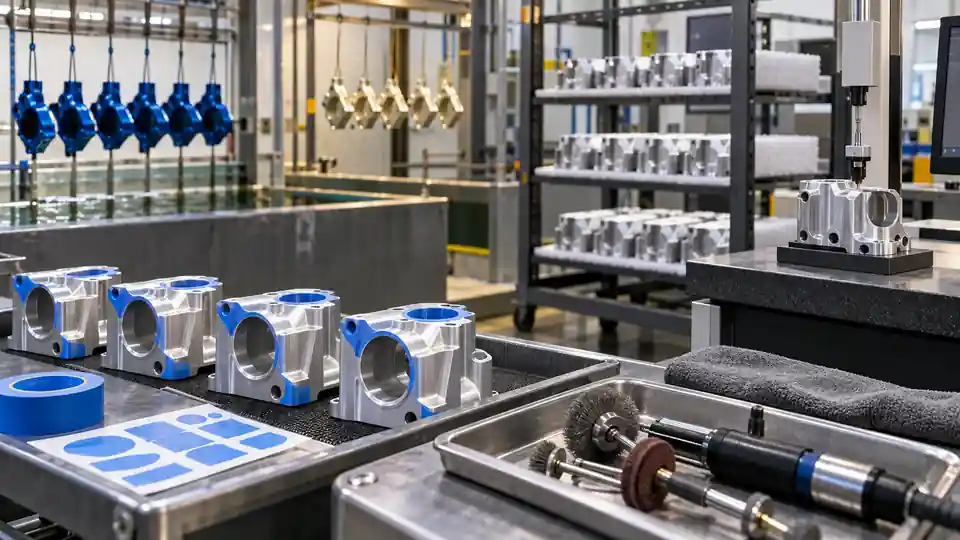
A machined part is not finished when the last cutting tool stops. Deburring, heat treatment, grinding, anodizing, plating, passivation, marking, cleaning, inspection, assembly, and packaging can determine whether the component is usable. When those operations are outsourced, their cost includes more than the processor’s unit price: minimum lot charges, masking, test coupons, transport, queue time, certificates, dimensional change, reinspection, and responsibility for nonconforming work.
These costs are often underestimated because the CNC drawing and quote describe the machined geometry in detail while treating finish as one short note. A processor cannot price “anodize black” or “heat treat as required” reliably without material, process specification, class/type, color or hardness, masking, rack/contact limits, dimensional state, test requirements, and lot size.
This guide explains how CNC secondary operation cost enters a quote and how buyers can define an end-to-end scope. It does not provide universal prices or lead times; both depend on part, process, specification, location, supplier, and release schedule.
What Is a Secondary Operation?
A secondary operation is any required step performed after or between primary machining stages. It can occur inside the machine shop or at a specialized sub-tier provider. Common examples include:
- manual or automated deburring;
- abrasive blasting, tumbling, polishing, or brushing;
- heat treatment, aging, stress relief, hardening, or tempering;
- surface or cylindrical grinding, honing, or lapping;
- anodizing, hardcoat, passivation, conversion coating, plating, or paint;
- laser engraving, dot-peen marking, ink marking, or labeling;
- welding, brazing, insert installation, or assembly;
- ultrasonic, solvent, aqueous, precision, or cleanroom-compatible cleaning;
- leak, pressure, conductivity, hardness, adhesion, thickness, or other testing;
- final dimensional inspection and documentation;
- preservation, clean bagging, protective caps, and custom packaging.
The word “secondary” does not mean unimportant. A coating may provide the wear surface, a heat treatment may create the required strength, and final grinding may establish the most critical dimension.
Build the Route Before Asking for Price
Map the manufacturing sequence from raw stock to shipped part. For each step, identify the incoming condition, work performed, characteristic changed, inspection gate, and output evidence.
A typical route may be:
- receive certified stock;
- rough machine with finish allowance;
- stress relieve or heat treat;
- straighten if permitted;
- finish machine critical datums and features;
- deburr and clean;
- mask and apply surface treatment;
- unmask, clean, and inspect coating;
- verify final dimensions and function;
- mark, package, and release.
Another part may require anodizing before final bore machining, or grinding after heat treatment, or leak testing after plug installation. There is no universal order. The drawing and RFQ must state which dimensions and properties apply at each relevant state.
Identify irreversible gates
Heat treatment, chemical stripping, plating, welding, and destructive tests can make rework expensive or impossible. Place technical approval before those gates. Verify part revision, quantity, material identity, machining allowance, masking, process specification, and test scope before releasing the lot.
If the sub-tier processor finds an ambiguity, it should return through the prime supplier’s controlled clarification path. An informal change between processor and machine shop can create a part that no longer matches the buyer’s release.
Minimum Lot Charges
Many outside processes have a minimum charge. The processor must prepare a tank, furnace load, rack, blast cabinet, cleaning line, test setup, paperwork, or certificate whether the lot contains one part or many.
Minimums strongly affect prototypes and small batches. One anodized prototype may cost almost as much at the processor as a small rack of parts. Splitting ten parts into two releases can create two minimum charges, two transport cycles, and two certification events.
Ask the quotation to show:
- processor minimum charge or lot basis;
- included quantity or rack/load capacity;
- cost for additional pieces beyond the minimum;
- repeated minimums for split shipments or partial rework;
- setup/test charges that are separate from processing;
- price validity and material/energy surcharges where relevant.
Do not treat the minimum as pure markup. It reflects a real batch activity. The sourcing opportunity is to coordinate compatible lots, select release sizes deliberately, or keep the process in-house when qualified—not to omit the requirement.
Transport, Handling, and Queue Time
An outsourced process adds at least two logistics handoffs: shipment to the processor and return to the machine shop or next supplier. Each handoff can add scheduling, packing, transit, receiving, counting, and inspection time.
Calendar lead time includes:
- waiting for a complete lot;
- booking the sub-tier queue;
- packaging for transport;
- local courier or freight;
- incoming review at the processor;
- processing and testing;
- certificate preparation;
- return transport;
- receiving and final inspection.
A two-hour coating cycle can occupy several calendar days. Ask for elapsed lead time and the processor’s scheduled day, not only process duration. For urgent prototypes, determine whether an expedite slot is confirmed or merely assumed.
Parts must be protected between operations. Ground faces, sealing surfaces, threads, sharp edges, and cosmetic finishes can be damaged by bulk handling. Packaging is part of the route, not an afterthought.
Masking, Racking, and Contact Areas
Masking prevents treatment on selected surfaces. Racking or fixturing provides electrical contact, positioning, drainage, or handling. Both require physical access and create cost.
Define masking on the drawing or a controlled finish map. Identify:
- surfaces and holes to remain untreated;
- transition location and allowed tolerance;
- whether threads are plugged, masked, or chased after processing;
- acceptable overspray, bleed, or edge feathering;
- critical sealing, bearing, grounding, and contact surfaces;
- allowed rack/contact locations and maximum mark size;
- whether temporary plugs, caps, or custom masks are required.
Masking labor may be per piece even when processing is lot-based. Intricate boundaries, many small holes, blind features, and tight transition tolerances increase time. Custom masks or reusable racks can require NRE and minimum volume.
Do not define masking after award. A coating thickness that closes a bore or an anodized electrical contact that should remain conductive can force stripping, rework, or scrap.
Dimensional Buildup and Material Removal
Secondary processes can add material, consume substrate, move the part, or change surface texture. The quote must identify the dimensional state.
Coatings and plating
Anodize converts part of the aluminum surface and grows part of the layer outward; the dimensional effect depends on process and specification. Electroplating and electroless nickel add thickness. Paint and powder coat add larger, more variable layers. Conversion coatings are generally much thinner but still require scope and contact control.
Define whether a tolerance applies before or after finish. For fits, threads, sealing faces, and precision bores, specify masking or machining allowance. Do not subtract a nominal coating thickness from CAD without agreeing on buildup, tolerance, distribution, and measurement method.
Heat treatment and stress relief
Thermal processing can create distortion, growth, scale, and hardness changes. A route may leave stock for post-treatment finishing or grinding. Identify straightening permissions, final hardness, test location, and dimensional verification after the thermal cycle.
Grinding, honing, and lapping
These processes remove controlled material and require adequate allowance. Too little stock may fail to clean up; too much increases cycle time and risk. The machine shop and finishing source should agree on incoming size, final size, datum, surface texture, and stock distribution.
Certificates and Requirement Flow-Down
The prime supplier remains responsible for the delivered part even when work is outsourced. It must flow the correct part number, revision, material, process specification, class/type, masking, tests, and documentation to the sub-tier source.
The purchase order should state the required evidence. Depending on the process, this may include:
- certificate of conformance with part, revision, quantity, and specification;
- heat-treatment cycle or furnace/load traceability;
- hardness or conductivity results;
- coating thickness, adhesion, corrosion, or other test results;
- lot/batch identity and processing date;
- approved processor identity when the customer controls sources;
- statement of exceptions or deviations.
Do not request an unavailable or irrelevant certificate after the lot is complete. Conversely, do not accept a certificate title as proof that required fields and test values are present. Review the document format during quotation for high-risk work.
Reinspection After Secondary Operations
Incoming machined dimensions do not prove final dimensions. Reinspect characteristics that can change through heat, coating buildup, masking, handling, cleaning, or grinding.
Build a risk-based matrix:
| Secondary operation | Characteristics commonly affected | Appropriate verification question |
|---|---|---|
| Heat treatment | flatness, straightness, size, hardness, scale/decarburization | Which features are finished or measured after treatment? |
| Anodize/hardcoat | bore/shaft size, thread fit, electrical contact, color, thickness | Which surfaces are masked and which dimensions are post-finish? |
| Electroless/electroplating | thickness, uniformity, edge buildup, adhesion, fit | How is coating thickness included in the tolerance budget? |
| Grinding/honing/lapping | final size, geometry, texture, burn or damage | What incoming stock and final datum control the process? |
| Blasting/polishing | texture, edge condition, cosmetic appearance, local material removal | Which faces are cosmetic and how is appearance accepted? |
| Welding/brazing | distortion, joint integrity, heat-affected properties | What fixture, sequence, test, and post-process machining apply? |
| Cleaning | residue, corrosion, particle level, material compatibility | What cleanliness method and acceptance evidence are required? |
| Marking | location, legibility, depth, surface damage | Is marking allowed on fatigue, sealing, or cosmetic zones? |
The matrix should be tailored to the part. Do not reinspect every feature automatically. Focus on requirements exposed to the secondary operation and any datum needed to verify them.
Rework and Responsibility Boundaries
When a finished part is nonconforming, the source of variation may be machining, handling, sub-tier processing, ambiguous requirements, or measurement. Define responsibility before work starts.
The prime supplier should control dispatch, sub-tier instructions, return inspection, and nonconformance. The processor should identify the lot and process condition, stop on deviations, and protect customer product. The buyer should define requirements and approve departures. None of these roles removes the need for evidence.
Ask the quotation to address:
- whether stripping and reprocessing are allowed;
- maximum number of rework cycles where relevant;
- who approves dimensional correction or cosmetic concession;
- whether rework requires new certificates and full reinspection;
- who carries risk for processor-caused scrap;
- whether replacement material and machining receive expedite priority;
- how affected lots are contained and traced.
Chemical stripping can alter dimensions, surface condition, fatigue performance, or hydrogen-related risk depending on material and process. Do not accept “strip and redo” as an automatic disposition.
Cost Structure by Secondary Operation
| Cost component | Frequency | Questions for the quote |
|---|---|---|
| Engineering review | New release or change | Are specification, material, masking, and test requirements complete? |
| Processor setup/minimum | Per lot/load | What quantity is covered and when does another minimum apply? |
| Masking/racking | Per piece or fixture | Is labor manual, is custom tooling needed, and where may contacts occur? |
| Transport/handling | Per trip/lot | How many handoffs and what protective packaging are included? |
| Processing | Per piece, area, weight, or load | What calculation basis and special surcharges apply? |
| Testing/coupons | Per lot or sample | Which tests, frequency, specimen, and destructive allowance apply? |
| Certificates | Per lot/document | What exact fields and traceability must be reported? |
| Reinspection | Per characteristic/lot/piece | Which final requirements are affected and require actual values? |
| Risk allowance | Route-specific | Which ambiguity or failure mode creates the allowance? |
A supplier can provide this structure without revealing confidential rates. Buyers can then normalize quotes that use different lot sizes or sub-tier assumptions.
Process-Specific Cost Drivers
Anodizing and hardcoat
Cost is influenced by alloy, part size, surface area, type/class, color, thickness, masking, rack contact, sealing, testing, and lot consistency. Very tight color matching and extensive masking can dominate simple geometry. Hardcoat affects dimensional fits more than a cosmetic conversion finish and may need post-process verification.
Electroless nickel and electroplating
Surface preparation, base material, deposit type, thickness, uniformity, masking, heat treatment, adhesion testing, and hydrogen-embrittlement controls where applicable affect route and price. Deep recesses and complex geometry can challenge uniform coverage even in nominally uniform processes.
Heat treatment
Furnace load, material, section thickness, required condition/hardness, atmosphere, quench, straightening, coupons, testing, approved source, and certification drive cost. Lead time can depend on when the processor accumulates a compatible load.
Precision finishing
Grinding, honing, and lapping depend on material condition, incoming allowance, feature size, length-to-diameter ratio, final tolerance, geometry, surface texture, and inspection. A precise finish callout without an incoming-stock agreement creates quote risk.
Cosmetic finishing
Brushing, blasting, polishing, and paint depend on visual zones, direction, gloss, texture, color standard, sample approval, masking, and handling. Define viewing conditions and acceptance sample where appearance matters.
In-House Versus Outsourced Processing
An integrated supplier can reduce transport, queue, and communication handoffs. A specialist processor may provide deeper capability, qualification, controlled equipment, or required accreditation. Neither structure is inherently superior.
Evaluate:
- process qualification and specification coverage;
- experience with the material and geometry;
- lead-time control and scheduled capacity;
- traceability and certificate quality;
- nonconformance communication;
- protection and packaging;
- change control and approved-source requirements;
- backup capacity.
Ask the prime supplier to identify material sub-tier processes and whether it may change the source without approval. You usually do not need every minor consumable supplier, but function-critical heat treatment, coating, or testing deserves visibility.
Prototype and Production Planning
For prototypes, confirm that the processor accepts the small lot and that the minimum charge is visible. Use standard colors, masks, and available schedules when design permits. If function can be tested before final cosmetics, separate the validation gate to avoid finishing obsolete revisions.
For pilot builds, validate masking, contact marks, dimensional change, color/appearance, certificates, packaging, and final inspection. Record the approved processor and exact specification. Do not extrapolate from a flat sample coupon to complex part coverage without checking geometry.
For production, coordinate lot size with machining releases, processor capacity, sampling, inventory, and delivery. Consider reusable racks/masks, qualified backup sources, and defined rework limits. Monitor actual yield at the interfaces, not just the processor’s pass rate.
The QuickCNCs rapid prototyping page and CNC milling services page provide context for machining stages that surround secondary work. The RFQ must define the complete final-part condition.
Build a Secondary-Operation Lead-Time Network
Do not add every operation’s quoted days in a straight line without checking dependencies. Some activities can run in parallel: certificates can be prepared while a lot is inspected, packaging can be procured before parts return, and a test fixture can be qualified during machining. Other activities are strictly sequential because the next process requires the previous condition.
Draw a small dependency network with the planned start, completion, transport, and approval gate for each step. Identify the critical path and the party who controls every handoff. Include weekends, processor receiving days, minimum load schedules, customer witness points, and document-review time when they affect the promised date.
Use three dates in the supplier response:
- earliest date the complete lot can enter the outside process;
- earliest date a verified first quantity can ship;
- date the full accepted quantity and documentation will be complete.
This avoids a common misunderstanding in which the processor’s “three-day lead time” begins only after it receives a complete and accepted lot, while the buyer assumes the three days start at purchase-order placement.
Plan partial lots carefully
Sending a partial lot can shorten first delivery, but it may repeat minimum charges, color or furnace-lot variation, destructive tests, certificates, transport, and final inspection. It can also complicate traceability. Ask the buyer whether early pieces justify those costs and define whether the split lots may be mixed in one assembly or shipment.
For a cosmetic finish, separate lots can show visible shade differences even when each meets the process specification. For heat treatment, different loads create separate evidence and may produce different distortion behavior. The release plan should treat partial lots as a controlled decision, not an informal expedite.
Estimate Surface-Area and Part-Handling Effects
Some processors price by piece, surface area, weight, rack position, load, or a combination. A small part can be expensive if it needs individual wiring, intricate masking, or careful orientation. A large simple part can consume tank, furnace, or rack capacity even when its count is one.
Provide an accurate 3D model and identify holes, blind cavities, threads, trapped volumes, and surfaces that require coverage. Geometry affects drainage, air pockets, solution carryover, electrical current distribution, spray access, cleaning, and inspection. The supplier and processor should decide the production rack or fixture; the buyer should define prohibited contact zones and functional surfaces.
Do not estimate coating cost from external surface area alone when masking or handling dominates. Separate at least:
- base process/load charge;
- area or weight-dependent processing;
- per-piece loading and unloading;
- masking and unmasking labor;
- custom rack, plug, cap, or fixture cost;
- required tests and coupons;
- final cosmetic and dimensional inspection.
For repeat production, record actual rack density, masking time, yield, and rework. Those results support a defensible quantity break and show whether reusable tooling is worthwhile.
Control Engineering Changes at the Sub-Tier
A drawing revision can change a masked face, coating callout, material, hardness, or inspection characteristic without changing the overall part shape. The prime supplier must review the effect and update every sub-tier instruction before the new revision is released.
Require obsolete travelers, masking diagrams, programs, labels, and certificates to be withdrawn. Define the effectivity by purchase order, work order, lot, or serial range. If work in process exists, record whether it can be completed to the old revision, reworked to the new revision, or must be scrapped.
The sub-tier source should not decide that a revision is “minor.” Its role is to acknowledge the controlled requirement and report conflicts. Engineering determines equivalence; purchasing authorizes commercial consequences; quality verifies the final evidence.
RFQ Checklist for Secondary Operations
Before sending the quote package, confirm:
- The 3D model and 2D drawing carry the same revision.
- Material grade, condition, and product form are defined.
- Every secondary process has a specification, type/class, and controlled revision where required.
- Process sequence and final accepted condition are clear.
- Pre-process and post-process dimensions are distinguished.
- Masking, plugged holes, threads, and transition boundaries are shown.
- Allowed rack/contact and cosmetic zones are identified.
- Coating thickness or material-removal allowance is included in tolerance planning.
- Required tests, coupons, sample frequency, and actual-value reports are stated.
- Certificates identify part, revision, quantity, lot, process, and specification.
- Sub-tier approval or customer-approved source rules are included.
- Transport packaging protects critical and cosmetic surfaces.
- Reinspection covers characteristics exposed to the operation.
- Rework, stripping, deviation, and scrap authority are defined.
- Quote quantities and release cadence expose repeated lot minimums.
- First-piece, first-shipment, and completion dates include sub-tier queue time.
Ask for a Delivered-Part Quote
The buyer should be able to compare one final accepted condition, even if suppliers use different networks. Request an itemized boundary: machined-only price, secondary-operation scope, certificates, final inspection, packaging, transport, and delivery terms. Make exclusions explicit.
Do not award a low machining price and discover later that finishing, masking, tests, and reinspection were not included. At the same time, allow the supplier to propose a more efficient sequence or qualified source if it preserves the requirement.
QuickCNCs coordinates machining and finishing for applicable work. To receive a comparable quote, submit the controlled model, drawing, quantities, material, process specifications, masking map, inspection evidence, packaging, and destination through the Request a Quote page.
The sound cost decision is end-to-end: define the final condition, map the route, expose lot minimums and handoffs, control dimensional change, verify certificates, reinspect affected characteristics, and assign rework authority before irreversible processing begins.