
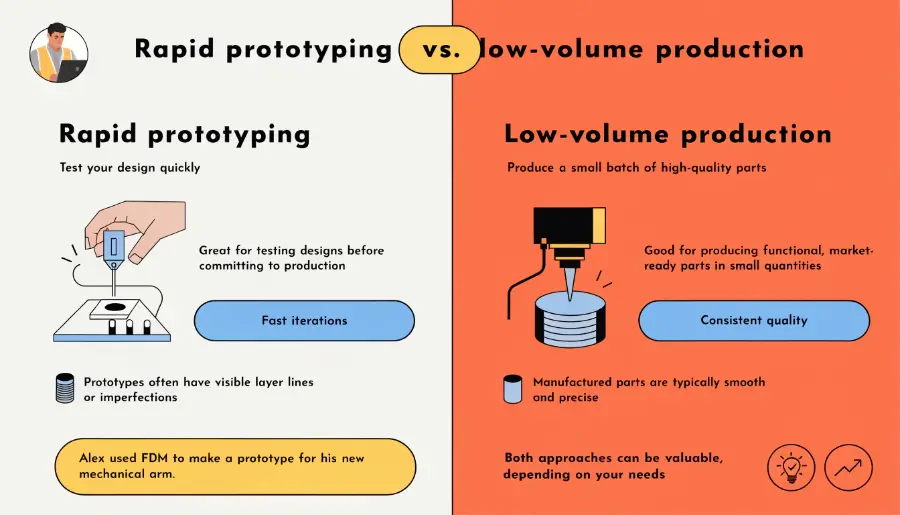
You have a great design. But now you face a hard choice. Do you build a quick prototype or jump to a small batch? Pick wrong, and you waste money, time, and material. Let me help you choose right.
Rapid prototyping is best when you want to test a design fast.1 Low-volume production is best when you need a small batch of near-final parts. Prototyping focuses on speed and quick changes. Low-volume production focuses on consistency, quality, and market-ready output.2 Both serve different goals in your product journey.
I have worked with many engineers like Alex who face this exact question. Many think it is an "either/or" choice. But it is not. Let me break down each path so you can move forward with confidence.
What is rapid prototyping, and when should you use it?
You made a design. But you are not sure it works. Waiting to find out after mass production is risky. That risk can cost you thousands. Rapid prototyping solves this fear early.
Rapid prototyping is a fast way to make one or a few parts to test your design. You use it when you still expect changes. It helps you check form, fit, and function before you commit. It cuts the risk of costly errors early in the process.
Why speed matters more than material
In prototyping, you care about learning fast. You do not care as much about final material strength. A prototype answers simple questions. Does the part fit? Does the button feel right? Does the joint move well?
Common prototyping methods
Here are the tools I use most for prototypes:
| Method | Best For | Turnaround |
|---|---|---|
| 3D Printing | Shape and fit checks | 1–3 days |
| CNC Machining | Functional testing | 3–7 days |
| Sheet metal | Housing mockups | 3–5 days |
I remember one client who skipped prototyping to save time. He ordered 300 parts right away. The parts did not fit his assembly. He lost weeks and a big chunk of budget. A single prototype would have caught the flaw. This is why I always tell teams to test first. A prototype is cheap insurance. It catches problems while they are still easy to fix.
What is low-volume production, and when should you use it?
Your design is ready. But you are not sure about full mass production yet. Big tooling costs scare you. A wrong bet could sink your budget. Low-volume production gives you a safe middle path.
Low-volume production makes a limited batch of end-use parts. You use it when your design is mostly settled. It fits pilot launches, customer trials, niche sales, and bridge manufacturing. It focuses on repeatability, finish quality, and real-world performance.
The bridge between prototype and mass production
Low-volume production usually means tens to a few thousand parts. It sits between a single prototype and huge factory runs. You get real parts you can sell or use. But you avoid the huge upfront cost of full tooling.
Methods that fit low-volume runs
| Method | Best For | Batch Size |
|---|---|---|
| CNC Machining | High-tolerance metal parts | 10–1,000 |
| Urethane Casting | Plastic parts, soft tooling | 10–100 |
| Injection Molding | Repeatable plastic parts | 500–5,000 |
Low-volume production is smart for niche markets. Say you only need 200 parts. Full mass tooling makes no sense. But you still want strong, consistent quality. Low-volume gives you that. It also lets you test the market before you scale. You learn if customers buy. You spot small design tweaks. Then you can ramp up with less risk. For engineers like Alex, this path keeps quality high while keeping costs under control.
How do costs compare between the two options?
Money drives every decision. You want the best value. But hidden costs can surprise you. Per-unit price is only part of the story. Let me show you the full picture.
Prototyping and low-volume runs both have higher per-unit costs than mass production. But their total upfront cost stays much lower. You skip expensive tooling. This makes both options friendly for early-stage products and small budgets.
Understanding per-unit vs total cost
Mass production has a low per-unit price. But it needs big tooling first. That tooling can cost tens of thousands. Prototyping and low-volume runs skip most of this. So your total spend stays small, even if each part costs more.
A simple cost breakdown
| Factor | Prototyping | Low-Volume | Mass Production |
|---|---|---|---|
| Per-unit cost | High | Medium-High | Low |
| Tooling cost | None/Low | Low-Medium | High |
| Total upfront | Lowest | Low | Highest |
| Best batch size | 1–5 | 10–1,000 | 5,000+ |
I always ask clients about their real goal. Are you testing an idea? Then keep spending low with a prototype. Are you selling a small batch? Then low-volume makes sense. Are tooling costs a worry? Prototyping avoids them fully. Low-volume may justify light tooling if the run is big enough. The key is to match your spend to your stage. Do not pay for mass production before you know demand. That is how good products still lose money.
Can you use both together for a smoother path?
Many teams see this as a fight. Prototyping versus low-volume. But that mindset traps you. It makes you pick one and miss the other’s value. The truth is simpler and better.
Yes, you can and should use both. Start with rapid prototyping to learn fast. Then move to low-volume production once your design is stable. This two-step path lowers risk and creates a smooth road from concept to launch.
A real-world sequence
Think about a startup building a handheld device. First, they 3D print prototypes. They test grip, button placement, and internal fit. They fix flaws fast and cheap. Then they shift to low-volume production. They make 100 to 500 units for a pilot run. They gather real customer feedback. Only after that do they scale to mass production.
Why this order works best
| Stage | Goal | Method |
|---|---|---|
| Step 1 | Test and learn | Rapid prototyping |
| Step 2 | Validate market | Low-volume production |
| Step 3 | Scale up | Mass production |
This path catches errors early. It also proves demand before big spending. Each step reduces risk for the next. I have guided many OEMs through this exact flow. It saves money and stress. You never bet big on an untested idea. Instead, you build proof at each stage. By the time you scale, you already know your design works and your market wants it. That confidence is worth far more than the small extra cost of doing both steps.
Conclusion
Choose prototyping to test fast. Choose low-volume for market-ready batches. Best of all, use both in sequence for a safe, smart path to launch.
-
"The Use of Additive Manufacturing Techniques in the Development of …", https://pmc.ncbi.nlm.nih.gov/articles/PMC11054453/. Rapid prototyping is defined in engineering literature as a methodology primarily oriented toward accelerating design iteration cycles, enabling designers to quickly fabricate physical models for form, fit, and function testing before committing to production tooling. Evidence role: definition; source type: research. Supports: The fundamental definition and purpose of rapid prototyping in engineering design processes. Scope note: The source defines the methodology generally but may not directly compare it to low-volume production approaches. ↩
-
"Standard Work for High Mix Low Volume Manufacturing", https://dspace.mit.edu/handle/1721.1/163283. Manufacturing literature characterizes low-volume production as a transitional stage between prototyping and mass production, distinguished by its emphasis on process repeatability, dimensional consistency, and the use of production-grade materials and finishing processes that yield market-ready parts. Evidence role: general_support; source type: research. Supports: The defining characteristics and objectives of low-volume or bridge production in manufacturing. Scope note: Sources may describe low-volume production in various industrial contexts with different specific quality thresholds. ↩