
Medical parts cannot fail. One wrong measurement, one bit of contamination, and a patient could be hurt. That fear is real for every engineer who outsources medical CNC work. The good news? Clear standards and proven practices can keep you safe.
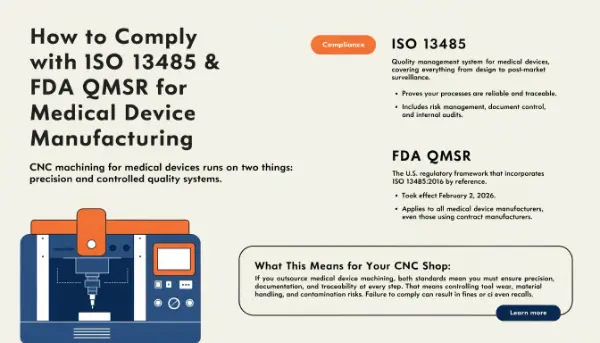
CNC machining for medical devices runs on two things: precision and controlled quality systems. The key standards are ISO 13485 for quality management and the FDA’s Quality Management System Regulation (QMSR), which took effect on February 2, 2026, and now includes ISO 13485:2016 by reference. Following these protects patients and your reputation.
I have spent over a decade helping clients like Alex, a German robotics engineer, source parts that meet tight tolerances. Medical work is even stricter than robotics. Let me walk you through the rules and the smart practices that I use every day with my clients at QuickCNCs.
What is the ISO standard for CNC in medical work?
You hear "ISO" thrown around a lot. But which one actually matters for medical CNC parts? Picking the wrong standard wastes money and time. Worse, it can leave you exposed to compliance failures you never saw coming.
The main ISO standard for medical CNC machining is ISO 13485. It defines quality management system requirements for companies that design, produce, install, and service medical devices. It covers documentation, traceability, validation, and process control. The FDA’s new QMSR now aligns directly with ISO 13485:2016, so this single standard carries global weight.
Why ISO 13485 is the heart of it all
ISO 13485 is not just a sticker on the wall. It forces a shop to prove every step. The shop must keep records for materials, machines, operators, and inspections. For implant work, the rules get even tighter. Suppliers must track components, material lots, and even the work-environment conditions when they affect safety.
Here is a simple breakdown of what ISO 13485 asks for:
| Requirement | What It Means | Why It Matters |
|---|---|---|
| Document control | Revision-controlled work instructions | Stops old drawings from being used |
| Traceability | Records from raw material to finished part | Makes recalls fast and accurate |
| Validation | IQ/OQ/PQ proof for critical steps | Shows the process stays in control |
| Calibration | Logged checks on all measuring tools | Keeps tolerances honest |
When I vet a supplier, ISO 13485 readiness is my first filter. If a shop cannot show audit-ready systems, I do not move forward. The standard gives both buyer and maker a shared language. That trust is what lets a German engineer rely on a Chinese shop with full confidence.
What is 21 CFR 820 for medical devices?
If you sell into the U.S. market, you cannot ignore the FDA. But the rules just changed, and many engineers still cite old numbers. Using outdated terms can flag your supplier as out of touch and put your project at risk.
21 CFR Part 820 is the FDA regulation that sets quality system requirements for medical device makers in the United States. As of February 2, 2026, it became the Quality Management System Regulation (QMSR), which incorporates ISO 13485:2016 by reference. This update aligns U.S. rules with the global standard, making compliance simpler for international suppliers.
What changed and why it helps you
For years, U.S. makers followed 21 CFR Part 820 while the rest of the world followed ISO 13485. That meant two systems, two audits, two headaches. The new QMSR fixes this. Now both point to the same core standard.
This is great news for buyers who source overseas. A shop with strong ISO 13485 systems is already most of the way to FDA compliance. Here is how the two connect:
| Topic | Old 21 CFR 820 | New QMSR (2026) |
|---|---|---|
| Core basis | Standalone U.S. rules | Built on ISO 13485:2016 |
| Global alignment | Separate from ISO | Fully aligned with ISO |
| Documentation | CGMP records | ISO-style records plus FDA additions |
| Effective date | Pre-2026 | February 2, 2026 |
I tell my clients to ask suppliers about both. Even with the merge, the FDA keeps some extra labeling and record rules on top of ISO. A smart shop knows the difference. Material certifications, lot control, and validation records all play into staying compliant. When you pick a supplier, ask them directly how they handle QMSR. Their answer tells you a lot.
What are the health and safety rules for CNC machining?
Medical parts must be clean and safe. But safety is not just about the part. It is about the people, the shop, and the data too. Ignore any of these, and contamination or breaches can sink your whole project.
Health and safety rules for medical CNC machining cover three areas: worker safety, part contamination control, and data protection. Shops must control coolants and residues, use clean handling and packaging, follow strict SOPs, and protect sensitive patient and product data with cybersecurity measures. Cleanroom environments are common for sensitive components.
Three layers of safety in medical machining
Let me break this into the parts that matter most. Each layer protects a different risk.
Part safety and contamination. Medical parts touch the body or go inside it. So finishes must be smooth. A rough surface can trap bacteria. That is why shops use passivation, polishing, or electropolishing. They also control coolants and clean each part fully before packaging.
Material safety. Not every metal is safe in a body. Good shops use biocompatible materials. Here are the common choices:
| Material | Best For | Key Trait |
|---|---|---|
| Titanium | Implants, joints | Light, strong, biocompatible |
| Stainless steel | Surgical tools | Corrosion resistant |
| PEEK | Spinal, dental parts | Sterilizable plastic |
| Ultem | Housings, fixtures | Heat and chemical resistant |
People and data safety. Workers need training and clear SOPs. One untrained operator can cause a deviation that ruins a lot. On top of that, shops now must guard patient and product data. Cybersecurity is no longer optional. I always check that a supplier trains its team often and protects the files I send them. These habits keep the whole process clean and safe.
Will CNC machinists be replaced by AI?
Many engineers and shop workers fear AI. They worry that machines will take over and human skill will not matter. This fear can make people resist new tools that could actually help them. Let me set the record straight.
No, CNC machinists will not be fully replaced by AI. AI improves planning, quality checks, and predictive maintenance, but human judgment stays vital for setup, problem-solving, and complex medical parts. The future is humans and AI working together, not AI alone. Skilled machinists who learn AI tools will be more valuable, not less.
Where AI helps and where humans win
AI is powerful, but it has limits. I have watched it change my work, yet my best machinists are still the backbone of every job. Here is how the roles split:
| Task | AI Strength | Human Strength |
|---|---|---|
| Toolpath planning | Fast optimization | Custom fixes for odd shapes |
| Quality checks (CMM, SPC) | Spotting tiny drifts | Deciding root cause |
| Maintenance | Predicting failures | Hands-on repair |
| Setup | Suggesting parameters | Reading the real material feel |
For medical parts, this matters even more. Tolerances of ±0.01mm leave no room for blind trust in software. A machinist who feels the cut, hears the tool, and reads the chip knows when something is wrong before the screen does.
AI does make us faster. Statistical process control catches problems early. Predictive tools cut downtime. But validation, IQ/OQ/PQ protocols, and final judgment still need a person. My advice to anyone in this field is simple. Learn the AI tools. Use them. They will not take your job. They will make you the engineer everyone wants on their team.
Conclusion
Medical CNC machining needs ISO 13485, FDA QMSR, safe materials, clean handling, and strong traceability. Pick suppliers who prove all of this, and your parts stay safe.