
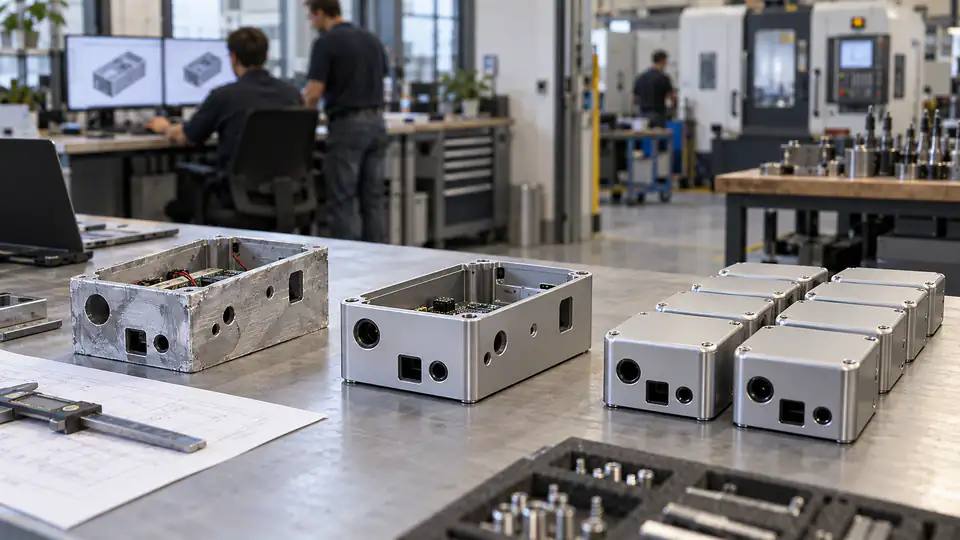
Engineering validation test (EVT), design validation test (DVT), and production validation test (PVT) are common product-development stages, but companies define their gates differently. For CNC parts, the stage determines what the build must learn, how closely it must represent production, which revisions may change, and how much tooling, inspection, documentation, and capacity evidence is justified.
This EVT DVT PVT CNC parts guide explains a practical progression from learning-oriented prototypes to production-representative output. The program’s approved development plan remains controlling; labels should never replace explicit build objectives and acceptance criteria.
Start with the Question the Build Must Answer
Every build should have a decision: architecture works, design meets requirements, manufacturing route is capable, supplier can meet rate, or launch is ready. List tests, samples, configurations, data, and owners needed for that decision.
Without this contract, teams can order expensive “production-like” parts for an early experiment or use quick prototypes as proof of production readiness.
EVT in Practical Terms
EVT commonly explores whether the engineering concept and major subsystems work. Designs may change quickly; multiple variants, debug access, temporary features, and substitute processes may be acceptable. The build prioritizes learning speed and controlled configuration.
CNC machining is valuable because it avoids hard production tooling, supports rapid revisions, and can make functional materials. However, prototype-machined geometry may not represent later casting, molding, forging, stamping, or high-volume machining behavior.
DVT in Practical Terms
DVT commonly verifies the near-final design against product requirements across environment, life, safety, reliability, compliance, and interfaces. Parts should be close to intended material, geometry, finish, and configuration. Changes require stronger control because test validity depends on a stable baseline.
The CNC supplier needs tighter documentation, complete drawings, defined inspection, process certificates, and repeatable lots. Alternate prototype shortcuts should be declared and assessed.
PVT in Practical Terms
PVT commonly validates the intended production system: suppliers, material sources, tooling, fixtures, programs, sub-tiers, inspection, assembly, packaging, data, staffing, and rate. Product may be saleable only if the program authorizes it; do not assume PVT units can ship to customers.
The route should resemble launch production closely enough that yield, cycle, capability, capacity, and control results are meaningful.
Company Definitions Vary
Some programs add alpha, beta, engineering pilot, design verification, manufacturing validation, pilot, pre-production, or ramp stages. Others use EVT/DVT/PVT for complete systems while individual components follow separate maturity.
Write the build scope: revision, quantity, intended process, deviations, tests, documentation, and disposition. The name alone cannot be quoted accurately.
Configuration Control at EVT
EVT changes are frequent, so speed needs disciplined identity. Assign part numbers or build variants, model/drawing revisions, change descriptions, quantities, and affected assemblies. Mark units so test data can be linked to exact geometry.
Redlined instructions may be acceptable under program rules, but freeze them for each build and convert successful changes into controlled design updates.
Configuration Control at DVT
DVT test articles need a stable baseline and complete bill of materials. Every deviation from intended design or process should be reviewed for effect on the test. A material substitution can invalidate thermal, strength, corrosion, or compliance evidence even when dimensions match.
Use formal engineering change and test-article release. Preserve as-built configuration by serial.
Configuration Control at PVT
PVT should use release processes and effective revisions managed through production systems. Program, fixture, inspection, packaging, label, and sub-tier changes need approval and effective lot/serial boundaries.
Temporary workarounds should have owners, expiration, risk, and removal plan. A line that succeeds only through unrecorded expert intervention is not validated.
Design Data for EVT
A 3D model plus a concise critical-dimension drawing may be adequate for an early functional part if material, finish, interfaces, and expected learning are clear. Identify tolerances that protect the experiment and avoid full production documentation where it does not affect the decision.
Still include units, revision, datums, threads, inserts, material condition, quantity, and acceptance. Ambiguity wastes prototype speed.
Design Data for DVT
Provide complete controlled model and drawing, GD&T, material and finish specifications, markings, critical characteristics, assembly interfaces, cosmetic zones, test needs, and traceability. Resolve model/drawing conflicts before the test build.
DVT articles should be inspectable against the same engineering requirements used to judge test validity.
Design Data for PVT
Add production control requirements: approved sources, inspection plan, sampling, FAI or PPAP, packaging, labels, serial/lot, certificates, change notification, retention, capacity, and release. The supplier should use production-intent work instructions and systems.
Document any remaining difference from launch and how it affects validation.
Material at EVT
Early builds may use available stock or an engineering-approved substitute to test fit or concept. Record the substitution and do not generalize results to strength, fatigue, thermal, chemical, or regulatory performance it cannot represent.
When material drives the hypothesis, use the intended grade and condition from the start. Decide deliberately.
Material at DVT
Use production-intent grade, temper, product form, source restrictions, and certification for material-dependent tests. Heat-lot traceability may be needed to explain variation or support compliance.
If a production source is unavailable, approve the deviation and identify which tests must be repeated later.
Material at PVT
Use approved production mills/distributors, ordering specifications, lot controls, incoming inspection, storage, and genealogy. Validate minimum-order, lead-time, yield, and certification flow.
Material shortages during PVT reveal launch risk; do not hide them with unapproved local stock.
CNC Process at EVT
The supplier may choose flexible three-axis, five-axis, turning, additive-plus-machining, or soft-fixture routes to accelerate learning. Manual deburring and inspection can be reasonable. The quote should disclose which choices differ from expected production.
Prioritize rapid DFM feedback: tool access, walls, radii, fits, and unclear requirements.
CNC Process at DVT
Move toward stable setup sequence, controlled fixtures, released programs, production-intent special processes, and repeatable inspection. The process should not introduce variation that obscures design test results.
Track yield and issues, but do not claim production capability from a small development lot.
CNC Process at PVT
Use intended machines or qualified equipment groups, fixtures, tools, program controls, probe routines, operators, sub-tiers, inspection, cleaning, and packaging. Run enough quantity and duration to exercise changeover, tool life, maintenance, and data systems.
Manual heroics should be logged and converted into standard work or eliminated.
Tooling Investment
EVT favors modular fixtures, soft jaws, sacrificial stock, and rapid tooling because revisions are likely. DVT may justify dedicated fixtures and gages for repeatable test articles. PVT needs production-ready tooling, spares, wear controls, qualification, and ownership.
Stage tooling gates to avoid expensive obsolescence. Approve the design before irreversible spend while preserving schedule for long-lead assets.
Tolerance Strategy
At EVT, tighten only interfaces and measurements required for the experiment. At DVT, the released design should carry functional tolerances supporting verification. At PVT, demonstrate that the production process and measurement system can sustain them.
Do not relax a DVT or PVT requirement informally to keep the schedule. Use controlled deviation and repeat affected validation if necessary.
Inspection at EVT
Inspect critical fit, datum, safety, and test-related features. A focused report can be more useful than a full layout. Preserve actual values for debugging and compare with assembly results.
Define whether noncritical features receive visual or sample checks. Prototype status is not permission to ship unknown geometry into a costly test.
Inspection at DVT
Use a complete dimensional or characteristic-accountability plan appropriate to design verification, with material and process certificates. Qualify methods for GD&T, texture, coating, or functional tests. Link data to serialized test units.
Measurement uncertainty and fixture/restraint should match the product requirement.
Inspection at PVT
Use production control plans, sampling, gages, CMM programs, MSA, capability studies, and final release. Validate electronic data flow, labels, records, and reaction plans. Compare first/last pieces and across stations or shifts.
Ensure inspection capacity supports planned rate rather than creating a hidden queue.
FAI and PPAP
EVT may use internal first-piece or prototype reports. DVT often needs formal first-article or complete layout depending on industry and customer. PVT commonly supports PPAP, FAI update, process validation, or customer production approval.
State the required framework and edition. FAI and PPAP answer different questions and should not be treated as interchangeable acronyms.
Special Processes
Early units may use a quick local finish for appearance or handling, but test relevance must be assessed. DVT needs qualified production-intent heat treatment, coating, NDT, cleaning, or sterilization for performance evidence. PVT validates approved sources, purchase-order flow-down, capacity, certificates, and contingency.
Different anodizers or heat treaters can change results even under the same nominal specification.
Cosmetic Standards
EVT appearance may be secondary unless the concept includes optics, sealing, or user touch. DVT should establish visual zones, texture, color, gloss, edge, and limit samples. PVT validates process distribution, racking, handling, packaging, and inspection under production lighting.
Do not postpone cosmetic definition until parts return from finishing.
Assembly Feedback
Record fit, force, alignment, gap, rework, shims, fastening, damage, and build time by part serial. Feed data back to tolerance analysis and DFM. A part can pass inspection and still reveal an assembly design problem.
At PVT, standard work and takt/cycle should replace undocumented technician adjustment.
Test Article Traceability
EVT needs enough identity to link variant and results. DVT should preserve serial-level design, material, process, deviations, and test history. PVT adds production genealogy, lot/process batches, inspection, assembly, packaging, and disposition.
Never pool test results across unrecorded configurations.
Failure Analysis
When a test fails, quarantine the article, preserve state, record configuration and history, and distinguish design, manufacturing, assembly, test-method, and handling causes. Do not rework before evidence is captured.
Update corrective action and decide which tests and units need repetition. A successful retest after undocumented adjustment is not closure.
Supplier DFM Feedback by Stage
EVT feedback should identify large design levers and ambiguity quickly. DVT feedback should quantify risk to tolerance, finish, reliability, and repeatability. PVT feedback should focus on yield, rate, controls, maintenance, supply, and change robustness.
Keep accepted DFM decisions in the design record so every supplier builds the same intent.
Quantities
Build quantity follows test matrix, destructive samples, setup learning, yield, spares, reliability, compliance, assembly, and process validation. Ordering a round number without mapping use creates shortages or excess.
Include material and process samples, first articles, masters, engineering retain, and expected loss. State disposition of unused units.
Schedule and Change Freeze
Set model/drawing freeze, supplier review, material order, tooling release, machining, special process, inspection, assembly, test, and decision dates. Long-lead production tooling may need conditional release with documented risk.
Late design changes should show affected parts, test, cost, scrap, and schedule rather than being silently absorbed.
Cost Structure
EVT unit cost is high because programming, setup, expedite, and engineering are spread over few pieces. DVT adds documentation, certified material, qualified processing, and complete inspection. PVT may add production tooling and approval while beginning to reveal recurring cost.
Separate nonrecurring and recurring charges. Do not use prototype unit price as production cost or production target price to deny valid prototype work.
Rate and Capacity
EVT schedule capacity is often sufficient. DVT tests repeatability and supply timing. PVT must demonstrate intended rate including machine cycle, setup, yield, inspection, finishing, packaging, staffing, and maintenance.
Record bottlenecks and recovery. A short run can mask tool-life or queue constraints.
Packaging Evolution
EVT needs safe shipment and part identity. DVT tests protective materials, cleanliness, corrosion, cosmetic protection, and unpacking. PVT validates production pack quantity, labels, barcode, pallet, transit route, returnable containers, and operator work.
Packaging is part of product realization; damaged conforming parts are not successful output.
Supplier Selection by Stage
A fast prototype shop may excel at EVT, while a production supplier offers process control and capacity. One supplier can cover all stages if it manages both flexible and controlled routes. Switching at DVT/PVT adds transfer and correlation work.
Choose intentionally and preserve buyer-owned design knowledge between sources.
Exit Criteria
Each stage ends when defined questions are answered, required tests pass, risks are accepted, open issues have owners, configuration is recorded, and the next plan is approved. Calendar date or consumed quantity alone is not an exit.
Do not start PVT with unresolved design instability that makes production evidence obsolete.
Build a Unit-to-Test Matrix
Map every manufactured serial or lot to its planned assembly and test. Record which units undergo dimensional layout, environmental cycling, life testing, destructive section, regulatory evaluation, firmware variant, or customer demonstration. Include spare and failure-analysis units. This prevents one attractive prototype from being reused across incompatible tests without history.
The matrix should identify configuration, material heat or batch, process route, deviations, inspection status, assembly mates, test procedure revision, and final disposition. When a unit is reworked or updated, preserve the before/after condition and decide which prior results remain valid.
Review sample allocation before the purchase order. If a destructive test consumes the only fully inspected article, later correlation may be impossible. Provide extra units where failure analysis or repeat is reasonably likely, but do not order unexplained surplus.
Manage Design Changes Between Stages
At EVT, many changes can be expected; at DVT and PVT, each change has broader validation consequences. Use an impact assessment covering geometry, material, interfaces, firmware/hardware compatibility, tooling, process, inspection, test, compliance, packaging, service, and already-built inventory.
Classify affected evidence: still valid, needs analysis, needs partial retest, or needs full repeat. Record the effective serial or build. Do not call a DVT failure “fixed” based only on the next CAD screenshot; verify the implemented change in controlled hardware.
Changes discovered during PVT also test the change-control system. Confirm new programs, fixtures, instructions, labels, sub-tier orders, and data reach the line before the revised lot starts.
Control Engineering Samples and Saleable Product
Mark and segregate engineering-only, regulatory, customer-evaluation, and potentially saleable units. Define who may authorize shipment or use. Prototype parts may have deviations, incomplete traceability, nonproduction processes, or unvalidated life and must not enter commercial inventory accidentally.
PVT product disposition should be explicit: scrap, engineering use, retain, rework after approval, or release under program authorization. If sale is possible, ensure every normal production requirement—regulatory, quality, labeling, warranty, cybersecurity, packaging, and documentation—was satisfied, not merely dimensional conformance.
Reconcile all serials at build closure, including destructive samples and missing parts. Remove obsolete labels and protect customer data.
Supplier Readiness Review Before PVT
Conduct a structured review of released design, material sources, tooling, programs, process flow, PFMEA/control plan where applicable, work instructions, special processes, inspection, MSA, staffing, maintenance, capacity, packaging, traceability, nonconformance, and continuity. Close critical gaps before the planned run.
Confirm long-lead material and sub-tier capacity for both PVT and launch. A supplier may complete a small trial using existing stock but fail the next release because mill minimums or finishing queues were not tested.
Define observers, data capture, daily review, stop criteria, and authority during the run. PVT should generate evidence and corrective actions, not only parts.
After the run, reconcile planned versus actual cycle, yield, downtime, inspections, rework, material use, staffing, and sub-tier turnaround. Convert every recurring manual adjustment into controlled standard work, tooling improvement, or an open launch risk with owner and deadline. Repeat the affected portion when evidence does not support the intended production rate or conformance.
Approve launch only after the cross-functional team accepts those residual risks and verifies the production baseline is fully released.
Archive the decision with the validated build records.
Stage Comparison
| Area | EVT | DVT | PVT |
|---|---|---|---|
| Primary question | Does the concept work? | Does released design meet requirements? | Can production repeatedly make and deliver it? |
| Configuration | Controlled variants | Near-final/released baseline | Production release and effective changes |
| Process | Flexible prototype route | Increasingly production-intent | Intended production system |
| Material/finish | Fit for learning; deviations explicit | Production-intent for valid tests | Approved production sources |
| Inspection | Critical learning features | Full verification as required | Production control, MSA, capability |
| Tooling | Soft/modular | Repeatable dedicated where justified | Qualified, durable, spare-supported |
| Data | Variant and test link | Serial as-built and design evidence | Full genealogy and release records |
| Output disposition | Engineering use | Validation-controlled | Program-authorized only |
Common Mistakes
- Using stage names without written objectives.
- Testing production claims on prototype material or process.
- Mixing revisions under one build label.
- Ordering tooling before design stability without risk approval.
- Treating one DVT conforming part as production capability.
- Entering PVT with temporary fixtures and manual corrections.
- Failing to link test failures to exact serial/configuration.
- Omitting special-process and inspection capacity from rate.
- Shipping PVT parts without explicit authorization.
- Carrying accepted prototype deviations into production silently.
RFQ Package
State stage and its internal definition, build objectives, part/revision, quantities and use, material and substitutes, process-intent requirements, tolerances, special processes, inspection and reports, serial/lot, tooling, test schedule, packaging, approval gates, and expected next-stage volume.
Ask the supplier to identify every production difference and the plan/cost to close it.
Supplier Questions
- Which build decision does each part support?
- What differs from production material, route, tooling, inspection, or finish?
- How are revisions and serials controlled during change?
- Which features and documents are required at this stage?
- What long-lead tooling or source approval should begin now?
- How will design and process failures be separated?
- What quantity supports tests, yield, spares, and destructive work?
- What evidence moves the program to the next stage?
- Which PVT controls prove rate and repeatability?
- What temporary condition must be closed before launch?
Stage-Gate Checklist
- Define build questions and measurable exit criteria.
- Freeze and identify every configuration and approved deviation.
- Match material and process intent to test validity.
- Scale tooling from flexible EVT to qualified PVT.
- Increase inspection and documentation with design maturity.
- Use production-intent special processes by relevant validation.
- Link each test result to serial, material, process, and revision.
- Capture assembly and failure feedback into design/process control.
- Separate prototype cost from recurring production cost.
- Demonstrate PVT rate including quality and sub-tier bottlenecks.
- Control packaging, labels, genealogy, and output disposition.
- Close temporary conditions before production approval.
The Practical Stage Decision
EVT should maximize reliable learning, DVT should validate the controlled design, and PVT should validate the production system. CNC requirements become progressively more representative, documented, repeatable, and capacity-focused. The exact names matter less than explicit evidence and exit rules.
At each gate, maintain a short build matrix listing revision, material route, tooling state, inspection depth, approved deviations, sample identity, test purpose, and disposition. This prevents an EVT shortcut from silently becoming a PVT assumption and makes it clear which results support design learning versus production approval.
To scope a stage-appropriate CNC build, send the current design, build objective, test matrix, material/process intent, quantity, inspection evidence, schedule, and next-stage volume through Request a Quote.