
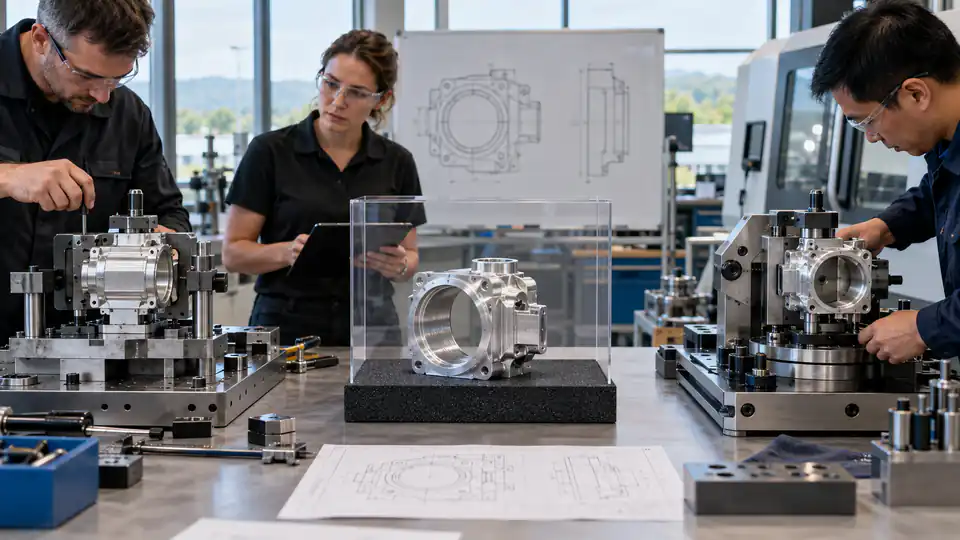
Dual sourcing can reduce dependency on one CNC supplier, but adding a second purchase order does not create equivalent product. Material source, stock form, CNC route, datums, fixtures, programs, deburring, special processes, inspection algorithms, packaging, and records can all differ. Transfer succeeds when the buyer defines an approved technical baseline and qualifies each route against it.
This CNC supplier transfer dual sourcing guide explains business cases, data packages, tooling, first articles, process correlation, capacity allocation, change control, and cutover. The goal is interchangeability and controlled resilience, not forced duplication of every proprietary manufacturing detail.
Define Why a Second Source Is Needed
Common objectives are continuity, regional supply, capacity, cost competition, technology access, customer mandate, tariff exposure, or planned exit from a supplier. Rank them. A continuity source held at zero volume needs a different plan from two suppliers sharing weekly demand.
Set success measures: approved parts, rate, quality, lead time, recovery time, cost, and data readiness.
Choose Dual Source, Backup, or Full Transfer
In active dual sourcing, both suppliers regularly produce and retain competence. A warm backup receives occasional orders or exercises. A cold backup has data and perhaps tooling but needs qualification or setup before production. A full transfer moves the primary route and may close the old source.
Use accurate labels. Calling an untested cold option “dual sourced” overstates resilience.
Establish the Product Baseline
Freeze part number, revision, model, drawing, specifications, approved deviations, customer requirements, material, finish, packaging, traceability, inspection, and acceptance. Resolve contradictions before sending the package.
The same controlled baseline should govern both suppliers. Supplier-specific process drawings remain separate unless the buyer owns and approves them.
Build the Transfer Data Package
Include native or neutral 3D model, controlled 2D drawing, referenced standards, CAD/MBD annotations, material and process specs, critical-characteristic rationale, approved alternates, quantities, forecast, lot/serial rules, inspection records, packaging, and change requirements.
Add lessons from production: clarified notes, failure modes, inspection interpretations, cosmetic standards, and known distortion risks. Do not transfer obsolete workarounds as design requirements.
Respect Intellectual Property
The incumbent may own CNC programs, fixture designs, toolpaths, process know-how, and inspection code even when the buyer owns the part design. Contract terms determine transfer rights. Do not copy proprietary data without authorization.
The new supplier can develop an independent route from buyer-owned requirements. If customer-paid tooling or data must transfer, inventory and document them explicitly.
Tooling Ownership and Condition
List fixtures, jaws, gages, masters, special cutters, racks, masks, packaging, and spare components. Record owner, asset ID, revision, location, condition, qualification, maintenance, and compatible machines.
Before physical transfer, inspect and photograph tools, back up approved files, define custody, transport, insurance, installation, and requalification. A fixture alone may not run without a supplier’s base pallet, hydraulic unit, posts, or setting method.
Decide Transfer or Duplicate Tooling
Moving the only fixture can stop incumbent production before the new source is approved. Duplicating tooling preserves overlap but adds cost and correlation effort. Modular inserts or common interfaces can support both.
Base the decision on demand coverage, lead time, asset condition, design stability, and outage consequence. Maintain a rollback route until cutover is accepted.
Material Equivalence
Confirm alloy, grade, specification, product form, temper, source, country, heat-lot traceability, testing, and stock size. Different mills or forms can meet nominal grade yet machine, distort, anodize, or perform differently.
Qualify alternate material sources where design or customer rules require. Preserve grain direction and certification. Do not let the second source use “equivalent” commercial stock without approval.
Process Route Equivalence
Suppliers need not use identical machines or toolpaths if both meet product and approved process requirements. Compare setup count, datum strategy, stock, heat treatment, finishing, deburring, cleaning, and final state. Identify characteristics sensitive to route differences.
When process is design-controlled or validated, exact changes may require approval. Otherwise specify outputs and critical controls without dictating unnecessary method.
CNC Program Development
The new supplier should develop or validly transfer programs, posts, simulation, setup sheets, tools, offsets, and prove-out. Record software, machine, program revision, and approval. Machine-side edits need capture and control.
Do not assume one supplier’s G-code is safe on another control or configuration. Repost or independently verify as required.
Fixture and Datum Strategy
Review how each supplier establishes functional datums, supports flexible parts, controls clamp force, preserves access, and transfers between operations. Different fixtures can produce different free-state or profile results.
Approve concepts for critical geometry before costly build. Qualification should include locator values, repeatability, station correlation, and distortion after release.
Special-Process Sources
Anodizing, heat treatment, plating, NDT, grinding, cleaning, and laboratories may be customer-approved by site. The second machine shop’s usual processors may not be allowed. Map and approve every sub-tier.
Using the same processor can improve appearance correlation but creates a shared single point. Two independent approved processors improve continuity but need comparison.
Measurement Method Alignment
Before comparing parts, align drawing interpretation, datum simulation, actual-size algorithms, filters, point patterns, temperature, restraint, and decision rules. Two CMMs can disagree while both are calibrated.
Exchange method descriptions and measure common artifacts or sample parts. Preserve raw data and uncertainty for critical features.
Visual and Cosmetic Correlation
Machining marks, edge break, polishing, blasting, anodize color, texture, and handling can differ. Use approved visual zones, limit samples, lighting, distance, orientation, and packaging. A numerical roughness value does not define full appearance.
Produce comparison panels or parts from relevant material heats and processors. Control master sample aging and revision.
First Article and Qualification
The new source normally needs a first article or customer-defined qualification using intended material, machine, fixtures, programs, sub-tiers, inspection, and packaging. A conforming sample from a temporary prototype route may not approve production.
Define full or delta scope, forms, samples, customer witness, and approval hold points before cutting. Link every result to the new route.
Capability and Run at Rate
For critical characteristics and volume, evaluate measurement system, process stability, capability, cycle, yield, setup, staffing, maintenance, and sub-tier capacity. A first article proves one configuration, not sustained output.
Use representative production conditions and the required rate. Include inspection and packaging bottlenecks.
Pilot Lot
Run a controlled pilot quantity large enough to exercise tools, loading, process drift, sub-tiers, inspection, packaging, and data. Identify pilot serials/lots and increase review. Track defects, cycle, tool life, and supplier questions.
Do not mix pilot product into normal shipments until the approval status and segregation permit it.
Side-by-Side Comparison
Compare incumbent and new-source parts across dimensions, GD&T, material, finish, appearance, function, assembly, packaging, and documentation. Focus on distributions and interfaces, not just pass/fail.
Differences within specification can still affect stack-up if supplier populations sit at opposite limits. Engineering should assess combined sourcing distributions.
Assembly Validation
Where function depends on mating parts, test cross combinations: supplier A part with supplier A and B mates, and supplier B part with both. Include worst credible sizes and finishes. Dual sourcing should preserve interchangeability unless matched sets are explicitly controlled.
Record serials, actual dimensions, procedure, and results. One hand-fit sample is weak evidence.
Traceability During Overlap
Mark or record supplier/site, production lot, material heat, process batches, and serials as required. Packaging and ERP should prevent commingling before qualification and support performance comparison afterward.
Do not alter the customer part mark unless authorized. Internal genealogy can retain source without visible supplier codes.
Inventory and Cutover
Map finished goods, work in process, raw material, consigned stock, tooling, open POs, sub-tier lots, and deviations at the incumbent. Decide consume, transfer, rework, return, or scrap. Preserve revision and source identity.
Set last-order, first-approved shipment, overlap, rollback, and final cutover dates. Avoid a gap between incumbent stop and new-source approval.
Capacity Allocation
Active dual sourcing needs a volume split that keeps both processes exercised. A nominal 80/20 split may not keep the secondary source ready if releases are infrequent or below setup minimum. Define baseline share, surge rights, forecast, and rebalancing rules.
Avoid abrupt shifts that overload inspection or processors. Review actual demonstrated capacity.
Pricing and Nonrecurring Cost
Separate qualification, programming, tooling, fixtures, gages, first article, process approval, material minimum, and engineering from recurring unit price. Duplicate sources can lose volume discounts and add management cost while reducing disruption risk.
Compare total landed and lifecycle cost, including inventory, freight, duty, quality, and transfer maintenance.
Supplier Performance Comparison
Use common definitions for quality, on-time delivery, lead time, responsiveness, certificate accuracy, yield, and change compliance. Normalize volume and complexity. Do not create destructive competition that encourages hidden assumptions or unauthorized process shortcuts.
Share factual feedback and require corrective action for systemic gaps.
Change Control After Approval
Each supplier must notify relevant changes in material, source, machine, fixture, program, site, sub-tier, process, inspection, and ownership. Assess independently and update effective lot/serial.
A change approved at supplier A does not automatically approve it at supplier B. Keep route-specific baselines.
Incumbent Exit Risks
A supplier losing business may reduce support, delay tooling release, dispute ownership, or release skilled staff. Manage professionally through contract, inventory, payment, data, and communication. Avoid announcing termination before continuity is secured when risk allows.
Retrieve customer property and records with controlled chain of custody. Close open nonconformances and certificates.
Knowledge Transfer
Buyer-owned lessons, design clarifications, failure modes, approved deviations, inspection interpretations, packaging issues, and service feedback should reach the new source. Separate them from incumbent proprietary method.
Use structured workshops and written decisions. Oral tribal knowledge disappears after staff changes.
Tolerance Distribution Across Sources
Two suppliers can pass the same limits but center their processes differently. If one shaft population sits near its upper limit and the other supplier’s mating bore also sits near its lower limit, switching combinations can reduce clearance even though both drawings pass. Compare means, spread, shape, and time sequence for critical interfaces.
Use the product tolerance stack and cross-source assembly matrix to decide whether separate centering targets or tighter process controls are needed. Do not create hidden supplier-specific drawing limits unless design authority controls them. The preferred solution is one robust specification and manufacturing targets that preserve margin.
Continue monitoring after approval; tools, material lots, and seasons can move distributions. Source identity in genealogy supports analysis without making source-dependent parts noninterchangeable.
Inspection Correlation Study
Select representative parts spanning the expected feature range and have both suppliers measure them under documented methods. For critical characteristics, include the buyer or reference laboratory where appropriate. Compare datums, algorithms, probes, point patterns, filters, temperature, and reported rounding before attributing differences to product.
Quantify repeatability within each method and bias between methods. Resolve technical causes, then approve programs or correlation factors only when the governing requirement permits. Do not average conflicting results or set informal guard bands without controlled decision rules.
Retain sample identities, raw data, software revisions, fixture IDs, and conclusions. Repeat correlation after meaningful program, equipment, or method change.
Golden Samples and Boundary Samples
Approved samples can communicate appearance, edge condition, marking, or assembly feel. Use conforming references plus limit or boundary examples when the characteristic is visual or attribute-based. Identify creator, part/revision, approval, protected storage, validity, and replacement rules.
Samples do not supersede drawings and specifications. They can age, scratch, corrode, fade, or differ by material heat. Inspect them periodically and prevent production use when condition changes.
If each supplier keeps a duplicate set, correlate the sets under the same lighting and method. Digital photographs are useful records but may not reproduce color or texture accurately.
Packaging and Logistics Equivalence
Different shipping distances, climates, carriers, customs, and pack densities can change corrosion, scratching, contamination, and lead time. Qualify each source’s tray, separators, protective material, desiccant, labels, pack quantity, pallet, and handling. Verify that packaging does not distort thin parts.
Transit trials should include real route and duration where risk is high. Inspect after unpacking at the customer, not only at supplier packout. Define returnable-container ownership, cleaning, availability, and reverse logistics.
Compare landed lead time and inventory, not ex-works machining days. A distant source may need regional safety stock or a different release cadence.
Regulatory and Trade Differences
A new country or source can change origin declarations, tariffs, sanctions, export-control handling, forced-labor due diligence, environmental declarations, and customer approvals. These issues do not prove technical conformance but can block lawful use or delivery.
Sourcing and legal teams should confirm requirements before technical data or purchase orders are sent. Protect controlled drawings and encryption where required. Establish who provides origin, commodity classification, and material declarations.
Do not change country-of-origin marking or certificates based on a commercial preference. Preserve evidence supporting the declared manufacturing route.
Ramp Curve and Exit Criteria
Move volume in defined steps: qualification samples, pilot, limited production, increasing share, and steady state. For each stage set quantity, quality threshold, delivery performance, capability or yield, open-action limit, approval, and rollback trigger. Consider the incumbent’s minimum sustainable volume.
Avoid shifting 100 percent immediately after one passing first article. The new source needs enough repetitions to expose tool life, fixture wear, shift coverage, sub-tier variation, packaging, and data flow. The incumbent needs clear forecast to maintain resources through overlap.
Close ramp only after records and customer approvals are complete, not when parts leave the new supplier’s dock.
Rollback Planning
Preserve a viable previous route until the new source proves output and rate. Define what would trigger rollback, who decides, available incumbent material and capacity, tooling location, program/configuration, approval status, and customer communication. A rollback is itself a controlled source change.
If incumbent tooling has moved, plan how quickly it can return or duplicate it before cutover. Keep last-approved baselines and critical spares. Avoid consuming all safety stock during ramp.
Exercise the decision in a tabletop before irreversible exit. Commercial disputes should not leave product without a technically approved path.
Cost Comparison Without False Equivalence
Normalize material specification, quantities, release size, tooling ownership, nonrecurring engineering, inspection, documentation, special processes, freight, duty, inventory, payment terms, scrap, warranty, and currency. One supplier may include first article and certificates while another excludes them.
Model total cost at base and surge volume, including the recurring cost of maintaining two approved sources. Assign value to avoided downtime transparently rather than assuming the cheapest unit price gives resilience.
Review price after pilot data reveals actual cycle and yield. Do not force an unsupported incumbent price onto a new route whose risk or geography differs.
Ongoing Readiness Tests
A low-volume backup can lose programmers, fixture knowledge, sub-tier approval, calibration, material availability, or software compatibility. Schedule periodic orders or exercises and define the maximum dormant interval. Verify programs, tooling, contacts, and first-off evidence.
Track time from order to approved shipment during the exercise. Record gaps and corrective actions. If maintaining readiness becomes uneconomic, classify the source as cold and adjust inventory or recovery expectations honestly.
Customer notification and partial FAI rules may apply after a production lapse; include them in the readiness calendar.
At each exercise, reconcile material shelf life, customer-owned inventory, gage calibration, fixture condition, special-tool availability, and current specification revisions. A source that can start machining but cannot obtain an approved finish or release inspection within the recovery objective is not ready. Report status with objective evidence to the sourcing owner before the source is counted in continuity metrics.
Remove expired claims promptly and update procurement systems so emergency buyers do not place orders against inactive approval.
Communicate the corrected source status to program and quality teams.
Transfer Governance
Assign buyer engineering, quality, sourcing, operations, and program owners plus supplier counterparts. Maintain risks, actions, decisions, due dates, configuration, approvals, and escalation. Define who can approve technical and commercial changes.
Stage gates prevent schedule pressure from skipping qualification.
Transfer Gate Table
| Gate | Required evidence | Exit decision |
|---|---|---|
| Baseline ready | Controlled design and requirements | Supplier may plan route |
| Process review | Material, machine, fixture, sub-tier, inspection | Tooling/program may proceed |
| First article | Complete results and certificates | Pilot authorized |
| Pilot/run at rate | Capability, rate, yield, packaging | Limited production authorized |
| Cross-validation | Assembly and supplier correlation | Interchangeability accepted |
| Cutover | Inventory, approvals, capacity, rollback | Volume may transfer |
| Sustainment | Performance and change control | Dual-source status maintained |
Common Failure Modes
- Second source receives an incomplete or obsolete design package.
- Buyer assumes ownership of incumbent programs or fixtures without contract.
- New source uses an unapproved material or finisher.
- CMM methods differ and create false product disagreement.
- Both suppliers target opposite tolerance limits.
- Prototype tooling is treated as production-ready.
- Incumbent is stopped before new capacity is approved.
- Secondary source receives too little work to remain ready.
- Changes are approved globally instead of by route.
- Traceability cannot distinguish source after commingling.
Buyer Questions
- What resilience or commercial objective defines the source model?
- Which product and process data does the buyer own and may transfer?
- Should tooling move, duplicate, or be redesigned?
- How will material and sub-tier sources be approved?
- How will measurement and cosmetic criteria be correlated?
- What first article, capability, rate, and assembly evidence is required?
- How are pilot and overlap lots identified?
- What volume keeps the secondary source ready?
- Which changes require route-specific approval?
- What rollback exists if pilot or cutover fails?
Transfer Checklist
- Define dual, warm backup, cold backup, or full-transfer state accurately.
- Freeze and distribute the complete controlled product baseline.
- Resolve IP, tooling ownership, data, and transfer rights.
- Approve material, processes, sub-tiers, and inspection for the new route.
- Develop and validate programs, fixtures, gages, and packaging.
- Align measurement methods and visual standards.
- Complete first article, pilot, capability, rate, and cross-assembly evidence.
- Preserve supplier/lot genealogy during overlap.
- Plan inventory, open orders, tooling, cutover, and rollback.
- Allocate enough recurring volume to sustain readiness.
- Maintain route-specific change control and performance review.
- Do not retire the incumbent until acceptance and recovery capacity are real.
The Practical Sourcing Decision
Dual sourcing works when both routes make interchangeable product from the same controlled design while maintaining independent, approved process capability. It fails when a buyer counts unqualified capacity or copies undocumented incumbent methods.
Build the technical baseline, qualify the complete route, validate cross-assembly, and keep both sources exercised. To plan a CNC supplier transfer, provide the controlled design package, forecast and recovery objective, current tooling and data ownership, critical features, approved-source constraints, and qualification requirements through Request a Quote.