
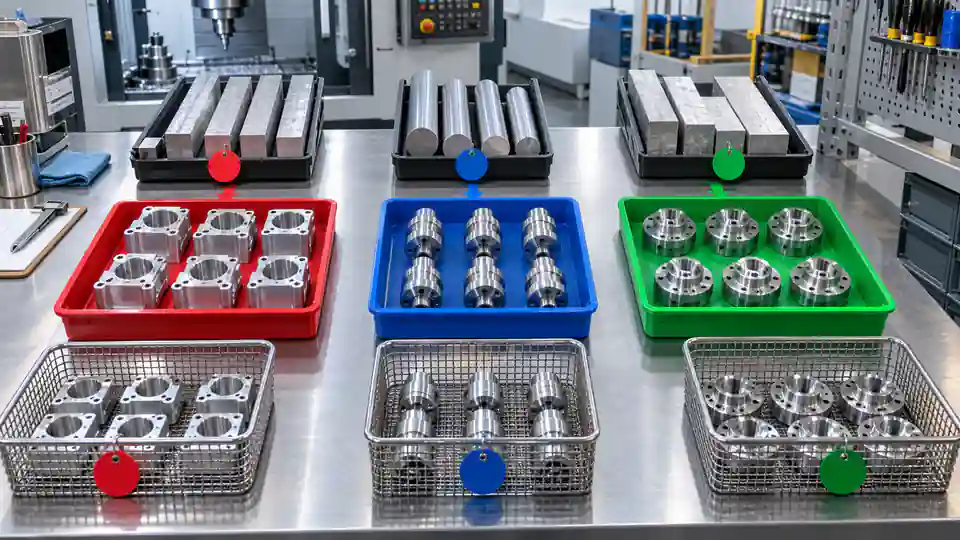
Traceability lets a buyer or supplier answer a practical question: which exact material, process conditions, sub-tier lots, inspection records, and shipments are connected to this CNC part? The answer can exist at batch, lot, work-order, or individual serial level. More detail is not automatically better; the scheme should support containment, compliance, service, and risk without creating identity errors of its own.
This CNC part lot traceability guide explains how identifiers move from raw stock through cutting, machining, special processing, inspection, packaging, and delivery. It separates material heat, manufacturing lot, process batch, and serial number so they are not treated as interchangeable labels.
Define the Traceability Objective
Start with the decisions the record must support: certificate verification, recall, counterfeit prevention, root-cause investigation, service history, regulatory reporting, shelf life, or customer configuration. The objective determines granularity and retention.
Do not request serial-level genealogy if lot-level containment is sufficient. Do not rely on one broad lot when failure consequence or process variation requires individual identity.
Material Heat or Batch
Metal heat or melt identity connects stock to the mill’s production and test evidence. Polymers, ceramics, adhesives, coatings, and composites may use resin batch, compound lot, cure batch, or manufacturer lot. This identifier describes source material, not the machining process.
Preserve the original identifier exactly and link distributor transactions or cut-piece IDs. One manufacturing lot can contain multiple material heats only if the requirement permits and the genealogy distinguishes them.
Manufacturing Lot
A manufacturing lot is a defined group produced under common conditions or grouped for control. Boundaries can use work order, setup, date, shift, material heat, machine, program, fixture, or customer release. The definition must be written and consistently applied.
If a tool change, program edit, machine transfer, heat change, or long interruption can alter risk, decide whether it starts a new lot or is recorded as an event within the lot.
Process Batch
Outside processors often group parts into furnace loads, anodize tanks, plating racks, passivation batches, paint lots, cleaning loads, or NDT batches. A process batch may combine several machining lots or split one lot across multiple loads.
Record both relationships. A certificate saying “lot 123” is ambiguous unless the system shows which part serials or quantities entered that processor batch.
Serial Number
A serial number uniquely identifies one item within the controlled namespace. It supports unit-level measurements, assembly pairing, rework, service, and failure history. Uniqueness requires allocation rules, verification, and prevention of duplicate or reused numbers.
Define format, check digits or barcode, issuing system, marking method, location, revision implications, and treatment of scrapped numbers. A number visible on a part is not enough if database records can be reassigned.
Part Number and Revision
Traceability begins with configuration. Every lot or serial record should identify part number, design revision, model/drawing data set, and effective specifications. Mixing revisions under one unlabeled lot creates a larger risk than missing a machine name.
When a revision changes mid-order, close or split the population and label packaging. Record approved deviations separately; they do not change the drawing revision.
Purchase Order and Customer Lot
Customer order, line, release, and requested lot can differ from the supplier’s work order. Map them rather than replacing one identifier with the other. One supplier batch may serve two customer releases only if requirements, approvals, and segregation permit.
Shipping records should allow the customer to identify which supplier lot or serials were delivered under each order.
Receiving Material
At receiving, compare purchase order, packing list, physical markings, certificates, quantity, and condition. Assign an internal stock ID without losing the original heat or batch. Quarantine discrepancies before material enters common storage.
Electronic records should retain supplier, manufacturer, specification, product form, size, received date, certificate, and location. Photographing the tag can support but not replace controlled data entry.
Cutting Blanks
Sawing plate or bar creates child pieces. The cutting transaction should record parent stock ID, heat, child blank ID, quantity, date, and work order. Transfer physical marking before the original stencil is removed.
Remnants return to controlled inventory with renewed identification. Similar unlabeled offcuts are a common source of alloy and heat mix-up.
Traveler Control
The traveler follows the lot or serial through operations. It records route revision, quantities in/out, operation completion, machine or work center, program/fixture where required, inspection, nonconformance, and operator or system authorization.
Prevent skipped operations and backdated entries. Electronic travelers need access control and an audit trail; paper travelers need legibility, page control, and protection from loss.
CNC Program and Setup Identity
For risk-relevant work, record CNC program name and revision, postprocessor or macro baseline, machine or approved equipment group, fixture, jaw/nest revision, and setup sheet. Tool offsets change routinely and need not all become genealogy unless the control plan requires them.
The trace record should support change impact without collecting unusable detail. Define which process variables are retained and why.
Operator and Inspection Identity
Record who performed or approved an operation when competence, accountability, or regulation requires it. Use controlled user identity rather than shared logins or illegible initials. Training records remain separate but linkable.
Inspection results should identify instrument or program, date/time, method revision, and part/lot. Preserve original values where the customer requires variable data.
Tooling and Consumables
Special cutters, electrodes, fixtures, gages, adhesives, coolants, or cleaning agents can affect product. Track their lot or tool ID where failure risk justifies it. Ordinary commodity tools may be controlled by specification and tool-life system without per-part genealogy.
Avoid a data-collection burden that operators cannot maintain accurately. Risk-assess each field.
Outside-Process Shipment
Before sending parts out, record part/revision, quantity, serial or lot, process specification, masking, approved source, and required certificate. Use containers that prevent commingling and preserve identification.
At return, reconcile quantities and identities, including test coupons, destructive samples, rejects, and split shipments. Link processor batch and certificate to the correct child population.
Split and Merge Events
One lot can split across machines or process batches; several small lots can merge for finishing or shipment. The data model must preserve parent-child relationships instead of overwriting the earlier identity.
When merge is prohibited, physical and electronic controls should stop it. When allowed, the new lot record should list every contributing source.
Rework and Repair
Rework retains original identity and adds an approved operation, results, and release. Repair may create a configured condition needing separate marking or lifetime record. Record nonconformance and authorization.
Do not issue a fresh serial number to hide prior history. If physical replacement receives a new number, close the scrapped number and link the reason.
Scrap and Quantity Reconciliation
At every major step, quantities in should equal conforming out plus work in process, test/destructive samples, rework, and scrap. Discrepancies can indicate missing parts, identity mix, or recording error.
For serialized parts, close each number with status. Destroy or control scrap markings so rejected product cannot re-enter the supply chain.
Marking Methods
Laser marking, dot peen, stamping, engraving, ink, labels, RFID, data matrix, and container marking have different permanence and product effects. Choose a method compatible with fatigue, corrosion, coating, cleanliness, wall thickness, appearance, and readability.
The drawing should define required content, location, size, and process restrictions. Verify after final finishing; an early mark may disappear or become unreadable.
Barcode and Data Matrix
Machine-readable codes reduce transcription but require data syntax, print/mark quality, scanner compatibility, and error handling. Human-readable backup helps when equipment fails. Validate every field and prevent a scanner from accepting the wrong part family.
Control label templates and software. A correct barcode carrying the wrong database record is still a traceability failure.
Container-Level Identity
Small parts or prohibited marking may use bag, tray, reel, or box identity. Seal or control containers and define maximum quantity. Opening, sampling, splitting, or repacking must create a recorded transaction.
Mixed loose parts cannot rely on paperwork placed nearby. Physical segregation is part of the system.
Serial-Level Data
Link each serial to material, lot, process batches, critical inspection, deviations, rework, assembly mate, and shipment when required. Do not attach every shop datum indiscriminately; define the minimum genealogy that supports product decisions.
Unit-level data need scan points and reconciliation so an operator cannot accidentally assign one result to the next part.
Lot-Level Data
Lot traceability can efficiently support stable low-risk production. Link material heats, route, process batches, sample inspection, certificates, and shipments to the defined population. The containment size is the entire lot unless finer evidence exists.
Choose lot boundaries small enough for credible recall and large enough to manage. Commercial shipment quantity is not always a sound manufacturing lot.
Time and Date Records
Timestamps help reconstruct sequence, tool events, environmental exposure, and custody. Synchronize system clocks and record time zone where sites differ. Manual entries should be contemporaneous.
Do not infer process order from file modification dates alone; controlled transaction history is stronger evidence.
Certificate Linkage
Material, heat treatment, plating, coating, NDT, calibration, and test certificates must identify the same population. Store the original or controlled copy and an index. Review part/revision, quantity, lot, process specification, result or conformance statement, and authorization.
A certificate folder with no mapping to serials or lots is document storage, not traceability.
Change Control
Machine, program, fixture, tool, material, source, process, specification, or inspection changes can define a new lot or require notification. Record effective serial or lot boundary. Never change a master record retroactively without audit trail.
The system should answer which product was made before and after a change.
Assembly Genealogy
An assembly can contain many serialized or lot-controlled components plus adhesives, lubricants, fasteners, firmware, and calibrated settings. Define which child identities must be linked to the parent serial and which consumables are controlled by assembly batch. Scan or verify components at the point of use, not from a list prepared beforehand.
Prevent impossible relationships: one serialized child cannot be installed in two parent assemblies unless it was formally removed and transferred. Record removal, replacement, repair, and reinstallation so service history remains accurate. If paired components are matched by measured value, preserve both serials and the selection rule.
For disassembly or cannibalization, require authorized status changes and inspection before a child returns to stock. A physical serial mark should agree with electronic installed/as-built configuration.
Temporary Identity During Processing
Final marking may occur only after coating, but the part needs identity earlier. Use temporary tags, laser-safe areas, fixture maps, serialized containers, or electronic station records. The method must survive washing, heat, coolant, and transport while avoiding prohibited marks.
When identity transfers from tag to final mark, use two-person verification or automated scan where risk warrants. Record old and new identifiers in one transaction and verify readability. Do not detach the temporary identity from the physical item until the final mark has been accepted.
If a process removes all markings, send controlled maps or segregated carriers and reconcile immediately on return.
Supplier Transfer and Legacy Data
Moving production to a new supplier requires transferring more than drawings. Define open serial ranges, last shipped and scrapped numbers, material and process genealogy, customer lot links, approved deviations, service history, and record-retention ownership. Prevent both suppliers from issuing overlapping serials.
Legacy data may use formats or lot definitions the new system cannot import. Preserve original records, create a controlled cross-reference, validate counts and identifiers, and document fields that cannot be migrated. Do not invent missing genealogy.
During overlap, label source supplier and effective boundary. First articles, qualification lots, or dual-source production should remain distinguishable for containment and performance review.
Data Quality Reconciliation
Automated systems still accumulate errors: orphan serials, negative quantity, duplicate scans, parts shipped before final release, or certificates linked to the wrong lot. Run scheduled reconciliation rules and route exceptions to trained reviewers. Corrections need reason, approver, time, and preserved prior value.
Compare physical inventory with system inventory and sample genealogy from the shop floor. A database can show a perfect chain for a part that is actually in the wrong tray. Include sub-tier quantities and destructive samples so balances are meaningful.
Monitor traceability performance through retrieval success, unresolved exceptions, duplicate attempts, late certificates, and mock-recall time—not simply number of scanned transactions.
Clock and Sequence Control
Timestamp consistency matters across machines, inspection systems, supplier portals, and global sites. Synchronize clocks from an approved source and define time zone. A certificate dated before the shipment is normal; an inspection result apparently recorded before machining may signal clock or data mapping error.
Use operation status and controlled sequence as the primary route evidence, with time as supporting context. Offline stations should queue signed transactions and prevent duplicate upload after reconnection. Manual contingency logs need unique pages or records, responsible users, and later reconciliation.
Daylight-saving or locale changes should not reorder events. Store a normalized timestamp while displaying local time where useful.
Traceability for Customer-Supplied Material
Consigned stock remains customer property and may arrive with its own asset, heat, or allocation ID. Verify condition, quantity, and certificate; preserve customer identity alongside the supplier’s internal stock ID. Segregate it from supplier-owned material and restrict use to authorized orders.
Report yield, remnants, scrap, and remaining balance. Do not substitute supplier stock or use consigned remnants on another customer without written authorization. When returning excess, provide identity and condition so the customer can restore it to inventory.
Loss or unexplained consumption needs immediate escalation because it affects both genealogy and property accounting.
Photograph damaged received containers and retain custody records when identity seals are broken, because later paperwork alone may not establish which contents remained controlled.
Quarantine and verify those contents before release.
Nonconformance and Deviation
Link each affected population to the nonconformance, actual results, containment, disposition, approval, rework, and final release. An approved concession is bounded by serial/lot/quantity and expiration.
Shipping systems should prevent unapproved or expired populations from release.
Recall and Containment Test
Periodically select a shipped serial or lot and trace backward to material and process evidence, then select a material heat or processor batch and trace forward to all affected product and customers. Measure completeness and elapsed time.
This bidirectional test exposes broken links before a real event. Correct missing data and narrow unnecessary recall populations.
Record Retention
Define duration by contract, regulation, product life, and risk. Preserve readability, backups, access, audit history, cybersecurity, and controlled disposal. Index records by part, revision, order, lot, serial, material, processor batch, and shipment as needed.
Plan migration from obsolete systems and test restores. A backup that cannot be searched quickly has limited containment value.
Data Integrity
Records should be attributable, legible, contemporaneous, original or controlled, and accurate. Limit permissions, require reason for correction, and preserve prior values. Shared accounts and editable spreadsheets without history weaken evidence.
Validate integrations between ERP, MES, QMS, CMM, label, and customer portals. Check units, truncation, duplicate IDs, failed transfers, and revision mapping.
Cybersecurity and Access
Trace data can contain customer, export-controlled, or proprietary information. Apply role-based access, secure transfer, encryption where required, monitoring, and incident response. Supplier portals and cloud backups need approved boundaries.
Security should not prevent authorized recall access. Test emergency retrieval under degraded conditions.
Traceability Matrix
| Stage | Identity created or preserved | Evidence |
|---|---|---|
| Material receiving | Supplier lot, heat/batch, internal stock ID | PO, packing list, MTR/CoC |
| Blank cutting | Parent and child blank IDs | Cut log and remnant record |
| Machining | Work order, lot/serial, program/setup | Traveler and inspection |
| Outside process | Sent population and processor batch | Shipment log and certificate |
| Final inspection | Accepted serial/lot and results | Report and release |
| Packaging | Container/label and quantity | Pack record |
| Shipment | Customer order and delivered population | Packing list and CoC |
The exact fields should follow product risk.
Common Failures
- Heat number retyped incorrectly.
- Unlabeled remnant returned to inventory.
- Multiple revisions mixed in one container.
- Outside processor certificate not mapped to serials.
- Replacement blank inherits the scrapped blank’s material record.
- Duplicate serial issued after database reset.
- Rework performed without updating the traveler.
- Label printed from the wrong part template.
- Records overwritten after inspection.
- Supplier can trace backward but not forward.
Design controls around these real failure paths.
What the Buyer Should Specify
State the required unit of traceability, lot-definition rules, serial format and marking, material and process linkage, delivered records, retention, change notification, approved sources, data format, portal, and recall response. Distinguish supplier-retained data from records shipped with every lot.
Do not say “full traceability” without the required chain. Suppliers cannot quote an undefined information system.
Supplier Audit Questions
- How are IDs created and uniqueness protected?
- How are heat and batch markings transferred to blanks?
- What events split or merge a manufacturing lot?
- How are program, fixture, machine, and process changes bounded?
- How are outside-process quantities and batches reconciled?
- How are rework, repair, scrap, and replacement recorded?
- Can one shipped serial be traced backward quickly?
- Can one heat or batch be traced forward to every customer?
- How are corrections, permissions, backups, and migrations controlled?
- When was the last mock recall and what did it find?
Implementation Checklist
- Define business and product decisions the genealogy must support.
- Separate material heat, manufacturing lot, process batch, and serial.
- Freeze part and revision identity at every transaction.
- Create parent-child records for cuts, splits, merges, and assemblies.
- Use physical segregation and durable marking or controlled containers.
- Reconcile quantities through processing, rework, scrap, and shipment.
- Link certificates and results to exact populations.
- Record effective boundaries for process and design changes.
- Protect uniqueness, access, corrections, and data interfaces.
- Test backward and forward traceability regularly.
- Retain readable records for the defined period.
- Deliver only the agreed records while retaining the full required history.
The Practical Traceability Decision
A strong system can move in both directions: from a shipped part back to its material and process history, and from a suspect heat or process batch forward to every affected part and customer. That capability depends on controlled physical identity plus accurate transactions—not labels or certificates alone.
The audit should include a timed retrieval exercise. Select one shipped serial number and reconstruct its parent material, operations, inspection, and shipment; then select one material heat and identify every child part and disposition. Record missing links, ambiguous splits, and unreconciled quantities as corrective actions.
Choose the narrowest granularity that protects the product, then test it with real retrieval. To define traceability scope for a CNC quotation, send the design, material and process requirements, quantities, lot/serial rules, marking, retention, and document needs through Request a Quote.