
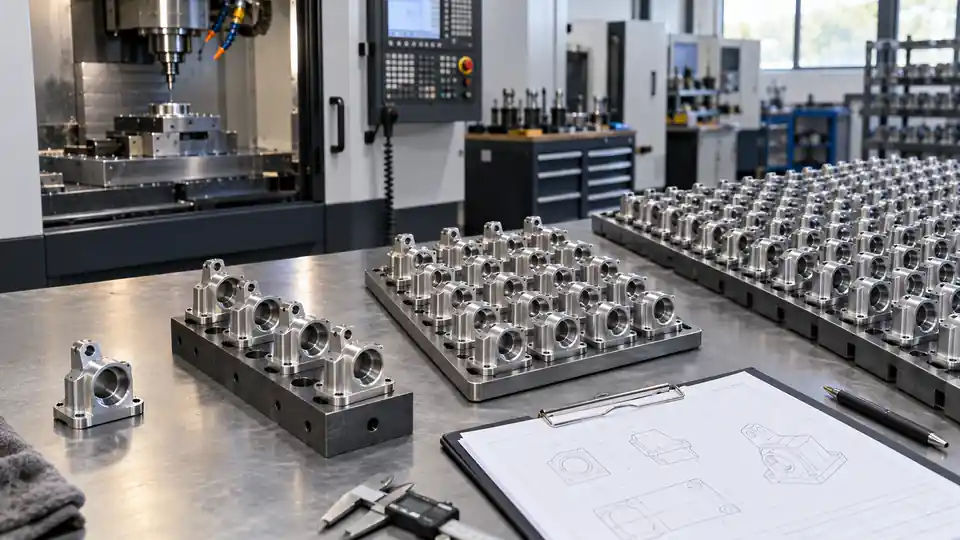
CNC unit price usually falls as quantity increases, but the curve is not a simple volume discount. The first part carries programming, process planning, workholding, setup, first-off verification, and purchasing effort that later pieces can share. Larger orders may justify better fixtures, automation, bar feeders, tombstones, in-process probing, or more efficient stock. At the same time, long runs add tool-life management, sampling, capacity commitment, inventory, and schedule risk.
A useful quantity-break quote explains those changes instead of presenting unexplained unit prices. Buyers need to know what is one-time, what repeats per setup or lot, what varies per piece, and which investment is included at each volume. Suppliers need the expected annual demand, release pattern, revision maturity, and inspection scope—not just a single headline quantity.
CNC quantity breaks should therefore correspond to real changes in setup, tooling, material yield, inspection, or release cadence, not arbitrary discount tiers.
This guide shows how prototypes, batches, and annual volume affect CNC price and lead time. It does not provide a universal rate or savings percentage; actual cost depends on geometry, material, tolerance, process, location, and commercial terms.
A Practical CNC Cost Model
For comparison, break total quoted cost into visible buckets:
Total cost = nonrecurring engineering + material + setup and batch costs + piece-level machining + outside processing + inspection/documentation + packaging/logistics + risk and commercial allowances.
Dividing total cost by quantity gives an average unit price, but that number can hide very different assumptions. A prototype quote may include all programming and fixture work in one unit. A production quote may list those items separately. One supplier may amortize a dedicated fixture over the current purchase order; another may assume annual demand and recover it over several releases.
Ask for the structure when a purchasing decision depends on volume. The supplier does not need to disclose its proprietary hourly rate or margin. It should be able to identify whether a charge is nonrecurring, per release, per setup, per lot, or per piece.
The NIST Manufacturing Cost Guide is a useful reference for thinking about lifecycle and cost categories. A supplier quotation remains the appropriate source for the specific part.
One-Time Programming and Engineering
Every new part needs some combination of drawing review, manufacturability analysis, CAM programming, simulation, setup documentation, tool planning, inspection planning, and first-off approval. The effort is not proportional to the number of pieces.
For a simple turned spacer, the nonrecurring work may be modest. For a multi-axis housing with tight datums, custom probing, and a CMM program, it may be a material portion of prototype cost. Once the approved program and process are stable, repeat releases can reuse much of that work—provided the part revision, machine platform, tooling, and quality requirements remain compatible.
Why prototype unit price looks high
Suppose a job needs eight hours of combined review, programming, setup preparation, and first-piece validation. At one piece, the entire effort belongs to that unit. At ten pieces, it is shared across ten. At one hundred pieces, its arithmetic contribution per piece is much smaller. This is amortization, not necessarily a discount.
Do not infer an actual shop rate from the example. The important point is classification. Ask the quote to show nonrecurring engineering (NRE) separately when repeat demand is likely. That makes revision changes, supplier transfer, and reorder comparisons clearer.
When programming repeats
Programming is not permanently “free” after the first order. It may need revision when:
- the CAD or drawing changes;
- stock form or material condition changes;
- the work moves to a different machine or control;
- the fixture or clamping strategy changes;
- a tool is discontinued or replaced;
- inspection characteristics or reporting change;
- production resumes after a long inactive period;
- a validated process requires requalification.
The reorder quote should state what retained data is being reused and what must be recreated.
Setup Amortization and Batch Size
A setup includes loading tools, installing and indicating workholding, establishing offsets, loading programs, proving safe motion, preparing inspection, and approving the first piece. Multi-operation parts may require several setups, each with its own fixed time.
Increasing the number of pieces in one uninterrupted batch spreads setup over more units. Splitting the same annual quantity into twelve monthly releases can be more expensive than one annual batch because setup and first-off verification repeat. The monthly pattern may still be commercially correct because it reduces inventory and supports revision flexibility.
Quantity therefore has two meanings:
- Order quantity: the total pieces on the purchase order.
- Release or batch quantity: the pieces manufactured under one setup and release cycle.
Always provide both when asking for annual-volume pricing. “1,200 parts per year” is incomplete if the supplier does not know whether demand arrives as 1,200 at once, 100 each month, or variable pull signals.
Setup preservation between releases
Some work can remain set up between nearby releases; other work must be removed to serve other jobs. A dedicated production cell, palletized fixture, or retained soft jaws can shorten recurrence. Ask whether the quoted lead time assumes a fresh setup for every release and whether retained fixtures require storage, maintenance, or ownership terms.
Fixture Investment and the Volume Crossover
Prototype work often uses a vise, modular tooling, adhesive, soft jaws, or another flexible method. These approaches minimize upfront cost and engineering time. At higher quantity, a dedicated fixture can reduce handling, permit multiple parts per cycle, control datums more consistently, support automation, and shorten inspection.
The economic decision is a crossover between nonrecurring fixture cost and recurring savings. A simple evaluation is:
Break-even pieces = dedicated fixture cost ÷ expected recurring saving per piece.
This calculation must include the real scope. The fixture may need design, material, machining, assembly, qualification, spare wear components, storage, and maintenance. Recurring savings may come from fewer setups, more parts per cycle, shorter loading, better repeatability, less scrap, or reduced inspection.
Who owns the fixture?
The purchase order should state ownership, storage, maintenance, access, transfer, and end-of-life responsibilities. If the buyer funds a fixture, that does not automatically mean it can be transferred without software, setup knowledge, gages, or validation records. If the supplier funds it through unit price, early transfer may require an unamortized-balance agreement.
Do not overinvest before the design is stable
A dedicated fixture built during early prototype revisions can become obsolete. Match the fixture strategy to design maturity:
- Use adaptable workholding for proof-of-concept and frequent changes.
- Add controlled soft jaws or modular plates for stable pilot builds.
- Invest in multi-part or automated fixtures when geometry, volume, and release cadence are credible.
- Qualify spare fixtures or critical wear components when continuity matters.
Material Purchasing and Quantity
Material price changes with order quantity, but stock yield and availability often matter more than the nominal price per kilogram.
A prototype may be cut from distributor stock or a documented remnant. A batch may justify a full bar, plate, or sheet. Annual volume may support mill-direct purchasing, custom extrusion, near-net forging, or reserved material. Each option changes minimum order, lead time, traceability, and inventory exposure.
Ask bidders to identify:
- material grade, temper/condition, and product form;
- purchased stock size and nesting/yield assumption;
- minimum buy or full-length/full-plate charge;
- whether reusable remainder is credited or retained;
- certificate and traceability scope;
- price-validity period for volatile material;
- who owns safety stock or obsolete material after a revision.
Low unit material cost is not automatically low total cost. A custom billet can reduce machining time but add mill lead time and minimum quantity. Standard stock can be available immediately but create a poor buy-to-fly ratio.
Piece-Level Machining Cost
Recurring machining includes cutting time, tool changes, loading/unloading, in-process checks, deburring, cleaning, and routine handling. It may improve with volume through learning and process optimization, but it does not disappear.
Typical volume improvements include:
- optimized toolpaths after a proven first article;
- tool-life data that reduces conservative replacement;
- multi-part fixturing or bar feeding;
- preset tools and standardized offsets;
- automated probing and part handling;
- fewer interruptions within a stable batch;
- balanced operations across machines.
Typical volume penalties include:
- tool wear and replacement across long runs;
- chip-control or coolant maintenance;
- more formal process monitoring;
- capacity reservation and overtime;
- extra handling, packaging, and lot traceability;
- scrap exposure across a large batch;
- production interruption for engineering changes.
The correct quantity break occurs where the proposed process actually changes, not at an arbitrary round number.
Inspection Cost Does Not Scale Linearly
Prototype and first-article work may require nearly all dimensions to be checked and reported. Production may use a qualified first piece, in-process controls, and sampling for selected characteristics. Safety-critical, regulatory, customer-specific, or unstable characteristics may still require 100% verification.
Separate these components:
- inspection planning and CMM/gage programming;
- first-off or first-article execution;
- routine per-piece inspection;
- lot sampling and final release;
- certificates and report preparation;
- functional, leak, pressure, or destructive tests;
- gage design and calibration.
A larger order can reduce inspection cost per part if approved sampling applies. It can also increase total inspection time and release delay. State the sampling plan, lot definition, recorded-value requirements, and escalation rule in the RFQ. Do not let one bidder assume basic final inspection while another includes a full dimensional report.
Outside Processing and Lot Charges
Anodizing, plating, heat treatment, passivation, grinding, nondestructive testing, marking, and special cleaning are often priced with minimum lot charges. A one-piece prototype may carry almost the same outside-process minimum as a small batch. Unit cost falls sharply until the minimum is absorbed.
At larger quantities, capacity, rack density, masking, test coupons, color consistency, furnace loading, and batch traceability become important. Multiple releases can repeat minimum charges and certificate fees.
Ask whether outside-processing prices assume one lot, whether partial shipments create repeated minimums, and whether the same sub-tier source is reserved for production. The QuickCNCs surface-finishing page gives relevant process context; the controlled RFQ should define the exact finish, masking, dimensional state, and evidence.
Packaging and Logistics by Quantity
Packaging can be minor for a robust prototype and critical for a production stream of cosmetic or precision parts. Larger quantity may justify reusable trays, cell dividers, caps, vapor-corrosion protection, clean bags, or custom dunnage. Those items can have their own tooling and minimum order.
Specify whether packaging is per piece, per tray, per lot, or returnable. State labeling, lot separation, maximum container weight, cleanliness, rust prevention, and shipping destination. International freight and customs charges should be compared at the same Incoterm and delivery point.
How Quantity Changes Lead Time
Price per piece often falls while total lead time rises. A one-piece prototype may fit into a short open machine window. A 2,000-piece order may require material reservation, dedicated fixtures, several machines, outside-processing capacity, and staged inspection.
Break lead time into phases:
- technical clarification and order review;
- material and special-component procurement;
- programming, tooling, and fixture preparation;
- first-piece machining and approval;
- batch production;
- outside processing;
- inspection and documentation;
- packaging and transport.
Ask for the first-article date, first deliverable quantity, completion date, and proposed shipment cadence. A supplier may deliver 100 parts quickly and the balance later, which can support the customer’s ramp better than waiting for a complete batch.
Capacity is calendar-specific
An annual-volume quote does not guarantee capacity. Identify whether lead time assumes normal queueing, reserved machine hours, forecast releases, blanket-order authorization, or committed material. If demand can surge, quote a base cadence and an expedite or upside-capacity mechanism rather than assuming unlimited flexibility.
Prototype, Batch, and Annual-Volume Strategies
| Demand stage | Typical objective | Appropriate cost treatment | Key lead-time question |
|---|---|---|---|
| 1–3 prototypes | Learn quickly and verify function | Separate NRE; flexible workholding; broad first-off review | What is the earliest technically credible first piece? |
| 5–25 engineering units | Validate design and assembly | Reuse program; controlled soft jaws; explicit inspection scope | Which approvals block the remaining batch? |
| 25–250 pilot or low volume | Prove repeatability and supply flow | Consider multi-part fixtures, tool-life plan, sampling | Can parts ship in staged releases? |
| 250–2,500 repeat production | Reduce recurring cost and stabilize cadence | Dedicated fixtures/automation where justified; lot controls | What batch size balances setup, inventory, and demand? |
| Annual or ramp program | Secure capacity and manage change | Forecast, blanket releases, material/capacity agreements | What is committed, flexible, and subject to revalidation? |
The ranges are illustrative, not universal. Part complexity and cycle time can make a ten-piece order behave like production, while a simple turned part can remain flexible at much higher quantity.
Request the Right Quantity Breaks
Do not ask for 1, 10, 100, and 1,000 pieces merely because those are round numbers. Select quantities that reflect decisions:
- prototype need;
- verification or design-build quantity;
- pilot batch;
- normal release size;
- expected annual demand;
- credible upside or downside scenario.
Tell the supplier which quantity is most likely. Otherwise, engineering effort may be spent optimizing a volume that will never be ordered.
Ask each quote to show:
- NRE/programming and whether it is charged again after revision;
- fixture/tooling cost, ownership, and amortization assumption;
- unit price by release quantity;
- minimum order or lot charge;
- material minimum buy and certificate scope;
- inspection plan and report scope;
- outside-processing minimums;
- packaging and delivery basis;
- first-article, first-delivery, and completion dates;
- price validity and volume assumptions.
Compare Quotations on a Common Basis
A useful comparison table separates cost rather than ranking the lowest unit price:
| Quote element | Supplier A | Supplier B | Buyer check |
|---|---|---|---|
| NRE and programming | Same revision and deliverables? | ||
| Fixture/tooling | Same ownership and lifetime? | ||
| Material | Same grade, form, certs, and minimum buy? | ||
| Unit machining | Same batch size and process scope? | ||
| Inspection | Same characteristics, sampling, and reports? | ||
| Outside processing | Same specification, masking, tests, and lot count? | ||
| Packaging/freight | Same delivery point and shipment cadence? | ||
| Lead time | First piece, first shipment, and completion comparable? |
Normalize the quote to expected releases. For example, annual demand of 1,200 made in twelve lots can carry twelve setup and final-release events. Comparing it with a one-batch price without adjustment creates a false saving.
Manage Revisions Across Volume Stages
The cheapest time to change a part is before dedicated stock, fixtures, and long-run production are committed. Use a release gate between prototype, pilot, and production. Freeze the part revision, approved deviations, fixture concept, inspection plan, and packaging before authorizing the next investment.
If a change occurs, identify affected raw material, work in process, completed stock, tooling, programs, gages, and reports. Ask the supplier to separate reusable and obsolete cost. Do not bury change cost in a new unit price; retain a clear decision record.
Annual pricing should also define the effect of demand changes. If actual volume is lower than forecast, determine whether unamortized tooling, reserved material, or capacity commitments remain. If demand is higher, determine when additional fixtures, shifts, or sub-tier capacity are needed.
Evaluate Inventory and Cash, Not Only Machining Price
A large batch moves setup cost out of the unit price but moves cash and risk into inventory. Include the cost of holding stock, storage space, insurance, incoming inspection, counting, damage, and eventual disposal. More importantly, consider the chance that the design changes or demand falls before all parts are consumed.
Use a total-cost comparison for each candidate batch size:
- purchase price for the planned releases;
- recurring setup and lot charges;
- freight and receiving events;
- average inventory and financing exposure;
- safety-stock benefit and shortage consequence;
- expected obsolescence from revision or demand change;
- administrative cost of placing and managing releases.
The calculation does not need false precision. Its purpose is to expose where an apparently cheap annual buy depends on perfect forecast consumption. A regulated or configuration-controlled product may carry particularly high obsolescence cost because an old revision cannot be consumed casually.
Blanket orders and scheduled releases
A blanket purchase order can reserve commercial terms while allowing staged deliveries. It does not automatically tell the supplier when to buy material or manufacture parts. Define forecast, firm-release horizon, cancellation window, minimum batch, maximum inventory authorization, and ownership of work in process.
For example, a buyer may provide a rolling forecast while making the next eight weeks firm. The supplier can propose a material-buy plan and a machining batch larger than each delivery. Finished goods may then be drawn down in scheduled releases. That can preserve setup efficiency without placing the entire annual quantity at the buyer’s dock.
Make the financial boundary explicit. Identify when raw material, work in process, finished inventory, and dedicated tooling become noncancelable. If the design changes, specify the review and disposition process rather than assuming one party absorbs all exposure.
Use Scenario Pricing for an Uncertain Ramp
Forecasts for a new product are rarely exact. Instead of asking for one annual price based on an optimistic volume, request a small set of operational scenarios. A useful ramp table can include:
- a downside case with low release quantity and flexible tooling;
- a base case with the expected monthly or quarterly cadence;
- an upside case that identifies added fixture, machine, or material commitments;
- an expedite case for a limited quantity, with the normal schedule protected;
- a design-change case showing which NRE and tooling would be revisited.
Ask the supplier to state the trigger between scenarios. The trigger may be a cumulative quantity, a firm forecast, a fixture approval, a material reservation, or a capacity deposit. This is more actionable than a promise that price will improve “at higher volume.”
Scenario pricing also reveals whether the proposed process scales. A prototype made through extensive manual fitting may be acceptable for learning but unsuitable for a ramp. Conversely, an elaborate automated cell may be uneconomic until the design and demand stabilize. The buyer should know which process is quoted at each quantity and when requalification is required.
Check the Unit-Price Curve for Discontinuities
Quantity prices should not be forced into a smooth curve. A sharp change can be legitimate when the manufacturing route changes—for example, when a full bar is consumed efficiently, a multi-part fixture becomes economic, a minimum plating lot is absorbed, or a second shift is needed. Ask the supplier to identify the operational reason.
Also examine increases or flat regions. A higher quantity can cross a machine-capacity boundary, require a new material lot, repeat a destructive test, or create overtime. A unit price that stays flat may already reflect an efficient bar-fed or palletized process. Treat each break as a manufacturing decision to understand, not as an automatic negotiation target.
Quantity-Break RFQ Checklist
Before requesting prices, provide:
- controlled 3D model and 2D drawing with matching revision;
- prototype quantity, normal release quantity, and annual forecast;
- expected release cadence and first-needed date;
- material grade, condition, product form, and certification;
- finish and outside-processing requirements;
- first-article and production inspection scope;
- packaging, lot separation, and delivery destination;
- design-maturity and anticipated change information;
- tooling ownership and transfer expectations;
- forecast flexibility, cancellation, and obsolete-inventory rules where relevant.
Then request assumptions and exclusions in writing. A transparent quote supports negotiation without forcing the supplier to disclose confidential costing data.
Choose the Quantity That Minimizes Total Risk and Cost
The lowest piece price can create high inventory, obsolescence, cash, and revision risk. The smallest batch can create repeated setup, inspection, and freight cost. The correct decision balances these effects against demand confidence and the consequence of shortage.
For early designs, pay for flexible manufacturing and fast learning. For a stable pilot, invest selectively in repeatable workholding and inspection. For production, optimize batch cadence, stock, capacity, and automation using credible demand. Revisit the model when the revision, annual volume, supplier route, or quality plan changes.
QuickCNCs supports both prototype and production CNC machining. To receive comparable quantity breaks, submit the controlled files, quantities, annual forecast, material, finish, inspection, packaging, and delivery requirements through the Request a Quote page. The most useful quotation is not the one with the most price rows; it is the one that shows what operational decision changes from one row to the next.