
Stainless steel is not one machining material. Austenitic 304/304L and 316/316L, free-machining 303, martensitic 410 or 420, duplex grades, and precipitation-hardening grades such as 17-4PH have different strength, work-hardening behavior, heat-treatment condition, corrosion performance, and chip formation. A useful quotation therefore starts with the exact grade, condition, product form, geometry, tolerance, finish, and quantity—not simply “stainless steel.”
Austenitic stainless grades are often more demanding than free-machining steels because they combine a tendency to work-harden with relatively low thermal conductivity and ductile chips. The result can be notch wear, built-up edge, chip-control problems, heat near the cutting edge, and dimensional drift. Those effects can be managed, but the cutting data must be selected for the actual grade, tool, operation, setup, and coolant delivery.
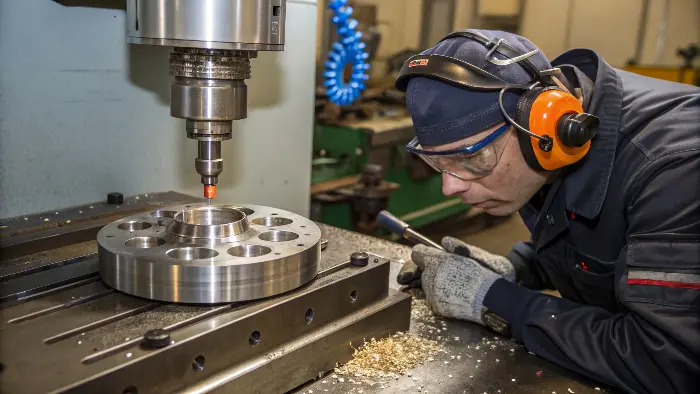
For a design or sourcing decision, first confirm whether corrosion resistance, weldability, strength, magnetic response, or machinability is the controlling requirement. The site’s CNC machining materials guide explains the additional grade, temper or condition, certification, and finish information that belongs in an RFQ.
Why is stainless steel difficult to machine?
The familiar machining problems are most pronounced in many austenitic and duplex grades, but the mechanism is not simply “high chromium makes the surface abrasive.” Cutting deforms material ahead of the edge; some stainless grades strain-harden substantially, so rubbing or repeated light passes can leave the next edge cutting a harder layer. Stainless steel also transfers heat away from the cutting zone less readily than aluminum, and ductile grades can form long chips or adhere to the edge.
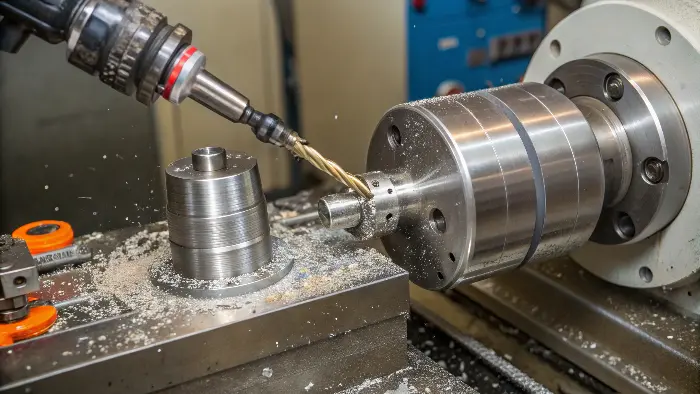
Grade and condition change the machining plan
| Example | What changes | RFQ implication |
|---|---|---|
| 303 | Designed for improved machinability, generally with a corrosion-resistance and fabrication trade-off versus 304-type grades | Do not substitute for 304/316 without engineering approval |
| 304/304L | Austenitic, ductile and prone to work hardening | State the exact UNS/EN grade and product form |
| 316/316L | Austenitic; molybdenum supports corrosion resistance in relevant environments, but does not make the grade universally “best” | Define the service environment and any certification requirement |
| 410/420 | Martensitic; hardness and machinability depend strongly on heat-treatment condition | Specify whether machining is before or after hardening and where grinding is required |
| 17-4PH | Precipitation-hardening; strength, distortion risk, and final properties depend on solution/aging condition | Call out the required condition, heat-treatment sequence, and final inspection |
| Duplex grades | Higher strength can raise cutting forces; work hardening and vibration control remain important | Confirm machine rigidity, tool access, and qualified cutting guidance for the selected grade |
Material producers also offer grades optimized for machining. For example, Outokumpu describes Prodec variants of 304L, 316L, 303 and 17-4PH. That does not authorize an automatic substitution: corrosion requirements, standards, certification, and availability still have to match the released specification.
Work hardening, heat, and chips are a system
- Work hardening: a sharp edge and a stable feed help the tool cut beneath the previously deformed layer. “More feed” is not a universal instruction; the toolmaker’s range, edge strength, feature, and available power set the limit.
- Heat management: cutting speed, insert grade and geometry, engagement, and directed coolant all affect where heat goes. Flood or through-tool coolant is often beneficial, but some operations may use a validated dry or minimum-lubrication strategy.
- Chip control: chipbreaker geometry, feed, depth of cut, tool path, and coolant direction must work together. Not every stainless grade produces the same chip.
- Rigidity: minimize unnecessary tool overhang and make the workholding secure without distorting a thin or finished feature.
Seco’s technical guidance on stainless-steel tool wear similarly treats work hardening, heat, chip formation, cutting speed, feed, depth of cut, and coolant as interacting variables rather than a single fixed recipe.
Why is it so hard to drill stainless steel?
Drilling combines limited chip space, a low cutting speed at the drill center, and difficult coolant access at the point. A worn edge or feed that permits rubbing can work-harden the hole bottom. Long chips may pack in the flutes, raise torque, damage the wall, and prevent coolant reaching the cutting zone.
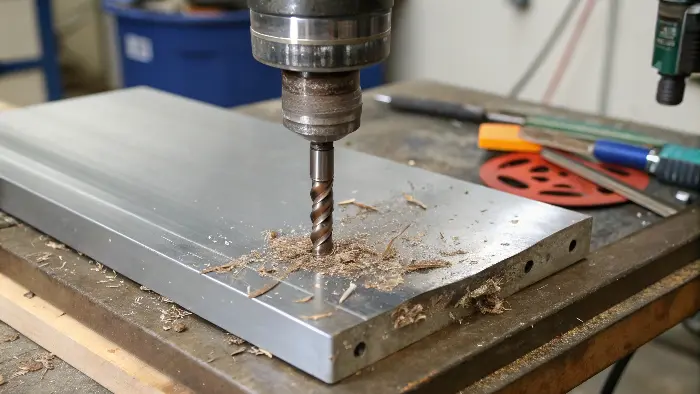
Choose the drilling cycle from the hole, not a slogan
Tool material, point geometry, margin design, coating, cutting data, runout, coolant route, hole diameter, depth-to-diameter ratio, and breakthrough condition all matter. A peck cycle can help clear chips in some deep-hole applications, but unnecessary full retracts can add time and may repeatedly re-enter a work-hardened surface. Modern through-coolant carbide drills may use continuous drilling within their qualified range. Follow the drill manufacturer’s application data and prove the cycle on the actual material condition and setup.
| Check | Why it matters |
|---|---|
| Exact grade and hardness/condition | Changes cutting force, heat and edge-life expectations |
| Hole diameter and depth | Sets chip space, coolant demand and tool selection |
| Entry and exit geometry | Angled surfaces and interrupted breakthrough can deflect or damage the drill |
| Runout and holder condition | Unequal edge loading shortens life and enlarges the hole |
| Coolant pressure and filtration | Affects heat removal and chip evacuation |
| Inspection method | A pin, bore gauge, CMM, or other method must match the tolerance and feature form |
Why is stainless steel so hard to work with?
“Hard to work with” is usually a cost and process-control question, not proof that the material is unsuitable. Compared with an easy-machining aluminum alloy, some stainless jobs need lower material-removal rates, more tool changes, stronger chip management, additional deburring, or stress/temperature controls. The actual cost multiplier cannot be stated responsibly without geometry, grade, condition, quantity, tolerance, and inspection scope.
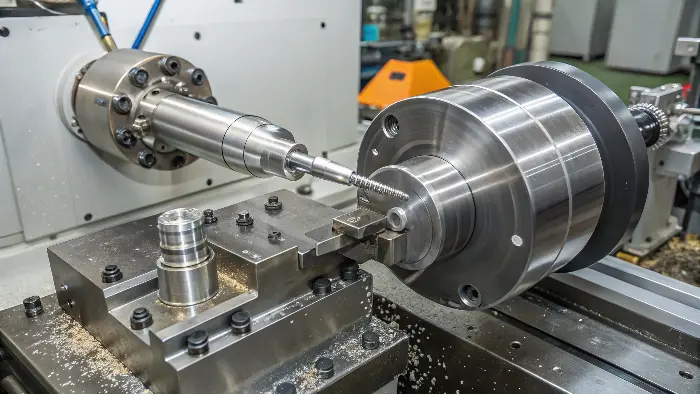
Design and RFQ choices that reduce risk
- Identify the grade by an accepted designation and state the required condition; do not rely on “stainless.”
- Keep inside radii compatible with practical cutter diameters and avoid unnecessarily deep, narrow pockets.
- Mark only function-critical tolerances and surface-finish requirements.
- Define datum surfaces, inspection temperature where relevant, and the required inspection record. The tolerances and inspection page provides a useful RFQ checklist.
- For turned geometry, identify long slender regions, grooves and cutoff conditions; see the CNC turning service overview.
- For prismatic parts, identify long-reach features and setup access; see the CNC milling service overview.
Conclusion
Stainless-steel machining becomes predictable when the grade and condition are explicit and the tool, cutting data, chip strategy, workholding, coolant, and inspection plan are selected as one system. Treat 303, 304, 316, martensitic, duplex and precipitation-hardening stainless steels as distinct materials. That is more useful for design and quoting than a universal speed, feed, coolant, or cost claim.