
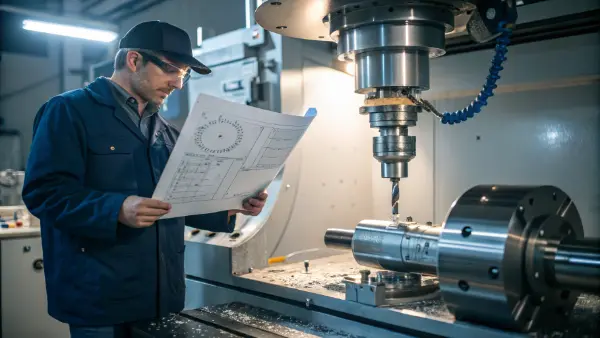
Are you struggling to pick the right machining method for your new design? Choosing the wrong process can waste time and ruin your budget. I see engineers face this problem every day. Let us fix this right now so you can make parts faster and cheaper.
For rotating parts, CNC turning is usually the best choice because the workpiece spins while a fixed tool cuts it. This makes it perfect for shafts, bushings, and bolts. CNC milling works better when the part is not round and needs complex flats or pockets. Turning is faster for round shapes, while milling gives you more design options for irregular shapes.
You might think any machine can make any part if you try hard enough. But matching the right machine to your part design is the real secret to perfect tolerances and fast delivery. Let me share my decade of experience to help you make the right call for your next project.
What is the difference between CNC turning and milling?
Do you get confused when looking at turning and milling machines? If you mix them up, you might send your drawing to the wrong shop and delay your project. I will show you the exact differences so you never make this mistake.
The main difference is how the machine moves. In CNC turning, the raw material spins at high speeds while the cutting tool stays still. In CNC milling, the raw material stays locked in place, and a spinning tool moves around to cut it. Turning makes round parts like cylinders, while milling makes square or flat parts with complex shapes.
I remember my early days in a busy CNC shop. I watched metal chips fly from both machines and thought they did the same thing. I quickly learned that each machine has a special job. We need to look closely at how they work to understand why. This helps you design parts that factories can actually build.
How the Tool and Material Move
In turning, the chuck holds a round bar of metal. The machine spins this bar very fast. A sharp tool pushes into the spinning metal to peel away layers. This is great for making symmetrical things like a car axle. You get perfect roundness this way. In milling, we bolt a block of metal to a heavy table. The table stays flat. A spindle holds a spinning cutter. The cutter drops down and carves shapes out of the block. The block does not spin at all.
When to Use Which Machine
If your part is mainly round, choose turning. Turning gives you a perfect center line. The concentricity is amazing. If it is mainly block-shaped, choose milling. Milling gives you the freedom to make wild, complex geometries on multiple sides. Sometimes you have a round part that needs a flat side or a hole drilled through the middle. In that case, we use a hybrid turn-mill machine. This saves time and keeps your project on track.
| Feature | CNC Turning | CNC Milling |
|---|---|---|
| Moving Part | The workpiece spins | The cutting tool spins |
| Best Shape | Round, cylindrical | Square, flat, irregular |
| Tool Changes | Needs very few | Needs many tool changes |
| Speed for Round Parts | Very fast | Slower |
You must remember this simple rule. Round parts go to the lathe. Flat parts go to the mill. This knowledge gives you control over your design process.
What are the four machining processes?
Hearing too many machine names can make your head spin. If you do not know the basic methods, you cannot talk clearly with your suppliers. I will break down the four main ways we cut metal so you can talk like an expert.
The four basic machining processes are turning, milling, drilling, and grinding. Turning shapes round parts by spinning the metal against a tool. Milling carves solid blocks using a spinning cutter. Drilling creates round holes by pushing a spinning bit into the material. Grinding uses an abrasive wheel to smooth surfaces and reach very tight tolerances.
When I manage global supply chains today, I need to know exactly which process a factory uses. Each method removes metal, but they do it in unique ways. Let us look at all four so you can see the big picture. This helps you plan your project steps perfectly.
The Core Four Methods
First, we have turning. As we discussed, this is the master of round parts. It handles shafts and pins with ease. Second, we have milling. This process rules the world of flat faces and deep pockets. It builds the bodies and housings of machines. Third, we have drilling. You probably have a hand drill at home. A CNC machine does the same thing but with perfect precision. It just makes holes for bolts or fluids. Finally, we have grinding. Grinding does not remove large chunks of metal. It takes off tiny amounts of dust. It uses a rough wheel to make a surface shine.
Choosing the Right Step
Most complex parts need more than one process. You rarely finish a part on just one machine. We might turn a shaft to get the main shape. Then we might mill a slot into it for a keyway. After that, we drill a hole through it. Finally, we grind the bearing surface so it fits perfectly into an assembly.
| Process | Main Action | Typical Output |
|---|---|---|
| Turning | Peeling a spinning rod | Shafts, pins, rings |
| Milling | Carving a static block | Housings, brackets, molds |
| Drilling | Plunging a spinning bit | Bolt holes, fluid channels |
| Grinding | Rubbing with a rough wheel | Ultra-smooth flat or round surfaces |
Understanding these four steps helps you design better parts. You will know exactly how the factory plans to build your creation from start to finish. This makes you a much better engineer.
What are the disadvantages of CNC turning?
Turning sounds perfect for round parts, right? But ignoring its weak spots can lead to bad parts and wasted money. I have seen many designs fail because the engineer asked a lathe to do the wrong job. Let us look at the downsides.
The main disadvantage of CNC turning is that it only makes round or symmetrical parts. You cannot easily make flat faces, square pockets, or complex 3D contours on a standard lathe. Turning machines also struggle with materials that have irregular shapes or hard spots. If your part is mostly non-round, turning will not work well.
I love turning machines, but they are not magic. When I first started working with overseas clients, I saw engineers try to force a lathe to make a square part. It was a disaster. We need to be realistic about what turning can and cannot do. This saves you from bad surprises during production.
Limitations in Shape
Turning forces the part to spin around one central axis. Because of this, it only wants to make circles. If you need a square block with a deep hole, turning is the wrong choice. The machine simply cannot cut a square edge while the material is spinning fast. You also have trouble if the raw material is an odd shape. The chuck needs a nice, even surface to grab. If it cannot hold the metal safely, it cannot spin it safely.
When Turning Fails
If your part has many flat sides, you must use a milling machine instead. Milling is much more versatile for materials with irregular hardness or shapes. Turning machines do not like interruptions in the cut. If a spinning part has a big gap in it, the tool bangs against the metal. This breaks the tool and ruins the part.
| Turning Weakness | Why It Happens | The Solution |
|---|---|---|
| Cannot make square parts | The part spins in circles | Use a milling machine |
| Hard to hold odd shapes | The chuck needs a round bar | Cast the part first, or mill it |
| No off-center features | The tool cuts on the center line | Use a mill-turn hybrid machine |
Sometimes, simple high-volume parts are great for turning. But if your design needs complex, multi-axis cuts, turning will hold you back. Always match the geometry to the machine limits.
Is milling or lathe easier?
Are you wondering which machine is easier to program and run? If you pick the harder method, your prototype will take longer and cost more. Let me clear up this common question so you can plan your time and budget safely.
A CNC lathe is generally easier to operate and program than a milling machine. Turning usually involves moving the tool on just two axes, X and Z. Milling often uses three, four, or five axes to cut complex 3D shapes. Because lathes need fewer tool changes and have simpler movements, they are faster and easier to set up for simple parts.
When I train new operators or talk to junior engineers, they always ask me this question. From my experience on the shop floor, I can tell you that the lathe is the easier machine to master first. It does fewer things, so it is easier to understand.
Why the Lathe is Simpler
Think about how a lathe works. You hold a round bar, and you move a tool left and right, or in and out. That is just two directions. The math is simple. The machine needs very few tool changes compared to a mill. You put in a good cutting tool, and it does most of the heavy work. This makes turning machines very cost-effective for simple, high-volume parts. The programming code is short and easy to read.
The Challenge of Milling
Milling is a very different story. You have to move the tool left, right, forward, backward, and up and down. Sometimes you even tilt the tool in odd directions. This requires complex software and very careful planning. You also have to change tools many times to finish one part. You might need a big cutter for rough work, a small cutter for details, and a drill for holes.
| Feature | Lathe (Turning) | Milling Machine |
|---|---|---|
| Number of Axes | Usually 2 (X, Z) | 3, 4, or 5 |
| Setup Time | Fast and easy | Slow and complex |
| Tooling Needed | Very little | Many different cutters |
| Programming | Simple math | Advanced 3D paths |
While a lathe is easier, milling gives you the power to make almost anything. If your part is simple and round, use the easy way. If you need intricate designs, you must accept the harder path of milling.
Conclusion
Choose turning for fast, round parts and milling for complex, flat shapes. Matching your design to the right machine saves money, guarantees tight tolerances, and speeds up your delivery times.