
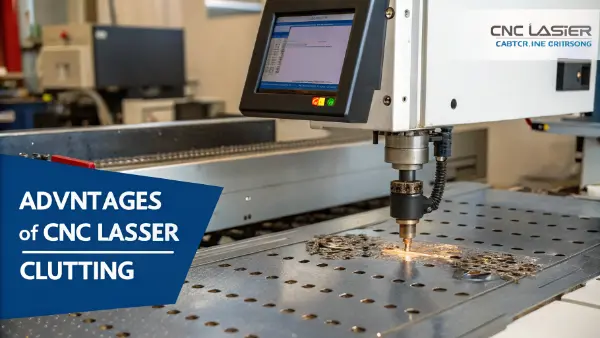
You need custom parts fast. Cutting metal by hand or with old tools takes too much time. Bad cuts ruin good material. CNC laser cutting fixes this problem. It gives you perfect parts in less time.
The main advantages of CNC laser cutting services are high precision, fast cutting speeds, and very clean edges. This process wastes less material because the laser beam is very thin. It leaves smooth cuts that do not need extra sanding. You can cut metals and plastics easily, making it great for custom parts and fast production runs.
I will show you why this tool is so helpful. You will see how it saves you money and time on your next project. Let us look at the details.
What are some advantages of laser cutting?
Making complex shapes is hard. Old machines break tools and leave messy edges. You lose time fixing these mistakes. Laser cutting solves this. The laser beam cuts any shape perfectly without touching the part.
Laser cutting offers many big advantages, like high accuracy, zero tool wear, and fast setup times. A laser can cut and engrave materials at the same time. The heat zone is small, so the metal does not warp. You can quickly switch between different designs without changing any physical tools.
Why accuracy matters so much
I see many engineers worry about tight tolerances. When you make robot parts, every millimeter counts. A laser beam is very small. It cuts very tight corners. You get the exact shape you draw on your computer. This high accuracy means your parts fit together perfectly every time. You never have to force pieces together. The machine follows your design without any mistakes.
Saving money on materials
Laser cutting has a very narrow kerf. The kerf is the width of the cut. A narrow kerf means you waste very little material. You can pack many small parts close together on one sheet of metal. This step is called nesting. Good nesting saves a lot of metal. Over time, you buy less raw material. This lowers your total cost. A company can save thousands of dollars a year just by wasting less metal.
| Feature | Laser Cutting | Traditional Sawing |
|---|---|---|
| Cut Width | Very thin | Very thick |
| Material Waste | Low | High |
| Nesting Parts | Easy | Hard |
Less work after cutting
When you cut metal with a saw, it leaves sharp burrs. You must pay someone to sand those edges. Laser cutting leaves smooth, clean edges. You do not need this extra finishing step. The parts are ready to use right away. I always tell my clients this is the best way to save time. You also get a very safe process. The laser sits inside a closed box. No worker puts their hands near a sharp blade. The whole system runs on automation. You get the same perfect result on part number one and part number one thousand.
What is a major limitation of CNC laser cutting?
You might think lasers can do everything. But sometimes, thick metals stop your project. A regular laser struggles with very thick steel. This slows down your work. You must know these limits before you start.
A major limitation of CNC laser cutting is its trouble with very thick materials. Lasers lose cutting power and accuracy when the metal gets too thick. The cut edge can become rough or melted. Also, lasers struggle to cut highly reflective metals like copper or brass because the shiny surface bounces the light away.
The problem with thick metals
Lasers work best on thin to medium sheet metals. When the metal is very thick, the laser beam loses its focus. The bottom of the cut gets wider than the top. We call this taper. A tapered edge is bad if you need a perfect straight side. If you need to cut steel that is two inches thick, a laser is not your best choice. A waterjet or a plasma cutter might do a better job. A thick part takes a long time to cut. The heat from a slow cut can also bend the metal.
Reflective materials bounce light
I once tried to laser cut a thick piece of shiny copper. The copper acted like a mirror. It bounced the laser beam right back at the machine. This can actually break the expensive laser lens. We must be very careful with brass, copper, and aluminum. New fiber lasers are better at this. But old CO2 lasers fail completely on shiny metals. You must pick the right machine for shiny parts.
| Material Type | Laser Cutting Result | Best Machine to Use |
|---|---|---|
| Thin Steel | Excellent | Fiber or CO2 Laser |
| Thick Steel | Poor (Tapered) | Plasma or Waterjet |
| Shiny Copper | Dangerous | Fiber Laser or CNC |
High power costs money
Another limit is the cost of the machine. A good laser needs a lot of electricity. It also uses special gases like nitrogen or oxygen to blow away the melted metal. These gases cost money every day. So, while the parts are cheap to make in high numbers, the starting cost of the machine is very high. You must plan your budget well. A small shop might not have the money to buy and run a large laser machine.
What are the advantages of CNC machining?
You need 3D parts, not just flat sheets. Lasers only cut flat things. Trying to make a 3D block with a laser is impossible. CNC machining fixes this. It carves solid blocks into complex 3D shapes.
The main advantages of CNC machining are its ability to create complex 3D shapes and its amazing precision. CNC milling and turning machines carve solid blocks of metal or plastic. They hold very tight tolerances. They can also cut very thick materials and create deep holes or threads, which a laser cutter cannot do.
Carving the real 3D world
A laser is like a pair of scissors cutting paper. It only cuts flat sheets. But what if you need a round joint for a robot arm? A CNC mill or lathe is the right tool. CNC machining takes a solid block of metal. Sharp tools spin very fast. They cut away the metal until you get your final 3D part. This process is called subtractive manufacturing. It gives you deep holes, blind pockets, and perfectly round shapes. You can make almost any shape you want.
Incredible tight tolerances
I know engineers love tight tolerances. CNC machining is the king of tight tolerances. You can easily get a tolerance of ±0.01mm. This is much better than most laser cutters. If two parts must slide together perfectly without shaking, you must use CNC machining. The spinning tools carve the metal with perfect control. The machine measures the part as it cuts.
| Feature | CNC Machining | Laser Cutting |
|---|---|---|
| Shape Type | 3D Blocks | 2D Flat Sheets |
| Best Tolerance | ±0.01mm | ±0.1mm |
| Tool Contact | Tools touch metal | No touch (Light) |
No limits on thickness
CNC machines do not care about how thick the material is. If the metal block fits inside the machine, the tools can cut it. You can machine a huge block of thick aluminum without any taper problems. The tools also cut shiny metals like copper without any light bouncing back. CNC machines offer great flexibility for thick and heavy parts. They give a smooth finish on every side. You can tap threads into holes. A laser cutter cannot make screw threads. This makes CNC very special for complete parts.
Is laser cutting better than CNC?
You must pick a process for your next job. Choosing the wrong one wastes money. You might pay for slow CNC work when a laser is faster. Knowing the difference solves this. You can pick the perfect tool every time.
Laser cutting is not always better than CNC machining. It depends on your part. Laser cutting is better for flat sheet metal because it is much faster and cheaper. CNC machining is better for 3D parts, thick metals, and very tight tolerances. Both are great tools, but they do different jobs.
When to pick the laser
If your design is drawn on a flat piece of paper, use the laser. I always tell my clients to use laser cutting for custom brackets, flat panels, and metal boxes. The laser cuts fast. It costs less. You do not need to buy custom tools. The laser just moves and cuts. It is perfect for fast prototypes. You can order 200 flat metal plates and get them very quickly. You save a lot of money on simple parts.
When to pick CNC machining
If your design looks like a solid block with deep holes, you must use CNC machining. A laser cannot make screw threads inside a hole. A CNC machine can do this easily. CNC is better for complex robot joints, engine parts, and thick blocks of metal. The finish on a CNC part is very beautiful on all sides. You get exact depths and angles. The machine carves the metal away step by step.
| Project Need | Choose Laser | Choose CNC |
|---|---|---|
| Fast Flat Parts | Yes | No |
| Deep Threaded Holes | No | Yes |
| Lowest Cost on Sheets | Yes | No |
Working together for best results
Actually, we often use both methods together. Sometimes I laser cut a flat shape first to save time. Then, I put that flat shape into a CNC machine. The CNC machine drills precise holes and cuts smooth threads. This combined way saves a lot of money. It gives you the speed of the laser and the precision of the CNC mill. You do not have to choose just one. You can use both to make the best part. I help engineers do this every day. It is the smartest way to build custom parts.
Conclusion
CNC laser cutting offers high speed, great precision, and clean edges for flat parts. CNC machining handles complex 3D shapes. Choose the right tool to save time and money.