
Are you struggling to get consistently perfect cylindrical parts from your supplier? The parts look good and the diameters check out, but they fail during assembly or in the field. This frustrating problem wastes time, money, and damages your reputation. You need a reliable method for quality control.
To master quality control in centerless grinding, you must go beyond simple diameter checks. You need to use multi-point measurement systems to detect geometric errors like roundness and cylindricity, employ profilometers for surface finish, and adhere to standards like ISO 1101 for geometric tolerances. Regularly calibrating your equipment and understanding the machine’s behavior are also crucial for ensuring every part meets spec consistently.
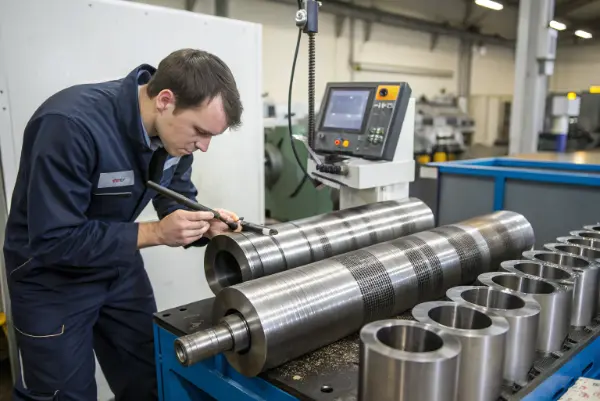
I’ve seen many talented engineers, like Alex from Germany, specify tight tolerances for their projects. They know exactly what they need. But they are often frustrated when parts arrive out-of-spec, even when the inspection report says everything is fine. The problem isn’t the drawing; it’s the hidden complexities of measuring a centerless ground part. A simple measurement can be misleading. The real key to quality lies in knowing what to look for and how to find it. We need to go deeper than the surface-level numbers.
Let’s explore the advanced techniques and standards that guarantee your parts are not just within tolerance, but truly functional and reliable.
Beyond the Micrometer: How Do You Accurately Measure Roundness and Lobing?
You’ve measured your ground parts with a two-point micrometer, and the diameter is perfect. Yet, the part fails in its bearing assembly. This "lobing" effect means the part isn’t truly round, causing vibration and premature failure, even when the diameter seems correct. The solution is using multi-point measurement systems.
To accurately measure roundness and detect lobing, you must use a V-block with a dial indicator or, for higher precision, a dedicated roundness measuring machine like a Talyrond. A standard two-point micrometer cannot detect odd-numbered lobes (3, 5, 7, etc.), which are a common result of centerless grinding. These advanced tools measure radial variations as the part rotates, giving you a true picture of its form.
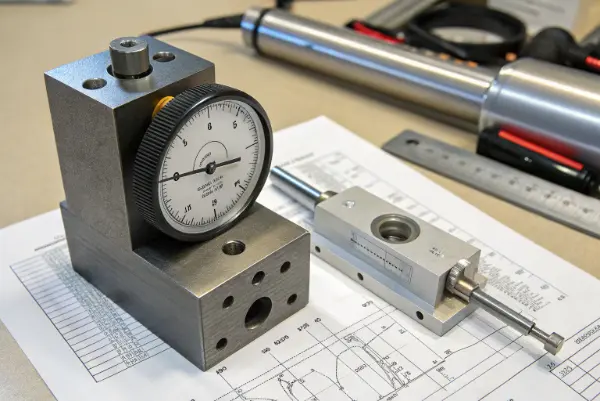
The biggest mistake I see in quality control for centerless grinding is relying only on a two-point micrometer. Imagine a part with three lobes. When you measure it with a micrometer, the anvils touch a high point on one side and a low point on the other. As you rotate the part, this relationship stays constant, giving you the same diameter reading every time. The part passes inspection but is not truly round. This is a classic trap.
In my early days, a client rejected an entire batch of 10,000 precision pins. My micrometer readings were perfect, all within the ±0.005mm tolerance. The client sent back a report from their Talyrond machine showing a 3-lobe condition on every part. It was a costly lesson in the limits of my tools. That’s when I invested in a V-block setup and started training my team to check for lobing specifically.
Here is a breakdown of different measurement methods and what they can actually detect:
| Measurement Tool | What It Measures | Pros | Cons |
|---|---|---|---|
| Two-Point Micrometer | Diameter between two opposing points. | Fast, easy, and common. | Cannot detect odd-numbered lobes (3, 5, 7, etc.). Gives a false sense of roundness. |
| V-Block & Dial Indicator | Variation in radius as the part is rotated. | Simple, inexpensive, and effective at detecting lobes. Good for shop-floor checks. | Accuracy depends on the V-block angle and indicator quality. Less precise than dedicated machines. |
| Roundness Tester (e.g., Talyrond) | Comprehensive geometric form (roundness, eccentricity, harmonics). | Extremely accurate. Provides a polar plot of the part’s profile. The "gold standard" for roundness. | Slow, expensive, and requires a controlled environment. Not practical for 100% inspection. |
For any critical application like bearings, shafts, or hydraulic pistons, you must specify a roundness tolerance (per ISO 1101) in addition to the diameter tolerance. Then, you must verify it with the right tool. For most jobs, a V-block check is a huge step up. For the highest precision, ask your supplier for a roundness tester report on a sample of the parts.
What Role Does Surface Finish Play and How Is It Measured?
You designed a part to have a smooth, low-friction surface. But when the parts arrive, they cause excess wear or fail to create a proper seal. The supplier insists the surface finish is correct, but something is clearly wrong. The problem is that a single parameter like Ra doesn’t tell the whole story.
Surface finish is critical for wear resistance, friction, and sealing. It is measured with a profilometer (or surface roughness tester), which drags a stylus across the surface. While Ra (average roughness) is common, it’s often insufficient. Parameters like Rz (maximum height of the profile) and Rpk (reduced peak height) provide a much better understanding of the surface’s functional performance.
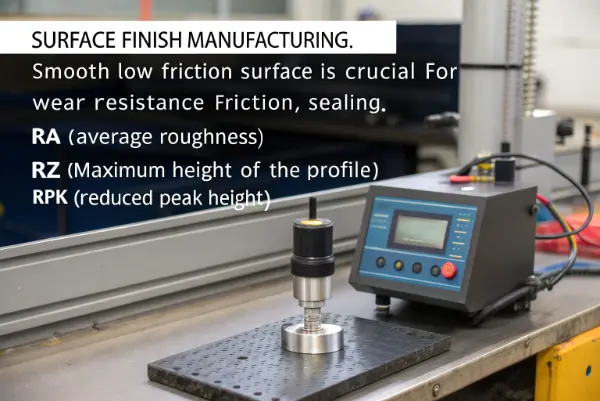
Centerless grinding produces a unique surface pattern. The process generates a cross-hatch pattern that is excellent for retaining lubrication. This is a huge advantage for components like engine pistons or hydraulic shafts. However, if the process is not controlled correctly, it can leave deep scratches or periodic marks that compromise the part’s function. The key is to measure the surface in a way that captures its true functional characteristics.
Relying only on Ra is a common pitfall. Ra gives you the arithmetic average of the peaks and valleys. Two very different surfaces can have the same Ra value. One surface might have uniform, rounded peaks, making it ideal for a bearing. The other might have sharp, jagged peaks that will quickly wear down a mating surface.
I worked on a project for a medical device company that required a component with a very specific sealing capability. The drawing called for Ra 0.4 µm. Our initial batches passed the Ra inspection, but they failed the client’s functional leak test. After a long discussion with their lead engineer, we realized the issue was the presence of occasional deep valleys in the surface, which the Ra measurement was averaging out. We switched to monitoring Rz, which measures the maximum peak-to-valley height. By controlling Rz, we eliminated the deep valleys and the parts started passing the leak test every time.
Here are some important surface finish parameters and what they mean for your part:
Key Surface Finish Parameters
- Ra (Roughness Average): The most common parameter. It gives a general idea of the surface texture but can be misleading. Good for general process control, not for predicting specific functions.
- Rz (Maximum Height of Profile): Measures the absolute distance between the highest peak and lowest valley within a sampling length. It’s very sensitive to individual defects like scratches or burrs. Use this when you need to avoid any large surface imperfections.
- Rpk (Reduced Peak Height): Represents the height of the protruding peaks above the core profile. A low Rpk is desirable for surfaces that need to be wear-resistant, as it means there are no high, sharp peaks to break off during initial run-in. This is a critical parameter for bearing and sealing surfaces.
- Rvk (Reduced Valley Depth): Represents the depth of the valleys below the core profile. A high Rvk is good for surfaces that need to hold lubricant. This is why the cross-hatch pattern from grinding is so valuable.
When specifying surface finish, think about how the part will function. Don’t just copy a generic Ra value from a textbook. For critical components, consider specifying Rz or Rpk/Rvk to ensure the surface will perform as intended.
How Do You Control Taper and Cylindricity Across Long Parts?
Your design involves a long, slender shaft that must fit perfectly into a housing. You measure both ends, and the diameters are spot on. But when you try to assemble it, the shaft gets stuck halfway. The issue is likely taper—a gradual change in diameter along the length of the part.
To control taper and cylindricity, you must take measurements at multiple points along the part’s length, not just at the ends. Use a high-precision micrometer or a laser scanner on a flat surface plate. For the highest accuracy, a Coordinate Measuring Machine (CMM) is required. The key is to compare the maximum and minimum diameter readings to ensure they fall within the specified cylindricity tolerance.
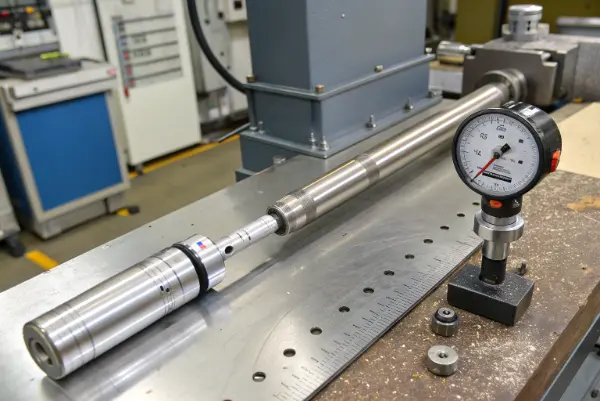
Taper is a natural enemy in centerless grinding, especially on long or thin parts. It happens when the angle between the grinding wheel and the regulating wheel is not set perfectly, or when the work-rest blade is worn unevenly. Even a tiny misalignment can cause the diameter to be slightly larger at one end than the other. Cylindricity is a more complex 3D tolerance that includes taper, roundness, and straightness. For a long part to be truly cylindrical, it must be perfectly round and have no taper from end to end.
I remember a project for an aerospace client involving 500mm long actuator rods. The diameter tolerance was tight, but the cylindricity tolerance was even tighter, at just 0.008mm over the entire length. Checking this was a challenge. We couldn’t just use a micrometer. We set up a dedicated inspection station with a granite surface plate and a high-resolution height gauge with a test indicator. We carefully rolled the part on V-blocks and measured the diameter at 50mm intervals. This process was slow, but it was the only way to guarantee that every single rod was free of taper and met the cylindricity requirement.
Here’s a practical guide to inspecting for these geometric errors:
Methods for Inspecting Taper and Cylindricity
-
Multi-Point Micrometer Check:
- Procedure: Place the part on a clean, flat surface. Measure the diameter at a minimum of three locations: near each end and in the middle. For very long parts, increase the number of measurement points.
- What it tells you: This is a quick check for taper. If the readings differ by more than the allowed tolerance, the part is tapered. It’s a good first-pass method on the shop floor.
-
Surface Plate and Indicator:
- Procedure: Place the part in a pair of matched V-blocks on a granite surface plate. Position a dial test indicator over the top of the part. Zero the indicator at one end, then slowly roll the part and slide the V-blocks to check for variations along the length.
- What it tells you: This method measures variations in the radius relative to a central axis. It is excellent for detecting both taper and issues with straightness.
-
Coordinate Measuring Machine (CMM):
- Procedure: The CMM probe touches the part at hundreds or thousands of points along its surface, creating a complete 3D digital model. The software then calculates the cylindricity by finding the smallest cylinder that can contain all the measured points.
- What it tells you: This is the most accurate and comprehensive method. It provides a definitive pass/fail result against the cylindricity tolerance specified in the drawing (symbol: ⌭). For mission-critical parts, a CMM report is the ultimate proof of quality.
When you are sourcing long, precise parts, ask your supplier how they plan to measure and control for taper and cylindricity. Their answer will tell you a lot about their level of expertise.
Which Standards and Calibration Routines Are Non-Negotiable?
You’ve set up your measurement tools and processes. But how do you ensure your measurements are accurate and consistent over time? Without proper standards and calibration, your entire quality control system can fall apart. Your measurements are only as reliable as the tools you use to make them.
The non-negotiable elements are adhering to geometric dimensioning and tolerancing (GD&T) standards like ISO 1101 and ASME Y14.5, and implementing a strict calibration schedule for all measurement equipment. Every tool, from micrometers to CMMs, must be regularly calibrated against traceable master gauges. This ensures that a measurement taken in your shop is the same as one taken by your client.
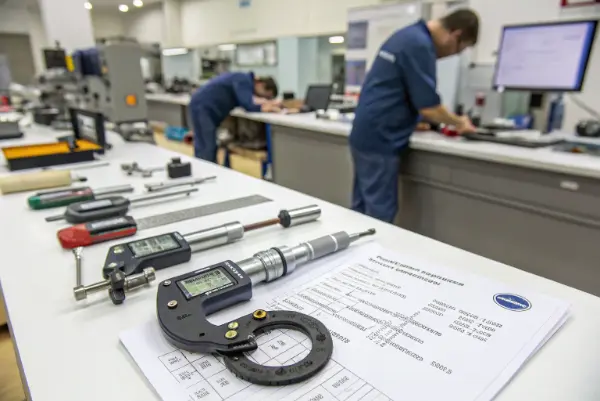
Standards and calibration are the foundation of trust in manufacturing. When I send a part to Alex in Germany, he needs to be confident that my measurement of 20.005mm is the same as his. This is only possible if both of us are using calibrated tools and speaking the same language of tolerances. That language is GD&T. These standards provide a clear, unambiguous way to define and inspect geometric features.
In my shop, nothing is left to chance. Every single measurement tool has a calibration schedule.
- Micrometers and Calipers: Calibrated monthly against a set of certified gauge blocks.
- Dial Indicators: Checked weekly for smooth operation and calibrated quarterly.
- Profilometer: Calibrated daily using a certified roughness standard specimen before the first use of the day.
- CMM: Calibrated annually by a certified third-party technician, with interim checks performed monthly.
We keep detailed records of every calibration event. This is not just for our own internal control; it’s a critical part of our ISO 9001 certification and a key reason why our clients trust us. If a client ever questions a measurement, I can provide the full calibration history for the exact tool that was used to inspect their part. This level of traceability is non-negotiable in precision manufacturing.
Here’s why this disciplined approach is so critical:
The Pillars of a Reliable QC System
- Traceability: Calibration must be traceable to national or international standards (like those from NIST in the USA or PTB in Germany). This creates an unbroken chain of comparisons, ensuring universal accuracy. Ask your supplier if their calibration is traceable.
- Consistency: A regular calibration schedule prevents measurement drift. Tools wear down, electronics can fluctuate, and environments can change. Regular checks catch these issues before they lead to out-of-spec parts being produced or accepted.
- Clarity (GD&T): Using GD&T on your drawings removes ambiguity. A simple diameter tolerance doesn’t define form. A cylindricity or roundness callout, as defined in ASME Y14.5 or ISO 1101, provides a clear, inspectable requirement that both you and your supplier can understand perfectly.
- Environment Control: For the highest precision, measurements must be taken in a temperature-controlled environment (typically 20°C or 68°F). Metal expands and contracts with temperature. A part measured in a hot workshop will be physically smaller when measured in a cool inspection lab.
Building a robust quality system isn’t just about buying expensive tools. It’s about creating a culture of discipline around standards, calibration, and meticulous record-keeping. It’s the only way to ensure that what you measure is what you actually have.
Conclusion
Mastering quality control in centerless grinding requires moving beyond basic checks and embracing advanced techniques for form, finish, and consistent calibration, ensuring every part is truly perfect.