
Choosing the right machining process feels like a high-stakes decision. Make the wrong call, and you risk blowing your budget, missing deadlines, and getting parts that don’t work. This is a common problem for engineers who need to turn a design into a physical reality.
For projects requiring high precision, complex geometries, or multiple identical parts, CNC machining is the superior choice. Its automated process guarantees repeatability and accuracy. Manual machining is better suited for simple, one-off jobs, quick repairs, or initial prototypes where the design is still evolving and the cost of a single part is the main concern.
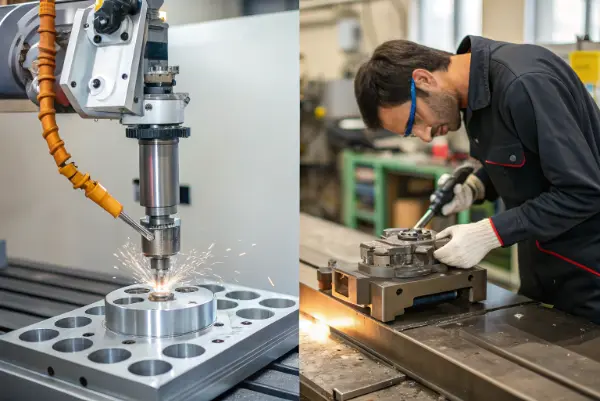
You now have the basic rule of thumb. But the real expertise comes from understanding the nuances behind that rule. Knowing when to break it can save you thousands of dollars, and knowing why it holds true can prevent a production disaster. I’ve spent over a decade helping clients navigate this choice. Let’s dig deeper into the factors that should guide your decision, moving beyond the simple answer and into practical application.
What is the difference between CNC machining and manual machining?
On the surface, both methods use cutting tools to remove material from a workpiece. But not understanding their fundamental operational differences can lead to costly assumptions. You might think you’re saving money with one method, only to realize you’ve compromised a critical design feature.
The core difference is the control system. Manual machining relies entirely on the skill and direct physical input of an operator turning cranks and reading dials. CNC (Computer Numerical Control) machining, on the other hand, uses a computer program (G-code) to automate the machine’s movements, executing pre-programmed instructions with extreme precision and repeatability.
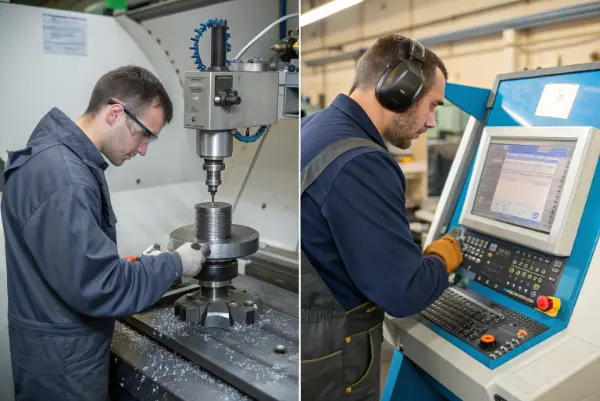
This distinction between human control and computer control changes everything about the process. I’ve worked in shops with both, and they feel like two different worlds. Let’s break this down further to see how it impacts your project.
The Heart of the Operation: Brain vs. Brawn
In a manual setup, the machinist is the computer. They are the brain behind the entire operation. I remember working alongside an old master machinist named Mr. Lee. He could look at a 2D drawing, and in his mind, he could see the 3D part. He would walk up to his Bridgeport mill, and with a series of deliberate, practiced movements of the cranks, he would bring that part to life. He was constantly listening to the sound of the cut, feeling the vibrations through the handles, and making tiny adjustments on the fly. It was a true craft, a blend of art and science that depended entirely on his decades of experience. His skill was not easily transferable; he was the process.
In CNC machining, the skill shifts from hands-on craft to digital proficiency. Here, the operator acts more like a pilot or a programmer. The process starts with a 3D CAD model—the digital blueprint. This model is fed into CAM (Computer-Aided Manufacturing) software, which generates the toolpaths and outputs the G-code. The operator’s job is to select the right tools, secure the workpiece, load the program, and run a simulation. Once they hit ‘Cycle Start,’ the computer takes complete control. The operator’s role becomes one of monitoring and quality control. This is why a client like Alex in Germany can send us a file, and we can produce a part identical to his design without him ever touching the machine himself.
A Structured Comparison
To make it even clearer, here is a table that breaks down the essential differences:
| Feature | Manual Machining | CNC Machining |
|---|---|---|
| Control System | Human operator (hands-on) | Computer program (G-code) |
| Primary Input | 2D Blueprints, Operator Skill | 3D CAD Files, CAM Software |
| Operator’s Role | Direct machine operation, constant input | Programming, setup, and monitoring |
| Ideal Use Case | Simple parts, quick repairs, single prototypes | Complex geometry, production runs |
| Repeatability | Low to moderate (depends on operator) | Extremely high and consistent |
| Labor Skill | Manual dexterity, feel, "artisan" craft | Digital literacy, programming, process control |
The key takeaway is that manual machining is a subtractive process guided by a human, while CNC machining is a subtractive process guided by a computer. This fundamental difference is the root of all the other advantages and disadvantages we will discuss.
Why is CNC machining preferred over manual machining?
You see CNC machines in every modern manufacturing facility, but is the hype and investment always justified? It’s easy to wonder if this advanced technology is truly necessary for your parts, or if you could get by with a simpler, more traditional approach.
CNC machining is preferred in modern manufacturing for its unmatched consistency, its ability to produce highly complex parts, and its overall efficiency in production. Automation drastically reduces human error, allows for continuous operation, and makes geometries that are physically impossible for a human to machine manually. This makes it essential for today’s advanced industries.
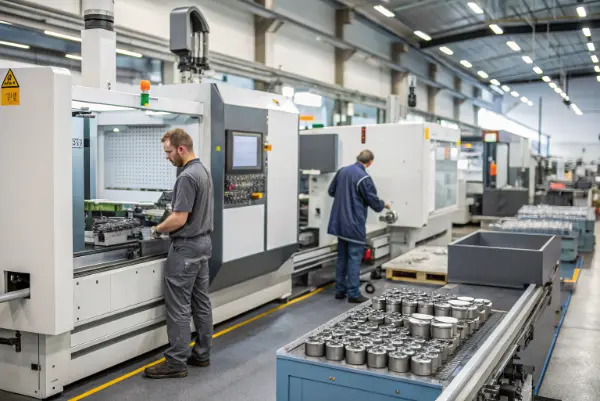
The preference for CNC isn’t just about chasing new technology; it’s about meeting the strict demands of modern engineering. For a professional like Alex, who designs components for robotic arms, these benefits are not just "nice to have"—they are absolutely critical for his products to function correctly and safely. Let’s explore the specific reasons why CNC has become the industry standard.
Unmatched Consistency and Repeatability
Imagine you’re building a robotic assembly with 50 identical joints. If each joint is machined manually, there will be tiny, unavoidable variations between them. One might be a fraction of a millimeter longer, another might have a hole that is slightly off-center. When you try to assemble them, these small errors add up. The assembly might be stiff, misaligned, or fail altogether.
This is where CNC shines. Once a program is perfected, a CNC machine can produce the first part and the 10,000th part with virtually no deviation. I once had a client who came to us after a project failed. They had outsourced 200 small, intricate housings to a manual shop to save costs. The parts looked fine individually, but less than 30% of them fit correctly with the mating electronic components. We reprogrammed the job for one of our CNC mills and ran the entire batch. Every single part was a perfect fit. For any product that requires interchangeable parts or series production, this level of consistency isn’t just a preference; it’s a requirement.
Conquering Geometric Complexity
Manual machines, like a standard 3-axis mill, primarily work on a 2.5D plane. The operator can move the tool along the X, Y, and Z axes, but creating smooth, complex, multi-dimensional curves is incredibly difficult, if not impossible.
Modern product design, from medical implants that mimic bone structures to aerodynamic aerospace parts, relies on complex surfaces and organic shapes. This is where advanced CNC machines, particularly 5-axis systems, become essential. A 5-axis machine can move a cutting tool across five different axes simultaneously. This allows it to machine intricate features, deep cavities with sloped walls, and smooth contoured surfaces in a single setup. A skilled manual machinist might spend days trying to approximate a complex curve using multiple setups and special fixtures. A 5-axis CNC machine can produce a perfect, smooth surface in a fraction of the time, following the digital model with sub-millimeter precision. This capability opens up a world of design possibilities that are simply out of reach for manual processes.
Which machining process is more accurate?
Engineers and designers are obsessed with accuracy. Your entire design can fail if a critical dimension is off by the width of a human hair. So, when choosing a manufacturing method, one of the first questions you should ask is: which one can hold the tightest tolerances?
CNC machining is fundamentally more accurate than manual machining. While a highly skilled manual machinist can achieve impressive tolerances, CNC machines consistently deliver higher precision due to the elimination of human error, the use of computer-controlled movements, and advanced feedback systems. For tight tolerances of ±0.01mm or better, CNC is the only reliable choice.
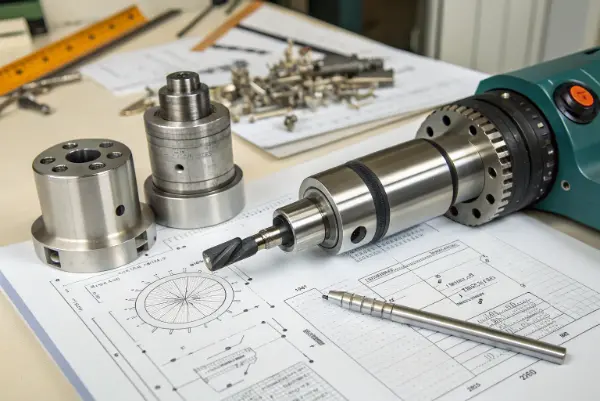
The debate isn’t about whether a manual machinist can be accurate—they can. The real issue is consistency and the ultimate limits of that accuracy. I’ve seen machinists create beautiful, precise parts by hand. But when a drawing calls for tolerances that push the boundaries of manufacturing, automation is no longer a luxury; it’s a necessity.
The Human Factor vs. The Digital Blueprint
The accuracy of manual machining is directly tied to the machinist’s skill, focus, and even their physical state. Reading a vernier caliper, turning a crank to the perfect mark, and compensating for tool wear all introduce potential for small errors. Even the most skilled operator can have a momentary lapse in concentration or misread a dial, leading to a scrapped part. Over a long day, fatigue sets in, and holding tight tolerances becomes progressively harder.
CNC machining removes these variables. The machine’s movements are dictated by G-code derived directly from the CAD file—the digital source of truth. The machine doesn’t get tired or distracted. It executes path calculations to a degree of precision far beyond human capability. A modern CNC machine can make positional moves in increments of 0.001mm (1 micron), an order of magnitude smaller than what a human can reliably achieve with hand wheels. For an engineer like Alex, whose robotic components require absolute precision for smooth and predictable motion, this level of digital accuracy is non-negotiable.
The Role of Technology in Pushing Boundaries
Beyond the basic control system, CNC machines incorporate technologies that further enhance their accuracy.
- Ball Screws and Linear Guides: Unlike the standard lead screws on manual machines, CNC machines use high-precision ball screws that eliminate backlash (the "slop" or play in the screw). This ensures that when the computer commands a 10.00mm move, the machine moves exactly 10.00mm.
- Closed-Loop Feedback Systems: Advanced CNC machines use encoders and probes that constantly measure the machine’s actual position and feed that information back to the controller. If there is any deviation from the programmed path—due to thermal expansion or tool pressure, for example—the controller makes real-time corrections. This is like having a digital supervisor checking the work millions of time per second.
- Probing and Tool Measurement: Before cutting, a CNC machine can use an automated probe to precisely locate the workpiece and set its work offsets. It can also use a tool setter to measure the exact length and diameter of each cutting tool, automatically compensating for any variation. This automated setup process is far more accurate and repeatable than the manual methods used by even the best machinists.
While a manual machinist can achieve tolerances of around ±0.05mm on a good day with a simple feature, a standard CNC machine can reliably hold ±0.02mm all day long. And our high-end machines at QuickCNCs regularly deliver parts with tolerances of ±0.005mm for critical applications. For ultimate precision, CNC is the undisputed winner.
What is the biggest disadvantage of using CNC?
CNC machining sounds like the perfect solution, but it’s not. Ignoring its drawbacks can lead to surprise costs and project delays. I’ve seen teams invest heavily in a CNC-based prototype only to realize a simpler, cheaper method would have been much faster for their needs.
The biggest disadvantage of using CNC machining is the high initial setup cost and complexity. This includes the expensive machinery itself, the required software (CAD/CAM), and the time-intensive process of programming, setup, and fixture design. For simple, one-off parts, this upfront investment in time and money often outweighs the benefits.
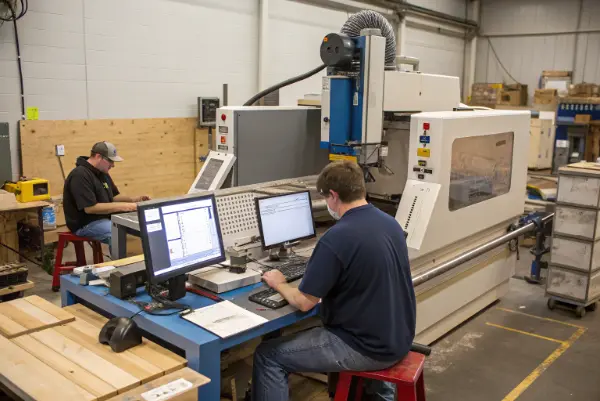
This initial barrier is significant. While CNC is incredibly efficient once the machine is running, getting to that point requires a substantial investment that isn’t always practical, especially for small-scale projects or early-stage R&D. Let’s unpack what contributes to this high initial cost.
The Upfront Investment: Time and Money
Unlike manual machining, where you can walk up to a mill with a drawing and start cutting within minutes, the CNC process has a significant "pre-flight" phase.
- Programming: Every new part requires a CNC program. This involves a skilled programmer using CAM software to generate the toolpaths, select cutting strategies, and simulate the process to avoid collisions. This programming can take anywhere from an hour for a simple part to days for a complex 5-axis component. This is skilled labor, and it costs money.
- Setup and Fixturing: Once the program is ready, the machine must be set up. This involves installing the correct cutting tools, calibrating their lengths, and designing and creating a fixture to securely hold the raw material. For complex parts, designing and making a custom fixture can be a project in itself, adding significant time and cost before a single chip is made.
- First-Part Inspection: The first part off the machine must be meticulously inspected to ensure the program and setup are correct. Any errors found require adjustments to the program and potentially a new setup.
For a single, simple part—like drilling a few holes in a plate or facing a block to size—a manual machinist could be done in the time it takes a CNC programmer just to finish the CAM work. This is why manual machining still holds a vital place for repairs, quick modifications, and one-off fixtures. The cost of CNC setup for such a simple job would be prohibitive.
The Cost-Benefit Analysis
The high setup cost creates a clear break-even point.
| Factor | Manual Machining | CNC Machining |
|---|---|---|
| Setup Cost | Very Low | High |
| Per-Part Cost (Running) | High (slow, labor-intensive) | Very Low (fast, automated) |
| Total Cost for 1 Part | Low | High |
| Total Cost for 1,000 Parts | Extremely High | Low |
As you can see, the economics are clear. For one part, manual is often cheaper. But as the quantity increases, the high setup cost of CNC is amortized over all the parts, and the low running cost makes it far more economical. I always advise my clients to consider their total project scope. If you’re making a single prototype that you know will change, manual might be better. If you’re making a prototype that you plan to scale to production, starting with CNC ensures a smooth transition, as the program will already be developed.
Conclusion
Choosing between CNC and manual machining depends on your project’s specific needs for precision, complexity, volume, and budget. CNC excels at repeatable accuracy, while manual machining offers speed for simple, one-off jobs.