
Are you struggling with glass-to-metal seals breaking in your electronics? Thermal changes can ruin a perfect design fast. Let me show you how Kovar alloy solves this exact problem and keeps your sensitive parts safe from heat damage.
Kovar is a nickel-cobalt-iron alloy perfectly matched to the thermal expansion rate of hard glass and ceramics. This unique property ensures a tight, leak-proof seal in microelectronic packaging over a wide temperature range. It protects delicate chips from moisture and physical stress, making it an absolute must for high-end devices.
I remember working on a big project a few years ago. A client lost a lot of money because their sensor housing cracked under high heat. They did not use the right metal for the job. If you want to avoid these bad mistakes, you need to understand how to design and machine Kovar the right way. Let us look at the best ways to use this metal.
What makes Kovar the best choice for microelectronic packaging?
Do your electronic housings fail when temperatures change fast? That is a bad nightmare for any engineer. Kovar stops these failures completely. It grows and shrinks at the exact same rate as the glass around it.
Kovar is the best choice because its Coefficient of Thermal Expansion (CTE) closely matches hard glass and alumina ceramics. This means when the package heats up or cools down, the metal and the glass move together. This matching movement prevents cracks and keeps a very strong, permanent vacuum seal.
The Secret Behind the Heat Match
Kovar is not just a random mix of metals. It is a very specific recipe. It contains mostly iron, a good amount of nickel, and some cobalt. This exact mix makes the magic happen. When you put a delicate computer chip inside a glass and metal box, you want that box to stay totally sealed. If the metal gets bigger faster than the glass when it gets hot, the glass will break. If the glass gets bigger faster, the seal will open. Both ways, air gets in and ruins the chip. Kovar stops this.
I see many engineers try to use normal stainless steel to save money. I always tell them to stop. Standard steel will push against the glass and crack it. Kovar acts like a partner to the glass. They hold hands and move together. You do not want to risk your whole system just to save a few dollars on the raw metal.
Here is a simple look at what makes Kovar work so well compared to other metals. You can see why we pick it for glass seals.
| Material Type | Heat Expansion Match | Good for Glass Seals? |
|---|---|---|
| Kovar Alloy | Exact match to hard glass | Yes, very good |
| Standard Aluminum | Grows way too fast | No, will crack glass |
| 304 Stainless Steel | Grows too fast | No, seal will fail |
| Pure Copper | Grows very fast | No, too soft and fast |
This table shows why Kovar wins every time. It is the only metal that truly plays nice with glass when things get hot.
How do you design Kovar parts to avoid machining defects?
Have you ever received Kovar parts with rough edges or bad sizes? Kovar is tough and sticky. It ruins cutting tools very quickly. Good design choices can make machining much easier and safer.
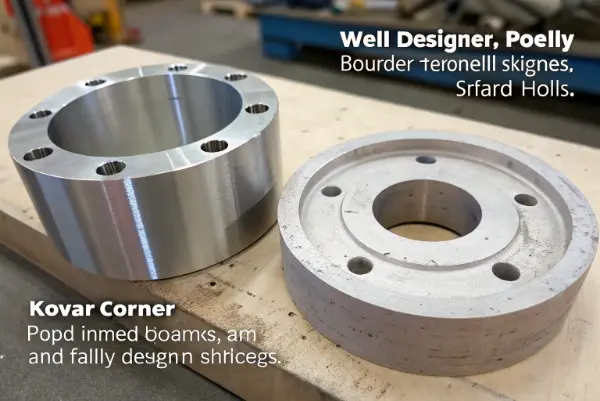
To avoid machining defects in Kovar, you must design with big inner corners and avoid deep, narrow holes. Keep your wall thickness even to stop the part from bending during heat treatment. Use standard hole sizes so your CNC shop can use normal drills instead of custom tools.
Smart Design for Better Cutting
Cutting Kovar is hard work. It acts a lot like soft titanium. It likes to stick to the cutting tool. When the metal sticks to the tool, the tool breaks. When the tool breaks, your part gets ruined. I always check my clients’ drawings before we start the CNC machines. I look for things that will make the cutting process hard.
If you design a box with perfectly sharp inner corners, my tools cannot cut that. A round tool cannot make a square hole. I have to use a very tiny tool to try and get close to a sharp corner. Tiny tools break easily in Kovar. You should always give me a big, round corner. This lets me use a big, strong tool. The big tool cuts faster and leaves a much smoother finish.
Also, think about the walls of your part. If you have one very thick wall and one very thin wall, the part will bend. Kovar gets hot when we cut it. It also needs heat treatment later to make it soft for the glass seal. Uneven walls warp under heat. Keep everything the same size if you can.
Here is a guide on how to design better parts for us to make.
| Bad Design Idea | Good Design Idea | Why it helps us |
|---|---|---|
| Sharp inner corners | Big round corners | Stronger tools will not break |
| Very deep tiny holes | Shallow wider holes | Drills will not snap off |
| Uneven wall sizes | Even wall sizes | Part will not bend in heat |
| Custom thread sizes | Standard thread sizes | We can buy cheap normal taps |
Follow these simple rules. Your parts will come out perfect, and we will make them much faster.
What are the best practices for welding and sealing Kovar?
Is your glass seal leaking air after welding? A bad weld can destroy a very expensive microelectronic package. You need the right surface cleaning and welding plan to keep the vacuum tight.
The best practice for welding Kovar is to plate the surface with nickel or gold first. This plating stops bad rust and makes the weld much stronger. Laser welding and resistance welding work best. You must also wash the parts completely to remove all machining oils before you heat them.
Getting the Perfect Seal Every Time
Making Kovar parts is only half the job. Putting the glass and metal together is the hardest part. You want to make a box that no air or water can enter. We call this a hermetic seal. To get this seal, the Kovar must be totally clean.
When we cut Kovar on our CNC machines, we use a lot of oil to keep the tools cold. This oil gets deep into the metal. If you try to melt glass onto oily Kovar, the oil will burn. It will make dirty bubbles in the glass. Those bubbles will pop and let air inside your package. You must wash the Kovar parts in special strong soap before you do anything else.
After you wash the parts, you need to put a very thin layer of nickel or gold on them. Kovar will rust a little bit when it gets hot. This rust makes the glass slip off. The gold or nickel acts like a clean skin. The glass loves to stick to it. When you weld the lid on, you should use a laser. A laser gives a very tiny, fast burst of heat. It melts the metal shut before the heat can travel down and break the glass.
Here are the steps we use to get a great seal.
| Step Number | What to do | Why it is important |
|---|---|---|
| Step 1 | Wash parts in strong soap | Removes all cutting oils |
| Step 2 | Heat in special gas oven | Removes stress from cutting |
| Step 3 | Plate with gold or nickel | Stops rust and helps glass stick |
| Step 4 | Melt glass into the metal | Makes the main tight seal |
| Step 5 | Laser weld the top lid | Closes the box without too much heat |
If you skip one of these steps, your part will leak. I have seen it happen many times. Take your time and do it right.
How can you reduce the cost of custom Kovar CNC machining?
Are your Kovar parts costing way too much money? The raw metal is expensive, and slow machining adds a lot to the bill. But you can easily cut down these high costs with a few smart moves.
You can reduce Kovar machining costs by buying standard block sizes and avoiding very tight sizes where you do not need them. Talk to your CNC partner early in the design stage. They can give you minor changes that speed up cutting time, save tool life, and lower the final price.
Keeping Your Budget Under Control
Kovar is not cheap. The nickel and cobalt in the metal cost a lot of money in the raw market. Because it is so hard to cut, we have to run our machines slower. Slow machine time means you pay more money per hour. But I always tell my clients that they have power over the final cost. You just need to know where to look.
The biggest mistake I see is engineers asking for crazy tight sizes everywhere on the part. If your drawing says every side of the box must be perfect to 0.005mm, I have to work very hard. I will check the part ten times. I will throw away bad parts. You will pay for all that extra time and scrap metal. Look at your design. Does the outside bottom of the box need to be perfect? Probably not. Only make the areas that touch the glass super tight. Let the rest of the box be normal.
Another good trick is to use standard block sizes. If you need a box that is 21mm tall, see if a 20mm tall box works instead. We can buy 20mm raw metal bars very easily. If you want 21mm, we have to buy a 25mm bar and spend an hour cutting it down. You pay for that wasted metal and time.
Here are the best ways to keep your Kovar bills low.
| Cost Problem | How to fix it | Money Saved |
|---|---|---|
| Tight sizes everywhere | Only use tight sizes on glass joints | High |
| Weird part heights | Design part to fit standard raw bars | Medium |
| Sharp corners wearing tools | Make all corners big and round | High |
| Waiting until the end to ask us | Send drawings early for our ideas | Very High |
Work with me early. I can point out these small things before you lock your design. We both win when the part is easy to make.
Conclusion
Kovar alloy is the perfect choice for safe microelectronic packaging. By matching heat expansion and using smart CNC design, you can build strong, leak-proof housings while saving money.