
Transmission shafts are the backbone of your mechanical system, but when they fail, the entire machine halts. Are you tired of unexpected downtime and costly repairs caused by snapped or worn-out shafts?
Transmission shaft failure usually stems from four primary causes: fatigue fracture from cyclic loading, excessive wear due to poor lubrication or contamination, corrosion in harsh environments, and plastic deformation from overloading. Preventing these issues requires selecting the right materials (like 4140 steel), ensuring precise alignment during assembly, and implementing a strict maintenance schedule.
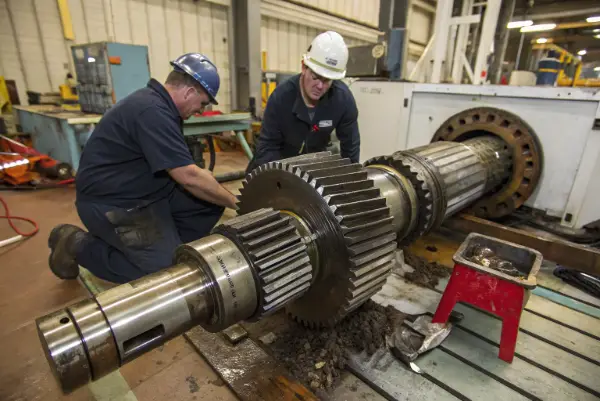
Let’s be honest. Seeing a shaft fail in a prototype or a production unit is a nightmare. I have seen it happen too many times in my career, from small robotic joints to massive industrial gearboxes. It usually means delays, angry bosses, and a lot of stress. But if we understand exactly how these shafts break, we can design them better from the start. Let’s dig into the specific failure modes so you can stop them before they start.
Why Does Fatigue Failure Happen in Transmission Shafts?
Fatigue is the silent killer of mechanical parts, often striking without any visible warning signs until it is too late. You might think your design is strong enough, but are you accounting for millions of stress cycles?
Fatigue failure occurs when a shaft is subjected to repeated cyclic loading, causing microscopic cracks to form and grow over time until the part snaps. This often happens at stress concentration points like keyways, sharp shoulders, or drilled holes, even if the load is well below the material’s yield strength.
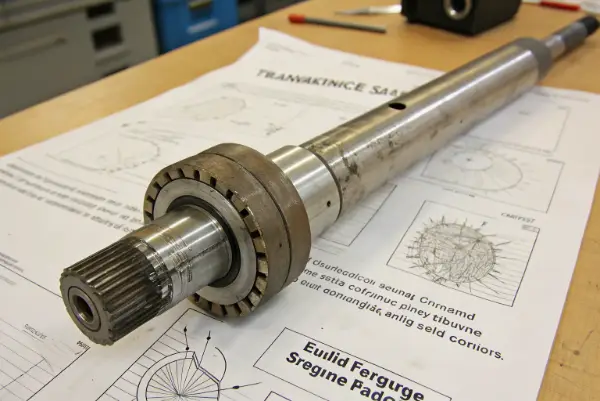
Fatigue is tricky. I remember a project involving a robotic arm for a client in Europe. The shaft looked perfect on paper. The static load calculations showed a safety factor of 3.0. Yet, three months into operation, the shaft snapped cleanly in half. Why? We ignored the specific stress concentrations at a sharp step in the shaft diameter.
To understand this better, we need to look at the mechanism of crack propagation. A tiny imperfection initiates a crack. As the shaft rotates, that crack opens and closes. Eventually, the remaining material cannot support the load, and it breaks instantly.
Here is a breakdown of how to diagnose and prevent this:
Diagnosis of Fatigue Failure
- Beach Marks: Look at the fracture surface. You will often see "beach marks" or "clamshell marks." These concentric lines show where the crack stopped and started.
- Smooth Zone vs. Rough Zone: The area where the crack grew slowly will look smooth. The final break area will look rough and granular.
- Origin Point: The cracks almost always start at a stress riser—a sharp corner, a keyway, or a surface scratch.
Prevention Strategies
| Strategy | Description | Why it Works |
|---|---|---|
| Increase Fillet Radii | Avoid sharp 90-degree corners at diameter changes. | Spreads out the stress flow lines, reducing peak stress. |
| Surface Finish | Polish critical areas or use shot peening. | Removes micro-scratches that act as crack initiators and induces compressive stress. |
| Material Choice | Use alloy steels like AISI 4340 or 4140. | These materials have higher fatigue limits compared to standard carbon steel. |
If you are designing high-speed shafts, you must run Finite Element Analysis (FEA). Do not just look at the maximum load. Look at the cyclic load. It saves you money in the long run.
How Does Surface Wear Destroy Shaft Integrity?
Friction is unavoidable, but when does normal operation turn into destructive wear? Ignoring the signs of abrasive or adhesive wear leads to loose tolerances and eventual system failure.
Surface wear happens when material is removed from the shaft due to friction against bearings, seals, or gears, often accelerated by poor lubrication or dirt. This leads to a loss of dimension accuracy, causing vibration, noise, and eventually, the inability to transmit torque effectively.
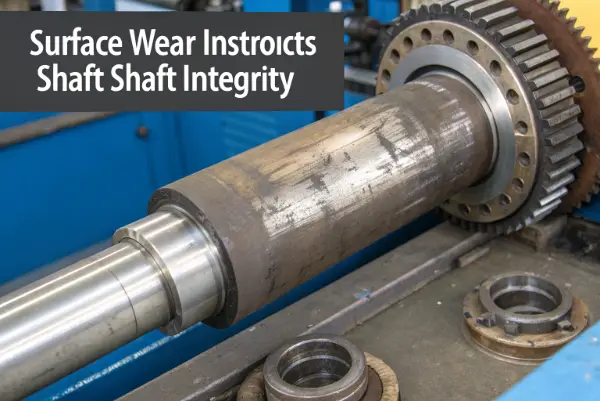
Wear is less dramatic than a snapped shaft, but it is just as deadly to precision. In my shop, we often see shafts come in for repair not because they broke, but because the bearing seat wore down by 0.05mm. In the world of robotics, 0.05mm is a disaster. It introduces backlash. The robot arm starts to jitter.
There are two main types of wear we see constantly:
- Abrasive Wear: This is when hard particles (dust, metal chips) get between the shaft and the mating part. They act like sandpaper.
- Adhesive Wear: This happens when lubrication fails. Metal touches metal. The high points of the surfaces weld together microscopically and then tear apart. This is often called "galling."
Analyzing the Root Causes
You need to identify the specific type of wear to fix it.
- Check the Lubricant: Is it dirty? If you see glitter in the oil, that is metal. You have abrasive wear.
- Check the Hardness: Is the shaft softer than the bearing? If the shaft is not hardened, the bearing might eat into it.
- Check the Environment: Is the machine in a dusty factory? If seals fail, dust gets in.
Solutions for Wear Resistance
- Heat Treatment: We recommend Induction Hardening or Case Hardening (Carburizing) for shaft journals. This makes the surface extremely hard (HRC 55-60) while keeping the core tough.
- Coating: Chrome plating or ceramic coatings can provide a hard, slick barrier.
- Better Seals: If dirt is the problem, no steel is hard enough. You must improve the sealing design to keep contaminants out.
Can Corrosion Be the Primary Cause of Shaft Failure?
We often think of steel as invincible, but what happens when chemical reactions attack the surface? Corrosion does not just look bad; it creates weak points that lead to catastrophic failure.
Corrosion failure occurs when the shaft material chemically reacts with its environment—such as moisture, acids, or salt—creating pits that reduce the cross-sectional area and act as stress risers. This significantly lowers the fatigue strength of the shaft, making it break under loads it should easily handle.
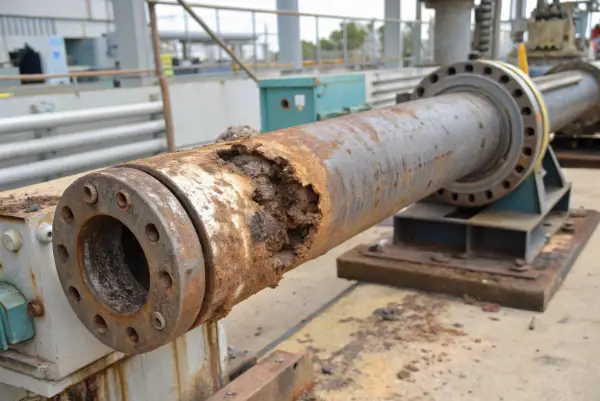
I once worked with a client making food processing equipment. They used standard 4140 steel for a drive shaft. It was strong, but the factory washed the machines down with harsh chemicals every night. Within six months, the shafts were pitted. One snapped unexpectedly. The corrosion pits acted exactly like a sharp notch in the steel.
Corrosion is deceptive. It eats away at the surface integrity. Even a small pit can reduce fatigue strength by 50% or more. This is called "corrosion fatigue."
Identifying Corrosion Types
- General Rust: The whole surface turns red/brown. This is obvious but usually slow.
- Pitting: Small, deep holes form. This is dangerous because it is hard to see but creates deep stress cracks.
- Fretting Corrosion: This happens between two tight-fitting parts (like a bearing on a shaft) that vibrate slightly. It produces a fine red powder.
Mitigation Techniques for Engineers
When you design for harsh environments, you must think about chemistry, not just physics.
| Protection Method | Detail | Best Application |
|---|---|---|
| Stainless Steel | Use grades like 304, 316, or 17-4 PH. | 17-4 PH is excellent because it is strong and corrosion-resistant. Standard 304 is too soft for high torque. |
| Plating | Zinc, Nickel, or Chrome plating. | Good for mild environments where cost is a major factor. |
| Black Oxide | A chemical conversion coating. | Only offers very mild protection. Mostly for aesthetics or indoor use. |
| Anodizing | Only for aluminum shafts. | Creates a hard, protective oxide layer. |
Don’t assume paint is enough. Paint chips. Once it chips, the corrosion starts underneath and spreads. For critical shafts, choose the right material or a chemical plating process.
How Does Overload Cause Plastic Deformation?
What happens when a machine is pushed beyond its design limits for just a second? Permanent twisting or bending of the shaft destroys alignment and renders the machine useless.
Plastic deformation happens when the stress on the shaft exceeds the material’s yield strength, causing it to bend or twist permanently without breaking. This is usually caused by a sudden shock load, a machine jam, or a motor providing more torque than the shaft diameter can handle.
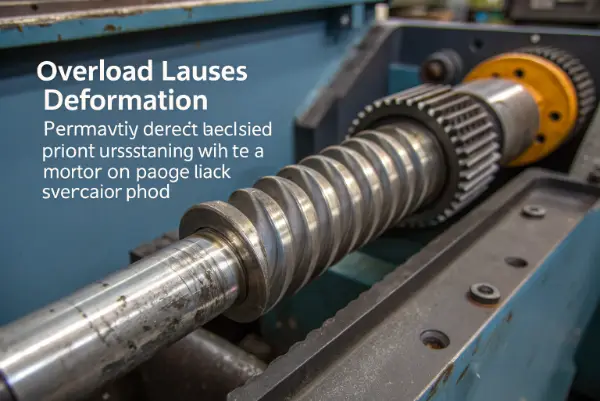
Plastic deformation is frustrating because the part is still in one piece, but it is ruined. I recall a case with a heavy-duty conveyor. A heavy box got stuck. The motor kept pushing. The shaft did not snap, but it twisted about 15 degrees. The keyway was deformed, and the timing of the whole machine was off. We had to replace the whole unit.
This is strictly a matter of yield strength. Unlike fatigue, which happens over time, plastic deformation happens instantly.
Signs of Deformation
- Runout: Put a dial indicator on the shaft and rotate it. If the needle jumps, the shaft is bent.
- Keyway Roll: The sides of the keyway will look pushed out or rounded.
- Vibration: A bent shaft is an unbalanced shaft. It will shake the whole machine.
Preventing Overload Failures
This is a design and safety issue.
- Calculate the Shock Factor: Do not just design for the running torque. Design for the "stall torque" of the motor or the impact of a sudden stop. Use a safety factor of 2.0 to 4.0 depending on the application.
- Use Torque Limiters: Install a mechanical fuse (shear pin) or a slip clutch. If the machine jams, this cheap part breaks or slips, saving the expensive shaft.
- Upgrade Materials: Move from a low-carbon steel (like 1018) to a heat-treated alloy (like 4140 Pre-hard or 4340). This drastically increases the yield strength.
- Increase Diameter: It sounds simple, but increasing the shaft diameter by just 10% increases its torsional strength significantly (since strength is proportional to the cube of the diameter).
Sometimes, engineers try to save weight by making shafts too thin. In my experience, a slightly heavier shaft is better than a bent one.
Conclusion
To stop transmission shafts from failing, you must identify if the enemy is fatigue, wear, corrosion, or overload. By choosing the right material, improving geometry, and planning for shock loads, you ensure your machines run smoothly and last longer.