
High-torque environments destroy weak components. You design a powerful robotic arm, but the transmission shaft shears under load, causing expensive downtime and safety risks. This failure is a nightmare for engineers.
Transmission shaft solutions for high-torque applications rely on selecting high-strength alloy steels (like 4340 or 4140), utilizing spline profiles for better load distribution, and applying heat treatments like induction hardening. Success depends on balancing material toughness with precise geometric tolerances to prevent fatigue failure during continuous heavy-duty cycles.
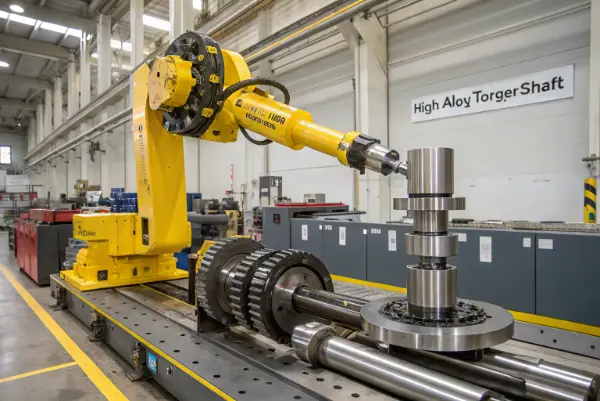
Choosing the wrong shaft isn’t just a design error; it is a business risk. In my years running QuickCNCs, I have seen brilliant designs fail because the shaft material was just slightly off-spec or the manufacturing process ignored surface finish. We need to look deeper into the specific choices that keep your machines running.
What Are the Best Materials for High-Torque Transmission Shafts?
Standard steel often cracks under extreme pressure. If you use generic mild steel for a heavy-duty gearbox, you are inviting catastrophic failure before the testing phase even ends.
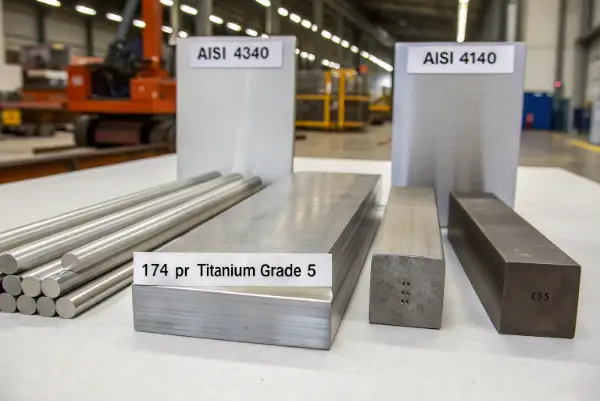
The best materials for high-torque shafts are alloy steels such as AISI 4340, AISI 4140, and 17-4 PH stainless steel. These metals offer high tensile strength and excellent fatigue resistance. For extreme cases, Titanium Grade 5 offers high strength with lower weight, though at a higher cost.
Analyzing Material Properties
When I talk to engineers like Alex from Germany, the first question is always about the material certificate. You cannot build a high-torque system on guesswork. The material dictates the lifespan of the part.
Let’s break down why these specific alloys work better than others. It is not just about being "hard." It is about how the material handles twisting forces (torsion) over time.
- AISI 4340 (Nickel-Chromium-Molybdenum Steel): This is the gold standard for many aerospace and heavy machinery parts. It has incredible toughness. If your shaft faces shock loads—like a robotic arm hitting a hard stop—4340 is forgiving. It bends slightly before it breaks.
- AISI 4140 (Chromium-Molybdenum Steel): This is the workhorse. It is cheaper than 4340 but still very strong. It is easier to machine, which lowers your production costs at QuickCNCs.
- 17-4 PH Stainless Steel: If your high-torque application is in a wet or corrosive environment (like food processing or marine robotics), rust will kill a standard steel shaft. 17-4 PH gives you the strength of an alloy steel with the rust resistance of stainless.
Here is a comparison table to help you decide:
| Material | Yield Strength (approx) | Machinability | Cost | Best Use Case |
|---|---|---|---|---|
| AISI 1045 | 310 MPa | Excellent | Low | Low-torque, general purpose |
| AISI 4140 | 655 MPa | Good | Medium | Heavy axles, conveyor shafts |
| AISI 4340 | 710 MPa | Fair | High | Aircraft landing gear, high-stress transmission |
| 17-4 PH | 760 MPa | Fair | High | Corrosive environments, marine pumps |
You must match the yield strength to your peak torque calculations. Always leave a safety factor of at least 1.5 to 2.0.
Which Profile Design Maximizes Torque Transmission?
A round shaft with a simple keyway is the weakest link in high-power systems. The key concentrates all the stress on one small point, leading to shearing and wobbly connections.
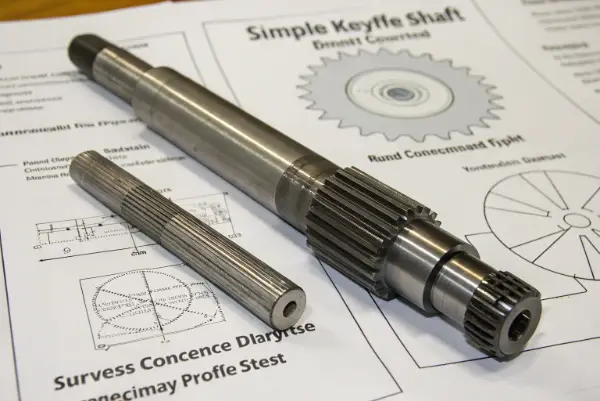
Spline profiles are superior to keyed shafts for high-torque transmission because they distribute the load across multiple teeth around the circumference. Involute splines are particularly effective as they self-center under load and reduce stress concentrations, significantly extending the service life of the connection.
Comparing Connection Geometries
I remember a project where a client used a single keyway for a 500Nm drive shaft. It failed within a week. The key simply sheared off. We redesigned it using a spline, and it is still running today.
The geometry of the connection point is critical. Here is how we look at it critically:
- Keyed Shafts: These are cheap and easy to make. You mill a slot and insert a square piece of metal. But, they create a "notch effect." This is a stress riser. Under high torque, cracks start at the sharp corners of the keyway.
- Hexagonal Shafts: These are better than keys. The shape drives the rotation. However, "hex" shapes can round off if the fit isn’t perfect. They are good for medium torque but not extreme torque.
- Spline Shafts (The Winner): Think of these as gears machined directly onto the shaft. Because there are many teeth (maybe 10 or 20), the force is spread out. If one tooth takes 100kg of force, twenty teeth take 5kg each. This huge reduction in local stress prevents failure.
Types of Splines:
- Parallel Key Splines: Older design, easier to measure, but less strong.
- Involute Splines: These have curved teeth. They are stronger because the curve reduces stress at the root of the tooth. They are harder to measure and require specialized wire EDM or hobbing tools, which we use frequently at QuickCNCs.
When designing for robotics, space is tight. Splines allow you to transmit more power with a smaller shaft diameter compared to a keyed shaft. This saves weight, which is vital for robotic arms.
How Does Heat Treatment Affect Shaft Durability?
A machined shaft without heat treatment is too soft for industrial wear. The surface will wear down quickly where bearings sit, or the splines will deform under pressure.
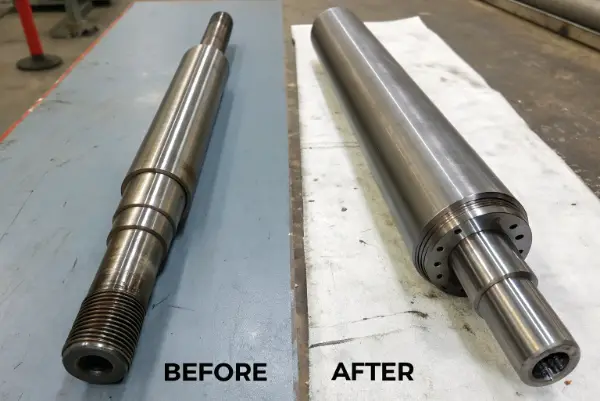
Induction hardening and Case hardening are essential processes that create a hard, wear-resistant outer layer while keeping the inner core tough and ductile. This combination prevents brittle fractures under shock loads while ensuring the surface can withstand constant friction and contact stress.
The Critical Balance of Hardness
Hardness is a double-edged sword. If you make the whole shaft extremely hard (through-hardening), it becomes brittle like glass. If a sudden jolt happens, it snaps.
We need a "hard skin, soft heart" approach. This is where specific treatments come in.
- Induction Hardening: We use an electromagnetic coil to heat just the surface of the steel very quickly, then cool it down (quench). This makes the outside rock-hard (around 55-60 HRC) but leaves the core softer. This is perfect for transmission shafts. The hard surface resists wear from bearings and seals. The soft core absorbs the twisting energy without snapping.
- Carburizing (Case Hardening): We put the steel in a carbon-rich environment at high heat. The carbon soaks into the surface. This creates a deeper hard layer than induction. It is great for gears and splines that mesh heavily.
- Nitriding: This adds nitrogen to the surface. It is done at lower temperatures, so the part distorts less. If your shaft has very tight tolerances (like Alex’s ±0.01mm requirements), nitriding is often the best choice because the part doesn’t warp as much during the process.
The Warping Problem:
Every time you heat metal, it moves. Heat treatment causes distortion.
If you machine a shaft to final size and then heat treat it, it might bend.
The correct workflow we use at QuickCNCs is:
- Rough machine the shaft (leave 0.5mm stock).
- Heat treat the shaft.
- Grind the shaft to the final tolerance.
Grinding is the only way to get that perfect ±0.005mm fit after the metal has been hardened. Don’t skip the grinding step for high-torque precision parts.
How Do Manufacturing Tolerances Impact Performance?
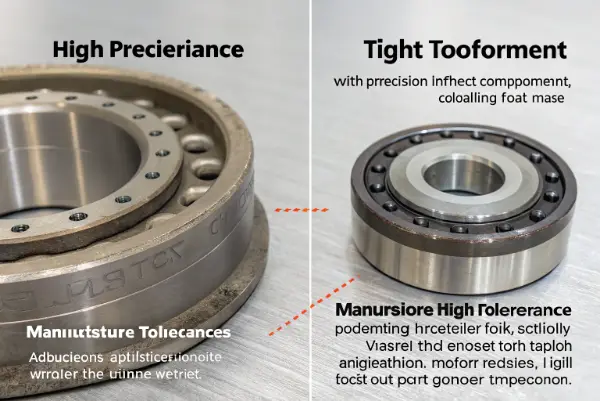
Even the strongest material will fail if the manufacturing tolerances are loose. Poor fit causes vibration, which destroys bearings and leads to fatigue failure in the transmission system.
High-precision manufacturing with tolerances of ±0.01mm or better is mandatory for high-torque shafts to ensure perfect concentricity and alignment. Tight tolerances minimize vibration and runout, which ensures that torque is transmitted smoothly without damaging the coupling or the motor.
The Cost of Imprecision
In my experience, "cheap" machining is the most expensive thing you can buy. Here is why tolerances matter so much in transmission.
If a shaft is slightly oval instead of round, or if it is slightly bent (runout), it acts like a hammer inside your machine. Every time it rotates, it bangs against the bearings. At 3000 RPM, that is 50 hits per second.
Key Tolerance Areas:
- Concentricity: This ensures the center of the shaft is exactly aligned with the center of the bearing journals. If this is off, the shaft wobbles. This wobble eats energy and creates heat.
- Surface Finish (Ra): For high torque, you often have high pressure on seals. A rough surface acts like sandpaper, destroying the rubber oil seals. You need a surface finish of Ra 0.4 or better (mirror-like) where seals touch. This usually requires cylindrical grinding.
- Fit Classes (ISO Fits): You need to specify the fit. Is it an interference fit (press fit) or a clearance fit (sliding)?
- Interference Fit (e.g., H7/p6): The shaft is slightly larger than the hole. You press it in. This is great for torque transfer but hard to assemble.
- Transition Fit: A compromise. Good for parts that need accurate location but might need disassembly.
Critical Thinking on GD&T (Geometric Dimensioning and Tolerancing):
Don’t just look at the diameter. Look at the Geometric tolerances.
You can have a shaft that is the perfect diameter but is bent like a banana.
On your drawings, you must specify Total Runout. This controls both the roundness and the straightness at the same time.
At QuickCNCs, we check runout on every single transmission shaft. For a robotics client like Alex, we know that a runout of 0.05mm is unacceptable. It needs to be under 0.01mm. This requires turning the part between centers and using high-end grinding machines, not just a standard lathe.
Conclusion
To handle high torque reliably, you must combine tough alloy steels like 4340, robust spline geometries, precise induction hardening, and strict grinding tolerances to prevent vibration and fatigue.