
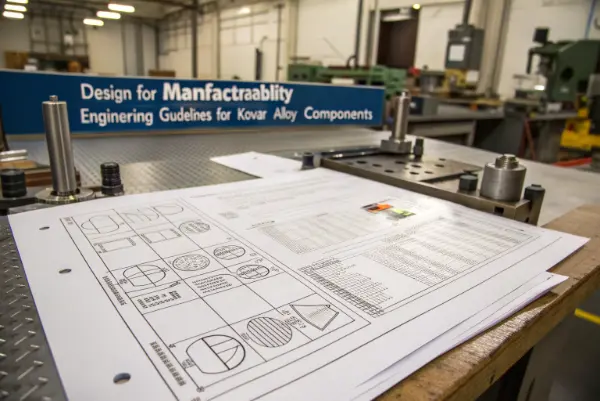
Designing Kovar parts can be a real headache. You waste materials and ruin tools when you get the design wrong. The good news is that following simple design rules can fix this. I will share my top guidelines to help you make perfect Kovar parts every time.
Design for manufacturability (DFM) for Kovar alloy means creating part designs that are easy and cheap to machine. Kovar is a special metal made of iron, nickel, and cobalt. It expands at the same rate as glass. Good DFM requires slow cutting speeds, sharp tools, and avoiding deep holes.
You might think any machine shop can handle Kovar, but that is not true. If you do not understand the exact nature of this metal, your project will fail before it even hits the CNC machine. Let us dig into the details.
How is Kovar made?
Sourcing good Kovar is tough. Bad batches lead to cracked parts and failed seals. Knowing how Kovar is made helps you choose the right material for your next project.
Kovar is made by melting iron, nickel, and cobalt together in a vacuum furnace. This process removes impurities like carbon and sulfur. The clean liquid metal is then poured into molds to cool. Finally, it is rolled or forged into bars, sheets, and wires for CNC machining.
Let us look closer at the melting process. Making Kovar is like baking a very precise cake. You cannot just mix metals in an open pot.
The Vacuum Melting Process
When I worked on a big project last year, the client bought cheap Kovar. The parts had tiny air bubbles inside. This happens when the metal is melted in open air. Good Kovar must be melted in a vacuum. A vacuum means there is no air at all. This stops oxygen from mixing with the hot metal. Oxygen causes weak spots. We call these weak spots inclusions. If your part has inclusions, it will break under pressure.
After melting, the metal cools down into large blocks. We call these blocks ingots. But an ingot is too big to put in a CNC machine. So, factories heat the ingot again and squeeze it through heavy rollers. This makes the metal stronger.
Hot Rolling vs Cold Rolling
There are two main ways to shape the metal. We have hot rolling and cold rolling. Hot rolling is done when the metal is very hot. It is fast and cheap. Cold rolling is done at room temperature. It gives a much smoother finish. For tight tolerances like ±0.01mm, you always want cold-rolled Kovar.
| Process | Temperature | Finish Quality | Cost | Best Use |
|---|---|---|---|---|
| Vacuum Melting | Very High | Very Clean | High | High-tech parts |
| Hot Rolling | High | Rough | Low | Big structural parts |
| Cold Rolling | Room | Very Smooth | Medium | Precision CNC machining |
Understanding these steps helps you talk to your material supplier. You will know exactly what to ask for to get the best quality.
What is the difference between Kovar and Alloy 42?
Picking the wrong metal ruins your glass-to-metal seals. Alloy 42 looks like Kovar, but it acts differently under heat. Choosing the right one saves your assembly from cracking.
The main difference is the cobalt content. Kovar contains 17% cobalt, 29% nickel, and iron. Alloy 42 has 42% nickel and iron, but no cobalt. Kovar matches hard glass like borosilicate perfectly. Alloy 42 is better for soft glass and is cheaper because it lacks cobalt.
Many engineers ask me which alloy they should use. They see Alloy 42 is cheaper and want to save money. But you have to be careful.
The Role of Cobalt
Cobalt is a very special metal. It is also very expensive. Kovar has about 17% cobalt. This cobalt does a magic trick. It makes the Kovar expand at the exact same rate as hard glass when heated. We call this the Coefficient of Thermal Expansion. If you are making a laser tube or an X-ray tube, you need hard glass. Therefore, you need Kovar.
Alloy 42 does not have cobalt. It only has iron and nickel. Because it lacks cobalt, it expands faster when heated. It matches soft glass or ceramics perfectly.
Choosing the Right Metal for Your Design
I had a customer from Germany who used Alloy 42 for a hard glass seal. The part cracked every time they turned on the machine. They spent weeks trying to fix the glass. I told them to switch to Kovar. The problem went away instantly.
| Feature | Kovar | Alloy 42 |
|---|---|---|
| Cobalt Content | ~17% | 0% |
| Nickel Content | ~29% | ~42% |
| Glass Match | Hard Glass (Borosilicate) | Soft Glass |
| Cost | Higher | Lower |
| Machinability | Gummy, harder to cut | Slightly easier to cut |
When you design your parts, always check the glass or ceramic you will use. Do not just look at the price. The wrong metal will cause leaks. A leak in a vacuum system is a total failure.
Is Kovar hard to machine?
Tool wear can eat up your budget fast. Kovar is notoriously sticky, causing standard tools to break and ruin your parts. With the right machining strategy, you can cut Kovar smoothly.
Yes, Kovar is difficult to machine because it is sticky. It tends to stick to the cutting tools, which causes the tools to wear out fast. To machine Kovar successfully, you must use very sharp carbide tools, slow cutting speeds, and a lot of cutting fluid.
Machining Kovar is not like cutting aluminum or steel. When I first started working with CNC machines, Kovar gave me a lot of trouble.
The Sticky Metal Problem
Kovar is not a very hard metal. But it is very tough and sticky. When the tool cuts the metal, the metal gets hot. Because it is sticky, the Kovar melts a little bit and sticks to the cutting tool. We call this a built-up edge. When the edge builds up, the tool stops cutting. It starts rubbing. This makes more heat. Soon, the tool breaks, and your part is ruined.
How to Machine Kovar Successfully
To fix this, your design must be smart. First, do not design very deep and narrow holes. Deep holes trap the heat. The metal chips cannot get out. If you need a deep hole, make it wider.
Second, use the right tools. High-speed steel tools will die quickly. You must use solid carbide tools. Carbide stays sharp longer.
| Machining Factor | Bad Practice | Good Practice |
|---|---|---|
| Tool Material | High-Speed Steel (HSS) | Solid Carbide |
| Cutting Speed | Fast (like aluminum) | Slow and steady |
| Coolant | Air or light oil | High-pressure liquid coolant |
| Hole Design | Deep and narrow | Shallow or wide |
When you design parts, keep the walls thick. Thin walls will bend because the tool pushes hard against the sticky metal. If you follow these simple rules, your supplier will love you. They will make your parts faster, and you will get a better price.
Is Kovar biocompatible?
Designing medical implants requires safe materials. Using toxic metals can cause serious health risks to patients. It is vital to know if Kovar is safe for human body use.
No, Kovar is not biocompatible. Kovar contains a high amount of nickel and cobalt. Both of these elements are toxic to the human body and can cause severe allergic reactions. Therefore, Kovar should never be used inside the body for medical implants like bone screws.
I often get drawings for medical devices. Sometimes, an engineer will pick Kovar because they need a glass seal in a medical tool. But we must be very careful about where that tool goes.
Why Kovar is Bad for the Body
The human body is full of salty water. Salty water is very bad for metals. It causes them to rust and break down. When Kovar breaks down in the body, it releases nickel and cobalt into the blood. Many people are highly allergic to nickel. It causes the skin to turn red and swell. Cobalt is even worse. Too much cobalt in the body is toxic. It can make a person very sick.
Safe Alternatives for Medical Devices
If you are making a tool that touches the outside of the body for a short time, Kovar might be okay if it is plated. We often plate Kovar with gold or nickel. But for implants, you must change your material.
Titanium is the best choice for implants. It is completely safe. The body actually grows bone right onto titanium.
| Material | Biocompatible? | Common Medical Use | Risk Level |
|---|---|---|---|
| Kovar | No | External X-ray tubes | High if implanted |
| Titanium | Yes | Bone screws, joint replacements | Very Low |
| Stainless Steel (316L) | Mostly | Surgical tools | Low |
So, if your design is a pacemaker that goes under the skin, do not use Kovar for the main shell. You can only use Kovar for the tiny pins that go through the glass, and they must be sealed completely inside a titanium box. Always keep Kovar away from living tissue.
Conclusion
Designing Kovar parts requires understanding its unique sticky nature and thermal properties. Following these simple guidelines ensures precision, reduces machining costs, and builds reliable glass-to-metal seals.