
You are designing a high-performance transmission system, but confusing standards are slowing you down. Without clear compliance guidelines, your project risks costly failures and safety recalls. Let me help you navigate the complex world of automotive shaft regulations so you can design with total confidence.
Automotive transmission shaft standards primarily rely on ASME B106.1M for design geometry and ISO/TS 16949 for quality management systems. Compliance requires rigorous testing for torque capacity, fatigue life, and rotational balance. Engineers must also adhere to specific OEM requirements regarding material composition, heat treatment depth, and dimensional tolerances to ensure safety and durability.
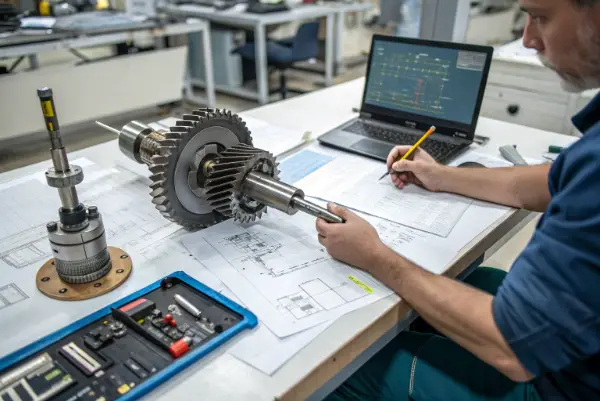
Understanding standards is only the first step. You also need to know how these regulations translate into real-world manufacturing and inspection processes. I have seen many good designs fail because the engineer did not account for how these standards are applied on the shop floor. Let’s break down the specific standards and inspection criteria you need to know.
What is the ASME standard for transmission shafts?
Many engineers struggle to find the exact American standard that governs shaft design. This confusion leads to over-engineering or, worse, under-engineering critical components. If you use the wrong reference, your transmission shaft might not withstand the necessary operational loads.
The primary standard for shaft design is ASME B106.1M "Design of Transmission Shafting." This standard provides formulas and guidelines for calculating stress, deflection, and critical speeds. It helps you determine the correct diameter and material based on the combined bending and torsion loads the shaft will experience during operation.

When we talk about ASME B106.1M, we are really talking about safety factors. In my years at QuickCNCs, I have noticed that European engineers like Alex often lean heavily on DIN or ISO standards. However, if you are designing for the global market, especially the US, ASME is unavoidable.
ASME B106.1M is not just a list of numbers; it is a methodology. It forces you to consider the "failure theories." The most common one applied here is the Maximum Shear Stress Theory or the Distortion Energy Theory (von Mises). The standard guides you through specific steps:
- Load Analysis: You must calculate the mean and alternating components of both bending moments and torque. Transmission shafts are rarely under static load; they vibrate and fluctuate.
- Material Factors: The standard requires you to adjust your endurance limit based on surface finish, size, and temperature. A polished shaft behaves differently than a rough-turned one.
- Stress Concentration: This is the killer. Keyways, shoulders, and grooves are where shafts break. The ASME code provides specific sensitivity factors ($q$) to adjust for these stress risers.
Here is a simplified view of how we approach this calculation in a manufacturing context:
| Factor | Description | Why it Matters |
|---|---|---|
| Bending Moment ($M$) | The external force trying to snap the shaft. | Determines stiffness requirements. |
| Torque ($T$) | The twisting force from the engine. | Determines the shear strength needed. |
| Fatigue Factor ($k_f$) | Adjustment for repetitive loading. | Prevents long-term failure cracks. |
| Safety Factor ($N$) | The margin of error (usually 1.5 to 3.0). | Accounts for unexpected shocks. |
By strictly following ASME B106.1M, we ensure that the shaft diameter is sufficient to handle the worst-case scenario without adding unnecessary weight.
What are the various types of shafts and standard sizes?
You might think every shaft needs to be custom-sized, but that increases costs significantly. Ignoring standard sizes and types forces you to buy custom raw materials and expensive tooling. Knowing the industry norms helps you design parts that are easier and cheaper to manufacture.
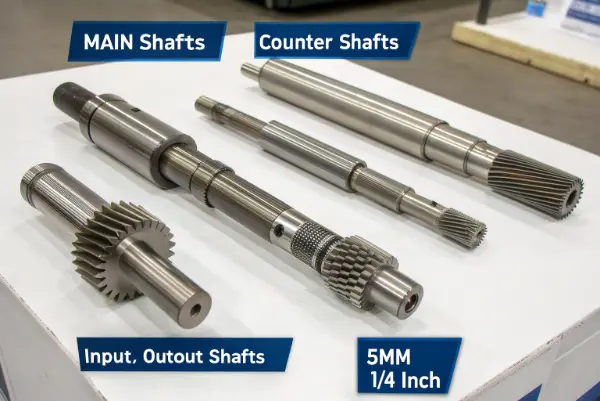
Transmission shafts generally fall into three categories: main shafts, counter shafts, and input/output shafts. While diameters are customizable, standard raw material sizes typically follow increments of 5mm or 1/4 inch. Designing your shaft steps and bearing seats around these standard stock sizes minimizes material waste and machining time.
In the CNC world, material selection and sizing are the first places we look to save you money. I remember a project where a client designed a shaft with a maximum diameter of 51mm. We had to buy 55mm bar stock and turn it down. If they had designed it at 50mm, we could have used 50mm precision ground stock or 52mm raw stock, saving 20% on material costs instantly.
Let’s break down the types deeper to understand their specific design needs:
- Input Shafts: These take power from the engine/clutch. They deal with high shock loads. They usually have splines on one end and a gear on the other. High surface hardness is critical here.
- Counter Shafts (Lay Shafts): These are often one solid piece with multiple gears machined directly onto them (cluster gears). They are heavy and prone to deflection (bending). Stiffness is the priority here.
- Main Shafts (Output): These hold sliding gears and synchronizers. They have complex features like oil holes, splines, and snap-ring grooves.
Regarding "Standard Sizes," there is no single ISO list that says "Car Shaft A must be 30mm." However, there are standard Bearing Interfaces. You must design your shaft diameters to fit standard bearings.
| Shaft Section | Typical Diameter Range (Passenger Car) | Associated Bearing Series |
|---|---|---|
| Pilot Tip | 15mm – 25mm | Needle Roller Bearings |
| Main Journal | 30mm – 50mm | Deep Groove Ball (62xx, 63xx) |
| Output Yoke | 35mm – 60mm | Tapered Roller Bearings |
When you design, always start with the bearing catalog. Select a standard bearing bore (e.g., 35mm, 40mm) and make that your shaft journal size. This is "design for manufacturing" at its most basic level.
What is the acceptable drive shaft run out?
Vibration is the enemy of any transmission system, and excessive runout is the primary cause. If you do not specify tight runout tolerances, the vehicle will suffer from noise, vibration, and harshness (NVH) issues. This leads to premature bearing failure and unhappy customers.
Acceptable drive shaft runout typically ranges from 0.005 inches (0.127 mm) to 0.010 inches (0.254 mm) measured at the center of the tube. However, for high-performance or precision transmission shafts, tolerances are tighter, often requiring Total Indicated Runout (TIR) of less than 0.002 inches (0.05 mm) at bearing journals.
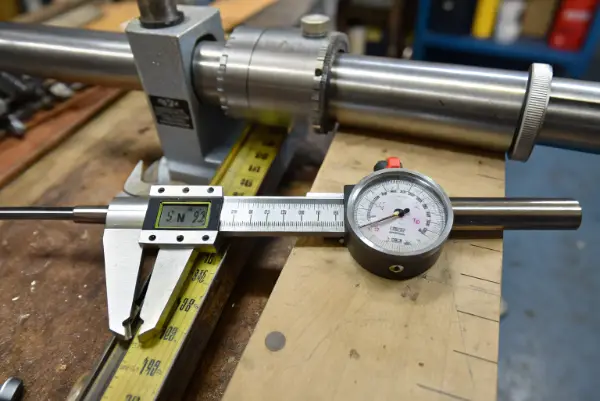
Runout is a concept that seems simple but is hard to control in production. When I worked on the shop floor, "straightening" shafts after heat treatment was a daily battle. Heat treatment releases internal stresses, causing the shaft to warp.
There are two types of runout you need to specify clearly on your prints:
- Circular Runout: Measured at a specific cross-section. This controls the roundness of that specific circle.
- Total Runout: Measured by moving the indicator along the entire length of the cylinder while the part rotates. This controls the straightness of the entire axis.
For transmission shafts, Total Runout is crucial. If a shaft is bent, it acts like a jump rope, whipping around and destroying the bearings.
Here is a critical breakdown of where runout matters most:
- Bearing Journals: Needs the tightest tolerance (e.g., 0.01mm – 0.02mm). If this is off, the bearing runs continuously off-center, generating massive heat.
- Gear Seats: Needs moderate tolerance (e.g., 0.03mm). If the gear seat has runout, the gear pitch varies as it rotates, causing a "whining" noise in the transmission.
- Shaft Ends/Flanges: Needs strict control to ensure the driveshaft bolts on straight.
Correcting Runout:
We usually machine the shaft green (soft), then heat treat it. After heat treatment, it might warp by 0.5mm. We then use a straightening press. We press the shaft past its yield point to bend it back straight. Only then do we perform the final grinding. If you skip the straightening step and just grind it round, you remove too much of the hardened case layer on one side, leading to weak spots. This is why specifying runout is also specifying a manufacturing process.
What would be inspected on the driveline and shafts?
You cannot ensure quality if you do not know what to check. Relying solely on visual inspection or basic dimensions will let internal defects slip through. A comprehensive inspection plan covers geometry, material integrity, and surface quality to guarantee the part performs as intended.
Inspection of driveline shafts includes dimensional checks (length, diameter, spline fit), geometric tolerances (concentricity, runout), and material verification (hardness testing). Critical non-destructive testing (NDT) methods like magnetic particle inspection (MPI) or ultrasonic testing are also used to detect surface cracks and internal voids.
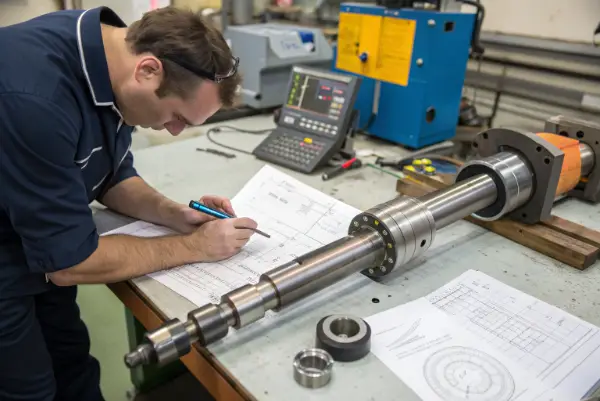
At QuickCNCs, inspection is not just the final step; it is happening constantly. For a safety-critical part like a transmission shaft, we have to look "inside" the metal.
Here is a deep dive into the specific inspections we perform for high-end automotive clients:
1. Dimensional and Geometric Inspection:
We use CMMs (Coordinate Measuring Machines) and laser scanners.
- Spline Profile: We verify the "profile error" of the splines. If the spline teeth are shaped wrong, they will wear out quickly. We use "Go/No-Go" spline gauges for quick checks and CMMs for detailed analysis.
- Surface Finish (Ra/Rz): The area where the oil seal sits must be incredibly smooth (often Ra 0.4 µm or better). If it is too rough, it rips the seal. If it is too smooth, it cannot hold an oil film.
2. Metallurgical Inspection:
- Case Depth: Transmission shafts are usually induction hardened or carburized. We need to know if the hard layer is deep enough. We cut a sample shaft, polish the cross-section, and use a microscope to measure the "effective case depth."
- Core Hardness: The center of the shaft must remain tough (softer) to absorb shock. If the core is too hard, the shaft becomes brittle and snaps.
3. Crack Detection (NDT):
- Magnetic Particle Inspection (Magnaflux): This is standard for steel shafts. We magnetize the shaft and spray it with fluorescent iron particles. Under UV light, any tiny surface crack glows bright green. This is non-negotiable for automotive shafts.
- Eddy Current Testing: Used to detect variations in heat treatment uniformity along the shaft without touching it.
The Inspection Checklist Table:
| Feature | Method | Common Defect |
|---|---|---|
| Splines | Spline Gauge / CMM | Profile error (loose fit) |
| Bearing Seat | Air Gauge / Micrometer | Oversize/Undersize (fit issues) |
| Heat Treat | Rockwell Tester (HRC) | Soft spots (rapid wear) |
| Surface | Profilometer | Chatter marks (seal leaks) |
| Cracks | MPI (Magnaflux) | Quench cracks (catastrophic failure) |
Checking these specific points ensures that the shaft you receive is not just a piece of metal, but a reliable mechanical component.
Conclusion
To ensure reliable transmission shafts, you must follow ASME design standards, utilize standard bearing sizes, maintain strict runout tolerances, and enforce a rigorous inspection plan covering dimensions and metallurgy.