
Have you ever had a precision component fail because thermal expansion ruined the seal or threw off a sensor alignment? It’s a frustrating and costly problem for engineers working with sensitive electronics or optics. Choosing the right low-expansion alloy is critical to preventing these disasters.
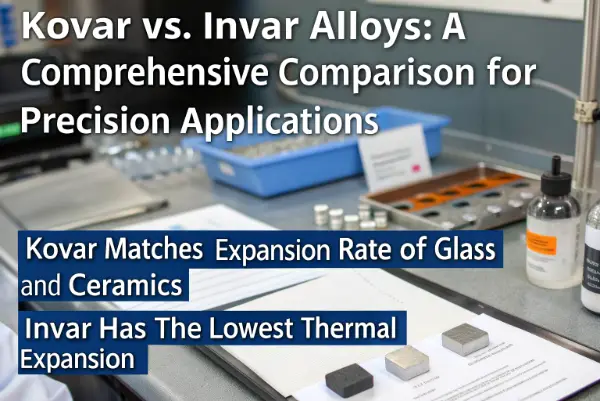
Kovar and Invar are both nickel-iron alloys known for low thermal expansion, but they serve different purposes. Invar (FeNi36) has the lowest thermal expansion known, making it ideal for dimensionally stable instruments. Kovar is specifically designed to match the expansion rate of borosilicate glass and alumina ceramics, making it perfect for hermetic seals in electronics.
Understanding these differences is just the starting point. When I first started in the CNC shop, I treated all "specialty" alloys the same, but experience taught me that mixing them up leads to expensive scrap. Let’s look closer at the specific properties, machining challenges, and best use cases for each material so you can make the right choice for your next project.
What is the difference between Kovar and Invar?
Confusing these two materials is easy because they look similar and both contain nickel and iron, but using the wrong one will ruin your assembly. You need to know exactly how they react to heat to avoid catastrophic failures in your designs.
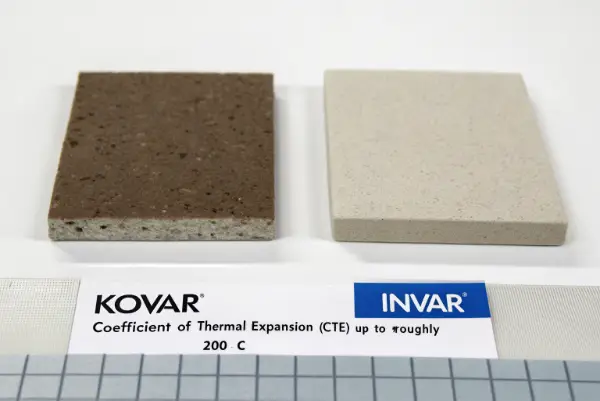
The main difference lies in their Coefficient of Thermal Expansion (CTE). Invar has a near-zero CTE up to roughly 200°C, meaning it barely changes size. Kovar has a slightly higher CTE that is engineered to mimic glass and ceramic, allowing it to expand and contract at the same rate as those materials to maintain a vacuum-tight seal.
To really understand why this matters, we need to look at the chemistry and the specific engineering applications. I remember a project for a client making laser housing units. They initially requested Kovar because they heard it was "stable." However, there was no glass sealing involved; they just needed the housing to not warp. I steered them toward Invar because Kovar would have expanded too much for their optical tolerances.
Let’s break down the critical differences in a more structured way:
Chemical Composition
The fundamental difference starts with the recipe.
- Invar (36 Alloy): Roughly 36% Nickel, remainder Iron. This specific ratio creates the "Invar Effect" (invariance to heat).
- Kovar (ASTM F15): Roughly 29% Nickel, 17% Cobalt, remainder Iron. The Cobalt is the key ingredient that adjusts the expansion curve.
Thermal Behavior Breakdown
This is where the rubber meets the road for engineers like Alex.
| Feature | Invar | Kovar |
|---|---|---|
| Primary Goal | Minimize size change absolutely. | Match expansion of other materials. |
| CTE (approx) | ~1.2 x 10⁻⁶/K (at 20-100°C) | ~5.5 x 10⁻⁶/K (at 20-200°C) |
| Best Application | Precision instruments, laser benches, composite molds, cryogenic tanks. | Vacuum tubes, X-ray tubes, microwave tubes, hermetic packages. |
| Magnetic Properties | Ferromagnetic at room temp. | Ferromagnetic at room temp. |
Critical Thinking: Why not use Invar for Seals?
You might ask, "If Invar doesn’t expand, isn’t that better for a seal?" The answer is no. If you bond metal to glass, and you heat the assembly, the glass will expand. If the metal (Invar) stays the same size while the glass grows, the bond line shears, and the glass cracks. You need the metal to "breathe" with the glass. That is why Kovar exists. It moves with the ceramic or glass, not against it.
Is Kovar hard to machine?
Machining Kovar can be a nightmare if your machinist treats it like standard stainless steel. Improper cutting techniques lead to gummy chips, rapid tool wear, and parts that are out of tolerance before they even leave the machine.
Yes, Kovar is generally considered difficult to machine because it is soft, gummy, and tough. It tends to gall (adhere) to the cutting tool and produces long, stringy chips that can clog machinery. However, with sharp carbide tools, positive cutting angles, and plenty of coolant, it can be machined to high precision.
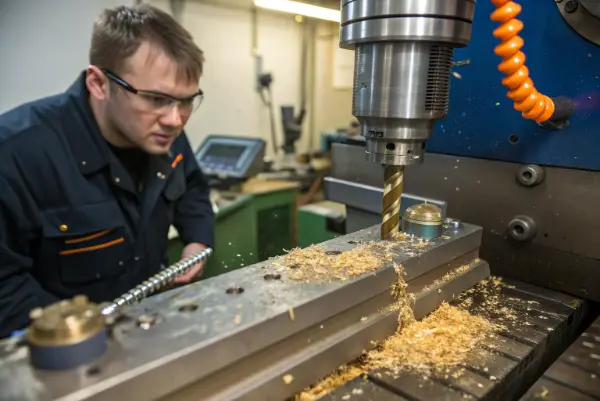
I have seen many seasoned machinists struggle with Kovar the first time. Years ago, I had an operator try to run a Kovar job using the same speeds and feeds as 304 stainless steel. The result was a disaster. The heat built up instantly, the tool edge broke down, and the surface finish looked like it had been chewed on. We had to scrap the material, which is not cheap.
Here is a deeper dive into the machining strategy we use at QuickCNCs to handle this material effectively:
The "Gumminess" Factor
Kovar does not break into nice, small chips like brass or aluminum. It stretches. This creates heat. To combat this, we have to change our approach:
- Tool Geometry: We never use negative rake tools. We need high positive rake angles to slice through the metal rather than pushing it.
- Chip Breaking: Since the chips are stringy, we use chip breakers on our inserts to force the metal to snap off. If we don’t, the "bird’s nest" of chips will wrap around the tool and ruin the part surface.
Cutting Parameters
You cannot rush Kovar.
- Speed: We run slower than steel. Think around 50-60 surface feet per minute (SFM) if using high-speed steel, or slightly faster with carbide.
- Feed: You must be aggressive with the feed. If you dwell or feed too lightly, the material work-hardens. Once the surface hardens, your tool will burn out in seconds. You have to cut under the hardened skin.
- Coolant: Flood coolant is mandatory. You need to get the heat away from the cutting zone immediately. We use a high-pressure sulfurized oil or a rich water-soluble oil emulsion.
Post-Machining Treatment
After machining, Kovar often has residual stresses. If your part requires extremely tight tolerances (like the ±0.01mm Alex expects), we highly recommend an intermediate stress-relief anneal. This prevents the part from warping later during the brazing or sealing process.
What is the difference between Kovar and Alloy 42?
Engineers often look for cheaper alternatives to Kovar for glass-to-metal sealing, and Alloy 42 frequently comes up in the search. Choosing the cheaper option without understanding the thermal mismatch can lead to seal failures in critical electronic components.
Alloy 42 is a nickel-iron alloy (42% Nickel) that is cheaper than Kovar because it lacks Cobalt, but its expansion rate is different. Alloy 42 matches "soft" glasses and some ceramics, while Kovar is strictly engineered for "hard" borosilicate glasses and alumina. Kovar provides a stronger, more reliable hermetic seal for high-performance applications.
In my experience sourcing materials for global clients, price is always a discussion. Alloy 42 is attractive because Cobalt is expensive. However, I always warn clients: do not swap these based on price alone. You must swap them based on the glass you are using.
Let’s explore the nuances of this choice to help you decide which material fits your specific BOM (Bill of Materials):
The Glass Compatibility Chart
This is the most important factor. You cannot mix and match.
-
Use Kovar (ASTM F15) with:
- Borosilicate Glass (Pyrex type).
- Alumina Ceramics (92% – 99% Al₂O₃).
- Why? The expansion curve of Kovar tracks these materials almost perfectly from room temperature up to the transformation point of the glass.
-
Use Alloy 42 (ASTM F30) with:
- Soft glasses (Soda-lime).
- Semiconductor lead frames (plastic packages).
- Automotive lighting seals.
- Why? Its CTE is lower than Kovar at high temps and creates a compression seal with soft glass, but it creates dangerous tension with hard glass.
The Cobalt Difference
The 17% Cobalt in Kovar is not just there to increase the price. It modifies the Curie point (the temperature where magnetic properties change).
- Kovar: The Cobalt raises the Curie point, making the thermal expansion curve stable and linear over a wider temperature range. This is vital for military or aerospace parts that go through thermal cycling.
- Alloy 42: Without Cobalt, the expansion curve is less linear at higher temperatures. For a simple lightbulb, this is fine. For a satellite component, it is a risk.
Cost vs. Performance
If you are making millions of consumer electronic parts (like IC lead frames), Alloy 42 is the standard. It is cost-effective and "good enough" for plastic encapsulation. But if you are Alex, designing a high-vacuum sensor for a robot arm, the cost saving of Alloy 42 is negligible compared to the risk of a vacuum leak. Stick with Kovar for high-reliability hermetic seals.
What is Kovar’s tensile strength?
Engineers need to know if the material can structurally support the load of the assembly, not just if it seals well. Relying on Kovar for structural strength without checking the data can lead to mechanical failure under stress.
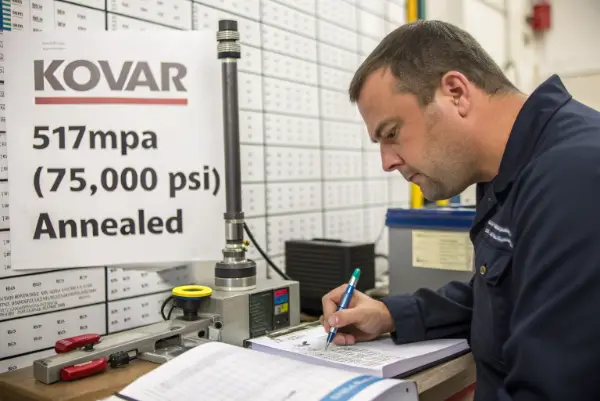
Kovar has a tensile strength of approximately 517 MPa (75,000 psi) in its annealed state, which is moderate compared to structural steels. However, its strength can be significantly increased through cold working, though this affects its magnetic and thermal properties. It is primarily designed for sealing, not for bearing heavy structural loads.
When designing a part, I often see engineers focus so much on the thermal properties that they forget about mechanical strength. Kovar is strong, but it is not Titanium or hardened tool steel. It behaves more like a 300-series stainless steel in terms of strength.
Here is a detailed breakdown of the mechanical data and what it means for your design process:
Mechanical Properties Overview (Annealed Condition)
| Property | Metric Value | Imperial Value | Note |
|---|---|---|---|
| Tensile Strength | ~517 MPa | ~75,000 psi | Good for holding seals, weak for structural beams. |
| Yield Strength | ~345 MPa | ~50,000 psi | The point where it permanently deforms. |
| Elongation | 30% | 30% | It is very ductile (stretchy). |
| Hardness | ~80 HRB | ~80 HRB | Relatively soft. |
The Trade-off: Strength vs. Seal
You can make Kovar stronger by cold rolling it (compressing it without heat). This can boost the tensile strength up to 100,000 psi or more.
- The Problem: Cold working changes the crystal structure. This changes the Coefficient of Thermal Expansion.
- The Result: If you harden Kovar to make it stronger, it might no longer match your glass or ceramic. The seal could fail.
- The Solution: Usually, Kovar parts are machined, then annealed (softened) before the sealing process. You must design your part assuming the annealed strength values, not the cold-worked values.
Practical Design Advice
If your robotic assembly requires a part that must be both a hermetic seal and a heavy load-bearing structural element, Kovar might be the weak link.
- Hybrid Design: I suggest using Kovar only for the feedthrough or the seal area.
- Welding: Kovar can be welded to stainless steel. You can use a strong stainless steel body for the structure and weld a Kovar flange onto it for the glass seal. This gives you the best of both worlds: strength where you need it, and thermal matching where the glass is.
Conclusion
Choosing between Kovar and Invar depends entirely on your thermal goal: use Invar for dimensional stability and Kovar for glass-to-metal sealing. Always consider machining difficulty and mechanical strength.