
We all know the struggle. Heavy steel shafts create vibration, rob power, and limit the speed of our high-performance machinery. If you are designing for robotics or automotive systems, traditional metals often hit a performance ceiling that frustrates even the best engineers.
Composite materials, specifically carbon fiber reinforced polymers (CFRP) and next-gen hybrid matrices, offer the ultimate solution for transmission shafts by reducing weight by up to 70% while increasing torque capacity and critical speed limits. These materials allow engineers to design longer, single-piece shafts that eliminate the need for center bearings and reduce overall system maintenance.
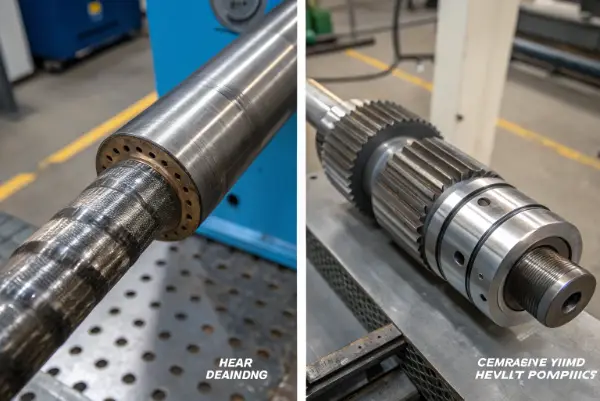
I have seen countless projects stall because the drivetrain was too heavy or the rotational inertia was too high. Switching to composites is not just a trend; it is a necessary evolution for efficiency. But before you switch your entire production line, you need to understand exactly what these materials are and how they behave under load. Let’s look at the specific types and future trends that matter for your designs.
What Are the Four Main Types of Composites Used Today?
Choosing the wrong composite matrix is a recipe for failure. You might select a material that is strong in tension but fails miserably under the torsional stress required for a driveshaft.
The four main types of composites relevant to structural engineering are Polymer Matrix Composites (PMCs), Metal Matrix Composites (MMCs), Ceramic Matrix Composites (CMCs), and Carbon-Carbon Composites (CCCs). For transmission shafts, PMCs—specifically carbon fiber—are the dominant choice due to their high strength-to-weight ratio.
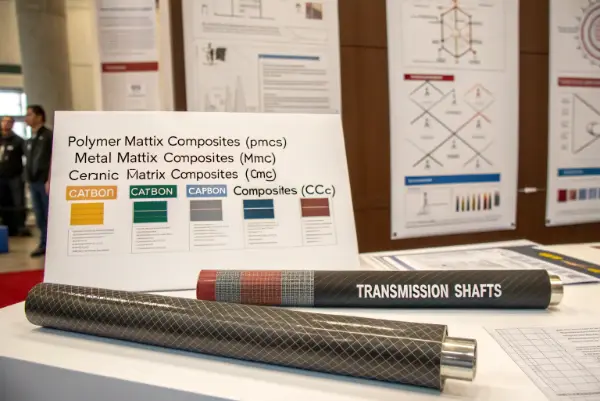
Let’s break this down further because "composite" is a very broad term. When I talk to clients about transmission shafts, we usually focus heavily on PMCs, but knowing the others is crucial for specific extreme environments.
1. Polymer Matrix Composites (PMCs)
This is your bread and butter for driveshafts. This involves high-strength fibers (like carbon or glass) embedded in a polymer resin (like epoxy).
- Pros: Extremely light, corrosion-resistant, and easy to manufacture via filament winding.
- Cons: Lower maximum operating temperature compared to metals.
2. Metal Matrix Composites (MMCs)
Here, the matrix is a metal like aluminum or titanium reinforced with ceramic fibers.
- Use Case: High-temperature engine components where standard aluminum would melt.
- Relevance: Rarely used for long driveshafts due to cost and weight, but excellent for connecting joints or flanges.
3. Ceramic Matrix Composites (CMCs)
These are ceramic fibers in a ceramic matrix.
- Use Case: Extreme heat environments, like turbine blades or aerospace exhaust systems.
- Relevance: Too brittle and expensive for standard mechanical transmission.
4. Carbon-Carbon Composites (CCCs)
Carbon fibers in a carbon matrix.
- Use Case: F1 brake discs and rocket nozzles.
- Relevance: Incredible heat resistance, but the manufacturing cost is astronomical for general robotics or automotive use.
For a mechanical engineer like you, the focus should almost always be on optimizing the PMC category. Specifically, we look at the winding angle of the fiber.
| Winding Angle | Property Enhanced | Best Application |
|---|---|---|
| 0° (Axial) | Bending Stiffness | Preventing whip at high speeds |
| 45° (Helical) | Torsional Strength | Transmitting torque/power |
| 90° (Hoop) | Crushing Resistance | Connecting metal end-fittings |
When we machine or assemble these at QuickCNCs, we often see hybrid winding patterns. A shaft might have a 45° layer for torque and a 0° layer to stop it from bending. It is all about tailoring the material to the exact load path.
What Else Can Be Used to Make Advanced Composites?
Standard carbon fiber is great, but sometimes it is not enough. You might have a specific frequency requirement or an impact resistance need that standard epoxy resins cannot handle.
Beyond standard carbon and glass fibers, advanced composites now utilize basalt fibers, aramid (Kevlar) for impact damping, and bio-based resins to improve sustainability without sacrificing performance. Nanomaterials like graphene are also being added to resins to drastically improve fracture toughness and electrical conductivity.
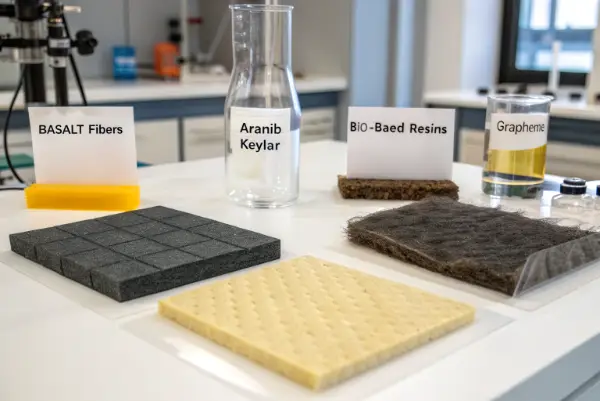
I remember a project where a client needed a shaft for a high-speed textile machine. Standard carbon fiber was too stiff and transmitted too much high-frequency vibration, causing wear on the bearings. We had to look at alternative reinforcements. This is where critical thinking about material composition comes into play.
Here are the key "alternative" ingredients pushing performance boundaries:
Basalt Fibers
Derived from volcanic rock.
- Why use it? It bridges the gap between cheap glass fiber and expensive carbon fiber. It has better vibration damping than carbon.
- Application: Excellent for shafts that need durability and shock absorption rather than pure stiffness.
Aramid (Kevlar) Hybrids
We often weave Kevlar with Carbon.
- Why use it? Carbon fails catastrophically (it snaps). Kevlar yields and holds together.
- Application: Safety-critical shafts. If the shaft fails, the Kevlar prevents it from shattering into dangerous shrapnel.
Nanomaterial Additives (The "Secret Sauce")
Adding Graphene or Carbon Nanotubes (CNTs) to the epoxy resin.
- The Problem: The "weak link" in a composite shaft is usually the glue (resin), not the fiber. Cracks start in the resin.
- The Solution: Nanoparticles stop these micro-cracks from spreading.
- Result: You get a shaft that lasts 5x longer under fatigue loading.
Material Selection Guide for Shafts:
- High RPM, Low Torque: High Modulus Carbon Fiber (Pitch-based).
- High Torque, Shock Loads: Hybrid Carbon/Glass or Carbon/Aramid.
- Cost-Sensitive: Standard Modulus Carbon (PAN-based) or Basalt.
At QuickCNCs, we often advise engineers to not just ask for "Carbon Fiber." You need to specify the resin toughness and the fiber mix. A shaft designed for a rock crusher needs different "stuff" inside it than a shaft designed for a surgical robot.
What Is the Next Generation of Composites?
You have mastered standard carbon fiber, but your competitors are already looking ahead. What happens when the shaft needs to heal itself or tell you when it is about to break?
The next generation of composites focuses on "smart" functionality, including self-healing polymers that repair micro-cracks automatically and embedded fiber-optic sensors that provide real-time data on torque, temperature, and structural health. This turns a passive mechanical part into an active data source.
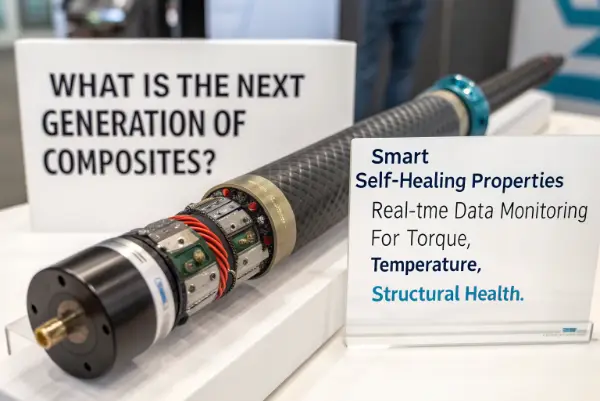
This is the area that excites me the most. In my years of sourcing, I used to just see "dumb" parts. Now, I see parts that communicate. Imagine you are running a factory in Germany. You have a robotic arm running 24/7. Usually, you replace the shaft on a schedule, maybe replacing it while it is still good (waste) or after it fails (downtime).
Next-gen composites change this paradigm through three key innovations:
1. Self-Healing Matrices
This sounds like science fiction, but it is real. Microcapsules of liquid healing agent are embedded in the resin.
- Mechanism: When a micro-crack forms, it ruptures the capsule. The agent flows into the crack and polymerizes (hardens).
- Impact: This extends the fatigue life of transmission shafts significantly. It handles the minor damage that usually goes unnoticed until it becomes a major failure.
2. Structural Health Monitoring (SHM)
We can now embed Fiber Bragg Grating (FBG) sensors inside the composite layers during the winding process.
- Function: The shaft measures its own torque load and temperature.
- Benefit: You can eliminate external torque sensors, saving weight and space. The shaft tells the controller, "I am overloaded, slow down."
3. Thermoplastic Composites (CFRTP)
Traditional composites use thermoset (once cured, they are set forever). The next gen uses thermoplastics (can be melted and reformed).
- Why it matters: They are tougher and far more recyclable.
- Production Speed: A thermoset part takes hours to cure. A thermoplastic part can be stamped or molded in minutes. For high-volume automotive shafts, this is the game-changer.
Comparison of Current vs. Next-Gen Tech:
| Feature | Current Standard (Thermoset Epoxy) | Next-Gen (Smart/Thermoplastic) |
|---|---|---|
| Maintenance | Scheduled / Reactive | Predictive (Self-monitoring) |
| Damage Response | Crack propagation | Self-healing / Crack arresting |
| Recyclability | Difficult / Downcycling | Melting and reforming |
| Cycle Time | Hours (Autoclave curing) | Minutes (Stamp forming) |
For engineers like Alex, this means your designs need to account for data integration. The mechanical shaft is becoming an electrical component.
What Is the Future of Composite Materials?
We have looked at the materials, but where is the industry actually going? Is it all just expensive aerospace tech, or will this become standard for general machinery?
The future of composite materials lies in automated mass production and full recyclability, moving away from labor-intensive hand-layup processes to AI-driven automated fiber placement (AFP). The goal is to make high-performance composites cost-competitive with steel and aluminum while achieving a circular economy through recyclable resin systems.
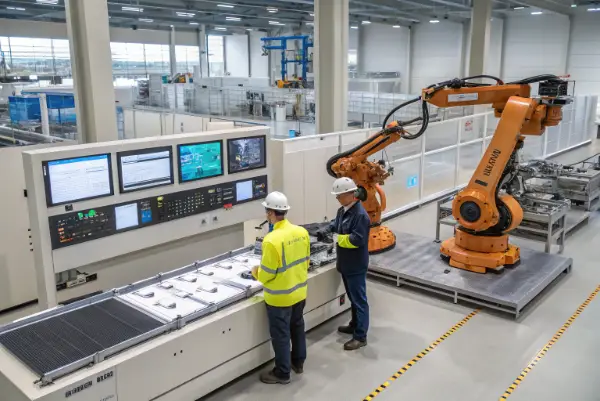
I often discuss costs with procurement managers. The biggest barrier to adopting composite shafts has always been price. "Jerry," they say, "I can buy a steel shaft for $50. Why pay $200 for carbon?" The future is about closing that gap.
Here is how the landscape is shifting over the next 5 to 10 years:
Automation is King
Right now, making a good composite shaft is an art. It requires skilled labor.
- The Shift: We are seeing Automated Fiber Placement (AFP) and rapid filament winding machines controlled by AI.
- The Result: The machine detects defects in real-time and adjusts tension. This lowers the scrap rate and the labor cost. High-quality composites will become accessible for mid-range robotics, not just high-end units.
The Circular Economy Challenge
Europe is leading the charge on this, and regulations are getting tighter. You cannot just throw a carbon fiber part in a landfill anymore.
- The Problem: Separating the fiber from the glue is hard.
- The Future: Solvolysis (chemical recycling) that recovers the carbon fiber with 90% of its strength intact. Designers will need to select resins specifically for their end-of-life recyclability.
Hybridization of Manufacturing
We will see more "over-molding." This means taking a wound carbon tube and injection molding complex plastic gears or splines directly onto the ends in one shot.
- Benefit: It eliminates the need for gluing metal end-fittings, which is the most common failure point in composite shafts today.
Critical Thinking for the Future Engineer:
You should not just ask "Is it strong enough?" You must ask:
- Scalability: Can I make 10,000 of these a year efficiently?
- Sustainability: What happens to this shaft in 10 years?
- Integration: Can I combine three parts (shaft, sensor, gear) into one composite structure?
At QuickCNCs, we are preparing for this by partnering with suppliers who are already experimenting with recyclable resins and automated winding. The future is light, smart, and surprisingly affordable.
Conclusion
Composite transmission shafts are evolving from simple lightweight alternatives into smart, self-healing, and sustainable systems. By leveraging advanced materials like thermoplastic matrices and nanomaterials, engineers can overcome the vibration and weight limitations of steel. The future belongs to those who design for automation and lifecycle intelligence.