
Every engineer knows the pain of a transmission shaft failing due to poor concentricity or surface finish issues. You design for microns, but the shop floor delivers errors. It stops your assembly line and kills your project timeline.
Advanced CNC machining techniques optimize transmission shaft production by utilizing multi-axis turning centers for single-setup completion, employing Swiss-style machining for slender shafts to prevent deflection, and integrating in-process probing to verify tolerances instantly. These methods ensure concentricity better than 0.01mm and surface finishes smoother than Ra 0.4, directly solving vibration and wear issues in high-speed assemblies.
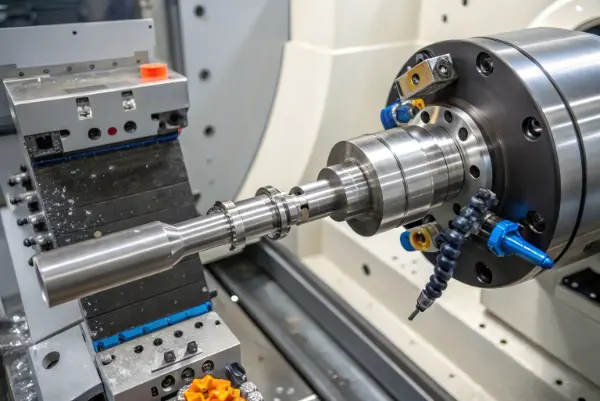
But knowing the methods isn’t enough; you need to know how to apply them correctly. I have seen too many perfect designs ruined by the wrong machine choice. In the following sections, we will explore exactly how to select the right technique for your specific shaft requirements.
Why Is Multi-Axis Turn-Mill Machining Crucial for Complex Shafts?
Moving a part from a lathe to a mill introduces human error and clamping inaccuracies every single time. If your transmission shaft requires keyways, splines, or off-center holes, doing it in multiple setups is a recipe for rejected parts.
Multi-axis turn-mill machining is crucial because it allows all turning, milling, and drilling operations to happen in a single setup. This "Done-In-One" approach eliminates re-fixturing errors, ensuring that features like splines and bearing journals maintain perfect geometric alignment relative to the shaft’s central axis.
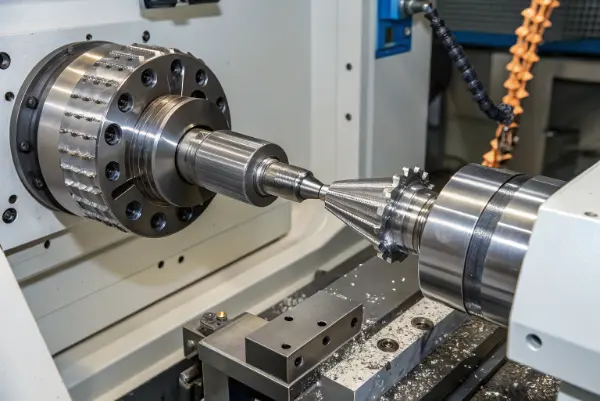
Let’s look deeper into why this matters for your robotics or automotive projects. When I first started in this industry, we used to make shafts on a standard 2-axis lathe. Then, we moved them to a vertical mill for the keyways. The rejection rate was nearly 15%. The problem was always the same: the keyway was slightly skewed relative to the axis.
With a Turn-Mill center (like a Mazak Integrex or similar), the workpiece stays in the chuck. The milling head comes in while the C-axis rotates the part precisely. This is not just about speed; it is about geometric dimensioning and tolerancing (GD&T).
Here is a breakdown of the specific advantages when dealing with complex features:
Comparison of Traditional vs. Turn-Mill Processes
| Feature | Traditional Method (2-3 Setups) | Multi-Axis Turn-Mill (1 Setup) |
|---|---|---|
| Concentricity | Risk of 0.02mm – 0.05mm error due to re-clamping. | Maintains < 0.005mm easily. |
| Spline Alignment | Hard to index perfectly. | C-axis indexing is accurate to 0.001 degrees. |
| Production Time | High idle time moving parts between machines. | Continuous cutting; reduces cycle time by 40%. |
| Tooling Cost | Requires multiple fixtures (lathe jaws + mill vise). | Requires only one set of jaws/collets. |
For engineers like Alex, who demand tight tolerances, this machine architecture is non-negotiable. If you are designing a shaft with cross-holes for locking pins or complex cam profiles, ask your supplier if they are using a turn-mill center. If they say they are moving it between three machines, expect tolerance stack-up issues. It saves you the headache of receiving parts that wobble at high RPMs.
How Does Swiss-Style Machining Prevent Deflection in Long, Slender Shafts?
Long, thin shafts are a nightmare to machine because they bend away from the cutting tool. This "deflection" causes the center of the shaft to be thicker than the ends, creating a barrel shape that ruins the fit.
Swiss-style machining prevents deflection by supporting the workpiece with a guide bushing very close to the cutting tool. The stock slides through this bushing, meaning the tool always cuts near the support point, effectively eliminating the leverage that causes bending in long, slender transmission shafts.
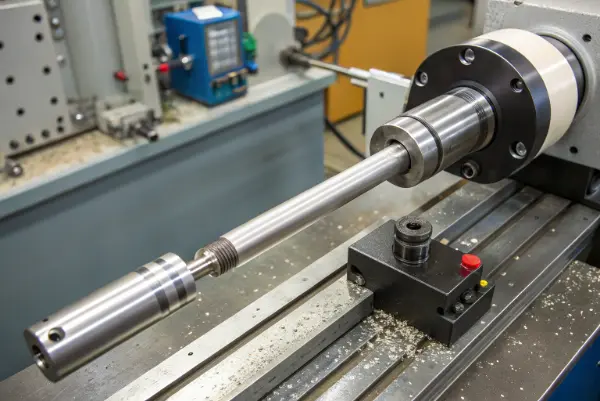
I remember a project for a medical device client where the shaft was 4mm in diameter but 150mm long. They tried to make it on a standard lathe with a tailstock. The vibration was terrible, and the surface finish looked like a threaded screw. We switched the job to a Citizen Swiss lathe, and the problem disappeared instantly.
The core concept here is distinct from conventional turning. In a normal lathe, the part is clamped and the tool moves. In a Swiss lathe, the tool is stationary (mostly) in the Z-axis, and the part moves through the guide bushing.
Understanding the Mechanics of Deflection Control
Why does this matter for transmission shafts? Because many drive shafts in precision robotics are long relative to their width (high L/D ratio).
- The Guide Bushing Advantage: The distance between the cutting edge and the support is often less than 10mm. Physics dictates that deflection is proportional to the cube of the length. By keeping this length near zero, rigidity is maximized.
- Segmented Machining: You cannot turn the whole length and then go back to cut a groove in the middle on a Swiss machine easily (because the part retracts into the bushing). You have to think linearly. This requires the programmer to be very skilled.
- Material Selection: Swiss machines require ground stock (centerless ground bars). If the raw material is not perfectly round, it will seize in the guide bushing. This adds a small cost to the material but guarantees the final roundness of your shaft.
Typical Applications for Swiss Machining
- Micro-motor shafts: Diameter < 3mm.
- Hydraulic spools: Long, with multiple precise grooves.
- Needle valves: Where taper control is critical.
If your transmission shaft has a length-to-diameter ratio greater than 10:1 (for example, 10mm diameter, 100mm long), stop looking for a standard lathe shop. You need a partner with Swiss machining capabilities. It is the only way to guarantee straightness without expensive secondary grinding operations.
What Role Does Cylindrical Grinding Play in Achieving Ultra-Precise Fits?
Sometimes, CNC turning is simply not accurate enough for the bearing seats on a high-speed transmission shaft. When you need tolerances tighter than IT6 or surface finishes like mirrors, the cutting tool has limits.
Cylindrical grinding plays the final critical role in achieving ultra-precise fits by using an abrasive wheel to remove microscopic amounts of material. This process achieves dimensional tolerances of ±0.002mm and surface roughness values of Ra 0.2 or better, ensuring silent operation and extended bearing life.
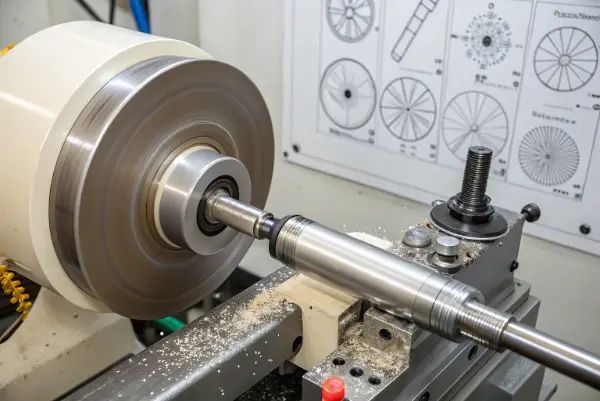
I often tell clients: "Turning is for geometry; grinding is for perfection." Even the best CNC lathe will leave microscopic feed lines (scallops) on the surface. For a static part, this is fine. For a shaft spinning at 10,000 RPM inside a high-precision bearing, these feed lines act like tiny files, wearing down the bearing prematurely.
When to Specify Grinding?
You do not need to grind the whole shaft. That is a waste of money. You only need to grind the "critical functional surfaces."
- Bearing Journals: The specific area where the bearing sits. A press fit here needs to be exact. If it is too loose, the shaft vibrates. If it is too tight, you damage the bearing during installation.
- Seal Surfaces: If an oil seal rides on the shaft, the surface must be incredibly smooth. A turned surface will tear the rubber seal lip, causing leaks within weeks.
- Tapered Fits: For mating gears or couplings that rely on friction.
The Process Workflow
To do this right, we follow a strict sequence at QuickCNCs:
- Step 1: Rough Turning: Leave 0.2mm – 0.3mm of extra material on the diameter.
- Step 2: Heat Treatment: Harden the steel (e.g., Case Hardening or Induction Hardening). This often warps the shaft slightly.
- Step 3: Finish Grinding: We put the hardened shaft on the cylindrical grinder. The abrasive wheel cuts through the hard skin and corrects any warping from the heat treatment.
This workflow is standard for high-end automotive and aerospace shafts. If you skip the grinding on a hardened shaft, you are asking for trouble. Turning hardened steel (hard turning) is possible, but it rarely matches the consistency of grinding over a large production run. Grinding ensures that every single shaft in a batch of 1,000 fits the bearing exactly the same way.
How Can In-Process Probing Ensure Consistency Across Production Batches?
Quality control usually happens after the part is made. But if you find an error then, the part is already scrap. In high-value manufacturing, we need to catch errors while the part is still inside the machine.
In-process probing ensures consistency by using a touch probe mounted inside the CNC machine to measure the shaft’s dimensions between cutting steps. The machine control reads this data and automatically adjusts the tool offsets (wear compensation) to correct any drift, guaranteeing that the final cut is precisely on target.
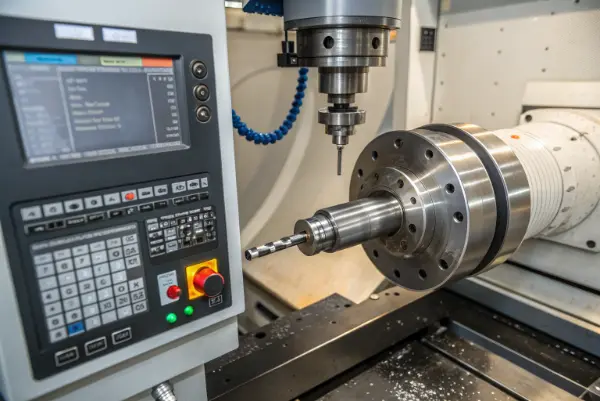
This is a game-changer for automated production. Tools wear down. It is a fact of life. As a cutting insert wears, the shaft diameter slowly gets larger. Without probing, an operator has to manually check every 5th part and adjust the machine. If they get distracted, you get bad parts.
The Feedback Loop Mechanism
Modern CNC machines, like the ones we use for Alex’s orders, have "macros" (little software programs) running in the background.
- The Check: After the semi-finish pass, the probe comes down and touches the shaft diameter.
- The Calculation: The machine expects the diameter to be 20.00mm. The probe measures 20.01mm. The machine calculates the error: +0.01mm.
- The Adjustment: The computer tells the finishing tool: "Move in an extra 0.01mm."
- The Result: The final cut is perfect, regardless of how worn the tool was (within limits).
Benefits Beyond Accuracy
Using in-process probing offers more than just dimensions. It also offers safety.
| Benefit | Description |
|---|---|
| Broken Tool Detection | The probe can check if a drill bit is broken before attempting to tap a thread, saving the expensive part from being destroyed. |
| Datum Setting | It automatically finds the center of the raw stock, accommodating for variations in casting or sawing. |
| Reporting | The probe data can be saved. We can provide a report showing exactly what the dimensions were before the part even left the machine. |
For engineers sourcing from overseas, asking for "In-Process Probing" is a great way to filter your suppliers. It shows that the shop invests in automation and process security. It removes the reliance on a tired operator reading a micrometer at 4 PM on a Friday. It ensures that the first part and the hundredth part are identical.
Conclusion
To get high-precision transmission shafts, you must match the design to the right manufacturing technology: use Turn-Mill for complex geometries, Swiss machining for slender parts, Grinding for bearing fits, and Probing for consistency.