
Confusion often arises when engineers discuss power transmission components, specifically regarding drive shafts and transmission shafts. You might order the wrong part or design a system inefficiently if you do not understand their distinct roles. This article clarifies these differences to help you make better manufacturing decisions.
A drive shaft transfers torque from the transmission to the differential, handling the final delivery of power to the wheels or machinery. A transmission shaft is an internal component located inside the gearbox that carries torque through various gear sets. While both transmit rotational force, the drive shaft is external and connects assemblies, whereas the transmission shaft is internal and facilitates gear ratio changes.
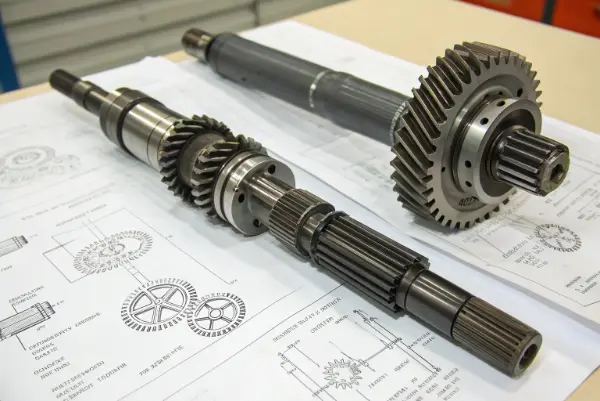
Let’s move past the basic definitions. In my years of handling CNC projects for clients in Europe, I have seen many technical drawings where terminology is mixed up. This leads to production delays. To ensure your next project runs smoothly, we need to break down the specific functions, materials, and design considerations for each component.
What is the fundamental difference between a drive shaft and a transmission shaft?
Many engineers mistakenly use these terms interchangeably, leading to confusion during the design and procurement phases. You need to know exactly which component bears which load to select the correct material and tolerance. Mixing them up can cause catastrophic mechanical failure in your assembly.
The fundamental difference lies in their location and function within the power train system. The transmission shaft operates inside the gearbox, subjecting itself to high shear stress and supporting gears to change torque and speed. The drive shaft connects the gearbox output to the final drive, compensating for distance and angles, often requiring flexibility.
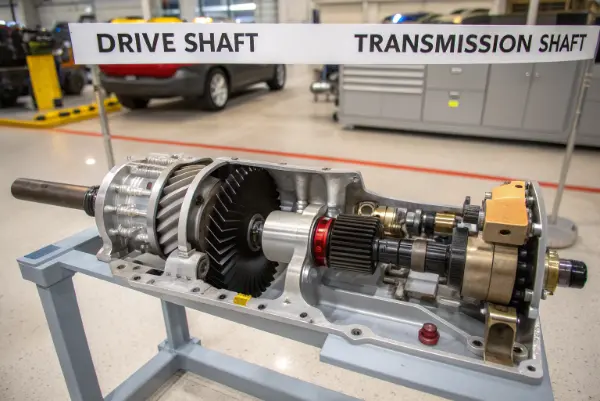
To truly understand this, we must look at the mechanics. When I review a CAD file from a client like Alex, I look for specific features. A transmission shaft usually has splines or keyways along most of its length to hold gears. It is short, rigid, and supports heavy radial loads. It does not need to flex. In contrast, a drive shaft is long and tubular. It must handle torsion but relatively lower bending loads compared to the transmission shaft.
Here is a breakdown of their primary characteristics:
| Feature | Transmission Shaft | Drive Shaft |
|---|---|---|
| Location | Inside the Gearbox | Between Gearbox and Differential |
| Primary Stress | Bending and Shear | Torsion (Twisting) |
| Construction | Solid steel bar | Hollow tube (usually) |
| Flexibility | Rigid, zero flex | flexible joints (U-joints/CV joints) |
| Length | Short | Long |
From a manufacturing perspective at QuickCNCs, the machining process differs greatly. For a transmission shaft, we focus on turning and precise spline cutting. We often use 8620 or 9310 alloy steels, followed by carburizing to harden the surface while keeping the core tough. Tolerance on bearing journals must be incredibly tight, often within 0.005mm.
For a drive shaft, the focus is on balance. We might machine the yokes and weld them to a DOM (Drawn Over Mandrel) tube. The material is often 1045 steel or aluminum for weight reduction. The critical quality control step here is dynamic balancing. If a drive shaft is not balanced, it will vibrate at high speeds, destroying the transmission seals. So, when you design these, think about the environment. Is it sealed in oil (transmission shaft)? Or is it exposed to the elements and needing movement compensation (drive shaft)?
What is the part located between the driveshaft and the transmission?
Connecting a rigid transmission to a moving drive shaft is a significant engineering challenge. If you bolt them directly together, the vibration and movement will snap the shaft or crack the transmission casing. You must identify the correct interface component to ensure smooth power transfer.
The part connecting the driveshaft to the transmission is typically a universal joint (U-joint) or a flexible coupling (guibo). This component allows the drive shaft to transmit power at an angle, accommodating the movement of the suspension or the misalignment between the engine and the final drive.
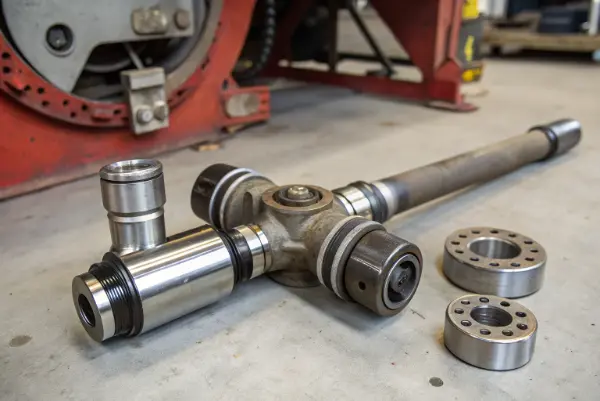
This interface is critical. In my early days as a machinist, I worked on a project where a client neglected the angle of operation. They connected a shaft too rigidly. The result was immediate bearing failure in the transmission. The component between the two shafts acts as a buffer. It is the "wrist" of the mechanical arm.
Let’s look at the two main types used in this connection:
-
Universal Joint (Cardan Joint):
- Structure: It consists of a cross (spider) connecting two yokes.
- Function: It allows the shaft to bend in any direction while spinning.
- Drawback: It causes a fluctuation in speed if the angle is too steep. This is known as "non-constant velocity."
- Manufacturing: We CNC machine the yokes from forged steel for maximum strength. The cross is usually a purchased standard part, but the yokes must be machined to fit the tube perfectly.
-
Flexible Coupling (Guibo/Flex Disc):
- Structure: A rubber disc reinforced with fiber cords and metal bushings.
- Function: It absorbs vibration and slight misalignments. It does not handle steep angles well.
- Advantage: It is much smoother and quieter than a U-joint.
- Application: You see this on high-end German cars where comfort is key.
When designing this connection, you must consider the "Slip Yoke." The distance between the transmission and the differential changes as the suspension moves up and down. The drive shaft effectively needs to get longer and shorter. The slip yoke slides into the transmission output shaft (which is splined). This allows for axial movement.
At QuickCNCs, we often manufacture custom slip yokes. The internal splines are broached or shaped. The surface finish on the outside of the slip yoke must be polished to a mirror finish (Ra 0.4 or better). Why? Because it slides against the rubber seal of the transmission. If it is rough, it will tear the seal, and the transmission fluid will leak out. This small detail is the difference between a part that lasts 100,000 miles and one that fails in a week.
How can you easily identify a drive shaft in a system?
Visual identification is necessary during maintenance, reverse engineering, or system layout planning. If you cannot quickly distinguish the drive shaft from other structural bars or linkages, you waste time. You need a reliable set of visual cues to spot the drive shaft immediately.
You can identify a drive shaft by looking for a long, rotating tube with universal joints or CV joints at both ends. It is usually the longest moving component under a chassis or in a machine, connecting the central power source to the final output mechanism, and often has visible counterweights welded onto it.
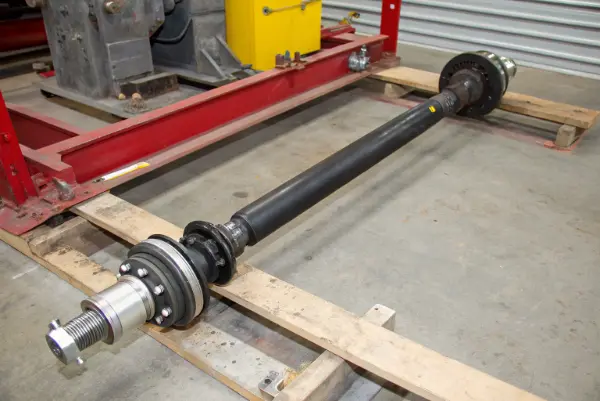
Identifying a drive shaft is straightforward if you know what to look for. Unlike the transmission shaft, which is hidden inside a casing, the drive shaft is exposed. It needs space to rotate.
Here is a checklist I use when inspecting a new machine or vehicle setup:
- The Tube Shape: 90% of drive shafts are hollow tubes. This increases the strength-to-weight ratio. A solid bar of that length would be too heavy and would sag under its own weight, causing "whipping" at high speeds. If you tap it with a wrench, it rings like a bell.
- The Joints: Look for the bulges at the ends. You will see the U-joint (cross shape) or a CV joint (a rubber boot). These are distinct indicators. Fixed structural bars do not have these.
- Balance Weights: Look closely at the ends of the tube. You will often see small rectangular metal plates welded onto the surface. These are balance weights added during the manufacturing process to ensure the shaft spins without vibration. No other chassis bar has these.
- Rotation: This is obvious, but if the machine is safe to operate, turn it on. The drive shaft spins. The suspension links do not.
From a CNC manufacturing standpoint, the "tube" aspect is interesting. We do not machine the entire length of the tube. That would be wasteful. Instead, we machine the end fittings—the weld yokes and flange yokes. We turn these on a lathe to precise diameters. Then, a specialized welder joins them to the tube.
However, in high-precision robotics (like the industry Alex works in), the "drive shaft" might look different. It might be a small, solid stainless steel shaft connecting a servo motor to a gearbox. In this context, identify it by tracing the power flow. Start at the motor. The first shaft that leaves the motor is the drive shaft. If it enters a box of gears, the shafts inside that box are transmission shafts. The shaft leaving the box is the output drive shaft. Tracing the energy path is the most reliable method for complex machinery.
What is the difference between a transmission shaft and a standard machine shaft?
Not all shafts are created equal, and treating a transmission shaft like a standard machine shaft leads to expensive errors. A standard shaft might just hold a pulley, but a transmission shaft endures complex, compounding forces. You must understand the specific engineering requirements of transmission components.
A transmission shaft is designed specifically to handle high torque loads, multiple gear engagements, and shear forces within a gearbox. A standard machine shaft is a general-purpose component used to support rotating parts like pulleys or idlers, often bearing lower loads and requiring less complex machining features like intricate splining.
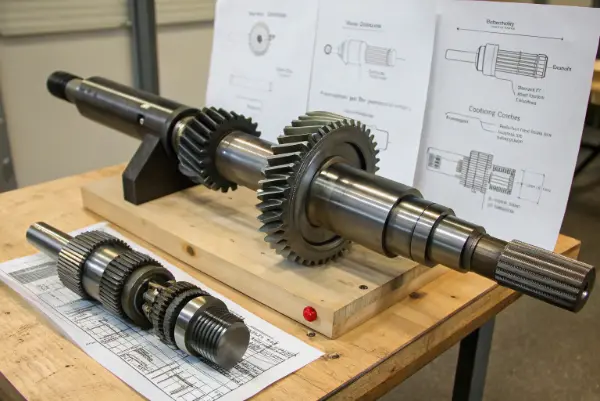
The difference here is really about complexity and stress. A standard machine shaft—let’s say for a conveyor belt roller—is simple. It is often just a cold-rolled steel bar (1018 or 1045) cut to length. We might turn the ends down to fit a bearing and maybe cut a keyway. It handles mostly bending loads (the weight of the belt).
A transmission shaft is a different beast entirely. It transmits power, which means it is under massive torsional stress (twisting). If you use simple 1018 steel for a transmission shaft, it will twist like a pretzel the moment the motor engages.
Here is a deeper comparison of the manufacturing differences:
-
Material Selection:
- Standard Shaft: Carbon steel (1045) or Stainless (304). Cheap and easy to machine.
- Transmission Shaft: Alloy steel (4140, 4340, 8620). These contain chromium and molybdenum for high strength and fatigue resistance.
-
Heat Treatment:
- Standard Shaft: Often used "as is" or induction hardened only at the bearing seats.
- Transmission Shaft: Usually requires "Case Hardening." We want the surface to be rock hard (60 HRC) to prevent wear from the gears spinning on it, but the core must remain soft and ductile to absorb shock loads without snapping.
-
Geometry and Features:
- Standard Shaft: Simple steps (diameters), keyways.
- Transmission Shaft: Complex splines (involute splines). Cutting these requires a hobbing machine or a wire EDM. The shaft often has oil holes drilled deep through the center to lubricate the gears. Deep hole drilling (gun drilling) is a specialized process that increases cost significantly.
I often advise clients like Alex to check their drawings. If you label a part "shaft," be specific. If it goes inside a gearbox, the tolerances for concentricity (how true the circle is) need to be tighter. A standard shaft can have a runout of 0.05mm. A transmission shaft running at 3000 RPM needs a runout of less than 0.01mm. If it is not perfectly straight, it will destroy the gear mesh and create noise. Precision is the defining characteristic of the transmission shaft.
Conclusion
The drive shaft connects components externally and handles angles, while the transmission shaft operates internally to manage gear ratios and torque. Identifying them correctly ensures you select the right materials and manufacturing processes.