
Deadlines are approaching, and receiving parts that don’t fit can ruin an entire project. As engineers, we know the pain of failed tolerances and rejected batches. Quality control isn’t just a step; it is the only way to ensure your design functions exactly as intended in the real world.
Quality control for precision machined parts relies on a mix of standard operating procedures and advanced metrology. It involves initial material verification, in-process inspections using calipers and micrometers, and final verification with CMM (Coordinate Measuring Machines). Standards like ISO 9001 ensure consistency, while Geometric Dimensioning and Tolerancing (GD&T) defines the specific accuracy required for complex features.
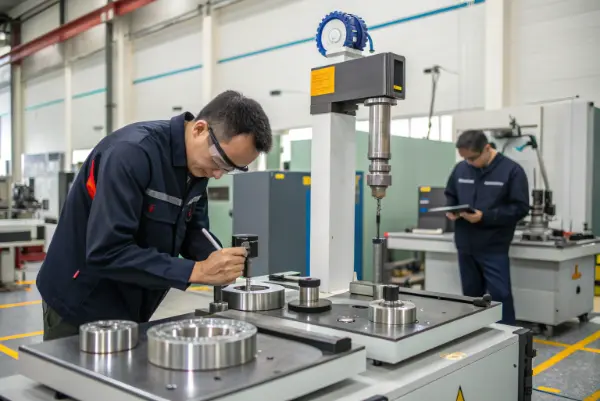
Many buyers assume that sending a 3D file is enough to get a perfect part. However, without a clear agreement on inspection methods, results will vary. I have seen projects fail simply because the supplier and the engineer measured the same feature differently. Let’s look at how we can prevent this.
Why Is Material Verification the First Step in Quality Control?
You can machine a part to perfect dimensions, but if the steel is too soft or the aluminum is the wrong grade, the part is useless. Skipping material verification is a common mistake that leads to catastrophic failures in the field. You need to know exactly what is going onto the machine.
Material verification ensures the raw stock matches the engineering specifications before cutting begins. This is typically done using Optical Emission Spectrometry (OES) or X-ray Fluorescence (XRF) analyzers to confirm chemical composition. Suppliers should always provide a Material Test Report (MTR) or Mill Certificate to prove the alloy grade, hardness, and heat treatment status.
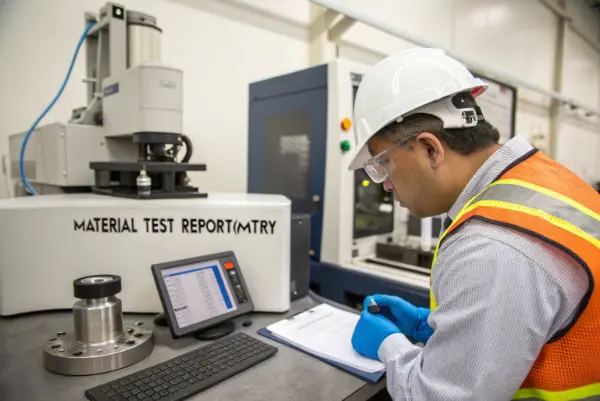
If you are building a robotic arm like Alex, my client in Germany, using 6061 aluminum instead of 7075 can cause structural failure under load. I once had a new supplier try to swap materials to save cost. We caught it immediately because we mandated a spectral analysis report before machining started.
Understanding Material Certificates
When we talk about material verification, we need to go deeper than just looking at a label on a metal bar. A true quality control process involves a "trust but verify" approach.
- Mill Certificates: These are documents from the original manufacturer of the metal. They list the chemical composition (how much carbon, chromium, nickel, etc.) and mechanical properties (tensile strength, yield strength).
- Incoming Inspection: When raw material arrives at our shop, we don’t just put it on the shelf. We check the diameter, straightness, and surface condition.
- Traceability: This is crucial. Every batch of parts needs to be traceable back to the specific batch of raw material. We use heat numbers (lot numbers) to tag materials.
Here is a simple breakdown of what we look for in material verification:
| Check Type | Tool Used | Purpose |
|---|---|---|
| Chemical Analysis | XRF Gun / Spectrometer | Confirms the alloy elements match the standard (e.g., verifying Nickel content in SS316). |
| Hardness Testing | Rockwell C / Brinell Tester | Ensures the material is not too soft for the application or too hard to machine. |
| Visual Inspection | Human Eye / Magnifier | Checks for cracks, rust, or dents on the raw bar stock. |
| Dimensional Check | Calipers / Micrometers | Confirms the stock size allows enough material for clean-up cuts. |
By strictly enforcing these checks, we prevent the nightmare scenario of machining thousands of parts from the wrong metal. It saves time and protects your reputation.
How Do Coordinate Measuring Machines (CMM) Guarantee High Precision?
Complex geometries often have features that standard hand tools cannot reach or measure accurately. Relying solely on manual measurement for tight tolerances introduces human error. When microns matter, you need a method that removes the variability of a human hand.
A Coordinate Measuring Machine (CMM) uses a sensitive probe to touch points on a part’s surface, mapping its geometry in 3D space. It compares these actual data points against the CAD model to verify dimensions, hole locations, and complex curves. This provides the highest level of accuracy for inspecting tight tolerances and GD&T requirements.
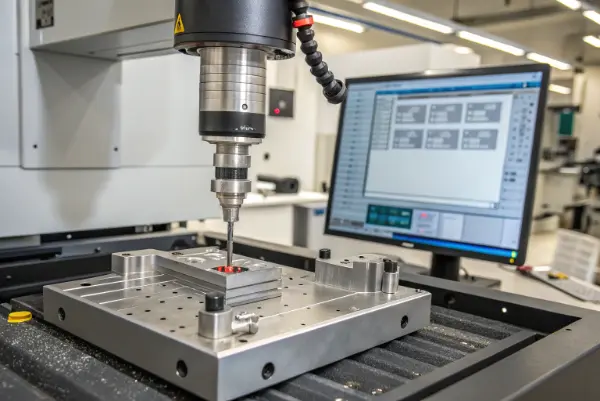
I remember a project involving a complex gearbox housing. The distance between bore centers had a tolerance of just ±0.005mm. Hand tools showed the part was "good," but the gears were binding. We put it on the CMM. The machine revealed a slight angular misalignment that calipers missed. The CMM saved the project from a costly assembly failure.
The Role of CMM in Modern Machining
The CMM is the supreme judge in a machine shop. However, it is not magic; it requires skilled programming and setup. We use CMMs for "Final Inspection," but they are also useful for "First Article Inspection" (FAI).
There are different types of CMM inspections we perform to ensure quality:
- Point-to-Point Inspection: The probe touches specific discrete points. This is great for measuring hole centers, plane flatness, and simple lengths.
- Scanning: The probe drags along the surface, collecting thousands of data points. This is essential for checking profiles, such as the curve of an airfoil or a mold surface.
- GD&T Verification: This is where CMM shines. It calculates "virtual" geometries. For example, it can determine if a cylinder is truly perpendicular to a base, not just if it is the right diameter.
Common CMM Reports and Data:
When we send a CMM report to a client, it usually includes a color-coded map.
- Green: Within tolerance.
- Red: Out of tolerance (too much material or too little).
- Yellow: Near the limit.
| CMM Feature | Benefit for the Engineer |
|---|---|
| True Position | Verifies a hole is in the exact xy location relative to datums, which is critical for mating parts. |
| Flatness | Ensures a sealing surface won’t leak, far better than using a straight edge. |
| Cylindricity | Checks if a shaft is round and straight along its entire length, crucial for bearings. |
| Profile of a Surface | Compares the complex 3D curve against the CAD model to ensure aerodynamic or ergonomic shape. |
Understanding these reports helps you and the supplier speak the same language. It removes ambiguity.
What Are Standard In-Process Inspection Techniques?
Waiting until the part is finished to check quality is a recipe for disaster and waste. If an error happens in the first operation, all subsequent work is a loss. You need to catch issues the moment they happen, right at the machine.
In-process inspection involves measuring parts while they are still being machined or immediately after each operation. Operators use hand tools like digital calipers, micrometers, thread gauges, and bore gauges to check critical dimensions. This creates a feedback loop, allowing the machinist to adjust tool offsets instantly to keep the process centered.
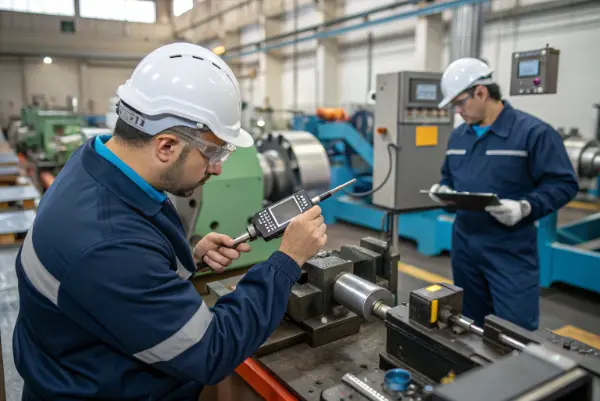
I always tell my team: "Do not make scrap." In-process inspection is the barrier against scrap. For example, when turning a shaft, tool wear will cause the diameter to slowly increase. By measuring every fifth part, the operator sees the trend. He can adjust the machine by 0.01mm before the part ever goes out of tolerance.
The Toolkit for Immediate Feedback
In-process inspection is about speed and consistency. We cannot stop the machine for an hour to use a CMM for every single check. We need reliable tools at the workstation.
We rely on a hierarchy of tools depending on the tolerance required:
- Calipers (Vernier or Digital): These are the "eyes" of the machinist. They are good for tolerances down to ±0.02mm. They check lengths, outer diameters, and step depths quickly.
- Micrometers: When we need to see ±0.005mm, we use micrometers. They are stiffer and less prone to user pressure errors than calipers. We use outside mics for shafts and inside mics for bores.
- Go/No-Go Gauges: These are fixed limit gauges. For threaded holes, a "Go" gauge should screw in, and a "No-Go" gauge should not. This is a binary pass/fail check that is very fast.
- Pin Gauges: Precision ground steel pins used to check hole sizes. If a 5.00mm pin fits but a 5.01mm pin does not, we know exactly where the hole size stands.
Sampling Plans:
We don’t always measure 100% of dimensions on 100% of parts during the run. That would be too slow. We use sampling based on AQL (Acceptable Quality Limit) standards.
| Production Volume | Inspection Frequency | Typical Checks |
|---|---|---|
| Prototype (1-5 pcs) | 100% Inspection | Every dimension is checked and recorded. |
| Small Batch (50-100 pcs) | Every 5th or 10th part | Critical dimensions (fits, bearings) checked. |
| Mass Production (1000+ pcs) | Statistical Process Control (SPC) | Random sampling charted to track process stability. |
This tiered approach balances cost with risk. It ensures that the process remains stable without adding unnecessary time to the production cycle.
How Does GD&T Influence Inspection Standards?
Drawing a line on a blueprint is easy, but defining exactly how straight that line must be is harder. Traditional "plus/minus" tolerancing often fails to describe how parts fit together. Without clear geometric definitions, a part can pass inspection but still fail assembly.
Geometric Dimensioning and Tolerancing (GD&T) is a symbolic language used on engineering drawings to explicitly describe geometry. It controls form, orientation, and location, such as parallelism, perpendicularity, and concentricity. Inspection standards for GD&T require specific setups, often involving surface plates, dial indicators, or CMMs to verify relationships between features.
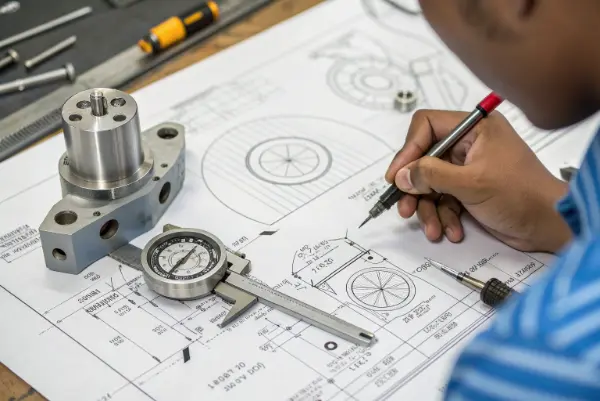
I often see drawings from younger engineers that lack GD&T. They might specify a hole location as X: 10mm, Y: 10mm ±0.1mm. But what if the hole is drilled at an angle? The entry point is correct, but the exit point is off. GD&T symbols like "Positional Tolerance" control the entire axis of the hole, ensuring a bolt will actually pass through it.
Decoding the Symbols for Better Quality
GD&T is not just for the designer; it is the instruction manual for the quality control team. It tells us what is most important. If you mark a surface with a "Flatness" tolerance, we know we must place it on a granite surface plate and run a dial indicator across it.
Here is how we interpret and inspect common GD&T calls:
- Datums (A, B, C): These are the reference planes. In inspection, we must clamp the part against these specific surfaces to measure everything else. If the datum is wrong, every measurement is wrong.
- Concentricity / Runout: Essential for rotating parts. We put the part in a V-block or on a lathe center and spin it while a dial indicator touches the surface. If the needle wiggles too much, the part is wobbling.
- Parallelism: We measure this by sliding a height gauge across the part while it sits on a surface plate. The top surface must stay within two parallel planes.
Why GD&T Saves Money:
It might seem complicated, but GD&T actually allows for looser tolerances where they don’t matter, and tighter ones where they do.
| GD&T Symbol | Inspection Method | Real-World Application |
|---|---|---|
| Position (⌖) | CMM or Functional Gauge | Ensures bolts line up with mating holes. |
| Perpendicularity (⊥) | Square block & Feeler gauge / CMM | Ensures a bracket stands straight up on a base. |
| Flatness (⏥) | Surface plate & Height gauge | Ensures a gasket seals properly to prevent leaks. |
| Roundness (○) | Roundness tester / Micrometer (multi-point) | Ensures a bearing fits without being pinched. |
By using these standards, you force the inspection team to verify function, not just numbers. It bridges the gap between the digital design and physical reality.
Conclusion
Quality control combines material verification, in-process checks, CMM precision, and strict GD&T standards. These methods ensure parts fit perfectly, reduce waste, and build trust between engineers and suppliers.