
You get a quote from a Chinese supplier that’s 50% cheaper than your local shop. It seems too good to be true. You’re tempted by the huge savings, but you worry about hidden fees, shipping costs, and quality issues that could turn your great deal into a project-killing nightmare.
CNC machining in China is often cheaper in direct costs like labor and tooling. However, the true cost must include shipping, tariffs, and communication overhead. When managed correctly with a reliable partner who provides value-added services like DFM, the total cost can still be significantly lower than domestic production, but you must evaluate the entire picture.
Many engineers I talk to get stuck on the unit price. They see a number on a quote and make their decision based on that alone. But after more than a decade of helping companies source parts globally, I’ve learned that the most successful projects are run by people who understand the full equation. The initial quote is just one part of the story. To make the right choice for your project, you need to perform a true cost analysis. Let’s break down all the factors you need to consider.
How Do Direct Costs Like Unit Price and Tooling Compare?
You need to get a prototype made, but the high labor and overhead costs of domestic shops are putting your budget under pressure. This can force you to compromise on your design or order smaller quantities, slowing down your entire development cycle and putting you behind schedule.
Direct costs for CNC machining in China are significantly lower, primarily due to more affordable skilled labor and lower factory overhead. Tooling and setup costs are also much more competitive. For both prototypes and production runs, the per-unit price from a Chinese supplier can be 30-60% less than a comparable domestic quote.
The most visible difference is always in the direct costs. This is what gets everyone’s attention first. The primary driver behind this is the cost of skilled labor. An experienced CNC machinist is a valuable professional anywhere in the world, but the local cost of living creates a huge difference in wages between a city like Stuttgart and a city like Shenzhen. This labor advantage extends beyond just running the machines. It also applies to the non-recurring engineering (NRE) costs, like creating custom fixtures or programming complex toolpaths. I remember a client who needed a complex fixture for a production run. The quote from his local shop in the US for the fixture alone was over $5,000. Our partner facility in China built an identical, high-quality fixture for under $1,500. That saving was passed directly to the client before we even machined the first part.
A Breakdown of Direct Costs
Let’s look at the main components that make up that initial quote.
| Cost Factor | Domestic (e.g., Germany/USA) | China | Why the Difference? |
|---|---|---|---|
| Labor Rate | High ($50-$100/hr) | Lower ($15-$30/hr) | A direct result of the difference in local economies and cost of living. |
| Tooling/Fixtures | Very High | Lower | The labor to design and create custom tooling is significantly less expensive. |
| Material Cost | Standard Global Price | Often Slightly Lower | China’s massive manufacturing sector buys materials in enormous bulk, creating savings. |
| Factory Overhead | High | Lower | The cost of rent, utilities, and local administrative compliance is lower. |
These factors combined mean that for the exact same part, made from the exact same material, the quote from a Chinese partner will almost always be lower. This isn’t about cutting corners; it’s about fundamental economic differences in the cost of doing business.
What Are the Hidden Costs of Sourcing from China You Might Miss?
You’ve received that very attractive quote and are ready to place the order. But you have a nagging feeling you’re missing something. What about shipping? What about taxes? What happens if the parts are wrong? These unknown variables can turn a great deal into a financial disaster that you have to explain to your boss.
The most common hidden costs are international shipping, import tariffs, and currency conversion fees. You must also factor in the "soft costs" of potential delays, communication overhead across time zones, and the huge financial risk of rework if quality is poor. A good partner will be transparent about these costs, but you must ask.

The number on the quote is not the number that hits your credit card. Forgetting this is the most common mistake I see new importers make. You have to think about the entire journey of the part from the factory floor in China to your assembly bench in Germany or the US. A few years ago, a startup founder came to me in a panic. He had ordered 500 enclosures from a supplier he found online. The price was great. But he never asked about shipping. The supplier sent the parts via express air freight, and he was hit with a $2,000 shipping bill he hadn’t budgeted for. Then, customs held the package and he had to pay an additional 25% tariff. His "cheap" parts suddenly became very expensive.
Budgeting for the Full Cost
To avoid surprises, you need to identify and budget for these costs upfront.
| Hidden Cost | Description | How to Mitigate |
|---|---|---|
| Shipping | Air freight is fast but expensive. Sea freight is slow but cheap. | Choose based on your project’s urgency and volume. Always get shipping quotes upfront. |
| Tariffs & Duties | Taxes imposed by your country on imported goods. Can be 0% to 25% or more. | Check your government’s trade website. Ask the supplier for the product’s HS Code. |
| Communication Lag | The cost of time lost due to time zones and language barriers. | Work with a partner who has a dedicated, fluent English-speaking project management team. |
| Rework Risk | The cost of scrapping bad parts, paying for a remake, and project delays. | This is the biggest risk. Mitigate it by vetting your supplier’s quality control systems. |
The risk of rework is the most dangerous hidden cost. If a batch of parts is bad, you don’t just lose the money you paid for them. You lose weeks or months on your project timeline, which can be far more damaging. This is why choosing a partner based on quality, not just price, is so critical.
How Does Engineering Support and DFM Affect the Total Cost?
You’ve designed a part that is perfectly functional on your CAD screen, but you’re not a machining expert. You have a feeling that some features might be difficult or expensive to make. If you send it to a low-quality supplier, they’ll just say "yes" and give you a high price, or worse, try and fail to make it.
High-quality engineering support and Design for Manufacturability (DFM) feedback are huge value-adds that reduce the true cost of a part. A good partner will analyze your design and suggest changes—like altering corner radii or adjusting tolerances—that can cut machining time and cost significantly without compromising function. This proactive support is a hidden saving.
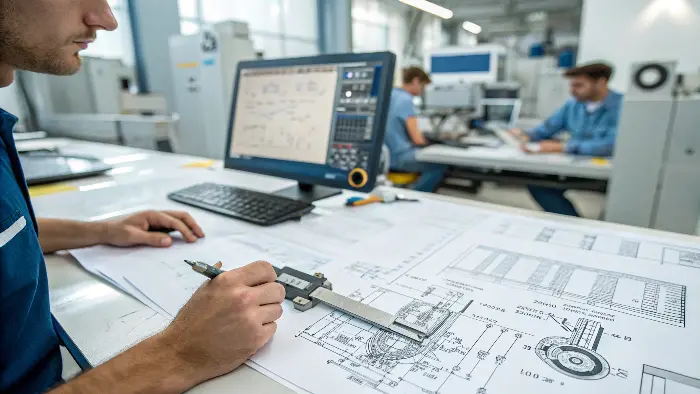
This is where a true partner separates themselves from a simple job shop. A job shop just makes what you send them. A partner helps you make it better and cheaper. DFM is the process of reviewing a design to find ways to make it more efficient to manufacture. This is where the biggest savings are often found, but they never show up on the initial quote. I always tell my team to act as a second pair of eyes for our clients. Just last month, we worked with an engineer, Alex, who had designed a new aluminum housing. His design called for a very tight tolerance of ±0.01mm on a surface that was purely for aesthetics. Our project manager flagged this and asked if a more standard tolerance of ±0.05mm would be acceptable. Alex agreed. That one small change allowed us to skip an entire finishing operation, saving him over $10 per part on a run of 500 units. That’s a $5,000 saving that came from a simple, proactive conversation.
Examples of DFM Savings
- Corner Radii: Your design has a sharp internal corner. A machine can’t make a perfectly sharp corner; it needs a radius left by the tool. If we can use a standard 3mm radius instead of a tiny 0.5mm one, we can use a larger, more rigid tool and cut the part much faster.
- Wall Thickness: You have very thin walls in your design. This can cause vibration during machining, leading to poor surface finish and requiring slower cutting speeds. Thickening the wall slightly can dramatically improve manufacturability.
- Material Selection: You specified a high-performance plastic like PEEK. Based on your application’s requirements, would a cheaper material like Delrin work just as well? This can cut material costs by over 70%.
This collaborative approach is what turns a simple transaction into a long-term partnership. The value of this expertise often far outweighs the few extra dollars you might pay on the unit price compared to the cheapest possible supplier.
What Financial Risks Should You Factor into Your Decision?
You’re about to send a 50% down payment overseas for your first production run. It’s a significant investment for your company. You worry about what happens if the supplier takes your money and disappears, if the quality is terrible, or if your intellectual property gets stolen.
The primary financial risks when sourcing from China are payment security, supply chain disruptions, and intellectual property (IP) theft. To mitigate these, use secure payment methods with clear terms, choose partners with a proven track record to avoid supply chain issues, and always use a Non-Disclosure Agreement (NDA) to protect your designs.

Managing risk is just as important as managing cost. A cheap part that never arrives or that compromises your company’s future is infinitely expensive. The good news is that these risks are all manageable if you are diligent and work with the right people. The key is to replace fear with a clear process. When it comes to payment, a standard and fair term is 50% upfront to cover material costs and 50% upon completion, before shipping. Never pay 100% upfront to a new supplier. For IP protection, an NDA is your first step. It sets a professional and legal expectation. But the real protection comes from a partner’s reputation. A company like ours, QuickCNCs, has a public brand and a long list of clients. Our entire business is built on long-term trust. We would never jeopardize our reputation for a short-term gain from one design. Our success depends entirely on our clients’ success.
A Checklist for Risk Management
- Payment Security: Use secure methods. PayPal offers some buyer protection for smaller orders. For larger orders, a formal contract and wire transfer with clear payment terms (e.g., 50/50) is best.
- Supply Chain Stability: Ask about potential delays. How do they handle things like Chinese New Year or port congestion? A good partner is transparent and has backup plans, like working with multiple shipping carriers.
- IP Protection: Always sign a bilingual (English and Chinese) NDA. More importantly, check the supplier’s reputation. Do they have testimonials? Have they worked with international companies before?
- Quality Assurance: This is the ultimate financial protection. The risk of receiving a bad batch of parts is huge. Mitigate this by insisting on a First Article Inspection (FAI) report on the first part and CMM inspection data for all critical features.
Conclusion
The true cost of CNC machining is never just the number on the quote. By comparing direct costs, accounting for hidden fees, demanding DFM support, and actively managing risks, you can make a truly informed decision. China can offer incredible savings and quality, but only with the right partner.