
Struggling to find a CNC partner that delivers on time and to your exact specifications? Project delays and bad parts can be incredibly frustrating, costing you time and money. The key is to have a solid framework for vetting suppliers and ensuring quality from start to finish.
To get reliable precision CNC machining, focus on suppliers with proven expertise in your industry. You should vet them by checking their quality control systems, requesting sample parts, and evaluating their communication. A good partner acts as an extension of your team, providing DFM feedback and transparent updates.
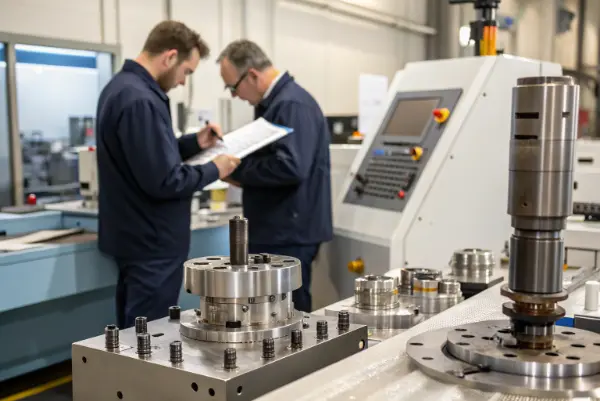
Getting reliable parts is about much more than just finding the cheapest quote. It is about building a partnership that you can trust. I have seen countless engineers, like Alex from Germany who I work with, transform their projects by shifting their focus from pure cost to overall value. The right partner saves you headaches down the line. But before we get into the details of finding that partner, let’s address the first question on everyone’s mind: the cost.
How much does a CNC service cost?
You need a budget for your project, but CNC machining quotes seem to vary wildly between suppliers. This makes it impossible to plan accurately and leaves you wondering if you’re overpaying. Understanding the key factors that drive cost can help you get fair and predictable pricing.
The cost of a CNC service depends on material type, machining time (complexity and tolerances), the number of setups required, and quantity. Simple aluminum parts in high volume might be a few dollars each, while complex, low-volume titanium parts can cost thousands. Always provide a complete technical drawing for an accurate quote.
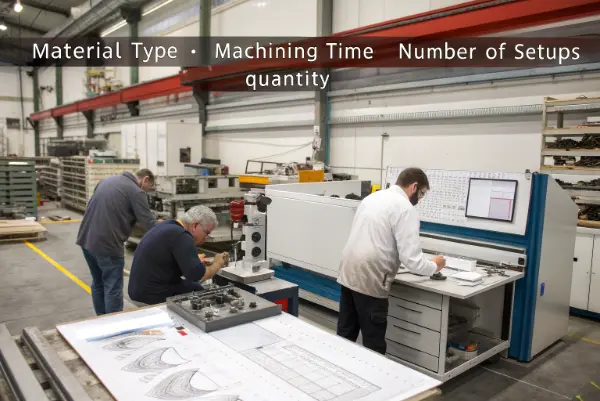
When I started in this business on the shop floor, I learned quickly that no two jobs are priced the same. The final cost is a mix of several important factors. To give you a clearer picture, I’ve broken down the main cost drivers.
Material Costs
The raw material is often a significant part of the total cost. Common metals like Aluminum 6061 are affordable and easy to machine. On the other hand, materials like Titanium or high-performance plastics like PEEK are expensive upfront and require more care, which adds to the cost.
Machining Time and Complexity
This is the biggest variable. How long does your part need to be on the machine? A simple block with a few holes is quick. A part with complex curves, thin walls, and very tight tolerances (like ±0.01mm) requires slower machine speeds, special tools, and more skill. This all adds up to more machine time and higher costs.
Setup and Programming
Before any metal is cut, a machinist has to program the CNC machine (CAM) and set up the machine with the right tools and fixtures. This setup cost is the same whether you make 1 part or 100 parts. This is why the price per part drops significantly with higher quantities.
Quantity and Economies of Scale
As I just mentioned, quantity has a huge impact. For a one-off prototype, the setup cost makes up a large portion of the price. When you order 1,000 pieces, that setup cost is spread across all the parts, making each one much cheaper.
Here is a simple table to show how these factors can affect the price of a hypothetical part:
| Material | Quantity | Estimated Price Per Part |
|---|---|---|
| Aluminum 6061 | 1 | $150 |
| Aluminum 6061 | 100 | $20 |
| Stainless Steel | 1 | $250 |
| Stainless Steel | 100 | $45 |
| PEEK | 1 | $400 |
| PEEK | 100 | $80 |
What is the hourly rate for a CNC machine?
You often hear about "machine hourly rates" but have no idea what a fair rate is or what it includes. This makes it tough to compare quotes or understand if you are getting good value. A clear understanding of what makes up the hourly rate will empower you to have better discussions with your suppliers.
A typical CNC machine hourly rate ranges from $50 to $150. This rate covers the machine’s cost, maintenance, tooling, electricity, and the operator’s labor. Simple 3-axis machining is on the lower end, while complex 5-axis machining with a highly skilled operator commands a higher rate.
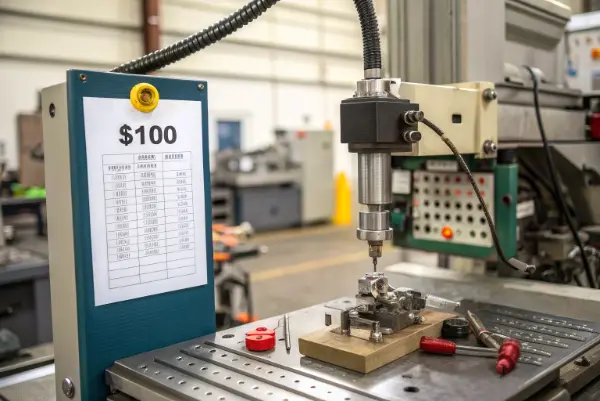
The hourly rate isn’t just a number pulled from thin air. It’s a calculation that keeps the shop running and ensures we can continue to invest in the technology you rely on. When I set up my first machine, I had to account for every single cost to figure out a rate that was fair to both me and my clients. It is more than just the machine itself.
What’s Inside the Hourly Rate?
Let’s break down the components. Think of it like a recipe. The main ingredients are the machine’s depreciation, the operator’s salary, and the shop’s overhead.
- Machine Cost & Depreciation: A high-quality CNC machine is a massive investment, sometimes costing hundreds of thousands of dollars. This cost is spread out over the machine’s expected lifespan. A more advanced 5-axis machine costs more per hour than a standard 3-axis mill.
- Labor: A skilled machinist or programmer is essential for producing quality parts. Their salary, benefits, and training are a major part of the hourly cost. You’re not just paying for the machine; you’re paying for the expertise behind it.
- Tooling & Maintenance: Cutting tools wear out and need to be replaced. Machines need regular maintenance, coolant, and occasional repairs. These consumable and maintenance costs are factored into the hourly rate to ensure consistent performance.
- Overhead: This includes everything else needed to run the business: rent for the workshop, electricity, software licenses (for CAD/CAM), quality control equipment, and administrative staff.
The rate you’re quoted directly reflects the level of technology and skill being applied to your project. A shop charging $50/hour might be using older 3-axis machines for simpler parts, which is perfectly fine for many applications. A shop charging $120/hour is likely using state-of-the-art 5-axis machines and employing top-tier machinists to handle very complex geometries and tight tolerances. It is all about matching the right capability to your specific needs.
What is the most accurate CNC machine?
You’re designing parts that require extreme precision, but you are not sure which technology can deliver it. Choosing the wrong process can lead to failed parts, wasted materials, and project delays. You need to know what machines are capable of hitting the tightest tolerances for your most demanding applications.
For ultimate accuracy, Wire EDM (Electrical Discharge Machining) and high-precision 5-axis milling centers are the top contenders. Wire EDM can achieve tolerances as tight as ±0.001mm by using an electrified wire to erode material. High-end 5-axis mills with thermal compensation and linear motor drives can reliably hold ±0.005mm.
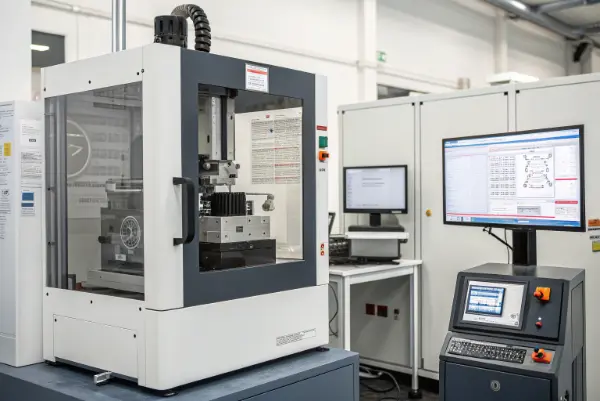
When an engineer like Alex sends me a drawing with tolerances in the single-digit microns, I know we need to bring out the best equipment. The term "accuracy" in CNC machining isn’t just about one machine type; it’s about a combination of the machine, the environment, and the process. I always tell my clients that accuracy is a system.
Pushing the Limits of Precision
The quest for accuracy has led to incredible innovations in machine tool technology. Standard CNC machines are very precise, but some applications in aerospace, medical devices, and optics require another level of performance.
- High-Precision 5-Axis Milling Centers: These are the workhorses for complex, accurate parts. What makes them "high-precision" are features like temperature-controlled components to prevent thermal expansion, linear motor drives instead of traditional ball screws for smoother motion, and sophisticated software for error compensation. Brands like Kern Microtechnik or DMG Mori are famous for machines that can hold tolerances under ±0.005mm. We use these for parts with complex 3D surfaces that need to be perfect.
- Wire EDM (Electrical Discharge Machining): This process is in a class of its own. It uses a thin, electrically charged wire to cut through metal like a cheese wire. Because there is no physical contact or cutting force, it doesn’t create stress in the material. This makes it ideal for creating extremely fine features and achieving unbelievable accuracy, often down to ±0.001mm. I recall a project for a medical client that required a tiny, intricate slot in a hardened steel component. Milling was not an option, but Wire EDM handled it perfectly.
- Jig Grinders: For the absolute highest surface finish and dimensional accuracy on hardened materials, jig grinders are the ultimate tool. They use grinding wheels to slowly remove tiny amounts of material, allowing for corrections at the micron level. This is a slower, more specialized process reserved for the most critical applications, like making molds and dies.
Choosing the right machine depends on your part’s geometry, material, and the specific tolerances you need to achieve.
Can a CNC machinist make 100k a year?
You might be curious about the people who actually make your parts. Is being a CNC machinist a good career? Understanding the value and skill of these professionals can give you a better appreciation for the craft and why high-quality work comes at a certain price.
Yes, a highly skilled CNC machinist, especially a programmer or a 5-axis specialist, can absolutely make over $100,000 a year in high-cost-of-living areas, particularly in the US. This salary reflects deep expertise in CAM software, complex machine setup, and problem-solving skills that are in high demand.
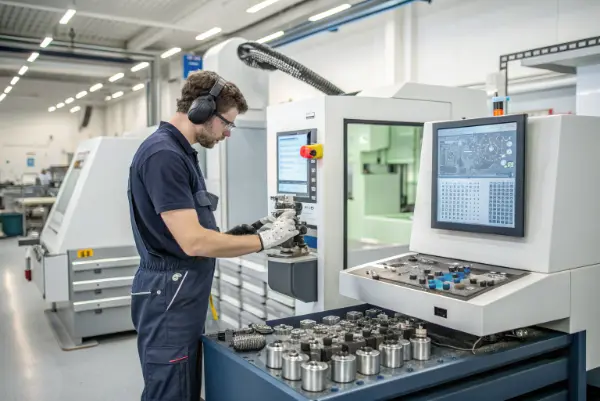
Absolutely. I started my career on the shop floor, and I’ve seen firsthand how the role of a machinist has evolved. The idea of a machinist just loading parts and pushing a green button is long gone. Today’s top machinists are highly skilled tech professionals, and their compensation reflects that.
The Path to a Six-Figure Salary
A machinist’s income is tied directly to their skill level and the value they bring. It’s not about years of experience alone; it’s about the depth of their expertise.
- Entry-Level Operator: Someone starting out as a machine operator, responsible for loading parts and monitoring a pre-programmed job, will earn a starting wage. They are learning the fundamentals of shop safety and machine operation.
- Setup Machinist / Programmer: This is where the real skill begins to show. These individuals can take a technical drawing, program the toolpaths using CAM software (like Mastercam or Fusion 360), select the right tools, and set up the machine from scratch. They are problem-solvers who understand feeds, speeds, and how to optimize a process. This level of skill commands a significantly higher salary.
- 5-Axis Specialist & Process Expert: The machinists who earn top dollar are the ones who have mastered the most complex machines and processes. A great 5-axis machinist can visualize and execute complex toolpaths to create parts that others would deem impossible. They often have deep knowledge of specific industries, like aerospace or medical, and can contribute to the design for manufacturability (DFM) process. Their ability to save time, reduce scrap, and produce perfect parts makes them invaluable.
I have worked with programmers who could look at a complex part and, in a few hours, devise a machining strategy that cut production time by 30%. That kind of expertise is worth a lot of money to a business, and they are compensated accordingly. The demand for these high-level skills far outstrips the supply, which is why top-tier machinists can command six-figure salaries.
Conclusion
Finding a reliable CNC service comes down to vetting partners for their expertise, communication, and quality systems, ensuring you get value beyond just the price.