
You need a custom part but have no idea about the budget. Getting quotes is time-consuming, and each one is wildly different. It’s frustrating to figure out what’s a fair price. This article breaks down the factors that drive CNC machining costs so you can budget accurately.
Custom CNC machining costs range from under $100 for a simple prototype to thousands for complex, high-volume production runs. Key factors include material, design complexity, quantity, tolerances, and the machine’s hourly rate. For a typical aluminum part, you might pay between $30 and $150 per unit for a small batch. The price drops significantly as your order quantity increases because setup costs are spread out over more parts.
That’s a huge price range, I know. It can feel impossible to plan your project budget with so much uncertainty. But the truth is, the price isn’t random. It’s based on a clear set of calculations that every good machine shop follows. So, what if you just have one specific part you need to make? Let’s break down exactly what goes into the cost for a single custom component to understand the real numbers you’ll be facing.
How much does it cost to have something CNC machined?
You have a 3D model ready to go but dread the pricing stage. How can you be sure you’re not overpaying for your custom part? Every shop gives you a different price for the same file, leaving you confused and wondering how they calculate their quotes. Let’s look at the core elements that every machine shop uses to price your part.
The cost for a single CNC machined part is driven by setup time, material cost, and machining time. A simple aluminum block might cost $50 – $100, while a complex steel component could be over $500. The initial setup fee is a major factor for one-off parts, often accounting for more than half the total cost. This is why prototyping is always more expensive per piece than production runs.
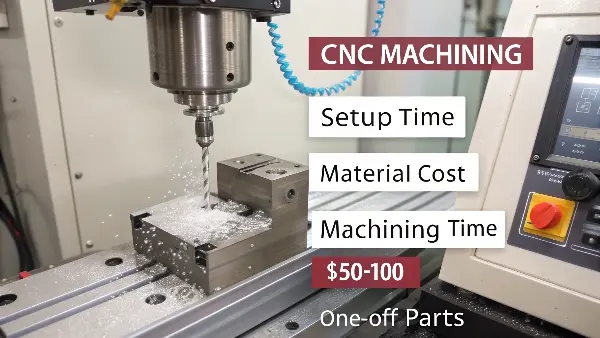
When I quote a project for a client like Alex, who designs high-precision robotics, I start by looking at three main things. These are the building blocks of any CNC machining quote. Understanding them helps you see where your money is going and where you can potentially save. It’s not just about the final number; it’s about the value you get from each step of the process. Let’s dive deeper into what really makes up the final price on your invoice.
The Big Three: Setup, Material, and Machining Time
The price of any custom part comes down to these three core factors. Think of them as the legs of a stool; if one is off, the whole price structure is unstable.
- Setup Time: This is the work that happens before a single chip is cut from the metal. It includes programming the CAM software from your 3D file, preparing the CNC machine, loading the correct cutting tools, and securing the raw material block. It’s a fixed, upfront labor cost. Whether I’m making one part or one hundred parts, this work has to be done. This is why a single prototype feels so expensive; it bears the entire setup cost alone.
- Material Cost: The raw material is a direct cost. Common materials like Aluminum 6061 are relatively cheap. However, if your design requires something more specialized like stainless steel, titanium, or a high-performance plastic like PEEK, the material cost can become a significant part of the total price. I always advise my clients to consider if a cheaper, more common material can meet their needs for early prototypes.
- Machining Time: This is the time the CNC machine is actually running and cutting your part. The more complex your design, the longer it takes. Features like deep pockets, thin walls, tiny holes, and intricate curves all add to the runtime. The machine’s hourly rate is multiplied by this time. A 5-axis machine can create very complex shapes but has a higher hourly rate than a standard 3-axis machine.
Other Factors That Influence the Price
Beyond the big three, a few other details can move the price up or down.
| Price Factor | Description | Impact on Cost |
|---|---|---|
| Tolerances | The required precision of the dimensions. Standard tolerances (+/- 0.1mm) are routine. | Tight tolerances (+/- 0.01mm) require more time, special tools, and careful inspection, which increases the cost significantly. |
| Quantity | The number of identical parts you order. | Higher quantities drastically lower the per-unit cost because the fixed setup cost is divided across more parts. |
| Finishing | Post-machining treatments like anodizing, bead blasting, or polishing. | Each finishing step is an additional process with its own cost for labor and materials, adding to the final price. |
| Inspection | The level of quality control and reporting required. | Basic inspection is standard. A full inspection report with CMM data takes time and specialized equipment, adding to the cost. |
Understanding these elements gives you the power to optimize your design for manufacturing. You can make small changes that have a large impact on the final cost without sacrificing the function of your part.
What is the typical CNC cutting design price?
You’ve designed a great part, but is it designed for manufacturing? A small design choice can sometimes double the machining cost without adding any real function. Engineers often get frustrated when their "perfect" design comes back with a surprisingly high quote. The reason is usually hidden in the details of the CAD file.
There is no direct "design price" for CNC cutting itself, as the cost is embedded in the setup and machining time. However, complex designs with features like deep pockets, thin walls, or complex 3D surfacing can dramatically increase prices. A design optimized for manufacturability (DFM) might cost $50 to machine, while a poorly optimized version of the same part could easily cost $150 or more due to longer machine time and special tooling.
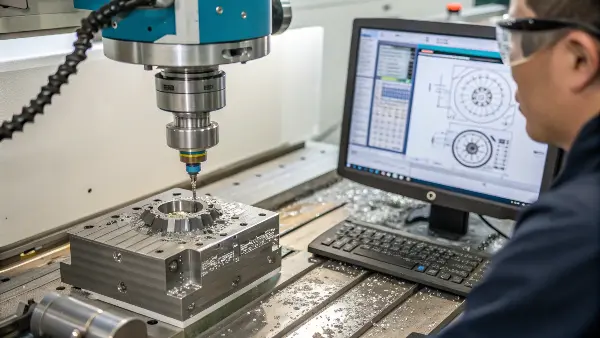
In my years of working with engineers from all over the world, I’ve seen firsthand how design choices directly impact the final price tag. It’s a common story. An engineer sends me a file, and I immediately see things that will make the part difficult and expensive to produce. The part might function perfectly in theory, but in the real world of machining, every detail matters. Let’s explore which specific design features have the biggest impact on your budget.
Design for Manufacturability (DFM) is Key
The best way to control costs is to think like a machinist when you are designing. This is called Design for Manufacturability, or DFM. When I review a CAD file from Alex, who is very experienced, his designs are usually easy to machine. But for newer engineers, I often provide feedback on how to make their parts more affordable.
Here are the most common design elements that drive up costs:
- Thin Walls: Walls that are too thin are prone to vibrating during machining, which forces the machinist to slow down the cutting speed dramatically. This increases machine time and therefore cost. They can also warp easily. Rule of thumb: keep walls on metal parts at least 1mm thick.
- Deep Pockets: A pocket is considered "deep" when its depth is more than 6 times its width. Machining these requires long, thin tools that are fragile and can’t cut aggressively. This means many slow, careful passes are needed, adding a lot of time to the cycle.
- Internal Sharp Corners: Standard cutting tools are round. They cannot create perfectly sharp internal corners. To achieve this, a secondary process like EDM (Electrical Discharge Machining) is needed, which is very expensive. A much better solution is to design your part with a small internal radius in every corner.
- Complex 3D Surfaces: Smooth, flowing, organic shapes look great, but they require a "ball-end" mill to trace the surface with thousands of tiny passes. This takes a huge amount of machine time compared to cutting flat faces. If a flat surface will work, use it.
How to Optimize Your Design for Lower Costs
To help you visualize this, here’s a table showing how simple design changes can affect the price.
| Poor Design Choice | Good DFM Alternative | Estimated Cost Impact |
|---|---|---|
| 0mm internal corner radius | 3mm internal corner radius | Reduces cost by 25-40% (avoids EDM) |
| 0.5mm thick wall | 1.5mm thick wall | Reduces cost by 15-30% (allows faster cutting) |
| Complex curved surface | Flat, angled surface | Reduces cost by 30-50% (reduces machine time) |
| Tight tolerance of +/- 0.01mm | Standard tolerance of +/- 0.1mm | Reduces cost by 20-35% (avoids extra setups/inspection) |
Before you send a design out for a quote, take a few minutes to review it with these points in mind. Ask yourself: "Can this wall be thicker? Does this corner really need to be sharp? Is this tight tolerance critical for function?" A few small adjustments can lead to huge savings.
How much does CNC machining cost per hour in China?
You want to lower manufacturing costs without sacrificing quality. Sourcing from China is a popular option, but the hourly rates can seem mysterious. Are the savings real? You worry that a low price might mean low quality or poor communication, creating bigger problems down the line. Let’s demystify the numbers and show what you can really expect.
The hourly rate for CNC machining in China typically ranges from $20 to $50 USD. A standard 3-axis CNC machine shop might charge around $25/hour. A more advanced shop with 5-axis machines and tight quality control could be closer to $45/hour. This is often 50-70% lower than comparable rates in North America or Western Europe, which can be upwards of $75-$150/hour.
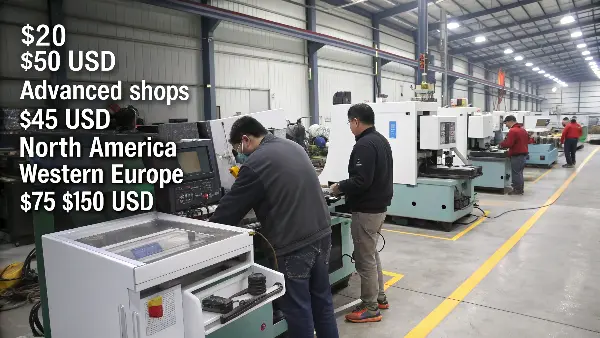
When I started QuickCNCs, my goal was to bridge the gap between clients like Alex in Germany and the high-quality machine shops here in China. The cost savings are a big reason why companies look overseas, but it’s important to understand what those hourly rates include. The number itself is only part of the story. A cheap rate is worthless if the parts are bad or delivered late. The real value comes from finding a partner who offers a competitive price while also delivering precision and reliability.
Breaking Down the Hourly Rate
The hourly rate isn’t just the cost of running the machine; it wraps up several expenses into one number. Understanding this helps you compare quotes more intelligently. A higher rate might actually be a better deal if it includes more services.
- Machine Cost (Amortization): The price of the CNC machine itself is a huge capital investment. A portion of that cost is factored into every hour it runs. High-end machines from brands like Haas, Mazak, or DMG Mori cost more, so their hourly rate will be higher.
- Labor Costs: This includes the salary of the skilled machinist who sets up and operates the machine, the programmer who creates the toolpaths, and the quality inspector who checks the final part. While labor costs in China are lower than in the West, skilled manufacturing labor is in high demand, and wages are rising.
- Overhead: This is the cost of keeping the lights on. It includes the rent for the workshop, electricity, cutting tools, coolant, maintenance, and administrative staff. A well-organized, clean, and climate-controlled shop will have higher overhead than a small, basic one.
- Profit Margin: Finally, a small percentage is added for profit, which allows the shop to reinvest in new technology and grow.
Why Rates Vary Between Shops in China
Not all Chinese suppliers are the same. Just like anywhere else, there is a wide spectrum of quality and capability, which is reflected in their pricing.
| Shop Type | Typical Hourly Rate (USD) | Best For |
|---|---|---|
| Small Local Workshop | $20 – $30 | Simple parts, non-critical prototypes where cost is the only factor. Communication can be a challenge. |
| Professional Mid-Sized Shop | $30 – $45 | The sweet spot for most overseas clients. Good balance of cost, quality, and communication. Often have experience with international standards. |
| Large, Certified Factory | $45 – $60+ | High-volume production, projects requiring certifications like ISO 9001 or AS9100. Best for medical or aerospace components. |
When you get a quote, don’t just look at the final number. Ask about their machines, their inspection process, and their experience with clients in your industry. My role at QuickCNCs is to manage this for my clients, ensuring they get the value of Chinese manufacturing without the risks. A slightly higher hourly rate from a reliable partner is always cheaper in the long run than a rock-bottom price that leads to rejected parts and project delays.
Is it cheaper to build your own CNC?
You see the high cost of outsourcing prototypes and wonder if there’s a better way. Maybe building your own CNC machine could save money in the long run? It’s a tempting idea, but you worry about the hidden costs, the time commitment, and whether a DIY machine can produce professional-quality parts. Let’s look at the real costs and benefits.
For a hobbyist, building a small CNC router can be cheaper over time, with kits costing $500 to $3,000. However, for a professional engineer or business, it is almost never cheaper. A DIY machine cannot match the precision, speed, or reliability of a commercial-grade machine, which costs upwards of $50,000. The time spent building, calibrating, and troubleshooting a DIY machine far outweighs the cost of outsourcing to a professional service.
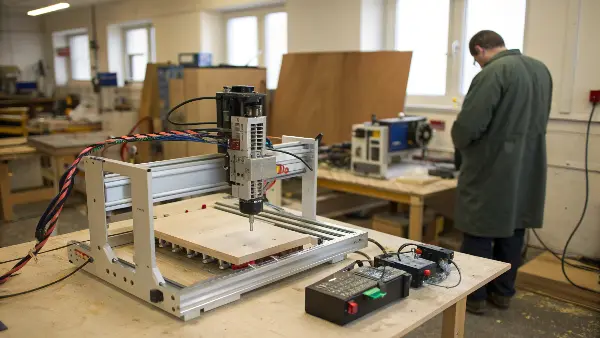
I get this question from time to time, especially from startups and product developers who are very hands-on. I have huge respect for the DIY community, and I started my own career on the shop floor, so I love the idea of building your own tools. But from a professional and business perspective, the calculation is very different. For someone like Alex, whose job depends on getting parts with tolerances of ±0.01mm, a homemade machine is simply not a viable option. Let’s break down why.
The True Cost of a DIY CNC Machine
The sticker price of a DIY kit is just the beginning. The real cost includes many other factors that are easy to overlook.
- The Machine Itself: A basic desktop CNC router kit for wood or plastic might cost around $1,500. A machine capable of cutting aluminum with any reasonable accuracy will be in the $3,000 – $5,000 range. This gets you the basic frame, motors, and controller.
- Essential Add-ons: The kit is never the full story. You will also need to buy software (CAD/CAM software can cost hundreds or thousands of dollars), cutting tools (end mills), work-holding clamps or a vise, and a dust collection system. These can easily add another $1,000 or more to your initial investment.
- Your Time: This is the biggest hidden cost. Assembling the machine can take a full weekend or more. Then comes the calibration and troubleshooting, which can take weeks or even months of tinkering to get right. As a professional engineer, your time is valuable. If you spend 40 hours building and tweaking your machine, that’s 40 hours you weren’t designing your next product. At a professional salary, that time is worth thousands of dollars.
Professional Machine vs. DIY Machine: A Reality Check
The core issue is the massive gap in capability between a hobby machine and the professional equipment used in a shop like ours.
| Feature | Professional CNC Machine | DIY CNC Machine |
|---|---|---|
| Material Capability | Can machine hardened steel, titanium, stainless steel, aluminum, and plastics with ease. | Primarily designed for soft materials like wood and plastic. Struggles with aluminum and cannot machine steel. |
| Precision (Tolerance) | Can easily hold tolerances of +/- 0.025mm or better. | Best-case scenario is +/- 0.1mm. Often much worse due to frame rigidity and backlash issues. |
| Speed & Power | High-power spindles and rigid frames allow for very fast and aggressive cutting, reducing cycle times. | Low-power spindles and flexible frames require very slow cutting speeds, making jobs take much longer. |
| Reliability | Designed to run 24/7 for years with routine maintenance. | Prone to frequent issues that require troubleshooting and repair. Not suitable for production or meeting deadlines. |
| Cost | $50,000 – $250,000+ | $1,500 – $5,000 (with add-ons) |
For a hobby or for learning the basics of CNC, building your own machine can be a fantastic and rewarding project. But for any commercial or professional engineering work where precision, reliability, and speed are important, outsourcing to a dedicated service provider is faster, more reliable, and ultimately, much cheaper.
Conclusion
Understanding CNC machining costs helps you design better parts and budget effectively. It all comes down to complexity, material, and quantity. We can help you navigate these factors.