
Are you struggling to get clean, precise grooves in your metal parts? Incorrect cutting parameters can lead to tool breakage, poor surface finish, and scrapped components, wasting both time and money. It’s a frustrating cycle that can derail even the most carefully planned projects.
To find the optimal cutting parameters for grooving, start with the tool manufacturer’s recommended cutting speed (Vc) and feed rate (fn) for the specific material. Adjust these values based on your setup’s rigidity, the grooving depth, and coolant application. For harder alloys, use lower speeds and feeds. For softer metals like aluminum, you can be more aggressive. Always prioritize good chip control by adjusting the depth of cut and feed.
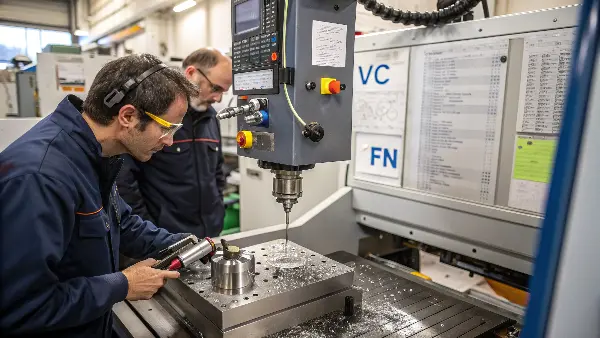
I remember the first time I managed a complex grooving job for a German client. The part was for a robotic arm and required deep, narrow grooves in stainless steel. We went through several inserts on the first day, and the surface finish was terrible. The problem wasn’t the machine or the material; it was our inability to find the right balance in our cutting parameters. It was a costly lesson in a fundamental truth: grooving isn’t just about removing material; it’s a delicate dance between speed, feed, and depth.
Getting this dance right is what separates a frustrating, expensive process from a smooth, efficient one. It’s what turns a design into a perfect part. Let’s break down how you can master this process and avoid the mistakes I once made.
How Do You Balance Cutting Speed, Feed Rate, and Depth of Cut for Grooving?
Pushing for faster cycle times by increasing one parameter often backfires. A high feed rate with the wrong speed can cause terrible vibration, while an aggressive depth of cut might snap your expensive grooving insert. It feels like you’re constantly fighting the machine to get it right.
The key to balancing these three parameters is to understand their relationship. Use cutting speed to manage heat and tool life. Use feed rate to control chip formation and surface finish. Use depth of cut to manage cutting forces and efficiency. Start with a moderate depth of cut and manufacturer-recommended speed and feed, then make small, incremental adjustments based on the results.
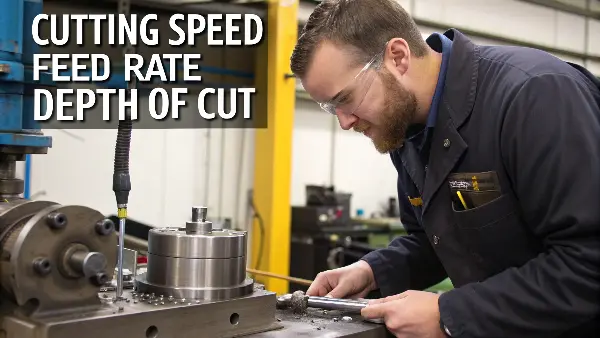
When I walk through a machine shop, I can often tell how experienced an operator is just by listening to the sound of the cut. A smooth, consistent hum means the parameters are likely dialed in. A screech or chatter tells me something is wrong. That "sweet spot" is a result of balancing cutting speed (Vc), feed rate (fn), and depth of cut (ap). These three elements work together, and changing one often requires adjusting the others. Let’s look at each one more closely.
The Role of Cutting Speed (Vc)
Cutting speed, measured in meters per minute (m/min) or surface feet per minute (SFM), is all about heat management.
- Too High: Generates excessive heat, leading to rapid tool wear, plastic deformation of the cutting edge, and a poor surface finish.
- Too Low: Can cause built-up edge (BUE), where workpiece material welds itself to the tool insert. This also ruins the surface finish and can lead to tool failure.
Your goal is to find a speed that allows for efficient cutting without burning up the tool.
The Role of Feed Rate (fn)
Feed rate, measured in millimeters per revolution (mm/rev) or inches per revolution (in/rev), directly impacts chip formation and surface finish.
- Too High: Creates thick chips that can be difficult to evacuate, leading to chip jamming and high cutting forces. Surface finish will be rough.
- Too Low: Creates thin, stringy chips that are hard to control. It also increases cycle time and can cause more tool rubbing than cutting, leading to work hardening and friction.
The ideal feed rate produces manageable, C-shaped or short spiral chips and the desired surface finish.
The Role of Depth of Cut (ap)
The depth of cut refers to how deep the tool engages with the material in a single pass.
- Too High: Dramatically increases cutting forces and stress on the tool. This is a common cause of insert breakage and machine chatter, especially in deep grooving.
- Too Low (Pecking): While safer for deep grooves, using too many small pecks increases cycle time. Finding the right "peck depth" is crucial for balancing safety and efficiency.
Here is a simple table to illustrate the relationship:
| Parameter | Primary Effect | Symptom if Too High | Symptom if Too Low |
|---|---|---|---|
| Cutting Speed | Heat & Tool Life | Burnt/worn tool, poor finish | Built-up edge (BUE), chatter |
| Feed Rate | Chip Formation & Finish | Thick chips, high forces, rough finish | Stringy chips, tool rubbing, work hardening |
| Depth of Cut | Cutting Forces & Efficiency | Tool breakage, vibration, chatter | Long cycle times, inefficient cutting |
The strategy I teach my team is to start with the tool supplier’s chart, then adjust one variable at a time. If the tool is wearing too fast, reduce speed by 10-15%. If chips are jamming, reduce the feed rate slightly or add a pecking cycle. This methodical approach is the fastest way to find the perfect balance.
What Are the Key Differences When Grooving Common Alloys like Aluminum, Steel, and Titanium?
You’ve set up a job for aluminum and it runs perfectly. Then, you switch to stainless steel using the same parameters, and suddenly your tool snaps. This material-specific behavior is a major source of frustration and wasted resources for engineers and machinists who are new to a specific alloy.
The primary differences lie in each alloy’s machinability, thermal conductivity, and hardness. Aluminum is soft and has high thermal conductivity, allowing for high speeds and feeds. Steel is harder and requires lower speeds to manage heat. Titanium has very low thermal conductivity, trapping heat at the tool tip, demanding even lower speeds, high-pressure coolant, and sharp cutting edges to avoid work hardening.
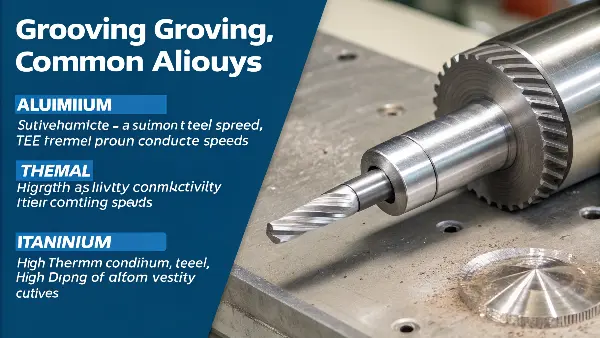
A few years ago, we took on a prototype job for an aerospace client that involved grooving all three of these materials. It was a perfect, real-world test of our process. The engineer on their end, much like Alex, needed consistent results across different components of the assembly. We learned very quickly that a "one size fits all" approach is a recipe for failure. Each metal alloy behaves uniquely under the pressure of a grooving tool. Understanding their individual personalities is essential.
Grooving Aluminum Alloys (e.g., 6061-T6)
Aluminum is generally a pleasure to machine. It is soft and has excellent thermal conductivity, which means heat dissipates quickly from the cutting zone.
- Machinability: High.
- Strategy: You can use very high cutting speeds and feed rates. The main challenge is built-up edge (BUE), where the gummy aluminum sticks to the tool.
- Tooling: Use inserts with very sharp, polished cutting edges and positive rake angles. Uncoated, highly polished carbide inserts or PCD (Polycrystalline Diamond) tools are ideal.
- Coolant: Flood coolant is effective at flushing away chips and preventing BUE.
Grooving Steel Alloys (e.g., 4140, 304 Stainless)
Steel is a broad category. Carbon steels like 4140 are quite predictable, while stainless steels like 304 are tougher and tend to work harden.
- Machinability: Medium to Low.
- Strategy: Heat is the main enemy. Cutting speeds must be significantly lower than for aluminum. Feed rates must be carefully chosen to create breakable chips without exerting too much force. For stainless steel, never let the tool dwell, as this will cause work hardening, making subsequent cuts extremely difficult.
- Tooling: Coated carbide inserts (e.g., TiAlN, TiCN) are a must. They provide a thermal barrier and resist abrasive wear. Chipbreakers designed for medium-to-roughing applications are often necessary.
Grooving Titanium Alloys (e.g., Ti-6Al-4V)
Titanium is notorious for its difficult machinability. It has extremely low thermal conductivity, which means all the cutting heat concentrates on the tool’s cutting edge.
- Machinability: Very Low.
- Strategy: The mantra is "low speed, steady feed." Use about 25-50% of the cutting speed you would for steel. The feed rate must be constant to avoid rubbing, which causes immediate work hardening. High-pressure coolant is almost mandatory to fight the intense heat and help with chip evacuation.
- Tooling: Use sharp, positive-rake uncoated carbide inserts or inserts with a coating specifically for high-temp alloys. A tough carbide substrate is needed to resist chipping.
Here’s a comparative starting point:
| Material | Cutting Speed (Vc) | Feed Rate (fn) | Key Challenge |
|---|---|---|---|
| Aluminum (6061) | 150-400 m/min | 0.10-0.25 mm/rev | Built-Up Edge (BUE) |
| Carbon Steel (4140) | 80-150 m/min | 0.08-0.18 mm/rev | Heat & Tool Wear |
| Stainless Steel (304) | 50-100 m/min | 0.05-0.15 mm/rev | Work Hardening & Heat |
| Titanium (Ti-6Al-4V) | 20-50 m/min | 0.05-0.12 mm/rev | Extreme Heat, Work Hardening |
Remember, these are just starting points. The real skill is in observing the cut, inspecting the chips, and making intelligent adjustments to optimize for your specific machine, tool, and part geometry.
Why is Choosing the Right Grooving Tool and Insert So Critical?
Have you ever tried to use a standard turning insert for a grooving operation and watched it fail immediately? Or used a grooving tool that was too wide or too weak for the job? This leads to chatter, broken tools, and parts that are out of tolerance.
Choosing the right tool is critical because grooving creates high cutting forces in a confined space. The tool must have the correct width, geometry, and rigidity to withstand these forces. The insert’s grade must match the material, and its chipbreaker must be designed to produce manageable chips within the narrow groove, preventing chip jamming and tool failure.
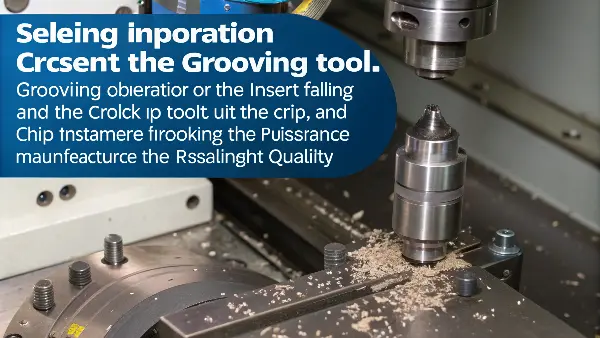
I see this issue frequently with new clients. They send a design that requires a deep, narrow groove, but they don’t specify any tooling. They assume any tool that fits will work. But the tool is more than just a piece of metal; it’s a system. The holder, the insert, the geometry, and the coating all work together. A mismatch in any of these components can lead to catastrophic failure. Making the right choice upfront saves hours of troubleshooting and prevents scrapped parts. It’s a core principle we apply to every project at QuickCNCs.
Understanding the Tooling System
A grooving tool isn’t just one piece. It’s a combination of the tool holder and the insert. Both must be chosen carefully.
- Tool Holder Rigidity: Grooving exerts significant radial and tangential cutting forces. The tool holder must be as short and stout as possible to minimize overhang and prevent vibration. A longer overhang acts like a lever, amplifying any vibration and leading to chatter and poor surface finish. For internal grooving, this is even more critical.
- Insert Width and Corner Radius: The insert width must obviously match the specified groove width. The corner radius is also critical. A larger radius provides a stronger cutting edge but increases radial cutting forces. A smaller radius reduces forces but is weaker. You must choose a radius that meets the print’s requirements while maximizing tool strength.
The Importance of Insert Geometry and Chipbreaker
The shape of the insert does the real work. The wrong choice here is often the root cause of grooving problems.
- Rake Angle: A positive rake angle reduces cutting forces and is ideal for gummy materials like aluminum and some stainless steels. A negative rake angle provides a stronger cutting edge, suitable for heavy roughing in hard materials or interrupted cuts, but it increases cutting forces.
- Chipbreaker: This is arguably the most crucial feature of a grooving insert. The groove is a confined space. If chips don’t break into small, manageable pieces, they will become a long, tangled mess that jams in the groove. This will almost certainly break the insert. Chipbreakers are designed for specific feed rates and depths of cut. Using a finishing chipbreaker for a roughing operation will not work, and vice versa.
Selecting the Right Carbide Grade and Coating
The material of the insert itself determines its ability to handle heat and abrasion.
- Carbide Grade: A "tough" grade resists chipping and breakage but wears faster at high speeds. A "hard" grade resists wear and can run faster, but it’s more brittle and prone to chipping under heavy loads or vibration. The choice depends on whether your operation is stable and high-speed or involves interruptions and potential chatter.
- Coating: Modern coatings like TiAlN, TiN, and AlCrN act as a thermal barrier, protecting the carbide substrate from heat. They also add lubricity and hardness. The coating must be matched to the workpiece material. For example, a TiAlN coating is excellent for steel, while an uncoated, polished insert might be better for aluminum to prevent built-up edge.
Here’s how these factors apply in practice:
| Task Component | Critical Choice | Why it Matters |
|---|---|---|
| Tool Holder | Shortest possible overhang | Minimizes vibration and chatter. |
| Insert Geometry | Chipbreaker matched to cut depth/feed | Ensures proper chip control to prevent jamming. |
| Insert Material | Carbide grade and coating for workpiece | Balances toughness vs. wear resistance; manages heat. |
| Corner Radius | As specified, or largest allowable for strength | Strengthens the corner but affects cutting forces. |
Choosing the right tool is an investment. It might seem cheaper to use a general-purpose insert, but the cost of one scrapped part or one broken tool almost always outweighs the savings.
How Can You Master Chip Control and Eliminate Vibration in Grooving Operations?
You’ve set your parameters, you’ve chosen your tool, but the moment the insert engages, a high-pitched squeal fills the shop. The surface finish looks like a torn-up road, and long, dangerous chips are wrapping around the workpiece. This is the twin nightmare of grooving: vibration and poor chip control.
To master chip control, use an insert with a chipbreaker designed for your specific depth of cut and feed rate. If chips are still stringy, slightly increase the feed or depth of cut. To eliminate vibration, reduce tool overhang, lower the cutting speed, and use a lighter depth of cut. Applying high-pressure coolant can also help by breaking chips and damping vibration.
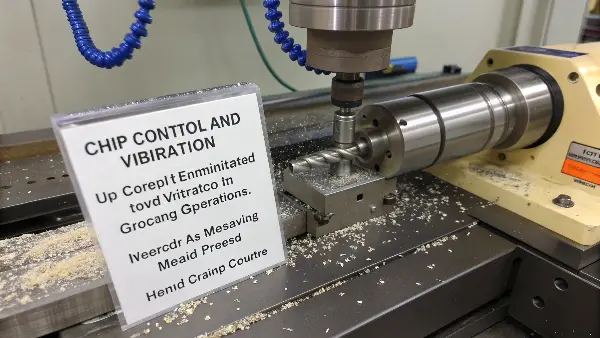
I’ve spent countless hours personally at the machine, adjusting parameters by tiny increments to stop a chatter problem. In one instance, working on a thin-walled titanium cylinder for a medical device, any vibration would have been catastrophic. We solved it not with a single big change, but with a series of small, strategic adjustments. It’s a process of elimination and fine-tuning that every skilled machinist must learn. Let’s look at the strategies to defeat these two common enemies.
Strategies for Effective Chip Control
Chip control in grooving is non-negotiable. A tangled chip can destroy the part, the insert, and even injure an operator.
- Select the Right Chipbreaker: This is your first line of defense. Tooling manufacturers offer a wide range of chipbreaker geometries. Look at their catalogs—they provide charts that map each chipbreaker to a specific range of feed rates and depths of cut. A "finishing" geometry will not break a thick chip from a roughing cut.
- Adjust Feed Rate and Depth of Cut: If your chips are too long and stringy, your feed rate or depth of cut is likely too low. The chip isn’t thick enough to curl and break against the workpiece or tool. Try increasing the feed rate in 10% increments. This often forces the chip to break.
- Use a Pecking Cycle: For deep grooves, instead of one continuous cut, use a pecking cycle (G75 on Fanuc controls). The tool cuts to a certain depth, retracts slightly to break the chip, and then plunges again. This is extremely effective for controlling chips in deep or narrow grooves.
- Directional Turning: After plunging the initial groove, you can use the same tool to "turn" sideways to widen the groove. This is less stressful on the tool than a wide plunge cut and provides better chip control.
Strategies for Eliminating Vibration (Chatter)
Vibration is a self-exciting instability that ruins surface finish and can destroy your tool.
- Minimize Tool Overhang: This is the most important rule. Keep the tool holder as short and rigid as possible. Every extra millimeter of overhang dramatically increases the tendency to vibrate. Check that the tool is clamped securely.
- Adjust Cutting Speed: Chatter often occurs within a specific range of RPMs. If you experience vibration, try reducing the cutting speed by 20-30%. Sometimes, surprisingly, increasing the speed can also move you out of the harmonic range, but decreasing it is usually the safer first step.
- Use a Lighter Depth of Cut: High radial forces from a deep cut are a major cause of chatter. Reduce the depth of cut and increase the number of passes if necessary.
- Change Insert Geometry: An insert with a more positive rake angle and a sharper cutting edge will reduce cutting forces and can help mitigate chatter.
- Check the Entire System: Vibration isn’t always from the tool. It can come from a loose workpiece, worn machine guideways, or a wobbly chuck. Ensure your entire setup, from the spindle to the part, is as rigid as possible.
Here’s a troubleshooting table that my team uses:
| Problem | Primary Cause | Solution 1 (Easiest) | Solution 2 | Solution 3 (Advanced) |
|---|---|---|---|---|
| Long, Stringy Chips | Feed/depth of cut too low | Increase feed rate by 10% | Use a pecking cycle (G75) | Switch to a more aggressive chipbreaker |
| Chip Jamming | Chips not evacuating | Reduce depth of cut | Use high-pressure coolant | Widen groove using turning motion |
| Vibration (Chatter) | Lack of rigidity or high forces | Reduce tool overhang | Reduce cutting speed by 20% | Use lighter depth of cut / change insert geometry |
By methodically applying these strategies, you can transform a chaotic, noisy grooving process into a predictable and precise manufacturing step.
Conclusion
Mastering grooving parameters comes down to a systematic approach. By balancing speed, feed, and material properties—while choosing the right tools and troubleshooting proactively—you can achieve precision and efficiency every time.