
Struggling to achieve the perfect surface finish on your cylindrical parts? Poor finishes can lead to component failure, project delays, and costly rework. Understanding the core principles of centerless grinding is the key to unlocking consistent, high-quality results and avoiding these frustrating setbacks.
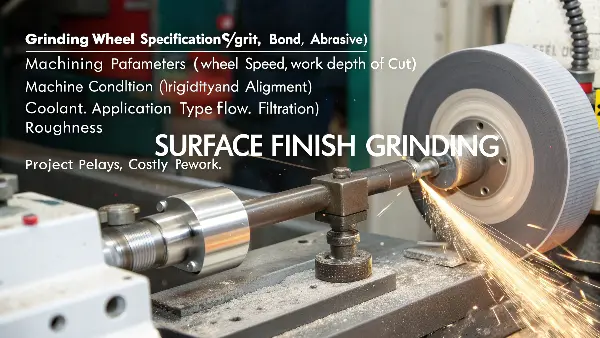
To master surface finish in centerless grinding, you must precisely control four main areas: the grinding wheel’s specifications (grit, bond, abrasive), the machining parameters (wheel speed, work speed, depth of cut), the machine’s condition (rigidity and alignment), and the coolant’s application (type, flow, and filtration). Balancing these elements is crucial for achieving your desired roughness average (Ra).
Achieving a great surface finish feels like part art, part science. When I first started on the shop floor, I spent countless hours learning this balance through trial and error. Today, I help engineers like you skip the guesswork. I’ve learned that if you understand the science behind it, mastering the art becomes much easier. Let’s break down the science so you can confidently specify and achieve the perfect finish for your parts, every single time.
What surface finish can you expect from centerless grinding?
Are you wondering if centerless grinding can meet your product’s demanding surface specifications? Choosing a process that can’t deliver will waste valuable time and budget on prototypes that fail inspection. Knowing the typical finish range for centerless grinding helps you make the right call from the start.
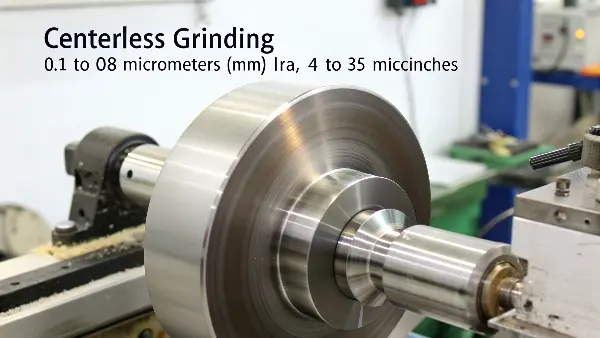
Centerless grinding typically produces a surface finish ranging from 0.1 to 0.8 micrometers (μm) Ra, which is equivalent to 4 to 32 microinches (μin). With specialized wheels, optimized parameters, and proper machine setup, it’s possible to achieve exceptional finishes even smoother than 0.1 μm Ra, making it a top choice for high-precision components.
When I work with clients, especially those in demanding fields like robotics or medical devices, the conversation always turns to surface roughness, or Ra. A client of mine, let’s call him Alex, a sharp engineer from Germany, needed pins for a robotic joint with a finish better than 0.2 μm Ra. He was worried about stick-slip motion affecting the robot’s precision. Centerless grinding was the perfect solution, but we had to control the process carefully to hit that target consistently.
Understanding Surface Roughness (Ra)
So, what is Ra? Think of it as the average height of the microscopic peaks and valleys on a material’s surface. A lower Ra value means a smoother surface. It’s the most common way engineers like Alex and I communicate how smooth a part needs to be. While other parameters like Rz (maximum height of the profile) or Rq (root mean square) exist, Ra gives a great overall picture of the surface texture.
Typical Finish Ranges for Centerless Grinding
Centerless grinding is known for its ability to produce excellent surface finishes efficiently. Let’s put its capabilities into perspective by comparing it with other common machining processes.
| Machining Process | Typical Surface Finish (Ra, μm) | Best Possible Finish (Ra, μm) |
|---|---|---|
| Sand Casting | 12.5 – 25 | 6.3 |
| Turning | 1.6 – 6.3 | 0.4 |
| Milling | 0.8 – 6.3 | 0.2 |
| Centerless Grinding | 0.2 – 1.6 | < 0.1 |
| Lapping/Polishing | 0.1 – 0.4 | < 0.025 |
As you can see, standard centerless grinding already provides a superior finish compared to turning or milling. When we fine-tune the process—using finer grit wheels, multi-stage grinding, and optimized parameters—we can push into the "superfinishing" territory, rivaling the results of lapping but at a much faster production rate.
When is a Mirror Finish Necessary?
For many applications, a standard finish of 0.4 μm to 0.8 μm Ra is perfectly adequate. However, for high-performance components, a mirror-like finish below 0.2 μm Ra is non-negotiable. These applications include:
- Bearings and Journals: To reduce friction and wear.
- Hydraulic Pistons and Valve Spools: To ensure a tight seal and prevent leaks.
- Medical Implants: For biocompatibility and to prevent tissue irritation.
- Robotic Joint Pins: Like in Alex’s project, to ensure smooth, repeatable motion.
Achieving these top-tier finishes isn’t accidental. It requires a deep understanding of all the factors at play.
What are the key factors affecting this surface finish?
Are your parts coming out with inconsistent finishes, even when you think you’re running the same process? Chasing down the root cause of chatter marks, feed lines, or burns can be incredibly frustrating. Let’s systematically identify the main variables so you can troubleshoot effectively.
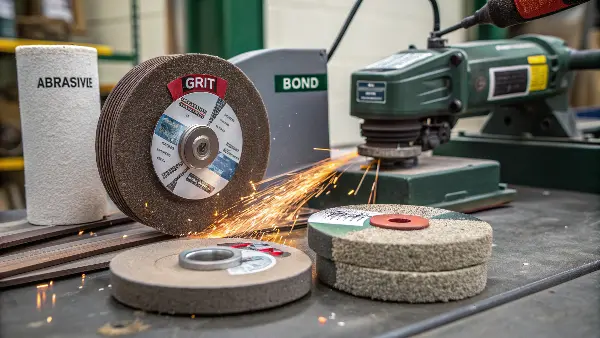
The final surface finish is a direct result of four key factors: the grinding wheel’s composition (abrasive, grit, bond), the properties of the workpiece material, the mechanical stability of the grinding machine itself, and the cooling system’s effectiveness. Ignoring any one of these can compromise your final part quality.
I remember a project where we were grinding hardened steel shafts, and suddenly, we started seeing tiny burn marks. The operator was convinced the speeds were wrong. After checking everything, we discovered the issue wasn’t the parameters but a partially clogged coolant nozzle. It was a simple fix, but it reminded me that you have to look at the entire system, not just the obvious settings.
Factor 1: The Grinding Wheel
The grinding wheel is the star of the show. Its characteristics are the single most important factor in determining the final finish.
- Abrasive Type: The material doing the cutting. Aluminum Oxide is a workhorse for steels, while Silicon Carbide is better for cast iron and non-ferrous metals. For hardened steels and superalloys, we often turn to "superabrasives" like Cubic Boron Nitride (CBN) or Diamond, which cut cleaner and last longer.
- Grit Size: This is the size of the abrasive particles. The rule is simple: Finer grit = Smoother finish. A coarse wheel (e.g., 46 grit) is great for removing a lot of material quickly, but it will leave a rough surface. A fine wheel (e.g., 120 grit or higher) takes smaller bites, creating a much smoother, more reflective surface.
- Bond Hardness: The "glue" holding the grits together. A "hard" bond holds onto the grits longer, which is good for soft materials. A "soft" bond releases dull grits more easily, exposing fresh, sharp ones. This self-sharpening action is crucial when grinding hard materials to prevent rubbing and heat buildup, which ruins the surface finish.
Factor 2: The Workpiece Material
The part itself fights back. Harder materials are more difficult to cut and generate more heat, increasing the risk of surface burns or micro-cracks. Ductile, or "gummy," materials like certain stainless steels or aluminum alloys can clog the grinding wheel, a phenomenon called "loading." When the wheel is loaded, it stops cutting and starts rubbing, which immediately degrades the surface finish. The material’s thermal conductivity also matters; materials that don’t dissipate heat well are more prone to thermal damage.
Factor 3: The Grinding Machine Condition
Your grinder needs to be a rock-solid platform. Any vibration during the process will be transferred directly to the workpiece, creating a pattern on the surface known as chatter.
- Machine Rigidity: A heavy, well-built machine with minimal vibration is essential for fine finishes.
- Spindle Bearings: Worn or poorly lubricated spindle bearings are a common source of vibration.
- Wheel Balance: An unbalanced grinding wheel is like a car tire out of balance—it will vibrate at high speeds. Wheels must be meticulously balanced before use.
- Alignment: The geometric alignment between the grinding wheel, regulating wheel, and work-rest blade must be perfect.
Factor 4: The Coolant System
Never underestimate the role of coolant. It does more than just cool the part.
- Lubrication: It lubricates the cutting zone, reducing friction between the wheel and the workpiece.
- Chip Removal: It flushes away the tiny metal chips (swarf) and abrasive particles, preventing them from being trapped and scratching the surface.
- Temperature Control: It prevents the workpiece from overheating, which can cause metallurgical damage and dimensional instability.
Proper filtration is critical. If you’re pumping dirty coolant full of grinding debris back onto your part, you’re essentially sandblasting your mirror finish away.
How do specific machining parameters affect surface finish?
Do you feel like you’re just guessing when you adjust speeds and feeds on the grinder? Turning the wrong knob can take your surface finish from perfect to poor in an instant. Understanding exactly how each parameter works is crucial for predictable and repeatable control.
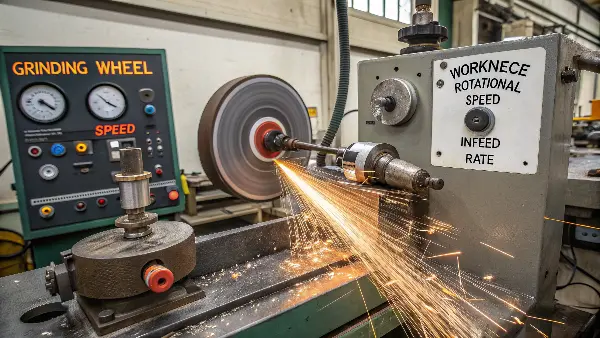
Machining parameters directly dictate the cutting action. Grinding wheel speed affects the force of each grit, workpiece rotational speed determines the scratch pattern, and the infeed rate (or depth of cut) controls the material removal rate. A slower workpiece speed and a smaller depth of cut generally lead to a better finish.
When I’m training new machinists, I tell them to think of the parameters as a recipe. You can have the best ingredients (a great wheel and a rigid machine), but if your cooking times and temperatures are off, the result won’t be good. It’s about finding the "sweet spot" where all the variables work in harmony. Let’s break down the main settings you’ll be adjusting.
Grinding Wheel Speed
This is the surface speed of the grinder, typically measured in meters per second (m/s) or surface feet per minute (SFM). Increasing the wheel speed generally improves the surface finish, but only up to a point.
- How it Works: A higher speed means each abrasive grit spends less time in contact with the workpiece, taking a smaller, thinner chip. This results in smaller, shallower scratches, creating a smoother surface.
- The Trade-off: Running the wheel too fast can increase vibration and heat generation. It can also make the wheel act "harder," meaning it doesn’t self-sharpen as effectively, leading to rubbing instead of cutting. Every wheel has a maximum safe operating speed that must never be exceeded.
Workpiece Rotational Speed (Regulating Wheel Speed)
In centerless grinding, the regulating wheel controls the rotation of the workpiece. This is one of the most powerful adjustments you can make for surface finish.
- How it Works: A slower workpiece speed means the helical scratch pattern left by the grinding wheel has a smaller lead angle. The scratches overlap more, creating a smoother, more uniform finish. Think of it like coloring in a box: quick, wide scribbles leave a lot of white space, while slow, overlapping strokes create a solid color.
- The Trade-off: Running the part too slowly drastically reduces your throughput. The goal is to find the slowest speed that meets your cycle time requirements while still delivering the target Ra.
Infeed Rate / Depth of Cut
This is how much material is removed per pass or per revolution of the workpiece.
- How it Works: A smaller depth of cut reduces the force on each abrasive grain. The grains take smaller "bites," leading to less material deformation, less heat, and a finer finish. For the best finishes, we always use a multi-stage approach: a roughing pass to remove most of the material, followed by one or more fine finishing passes with a very small depth of cut.
- The Trade-off: Lighter cuts mean more passes and longer cycle times. This is another balancing act between quality and productivity.
Dressing Parameters
The grinding wheel needs to be "dressed" periodically to keep it sharp and true. This process uses a diamond tool to cut the face of the wheel, removing loaded material and dull grains. The dressing parameters have a huge impact on how the wheel cuts.
- Dresser Traverse Speed: A slow traverse speed creates a smoother, less aggressive cutting face on the wheel, which in turn produces a better workpiece finish.
- Dresser Depth: A shallow dressing depth exposes the grit without creating a coarse texture on the wheel.
Finding the right combination is key. For Alex’s robotic pins, we used a high grinding speed, a slow workpiece speed, and a very light final pass of just a few microns, which gave us that beautiful, functional surface he needed.
So, how can you improve the surface finish in your grinding process?
You understand the factors and parameters, but how do you put it all together to solve real-world problems? Seeing a bad finish can be demoralizing, especially when deadlines are tight. The key is to have a clear, actionable strategy for improvement.
To systematically improve surface finish, use a two-phase approach. First, optimize your setup by selecting a fine-grit wheel, ensuring the machine is rigid and balanced, and using clean, well-directed coolant. Second, fine-tune your operating parameters by using a slow workpiece speed, a light depth of cut, and proper wheel dressing.
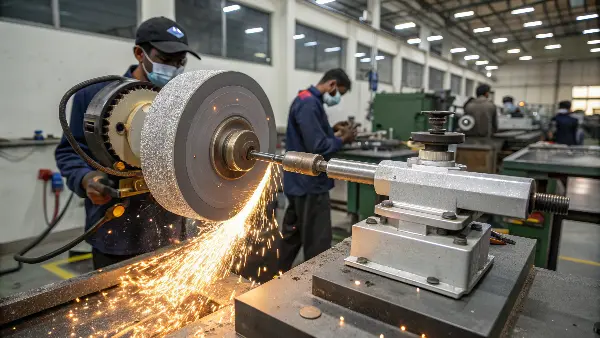
Improving surface finish is a process of elimination and refinement. When a client sends me a part with a finish issue, I don’t just start turning dials. I go through a mental checklist, starting with the foundation and moving to the fine-tuning. This methodical approach saves time and gets to the solution faster. Here is a practical guide drawn from years of experience on the shop floor.
Phase 1: Optimize Your Foundational Setup
Before you touch any speed or feed settings, make sure your foundation is solid. Over 50% of surface finish problems can be traced back to the setup.
- Choose the Right Wheel: This is Step 1. For a fine finish, select a wheel with a finer grit size (100 or higher) and a softer bond. The softer bond allows the wheel to "break down" slightly, exposing fresh, sharp abrasive grains and preventing rubbing. If grinding very hard materials, consider a CBN or diamond wheel.
- Balance the Grinding Wheel: This is non-negotiable. Mount the wheel on a balancing arbor and balance it statically. For high-precision work, dynamic on-machine balancing is even better. An unbalanced wheel is a guaranteed source of vibration and chatter marks.
- Check Machine Stability and Alignment: Push on the machine components. Is there any give? Check the work-rest blade for wear and ensure it’s securely fastened. Use a dial indicator to verify that the spindles are running true and the machine’s geometry is correctly aligned.
- Optimize Your Coolant: Ensure your coolant is clean. Check the filters. I’ve seen shops with expensive machines get poor results because of dirty coolant. Make sure the nozzles are aimed directly at the grinding zone to both cool the part and flush away swarf effectively. Use a high-quality grinding oil or synthetic coolant for the best lubricity.
Phase 2: Fine-Tune Your Operating Parameters
Once your setup is perfect, you can start refining the process parameters. Use a "one variable at a time" approach to see the effect of each change.
- Reduce Workpiece Rotational Speed: This is often the most effective adjustment for improving finish. Slow down the regulating wheel to increase the overlap of the cutting paths. Start with a 20% reduction and check the result.
- Decrease the Infeed Rate / Depth of Cut: For your final pass, use a "spark-out" or a very light finishing pass. This means allowing the wheel to traverse the part with almost no infeed, essentially polishing the surface and removing any residual waviness.
- Refine Your Wheel Dressing: The wheel’s surface is a mirror image of your dressing action. To get a smooth part, you need a smoothly dressed wheel. Use a sharp diamond and a slow dressing traverse speed. This creates a fine, non-aggressive cutting surface on the wheel, perfect for finishing.
- Increase Grinding Wheel Speed (with caution): If other adjustments aren’t enough, you can try increasing the wheel’s surface speed slightly. This makes the wheel act harder and take smaller chips. Be careful not to exceed the wheel’s maximum safe speed or generate excessive heat.
By following this two-phase strategy, you move from guesswork to a deliberate, controlled process. This is how we consistently deliver parts that meet the tightest specifications for clients around the world.
Conclusion
Mastering centerless grinding finish is about a systematic approach. By controlling the wheel, machine, coolant, and parameters, you can consistently achieve the precise surface your high-performance components demand.