
Machining carbon fiber reinforced polymer (CFRP) is a nightmare. It wears out expensive carbide tools in minutes, causing delamination and poor finishes. This leads to scrapped parts and project delays, undermining the benefits of this advanced material. Switching to the correct diamond tooling can transform your results.
To master carbon fiber machining, select either Polycrystalline Diamond (PCD) or Chemical Vapor Deposition (CVD) diamond-coated tools. PCD excels in high-volume roughing due to its toughness, while CVD’s continuous sharp edge provides a superior finish for intricate details. Proper tool geometry and optimized speeds are crucial to prevent delamination.
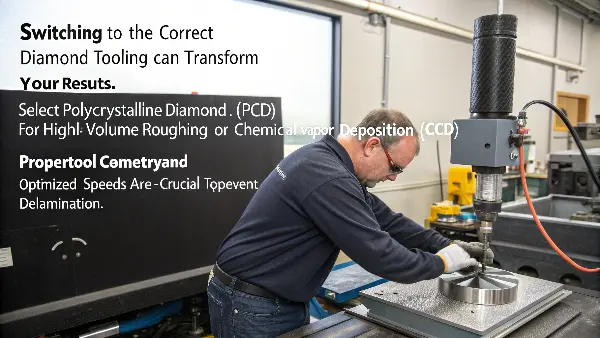
I remember a project with a client from the aerospace sector. They were struggling with inconsistent results on a critical CFRP component. Their tool costs were through the roof, and part rejection rates were high. They were about to give up on using carbon fiber for that part. We introduced them to diamond tooling, and it completely changed their production process. To get those same results, you first need to understand the core problem. Let’s explore why the tools you might be used to just aren’t up to the task.
Why do standard carbide tools fail on carbon fiber?
Are you burning through tungsten carbide end mills when machining carbon fiber? The extreme abrasiveness of carbon fibers dulls sharp cutting edges almost instantly. This leads to friction and heat buildup, which burns the epoxy resin matrix, ruins your part, and destroys the tool, costing you time and money.
Standard carbide tools fail because carbon fiber is incredibly abrasive, not hard. The carbon fibers act like millions of tiny files, grinding away the tool’s cutting edge. This rapid wear increases cutting forces, generates excessive heat that damages the resin matrix, and leads to common defects like delamination and fiber pull-out.
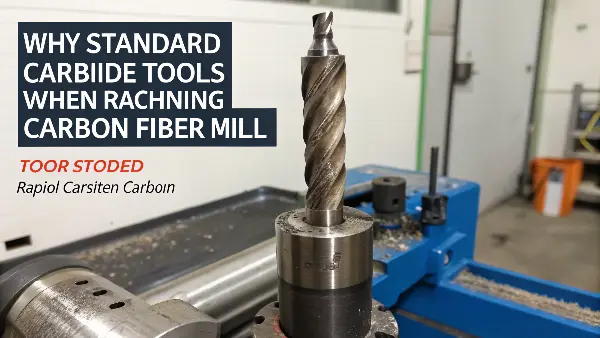
When I first started machining CFRP composites years ago, I made the same mistake many engineers make. I assumed that a high-quality, coated tungsten carbide tool, which works wonders on aluminum and steel, would be sufficient. I learned a hard lesson very quickly. The first part looked okay, but by the third, the finish quality had dropped significantly. By the tenth part, the tool was completely useless. The problem isn’t the hardness of the material but its structure. Carbon fiber is a composite—strong, stiff fibers suspended in a softer polymer resin matrix, usually epoxy. When you cut it, you aren’t shearing a uniform material like metal. You are shearing through brittle, abrasive fibers while also cutting a soft, low-melting-point polymer.
This dual-nature is a nightmare for standard tools. Here’s a breakdown of the failure mechanism:
- Abrasive Wear: The carbon fibers are much harder than the cobalt binder used in tungsten carbide tools. They literally sandblast the cutting edge on a microscopic level. The sharp edge needed for a clean cut disappears, sometimes in minutes.
- Heat Buildup: As the tool dulls, it stops shearing and starts plowing through the material. This generates immense friction and heat. The epoxy resin has a low glass transition temperature, often around 120-150°C. The heat from a dull tool can easily exceed this, causing the resin to soften, melt, or even burn. This results in a gummy, smeared cut surface instead of a clean one.
- Increased Cutting Forces: A dull tool requires much more force to push through the material. This pressure can delaminate the layers of the composite or cause entire fibers to be pulled out instead of being cleanly cut. This not only ruins the part but also puts a huge strain on the machine spindle.
This is why diamond, the hardest known material, is not just a luxury but a necessity for any serious carbon fiber machining.
What are the key types of diamond tooling for carbon fiber?
Confused about whether to use PCD or CVD diamond tools for your project? The choice can seem complicated, but it comes down to your priorities. Are you doing high-volume roughing where durability is key, or intricate finishing where a flawless edge is non-negotiable? Both have their place.
The two primary types are Polycrystalline Diamond (PCD) and Chemical Vapor Deposition (CVD) diamond-coated tools. PCD tools are extremely tough and wear-resistant, ideal for roughing and trimming thick laminates. CVD diamond-coated tools offer an exceptionally sharp, continuous cutting edge, resulting in superior surface finishes, especially on thin or complex parts.
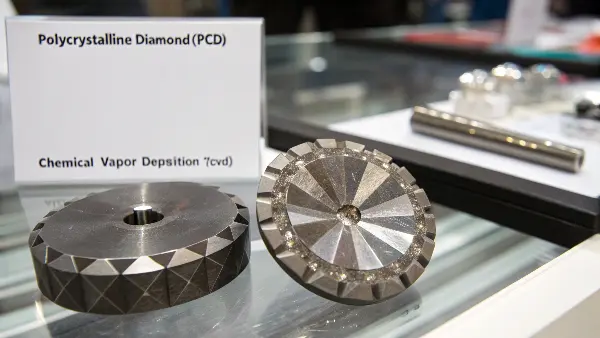
Choosing between PCD and CVD diamond isn’t just about picking the "best" one; it’s about picking the right one for the job. Having worked on hundreds of CFRP projects, from drone frames to automotive panels, I’ve learned that matching the tool to the application is the secret to success. Think of it like choosing between a heavy-duty truck and a sports car—both are excellent vehicles, but for very different purposes.
Let’s break down the differences to make the choice clearer for your next project.
Polycrystalline Diamond (PCD)
PCD tools are made by sintering synthetic diamond particles with a metallic binder at high pressure and temperature. This creates a composite material that is brazed onto a carbide tool body.
- Strengths: Its main advantage is toughness. The metallic binder stops cracks from propagating, so it can handle interrupted cuts and higher feed rates without chipping. This makes it a workhorse for applications like edge trimming, slotting, and rough milling where a lot of material needs to be removed quickly.
- Weaknesses: The cutting edge is not a continuous diamond crystal. It’s composed of many small diamond grains, so it can’t be sharpened to the same level of acute sharpness as a CVD tool. This can sometimes lead to slightly more pressure on the part, which can be a concern for very thin or delicate laminates.
Chemical Vapor Deposition (CVD) Diamond
CVD diamond tools start with a very sharp tungsten carbide tool. A thin layer of pure, binder-free diamond is then "grown" directly onto the tool’s surface in a vacuum chamber.
- Strengths: The resulting diamond coating is exceptionally uniform, hard, and can be applied over complex geometries like drills and fine-detail end mills. Because it is pure diamond, it can hold an incredibly sharp edge. This razor-sharpness allows it to shear carbon fibers with minimal force, resulting in a pristine surface finish with almost no fiber pull-out or delamination.
- Weaknesses: This pure diamond layer is more brittle than PCD. Heavy shocks or high-impact cutting can cause the coating to chip or delaminate from the carbide substrate. This makes it less suitable for aggressive roughing or interrupted cuts.
Here is a simple table to help you decide:
| Feature | Polycrystalline Diamond (PCD) | CVD Diamond-Coated |
|---|---|---|
| Primary Use | High-volume roughing, edge trimming | Finishing, drilling, complex shapes |
| Toughness | Very High | Moderate |
| Sharpness | Good | Exceptional |
| Tool Life | Excellent | Very Good to Excellent |
| Surface Finish | Good to Very Good | Excellent |
| Cost | High | Very High |
| Best For | Removing material quickly | Achieving a perfect finish |
For a client making thick chassis components for a race car, we recommended PCD routers for trimming the part contours. For another client designing intricate medical device housings, CVD-coated drills and end mills were the only way to achieve the required burr-free finish.
How do you select the best diamond tool geometry for your application?
Choosing the right type of diamond is only half the battle. Are you using a straight flute, a burr-style router, or a compression cutter? The geometry of the tool is just as critical. Using the wrong one can lead to delamination, uncut fibers, and a poor finish, even with diamond.
For carbon fiber, select tool geometry based on the operation. Use burr-style routers for aggressive roughing and edge trimming to minimize lateral forces. For through-cuts in laminates, a compression router (with up-cut and down-cut flutes) is essential to prevent delamination on both the top and bottom surfaces. For drilling, specialized drill-reamers prevent cracking.
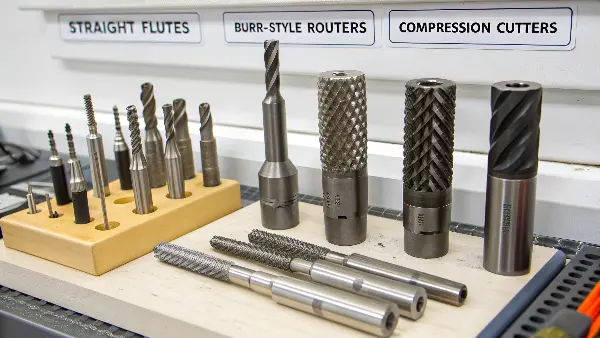
I learned this lesson on a project involving thin carbon fiber sheets, about 1.5mm thick. We started with a standard straight-flute diamond router. While it cut the material, it left a fuzzy, frayed edge on the top surface. The upward force of the tool was pulling the top layers of fiber away from the matrix before they could be cut. We switched to a down-cut spiral tool. This fixed the top surface, creating a perfectly clean edge. But when we inspected the bottom, we found splintering and blowout. The down-cut tool was pushing the uncut fibers out of the bottom layer. The solution was a compression router. This tool was a game-changer. It has up-cut flutes on the tip and down-cut flutes on the shank. Once engaged in the material, it simultaneously pulls the top layers down and the bottom layers up, "compressing" them towards the center. The result was a perfectly clean edge on both sides.
Understanding these specialized geometries is key for any engineer working with CFRP. Here are the most common types and their uses:
Common Tool Geometries for CFRP
| Tool Geometry | Description | Primary Application | Key Benefit |
|---|---|---|---|
| Burr Style Router | Has many fine cutting edges, like a file. Comes in diamond-cut or chip-breaker patterns. | General purpose roughing, trimming, slotting. | Reduces cutting forces and delamination by grinding rather than shearing. Very stable. |
| Compression Router | Combines up-cut and down-cut flutes on a single tool. | Through-cutting of laminated panels (profiling). | Prevents delamination on both top and bottom surfaces of the part. A must-have for clean edges. |
| Down-Cut Router | Flutes push chips and cutting forces downward, into the material. | Shallow pockets, through-cuts where top surface finish is critical. | Creates a clean, sharp top edge. Helps hold thin material down. |
| Straight Flute Router | Neutral flute design with no axial force (up or down). | Slotting and grooving. | Good for applications where you need to avoid lifting or pushing the workpiece. |
| Specialized Drills | Often called "dagger drills" or have a multi-faceted point geometry. | Drilling holes. | Creates a clean entry and exit hole by shearing the material from the outside-in, preventing blowout. |
When you send a design to a machine shop like ours, specifying the desired outcome is more important than specifying the exact tool. For example, instead of saying "use a 4mm CVD compression router," tell us "this through-cut needs to be free of delamination on both sides." This allows us, the manufacturing experts, to select the absolute best tool and process from our experience to achieve your goal. For instance, for very thick laminates (>10mm), we might even use a multi-pass strategy with different tools to get the best result.
What are the optimal machining parameters for diamond tools on carbon fiber?
Have you invested in expensive diamond tooling only to get poor results? Just having the right tool isn’t enough. Using the wrong speeds and feeds can still lead to heat damage, delamination, and premature tool failure. Finding that sweet spot is critical for success.
Optimal parameters for diamond tools on carbon fiber involve high cutting speeds (SFM) and moderate feed rates. High spindle speed (RPM) ensures the tool is shearing fibers cleanly, while a controlled feed rate prevents overwhelming the cutting edge. For CFRP, typical speeds are 15,000-25,000 RPM with feed rates around 500-1500 mm/min.
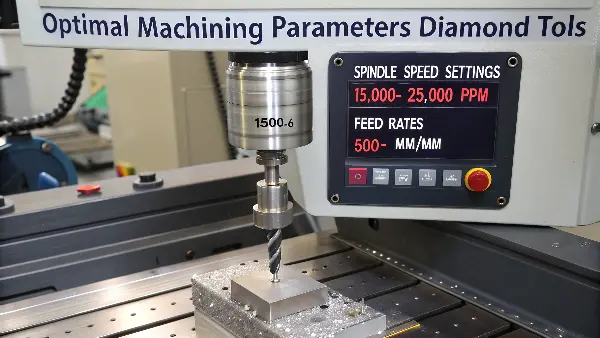
I often get questions from engineers like Alex who want to know the "perfect" numbers for speed and feed. The honest answer is: it depends. The ideal parameters are a function of the specific tool, the thickness and type of the CFRP laminate, the machine’s rigidity, and the part geometry. However, there are fundamental principles that always apply. Machining composites is very different from machining metals. With metals, you often use lower RPMs and coolants. With carbon fiber, it’s the opposite.
High rotational speed is your best friend. A high surface feet per minute (SFM) allows the diamond cutting edge to pass a given point so quickly that it shears the brittle carbon fiber before it has a chance to bend or be pulled away from the resin matrix. This is the key to minimizing fiber pull-out and achieving a clean cut. Think of it like cutting a single hair with scissors. A slow, hesitant cut will just push the hair over. A fast, decisive snip cuts it cleanly.
The feed rate needs to be balanced. Too slow, and the tool will dwell in one spot, rubbing instead of cutting. This generates immense heat, which can quickly burn and melt the epoxy resin, ruining the part and dulling the tool. Too fast, and you risk chipping the brittle diamond coating (on CVD tools) or overwhelming the cutting edges, leading to high forces that can cause delamination. We always start with the tool manufacturer’s recommendations and then adjust based on a test cut. We listen to the sound of the cut and inspect the finish under magnification to fine-tune the parameters for the best possible result.
Here’s a general starting point for different operations:
| Operation | Tool Type | Spindle Speed (RPM) | Feed Rate (mm/min) | Notes |
|---|---|---|---|---|
| Edge Trimming | PCD or CVD Burr | 18,000 – 25,000 | 750 – 2,000 | High speed is key. Listen for a clean "buzzing" sound, not a "rumbling" sound. |
| Profiling | CVD Compression Router | 16,000 – 22,000 | 500 – 1,500 | Feed rate should be moderate to allow the compression zone to work effectively. |
| Drilling | CVD Coated Drill | 5,000 – 10,000 | 100 – 300 (Plunge) | Use a pecking cycle to clear dust and reduce heat. Slower RPM than milling. |
| Slotting | PCD Straight Flute | 18,000 – 24,000 | 600 – 1,200 | Depth of cut should be shallow, typically no more than half the tool diameter per pass. |
One more critical point: dust extraction. Aggressive and effective vacuum dust extraction is not optional. The fine carbon dust is not only a health hazard but also highly abrasive and conductive. It can get into machine ways and electronics, causing damage. A powerful vacuum system pulls the dust away from the cutting zone, which also helps keep the tool cool and improves the cut quality. We never machine CFRP without it.
Conclusion
In short, mastering carbon fiber machining requires switching to PCD or CVD diamond tools, selecting the right geometry for the task, and optimizing your speeds and feeds for clean, cool cutting.