
You’ve designed a critical component, but now you face the challenge of getting it machined perfectly. The wrong choices in design or suppliers can lead to costly delays and parts that don’t meet spec. This uncertainty is stressful when project deadlines are tight.
Start by optimizing your design for manufacturability (DFM). Then, understand the key components of the CNC machine that will produce your part. Finally, select a manufacturing partner with the right equipment and expertise. Making informed choices at each stage is crucial for achieving precision, managing costs, and ensuring your project’s success.
I’ve spent over a decade in this industry, first on the shop floor and now helping engineers bring their designs to life. I have seen how small oversights can lead to big problems down the line. The good news is that you can navigate this process with confidence by understanding a few key areas. It all begins with your design and how well it is prepared for the machine. Let’s break down what you need to know.
How should you design a part for CNC machining?
You have a perfect design in your CAD software, but is it ready for the real world? Designs that look great on screen can be surprisingly expensive or even impossible to machine. This gap between design and reality often leads to frustrating rework and budget overruns.
To design for CNC, simplify your geometry whenever possible. Use standard hole sizes, avoid deep pockets with small corner radii, and design sensible tolerances. Consider the material you are using and how it will be held during machining. These DFM (Design for Manufacturability) principles will significantly reduce your costs and lead times.
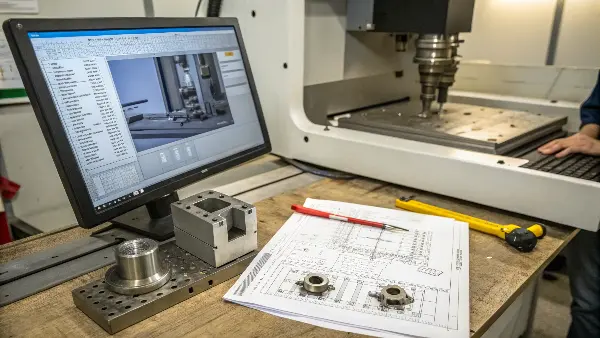
When I work with clients, the first thing we review is the part design. A poorly optimized design is the number one cause of high quotes and production delays. The goal is to make the machinist’s job as easy as possible. An easy job is a fast job, and a fast job is a less expensive one. Let’s look at a few core principles.
Key DFM Considerations for CNC
- Wall Thickness: Thin walls are difficult to machine. They can vibrate, warp, or even break during the process. As a rule of thumb, try to keep walls on metal parts thicker than 0.8mm (0.030 inches) and plastic parts thicker than 1.5mm (0.060 inches).
- Internal Radii: CNC machines use cylindrical tools, so they naturally create rounded internal corners. A sharp internal corner is impossible to machine and requires a secondary process like EDM. Instead, design your internal corners with a radius that is slightly larger than the cutting tool’s radius. A good practice is to make the radius at least 1/3 of the pocket’s depth.
- Tolerances: Tighter tolerances mean more machine time, special tools, and more inspections. This all adds up to a higher cost. Ask yourself if every feature needs a tolerance of ±0.01mm. Apply tight tolerances only where they are functionally critical. For non-critical features, a standard tolerance like ±0.1mm (±0.005 inches) is usually sufficient and much more economical.
Here is a quick table to guide your design choices:
| Feature | Avoid | Recommended Practice |
|---|---|---|
| Internal Corners | Sharp, 90-degree corners | Radius > 3mm, or at least 130% of tool radius |
| Holes | Non-standard sizes, blind holes | Standard drill sizes, through-holes |
| Text/Lettering | Engraved text (time-consuming) | Raised text (milled away background) |
| Deep Pockets | Depth-to-width ratio > 4:1 | Keep pockets shallow and wide |
By thinking like a machinist during the design phase, you set your project up for success from the very beginning.
What are the 7 major parts of a CNC machine?
You’ve designed your part, but do you know how it’s actually made? A CNC machine looks like a simple box, but inside are complex systems working together. Not understanding these systems can make it hard to judge a supplier’s capabilities or troubleshoot quality issues.
The main parts of a CNC machine are the frame, control panel (or CNC controller), spindle, drive system (motors and ball screws), cutting bed, tool changer, and coolant system. Each component plays a vital role in the machine’s overall accuracy, speed, and reliability, directly impacting the quality of your finished parts.
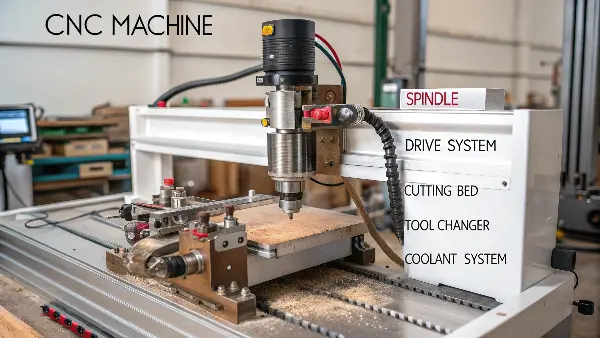
To choose the right manufacturing partner, you need to know if they have the right tools for your job. Understanding the machine’s anatomy helps you ask better questions. When I first started as a machinist, I learned quickly that a machine is only as good as its weakest component. A machine with a powerful spindle but a weak frame will still produce chatter and poor surface finishes. It is the combination of these parts that determines capability.
How Each Part Affects Your Machined Component
- Frame: This is the backbone of the machine. A heavy, rigid frame made from cast iron absorbs vibrations and ensures stability. A less rigid frame will vibrate during heavy cuts, which leads to poor surface finish and dimensional inaccuracies in your part. When you need high precision, a machine with a solid foundation is non-negotiable.
- Control Panel (CNC Controller): This is the brain. It reads the G-code and controls the machine’s movements. Advanced controllers can process code faster and enable more complex cutting paths (like 5-axis simultaneous motion). For parts with complex Ccomplex surfaces, a machine with a high-end controller like Fanuc, Siemens, or Heidenhain is essential.
- Spindle: The heart of the machine, the spindle holds the cutting tool and rotates it. Its speed (RPM) and torque determine what materials can be cut and how fast. High-speed spindles are great for aluminum, while high-torque spindles are needed for tough materials like stainless steel or titanium. We will dive deeper into this next.
- Drive System: This system moves the machine axes. It consists of servo motors, drive amplifiers, and ball screws. High-quality drive systems provide precise, repeatable positioning with no backlash. This directly translates to the dimensional accuracy of your part’s features.
- Cutting Bed: This is where your raw material is secured. A flat, stable bed is critical. It must hold the workpiece rigidly so it doesn’t move during machining. The size of the bed also determines the maximum part size a machine can handle.
- Tool Changer: An automatic tool changer (ATC) allows the machine to switch cutting tools without operator intervention. A fast and reliable ATC reduces cycle time, making the production of complex parts with many different features more efficient and less expensive.
- Coolant System: This system sprays fluid on the cutting tool and workpiece. It cools the tool, lubricates the cut, and clears away chips. Proper coolant delivery prevents tool wear and ensures a good surface finish on your part, especially in materials like aluminum and steel.
Knowing these parts helps you have more meaningful conversations with your suppliers. You can ask about their machine’s frame construction or the controller they use, giving you a better picture of their true capabilities.
How do you choose the right spindle for CNC jobs?
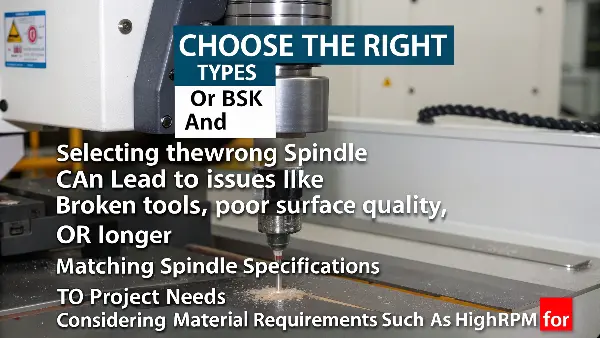
You know the spindle is the heart of a CNC machine, but not all spindles are created equal. Using a machine with the wrong spindle for your specific material and design can be disastrous. It can lead to broken tools, poor surface quality, or incredibly long machining times, all of which drive up costs.
To choose the right spindle, you must match its specifications to your project’s needs. Consider the material: high RPM (20,000+) is ideal for aluminum, while high torque is essential for cutting hard steels. Also, check the tool holder type (like BT, SK, or HSK), as it affects rigidity and runout, which are critical for high-precision work.
I remember a project with a client who needed a large aluminum housing with many deep pockets. The first shop they tried used a low-speed, high-torque machine designed for steel. The cycle time was enormous, and the quote was sky-high. We moved the job to a machine with a high-speed spindle, and we cut the machining time by over 60%. The spindle wasn’t "better," it was just the right one for that job. This choice saved my client thousands of dollars.
Spindle Characteristics and Their Impact
The two most important specifications of a spindle are its speed and power, which are often shown on a power-torque curve.
- High-Speed Spindles (Low Torque): These spindles excel at RPMs from 15,000 to 40,000 or even higher. They are perfect for soft materials like aluminum, brass, and plastics. The high RPM allows for very fast feed rates, which reduces cycle time dramatically. This is called High-Speed Machining (HSM). However, they lack the torque needed to make deep cuts in hard materials.
- High-Torque Spindles (Low Speed): These spindles are workhorses, typically operating below 10,000 RPM. They have the power to push large cutting tools through tough materials like stainless steel, tool steel, and titanium without stalling. Using a high-speed spindle on these materials would lead to excessive tool wear or breakage.
The tool interface is another critical factor. It’s the connection between the spindle and the tool holder.
| Spindle Taper | Characteristics | Best For |
|---|---|---|
| BT / CAT | Common, robust, good for general-purpose machining. Contact is on the taper only. | General milling, drilling, moderate speeds. |
| HSK | Hollow, shorter, lighter. Dual contact on taper and face for high rigidity. | High-speed machining (>15,000 RPM), high-precision work, 5-axis jobs. |
When you discuss your project with a supplier, ask about their spindles. If you have an aluminum part with complex 3D surfacing, ask if they have machines with HSK spindles and high RPMs. If you are making a sturdy fixture from tool steel, ask about their high-torque capabilities. Matching the spindle to the job is a key step toward efficiency and quality.
Are Chinese CNC machines and services any good?
You have a great design and you know what kind of machine you need, but where do you get your parts made? The idea of sourcing from China is tempting due to the cost savings, but many engineers worry about quality, communication, and reliability. This hesitation is understandable.
Yes, Chinese CNC machines and services can be excellent, but quality varies greatly. Top-tier Chinese suppliers use the same high-end imported machines (like Haas, DMG Mori, Mazak), quality control equipment (CMMs), and materials as Western shops. The key is to find reputable partners who have a proven track record of working with international clients.
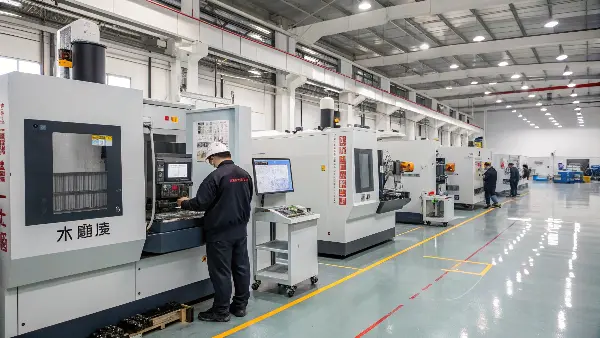
When I started QuickCNCs, my goal was to bridge this exact gap. As someone who has worked in both Chinese shops and with global clients, I’ve seen both sides of the story. The stereotype of low-quality Chinese manufacturing is outdated. The reality today is much more nuanced. There are thousands of CNC shops in China, ranging from small family-run operations to massive, state-of-the-art factories. The trick is knowing how to find the good ones.
Separating High-Quality from Low-Quality Suppliers
A top-tier Chinese supplier is not defined by the brand of machine they own, but by their process and their people. Here’s what I’ve learned to look for:
- Investment in Quality Control: Do they have a dedicated quality department? Do they use CMMs (Coordinate Measuring Machines), optical projectors, and calibrated gauges? Ask for their inspection reports on past projects. A good shop will have no problem providing this. A great shop will provide it with every order.
- Engineering and Communication: Can you communicate directly with an engineer who speaks clear English? A salesperson can sell you a part, but an engineer can solve your problems. Effective communication is the most critical factor for success. Misunderstandings about a drawing or a tolerance can ruin a batch of parts. This is why our team at QuickCNCs always includes project managers with strong engineering backgrounds.
- Experience with International Standards: Are they familiar with ISO, DIN, or ASME standards? Do they understand material certifications like EN 10204 3.1? A supplier who regularly works with clients in Europe and North America will already have these systems in place. They won’t be surprised when you ask for a material certificate or a full dimensional inspection report.
- Transparency: A good partner will be open about their capabilities and their supply chain. They will tell you if a specific process, like heat treatment or anodizing, is done by a trusted subcontractor. They should provide clear, all-inclusive quotes without hidden fees.
The best Chinese suppliers are not just "low-cost"; they are strategic partners who offer a powerful combination of advanced technology, scalable capacity, and competitive pricing. The challenge is not a lack of quality in China, but the difficulty of finding and validating it from thousands of miles away.
Conclusion
Choosing the right approach for your CNC parts involves smart design, understanding the machines, and selecting the right partner. These choices directly impact your project’s cost, quality, and timeline.