
You might still picture Chinese manufacturing as endless assembly lines churning out simple, low-cost products. This outdated view could be holding you back. You might be overpaying for complex parts in Europe or North America, thinking that advanced machining isn’t available or reliable in China.
By 2025, the top CNC machining facilities in China will offer capabilities that rival the best in the world. This includes widespread use of simultaneous 5-axis machining, automated production with robotics for 24/7 operation, mill-turn and Swiss-style lathes for complex single-setup parts, and advanced metrology like CMM and 3D scanning to guarantee tight tolerances.
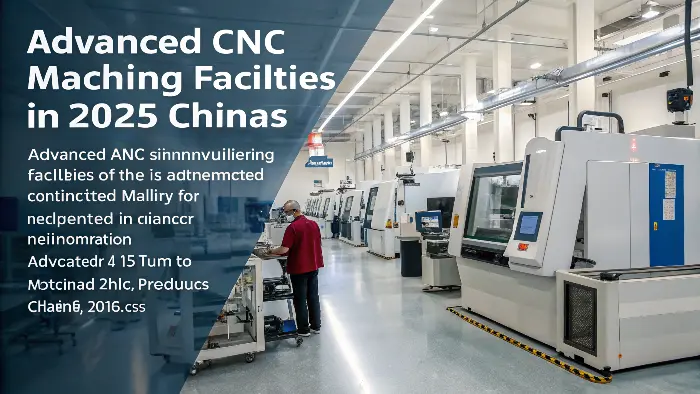
This isn’t just a prediction; it’s the reality I see on the ground every day. When I started my career on the shop floor, a 4-axis machine was considered high-tech. Today, when I visit my partner facilities, I see workshops that look like they are from the future. They are clean, automated, and filled with the best equipment from Germany, Japan, and Switzerland. For engineers like Alex in Germany who need precision and reliability, understanding this evolution is key. Let’s explore what these advanced capabilities really mean for your projects.
How Has Simultaneous 5-Axis and Mill-Turn Machining Evolved?
Your part has complex curves and angled features, requiring multiple setups on a standard 3-axis machine. You know that every time the part is re-clamped, you risk losing accuracy. This manual process is slow, expensive, and introduces a high potential for error, jeopardizing your entire design.
Simultaneous 5-axis and mill-turn machining are no longer niche services in China; they are core competencies of any serious supplier. Top shops have invested heavily in machines from global leaders like DMG Mori, Mazak, and Haas. This allows them to produce incredibly complex parts for aerospace, medical, and robotics in a single setup, ensuring maximum precision and efficiency.
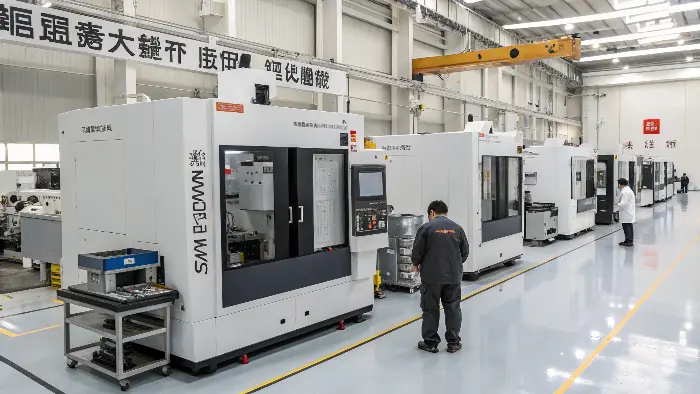
The leap to widespread 5-axis and mill-turn capability is one of the biggest changes I’ve seen in the last decade. I remember working with a client on a turbine blade prototype. In the past, a part like that would have required five or six different setups, and the final surface finish would never be perfect due to the blended toolpaths. We recently made a similar part for another client on a new DMG Mori 5-axis machine. It was machined in one continuous operation. The surface finish was flawless, and the dimensional accuracy was within ±0.01mm. This is the level of technology that is now readily available.
Simultaneous 5-Axis vs. 3+2 Machining
It’s important to understand the difference. Many shops offer "5-axis" machining, but they might be using a 3+2 axis setup. In 3+2 machining, the two rotational axes lock into a tilted position, and the machine then works like a 3-axis machine. It’s great for reducing setups but can’t create the truly complex, curved surfaces that simultaneous 5-axis can. Simultaneous 5-axis machining involves all five axes moving at the same time, allowing for the creation of organic shapes, impellers, and other highly complex geometries in one smooth motion.
The Power of Mill-Turn Centers
Mill-turn machines, or multi-axis turning centers, are another game-changer. These are essentially a CNC lathe and a CNC mill combined into one machine. They can turn a cylindrical part and then use live tooling to mill flats, drill holes, or even create complex features without ever moving the part to a different machine.
| Capability | Best Application | Key Benefit for Engineers |
|---|---|---|
| 3-Axis Machining | Prismatic parts, brackets, plates. | Cost-effective for simple geometries. |
| 3+2 Axis Machining | Parts with angled holes or features on multiple faces. | Reduces setups and improves accuracy over multiple 3-axis operations. |
| Simultaneous 5-Axis | Turbine blades, medical implants, complex molds. | Can create any shape in a single setup. Unmatched precision and surface finish. |
| Mill-Turn Machining | Shafts with keyways, complex hydraulic fittings, medical screws. | "Done-in-one" production for complex cylindrical parts, eliminating setup errors. |
For an engineer like Alex designing robotic joints, these technologies mean he can design parts for optimal function, not just for ease of manufacturing. He can combine multiple components into one complex part, reducing weight and increasing strength, confident that it can be machined accurately.
Is Automation Making Chinese CNC Shops More Reliable?
You’ve approved a prototype, and now you need a production run of 500 pieces. You worry about consistency. Will the 500th part be identical to the first? Human fatigue and small variations in setup can lead to quality drift over a long run, causing major headaches during assembly.
Yes, automation is dramatically increasing reliability. Leading Chinese shops are integrating robotic arms for machine tending and pallet systems for queuing jobs. This enables "lights-out" manufacturing, where machines run 24/7 with minimal human intervention. This not only boosts efficiency but also eliminates human error, ensuring every single part is machined with perfect consistency.
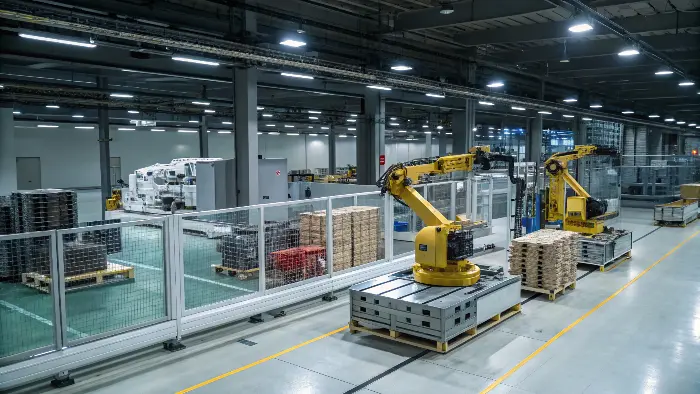
Walking into a top-tier workshop at 10 PM is an amazing experience. The lights are dim, but the factory is alive with activity. Robotic arms glide silently, loading raw billets into machines and placing finished parts onto inspection trays. Pallet pools automatically swap out completed jobs for the next ones in the queue. This isn’t science fiction; this is how modern Chinese factories maintain a competitive edge and deliver exceptional consistency. I had a client who needed a recurring order of 1,000 identical housings every month. The first run we did at a traditional shop had a 5% rejection rate due to minor variations. We moved the project to an automated facility. The rejection rate dropped to zero, and the lead time was cut by 30% because the machines could run nonstop through the night and weekends.
Key Automation Technologies
This new level of reliability is driven by specific technologies that work together as a system.
- Robotic Machine Tending: A robot is much more consistent than a human at loading a part into a chuck or vise. It applies the same pressure every time and places it in the exact same position, which is critical for maintaining tight tolerances across thousands of parts.
- Automated Pallet Changers: These systems hold multiple blocks of raw material, each on a separate pallet. The CNC machine can finish one job, automatically swap in the next pallet, and begin cutting without waiting for an operator. This maximizes machine uptime.
- In-Process Probing: Modern machines are equipped with probes that can automatically measure the part while it’s still in the machine. If the probe detects a tool is wearing down, it can automatically switch to a new tool or adjust its offsets to maintain accuracy.
The Impact on Your Projects
This shift to automation has direct benefits for you as an engineer.
| Benefit | How It Helps You |
|---|---|
| Unmatched Consistency | Every part in your order is a perfect clone of the approved sample. No more surprises during assembly. |
| Faster Lead Times | 24/7 operation means production runs are completed much faster. |
| Lower Costs at Volume | Reduced labor and maximized machine efficiency translate to a lower cost per part on larger orders. |
| Predictable Scheduling | Automated systems are highly predictable, allowing suppliers to give you more reliable delivery dates. |
For engineers who need to scale from prototype to production, this automation is the key. It provides the confidence that the quality and precision you signed off on will be maintained, no matter the quantity.
How Advanced is Quality Control in Top Chinese Facilities?
You receive a shipment of parts from an overseas supplier. The parts look fine, and they come with a simple inspection report. But when your own QC department measures them with high-precision equipment, they find critical dimensions are out of tolerance. The project grinds to a halt.
Quality control in premier Chinese shops has evolved far beyond calipers. They now operate dedicated, climate-controlled metrology labs with advanced equipment like Zeiss CMMs, 3D laser scanners, and XRF material analyzers. They provide comprehensive inspection reports (like FAI reports) that offer undeniable, data-backed proof that your parts meet every specification on the drawing.
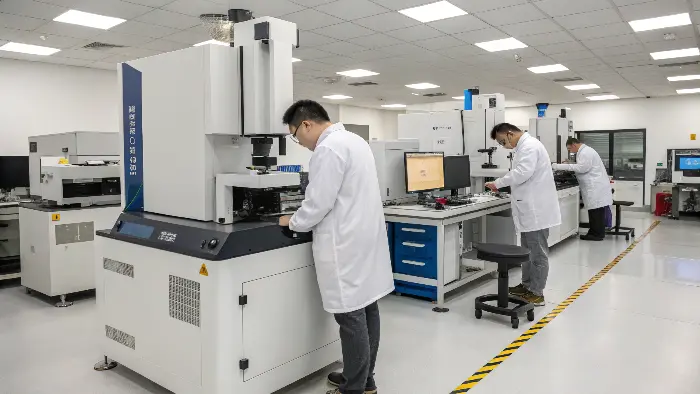
Trust is built on proof. In CNC machining, the proof is in the measurement data. I insist that all my partners invest in top-tier inspection equipment because it’s the only way to eliminate doubt. I once had a client, a German robotics engineer just like Alex, who was extremely skeptical. He needed a gear housing with a positional tolerance of just ±0.015mm between several bores. He didn’t believe it could be reliably achieved overseas. For his first order, we provided a 15-page CMM report for each part, showing the measurement of every critical feature. The report was color-coded, showing that all dimensions were well within the middle of the tolerance band. Seeing that objective data completely changed his perspective. He knew we weren’t just telling him the parts were good; we were proving it.
The Pillars of Modern Metrology
A world-class QC department is built on several key technologies.
- Coordinate Measuring Machines (CMMs): This is the gold standard. A CMM uses a highly sensitive probe to touch hundreds or thousands of points on a part to create a precise 3D map of its features. It’s the only way to accurately measure complex geometric dimensioning and tolerancing (GD&T) callouts like position, profile, and runout.
- 3D Laser Scanners: For parts with highly organic or complex surfaces, a 3D scanner can capture millions of data points in seconds. This data is then overlaid on the original CAD model to create a color-coded deviation map, instantly showing any areas that are out of spec.
- Material Verification: How do you know the Aluminum 6061-T6 you ordered is what you actually received? Top shops use X-Ray Fluorescence (XRF) guns. They can point this device at the raw material or finished part and get an instant chemical breakdown, verifying the alloy composition. This is crucial for performance and regulatory compliance.
Documentation You Should Expect
A professional partner will provide clear, detailed documentation to back up their quality.
| Document | What It Is | Why You Need It |
|---|---|---|
| Material Certificate | A certificate from the raw material mill, confirming the material type and batch number. | Guarantees you are getting the exact material you specified. |
| First Article Inspection (FAI) Report | A detailed report measuring every single dimension on the drawing for the first part produced. | Confirms the manufacturing process is set up correctly before starting mass production. |
| Full CMM Report | The raw data output from the CMM, showing the measured value for critical GD&T features. | Provides objective, undeniable proof of precision for your most critical parts. |
When you evaluate a potential partner, ask to see examples of these reports. A supplier who is proud of their quality will be happy to share them.
Conclusion
The landscape of CNC machining in China has fundamentally transformed. By 2025, the question is no longer "Can China make it?" but "How can I leverage their advanced capabilities?" With 5-axis machines, automation, and world-class QC, Chinese partners offer a powerful advantage for any engineering project.