
Your freshly machined carbon fiber part looks raw and unfinished. This rough appearance can undermine its performance and make a sophisticated design look cheap. Choosing the right surface finishing technique is key to transforming it into a durable, professional-grade component that truly stands out.
To get a perfect finish on carbon fiber, you must follow a careful process of sanding, polishing, and coating. This starts with wet sanding to create a smooth surface, followed by polishing compounds to achieve a high gloss. Finally, applying a protective layer like a UV-resistant clear coat or a ceramic coating protects the part from damage and enhances its final look, whether matte or glossy.
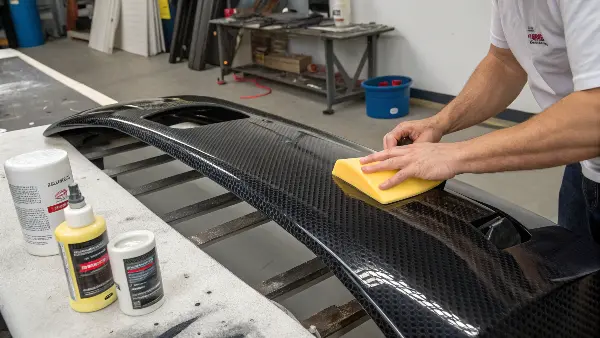
But achieving that deep, liquid gloss or a slick matte finish is more complex than it seems. Each step serves a critical purpose, and skipping one can ruin the final result. I’ve seen it happen many times. Let’s walk through the essential techniques I use in my shop, so you can confidently choose the best approach for your project and avoid common pitfalls.
Why is a Clear Coat the Most Common Choice for Protecting Carbon Fiber?
You’ve spent a lot of time and money developing a beautiful carbon fiber part. But left unprotected, it’s vulnerable to UV rays that yellow the resin and scratches that ruin the look. Applying a high-quality clear coat is the most reliable way to provide long-lasting protection and a professional appearance.
A clear coat is the go-to finish because it offers the best combination of UV protection, chemical resistance, and aesthetic enhancement. It acts as a sacrificial barrier, shielding the epoxy resin from sun damage that causes yellowing and degradation. It also provides a hard, durable surface that resists scratches and makes the carbon weave pop with incredible depth and gloss.
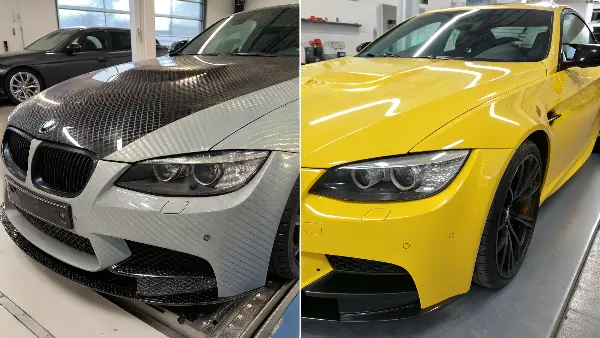
In my experience, about 90% of the carbon fiber projects we handle for clients like Alex in Germany end up with a clear coat. The reason is simple: it works, and it delivers the look everyone associates with high-performance carbon fiber. When you see a supercar with a gleaming carbon fiber hood, you’re looking at a part that has been meticulously sanded and then coated with a top-tier automotive-grade 2K (two-component) clear coat. This isn’t just about looks. The epoxy resin that holds the carbon fibers together is sensitive to sunlight. Without protection, it will break down, turning yellow and brittle over time. A good clear coat contains UV inhibitors that act like sunscreen for your part, preserving its structural integrity and appearance for years.
When choosing a clear coat, you have a few options, but they are not all created equal.
Types of Clear Coats for Carbon Fiber
| Type of Clear Coat | Key Feature | Best For | My Insight |
|---|---|---|---|
| 2K (Two-Component) | Highest durability, chemical & UV resistance. | Automotive, marine, and high-performance parts. | This is the industry standard. It’s a chemical reaction between the paint and a hardener, creating a tough shell. Requires proper safety gear (respirator) to apply. |
| 1K (Single-Component) | Easy to apply from an aerosol can. | Prototypes, non-critical cosmetic parts. | Convenient for quick jobs, but it’s much less durable than 2K. It dries by solvent evaporation and will not stand up to fuel, chemicals, or serious abrasion. |
| Gloss Finish | High-shine, deep, wet look. | Show cars, premium products. | This is the classic carbon fiber look. It highlights the weave and makes it look three-dimensional. It also shows imperfections, so surface prep is critical. |
| Matte/Satin Finish | Low-sheen, modern, stealth look. | Interior components, custom projects. | A matte finish is very popular right now. It hides fingerprints better than gloss and gives a more subtle, technical appearance. It’s applied the same way but has a matting agent mixed in. |
For any serious application, I always recommend a 2K clear coat. It costs more and requires more care to apply, but the protection it offers is unmatched. It’s the only way to guarantee your part will look as good in five years as it does today.
How Do You Polish Carbon Fiber to a Mirror Shine?
Your carbon fiber part has a 2K clear coat, but it still doesn’t have that perfectly flat, liquid-like mirror shine. It might have a slight texture, known as "orange peel," or tiny dust nibs. This can make a high-end part look amateurish. The secret to a world-class finish lies in a meticulous polishing process.
To achieve a mirror shine, you must first level the clear coat through a process called wet sanding, starting with a fine grit like 1500 and progressing to 3000 or even 5000. After sanding, you use a series of cutting and polishing compounds with a machine polisher to remove the sanding marks and bring out a deep, flawless, and brilliant gloss.
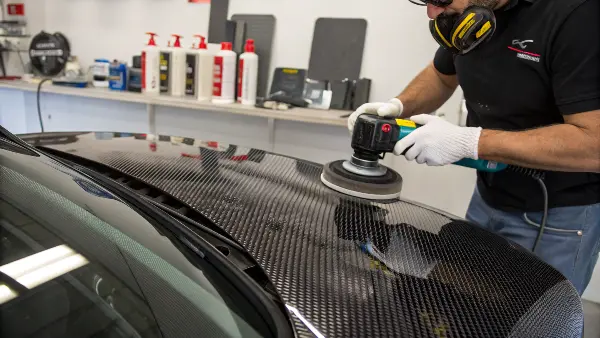
I remember working on a set of custom interior panels for a client’s luxury car. After we applied the clear coat, it looked good, but not perfect. The client wanted a finish so deep you could swim in it. Just polishing it wouldn’t cut it. We had to do a full "cut and buff," which is what the pros call this process of wet sanding and polishing. It’s nerve-wracking because if you sand too aggressively, you can burn right through the clear coat and ruin the part. You have to be patient and let the tools do the work. The key is to create a perfectly flat surface, because flatness is what reflects light perfectly and creates that mirror effect.
Here’s the step-by-step process we use at QuickCNCs to get that show-car shine.
The Cut and Buff Process for a Mirror Finish
-
Step 1: Curing
First things first, let the 2K clear coat fully cure. This can take anywhere from 24 hours to a week depending on the product and temperature. Don’t rush this step. Polishing an uncured surface will just make a sticky mess. Check the manufacturer’s data sheet for exact cure times. -
Step 2: Wet Sanding
This is the most critical stage. The goal is to remove the orange peel and level the surface until it’s uniformly dull and smooth.- Start with 1500-grit waterproof sandpaper on a soft block.
- Use plenty of water with a drop of soap to lubricate the surface and prevent clogging.
- Sand gently in one direction until the entire surface has a uniform, matte appearance. You should not see any shiny spots.
- Progress to 2000-grit, sanding in the opposite direction (e.g., perpendicular to your first pass). This helps ensure you remove all the 1500-grit scratches.
- Finish with 3000-grit or even 5000-grit sandpaper to refine the surface even further. By the time you’re done, the part will have a satin-like sheen.
-
Step 3: Compounding (The "Cut")
Now, you’ll use a machine polisher (a dual-action or rotary polisher works best) and a cutting compound.- Apply a few small drops of heavy-cut compound onto a foam or wool cutting pad.
- Work in a small 2’x2′ (60cm x 60cm) section at a time.
- Spread the compound on low speed, then increase the speed to medium and work the compound until it starts to turn clear. This will remove all the sanding marks.
-
Step 4: Polishing (The "Buff")
Switch to a softer polishing pad and a fine finishing polish.- This step refines the surface even more, removing any haze or swirl marks left by the aggressive compound.
- The process is the same: work in small sections until you achieve a brilliant shine.
This process takes time and skill, but the result is a flawless, deep finish that simply can’t be achieved any other way.
Are There Simpler Finishes Besides a Full Clear Coat?
Sometimes, a project doesn’t need the time or expense of a full, multi-stage 2K clear coat finish. You might be working on a prototype, an interior part not exposed to UV light, or you might just prefer a more natural look. So, what are the alternatives for finishing and protecting carbon fiber?
Yes, simpler finishes exist. For a quick gloss and some protection on raw carbon fiber, you can use wipe-on or aerosol polishes and waxes. For a natural, semi-gloss look with minimal effort, applying certain oils can enhance the weave. These methods are faster and easier than a clear coat but offer less long-term durability and UV protection.
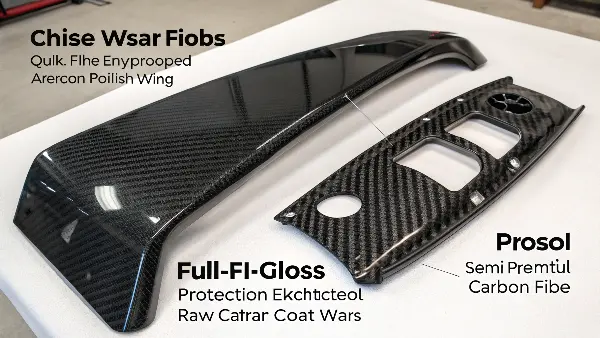
I sometimes recommend these simpler finishes for clients who are rapidly iterating on prototypes. For example, Alex, the engineer from Germany, might need to 3D print a fixture to check the fit of a carbon fiber part. In that case, spending two days on a perfect finish is a waste of time. He just needs it to look presentable for a meeting or a quick test. Or, sometimes, a designer wants a more "raw" aesthetic for an interior design piece. In these situations, a heavy, glossy clear coat can look too much like plastic. A simpler finish can preserve the tactile feel of the material. It’s about matching the finish to the application. You don’t always need to bring out the big guns.
Let’s look at some of these easier methods. They won’t provide the same rock-hard protection as a 2K clear coat, but they have their place.
Comparison of Simple Finishing Techniques
| Finishing Method | Process | Pros | Cons |
|---|---|---|---|
| Buffing the Resin | Sand raw part up to 2000-grit, then buff with polishing compound. | No added material, maintains the pure feel of the part. | Offers zero UV protection. The epoxy itself will yellow and degrade over time if exposed to sunlight. Best for indoor parts only. |
| Paste Wax | Apply a high-quality carnauba paste wax after a light polish. | Easy to apply, enhances gloss, provides some water repellency. | Very low durability. Wears off quickly and offers minimal scratch or UV protection. Needs frequent reapplication. |
| Spray-on Sealant | Modern polymer or ceramic-infused spray waxes. | Extremely fast to apply, adds slickness and gloss. | Similar to wax, durability is limited to a few months at best. Not a true protective layer. Good for a quick shine. |
| Wipe-on Oil | Applying specific oils like Tung oil or specialized polymer oils. | Creates a unique, low-sheen, hand-rubbed look. | Offers little to no protection against scratches or UV. Can be difficult to apply evenly and may attract dust while drying. |
These methods are perfect for specific use cases:
- Prototyping: A quick buff and wax is enough to make a part look good for a presentation without investing hours of labor.
- Interior Parts: For a decorative piece inside a car or a home that will never see sunlight, buffing the raw resin can provide a beautiful, natural finish.
- Temporary Protection: If you just need to protect a part for a few months before deciding on a permanent solution, a spray sealant is a good stop-gap measure.
Ultimately, these are quick fixes or stylistic choices. For any part that needs to perform and last in the real world, especially outdoors, nothing beats a properly applied 2K clear coat.
Conclusion
Finishing carbon fiber is a critical step that defines its final look and durability. From robust 2K clear coats to simple polishes, the right technique protects your investment and elevates your design.