
Struggling to get your aerospace parts accepted? You follow standard ISO tolerances, but your components are still rejected, causing delays and budget overruns. Understanding the unique, safety-critical demands of the aerospace industry is the key to getting it right the first time.
Aerospace tolerancing requirements are significantly stricter than general manufacturing standards like ISO 2768 because of the industry’s extreme focus on safety, reliability, and performance under harsh conditions. While ISO standards provide a good baseline, they do not cover the specific risks and traceability needed for aviation and space. This is why the industry relies on the AS9100 quality management system, which incorporates ISO 9001 but adds critical aerospace-specific requirements.

As a manufacturing professional, I’ve worked with hundreds of engineers across the globe. A common point of confusion I see is the jump from standard industrial parts to aerospace components. An engineer like Alex, a client of mine from Germany who designs high-precision robotics, is used to tight tolerances. But even he was surprised by the level of documentation and specificity required when he first ventured into a project for an aerospace sub-contractor. The rules are different because the stakes are infinitely higher. Let’s break down these standards so you can navigate your next aerospace project with confidence.
What is the ISO standard for tolerancing?
Are you confused by the different ISO numbers on technical drawings? Choosing or interpreting the wrong standard can lead to parts that don’t fit, causing expensive rework and project delays. Let’s clarify the most common ISO standard for general tolerancing to build a solid foundation.
The most widely used International Organization for Standardization (ISO) standard for general tolerancing is ISO 2768. It specifies default tolerances for linear, angular, and geometric features that don’t have a specific tolerance indicated on the drawing. It is divided into two parts: ISO 2768-1 for dimensions and ISO 2768-2 for geometry, each with distinct classes of precision.
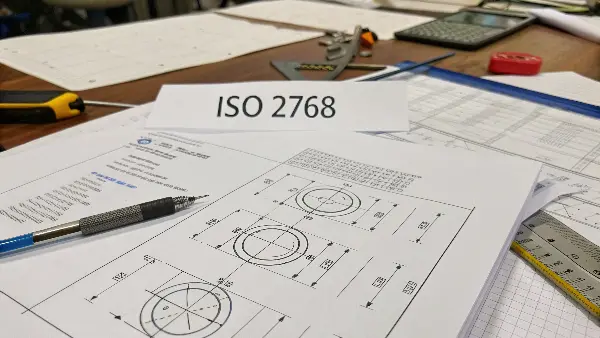
When a designer creates a drawing, it’s impractical to put a specific tolerance on every single dimension. For non-critical features, they rely on a general note. This is where ISO 2768 comes in. I see notes like "General Tolerances to ISO 2768-mK" on drawings every day. It’s a shorthand that saves time and keeps drawings clean. Let’s look at what it means.
Breaking Down ISO 2768
The standard has two components that are often used together:
- ISO 2768-1: This part covers linear and angular dimensions. It provides four tolerance classes:
- f (fine): For high-precision work.
- m (medium): The most common class, for standard machining.
- c (coarse): For less critical features.
- v (very coarse): For processes where precision is not a concern.
Here is a simplified table for ISO 2768-1 (class ‘m’) to give you an idea.
| Basic Dimension Range (mm) | Permissible Deviations (mm) |
|---|---|
| > 0.5 to 3 | ±0.1 |
| > 3 to 6 | ±0.1 |
| > 6 to 30 | ±0.2 |
| > 30 to 120 | ±0.3 |
| > 120 to 400 | ±0.5 |
- ISO 2768-2: This part deals with general geometrical tolerances like flatness, straightness, perpendicularity, and symmetry. It has three classes: H (fine), K (medium), and L (coarse).
Another important standard is ISO 286, which defines a system of fits and limits. Unlike the general tolerances of ISO 2768, ISO 286 is used for specific relationships between two mating parts, like a shaft fitting into a hole (e.g., H7/g6). This is for functional fits where clearance or interference is critical. For most general-purpose parts I machine, ISO 2768 is the default.
What is the tolerance of aerospace?
Think your design’s tolerances are tight? Aerospace parts operate in environments where a few microns can mean the difference between flawless performance and catastrophic failure. Let’s look at what "aerospace tolerance" really means and why it’s so demanding.
Aerospace tolerances are not defined by a single standard number but are exceptionally tight, often reaching ±0.01mm (10 microns) or better. These tolerances are driven by the component’s specific function, the material used, and the extreme operating conditions. They are dictated by strict Original Equipment Manufacturer (OEM) specifications, military standards (MIL-SPEC), and the overarching AS9100 quality system, not a general-purpose ISO standard.
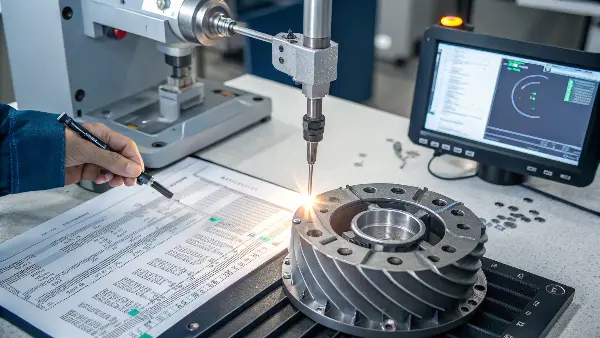
When you move from an industrial machine bracket to an aircraft actuator component, the entire mindset around tolerance changes. It’s no longer just about whether the part will fit; it’s about how it will perform under 50,000 cycles of stress at -50°C. I remember a project for a client manufacturing parts for a satellite deployment mechanism. A simple pin had a diameter tolerance of ±0.005mm. Why? Because the thermal expansion in space could cause a slightly larger pin to seize, and a slightly smaller one to have excessive play, compromising the entire mission.
Factors Driving Aerospace Tolerances
The extreme precision is not arbitrary. It is a direct result of several critical factors:
- Safety and Reliability: This is the most important driver. A failure in a car engine is a problem. A failure in a jet engine at 35,000 feet is a catastrophe. Every component must perform flawlessly for its entire service life.
- Extreme Operating Environments: Parts must withstand massive temperature swings (from cryogenic cold in space to thousands of degrees in an engine), high G-forces, constant vibration, and extreme pressure changes. Tolerances must account for how materials expand, contract, and behave under this stress.
- Component Interchangeability: An airline needs to be able to replace a part on a plane in any airport in the world. This demands that every spare part is manufactured to the exact same, highly precise specifications as the original.
General vs. Aerospace Tolerances: A Comparison
To put it in perspective, let’s compare a standard industrial part with a similar aerospace component.
| Feature | General Tolerance (ISO 2768-m) | Typical Aerospace Tolerance | Reason for Difference |
|---|---|---|---|
| Mounting Hole (20mm) | ±0.2 mm | ±0.02 mm | Prevents vibration-induced fatigue and ensures load distribution. |
| Flatness (100mm face) | 0.2 mm | 0.025 mm | Ensures a perfect seal against pressure or fluid leaks. |
| Positional Accuracy | ±0.5 mm | True Position within 0.05mm (GD&T) | Guarantees alignment with other critical system components. |
This is why aerospace drawings are covered in Geometric Dimensioning and Tolerancing (GD&T) callouts. Every feature’s form, orientation, and location relative to others is tightly controlled.
What is the ISO standard for the aerospace industry?
Are you searching for the one ISO standard that governs the entire aerospace industry? The reality is you won’t find it. The industry’s requirements are far too complex and safety-critical to be captured in a single, general document. Instead, we should talk about the foundational ISO standard that the entire aerospace quality system is built upon.
There is no single "ISO standard for the aerospace industry." The industry uses ISO 9001, the international benchmark for Quality Management Systems (QMS), as its base. However, ISO 9001 is too generic for the specific demands of aviation, space, and defense. Because of this, the industry developed the more stringent and detailed AS9100 standard series, which includes ISO 9001 in its entirety and adds aerospace-specific requirements.
I often speak with procurement managers who are new to sourcing aerospace parts. A common first question is, "Are you ISO certified?" My answer is "Yes, but for aerospace, that’s just the starting point." Being certified to ISO 9001 is essential. It proves a company has a documented, controlled process for quality. But it doesn’t prove that the company understands the specific risks and regulations of the aerospace sector.
ISO 9001: The Foundation
Think of ISO 9001 as the universal language of quality. It provides a framework for any organization, in any industry, to follow. Its core principles are:
- Customer Focus: Understanding and meeting customer needs.
- Process Approach: Managing activities as interconnected processes.
- Evidence-based Decision Making: Using data to make informed choices.
- Continuous Improvement: Constantly seeking ways to improve processes and outcomes.
- Leadership and Engagement: Involving everyone in the quality mission.
An ISO 9001 certified shop will have clear procedures for handling orders, controlling documents, training staff, and calibrating inspection tools. It’s a solid system for ensuring consistency and customer satisfaction.
Why ISO 9001 Isn’t Enough for Aerospace
So, why doesn’t the aerospace industry just stop at ISO 9001? Because the consequences of failure are too high. ISO 9001 lacks the specificity to address the unique challenges of aerospace manufacturing. For example, it doesn’t explicitly mandate:
- Rigorous Risk Management: Identifying potential failures in a design or process and actively mitigating them.
- Strict Configuration Management: Tracking every change to a part’s design, no matter how small, over its entire lifecycle.
- Counterfeit Part Prevention: Implementing systems to ensure no fake or unapproved materials enter the supply chain.
- Supply Chain Traceability: Knowing the exact origin and history of every single piece of raw material.
- First Article Inspection (FAI): A formal, documented process of verifying that the first production part meets all design requirements.
To use an analogy, ISO 9001 is like getting a general driver’s license. It shows you can operate a vehicle safely on public roads. But AS9100 is like getting a commercial pilot’s license. It requires far more intensive training, stricter medical checks, and specialized knowledge for a high-consequence environment.
Is AS9100 maintained by ISO to address requirements of the aerospace industry?
You’ve heard of ISO 9001 and AS9100, but do you know who controls them? Misunderstanding their relationship can lead you to select a supplier who is qualified but not for the specific demands of your aerospace project. Let’s clarify who is behind the AS9100 standard and why it is so important.
No, AS9100 is not maintained by the ISO. The AS9100 standard is developed and managed by the International Aerospace Quality Group (IAQG). While AS9100 fully incorporates the text of ISO 9001, the IAQG adds nearly 100 additional clauses and notes specific to the aviation, space, and defense industries to address their unique requirements for safety, reliability, and regulatory compliance.
When my company, QuickCNCs, pursued AS9100 certification, it was a huge undertaking. It went far beyond our existing ISO 9001 system. We had to change not just our inspection processes, but our entire approach to project management, risk assessment, and supply chain control. This is because AS9100 isn’t just about the final part; it’s about proving you have a robust system that guarantees quality from the moment raw material arrives to the moment the finished part is shipped.
Who is the IAQG?
The International Aerospace Quality Group (IAQG) is a global cooperative organization of major aerospace companies. Its members include primes like Boeing, Airbus, Lockheed Martin, and Rolls-Royce. These competitors came together with a common goal: to establish a single, unified quality standard for the entire global aerospace supply chain. By creating AS9100, they ensured that a supplier in China, Germany, or Brazil is held to the exact same high standards, improving quality and reducing costs for everyone.
Key Additions in AS9100 Beyond ISO 9001
AS9100 takes the framework of ISO 9001 and builds a fortress of aerospace-specific requirements on top of it. Here are some of the most critical additions:
| AS9100 Requirement | What It Means in Practice |
|---|---|
| Project Management | Formal planning and management of projects to meet delivery schedules without compromising quality. |
| Risk Management | Proactively identifying, analyzing, and mitigating risks throughout a product’s lifecycle, from design to production. |
| Configuration Management | A strict system to control and document any changes to a product’s design, materials, or processes. |
| Supplier Control | Cascading all quality requirements down to sub-tier suppliers and monitoring their performance closely. |
| Counterfeit Parts | Mandated processes for preventing, detecting, and reporting counterfeit materials and components. |
| First Article Inspection | AS9102 mandates a full inspection and documentation of the first production run to verify every detail of the design. |
When Alex, my German engineering client, sends us a drawing that calls for AS9100 compliance, our process is completely different. We create a "traveler" document that follows the part through every single step. We record the material certificate, the CNC machine used, the specific operator, the cutting tools, the inspection results at each stage, and the calibration records of the CMM used for the final check. That traceability is the heart of AS9100.
Conclusion
Aerospace tolerancing goes far beyond standard ISO norms. It relies on the AS9100 quality system, which builds on ISO 9001 to ensure the ultimate safety, reliability, and performance.