
Choosing the right metal for your CNC project can feel overwhelming. A wrong choice can lead to high costs, poor performance, and production delays. You need a material that meets your design requirements without complicating the manufacturing process or blowing your budget.
Aluminum, specifically alloy 6061, is the most common metal used in CNC machining. Its excellent machinability, good strength-to-weight ratio, and natural corrosion resistance make it a versatile and cost-effective choice for both prototypes and production parts. For high-strength applications, alloys like 7075 are also frequently used. Other common metals include various steels, brass, and titanium.
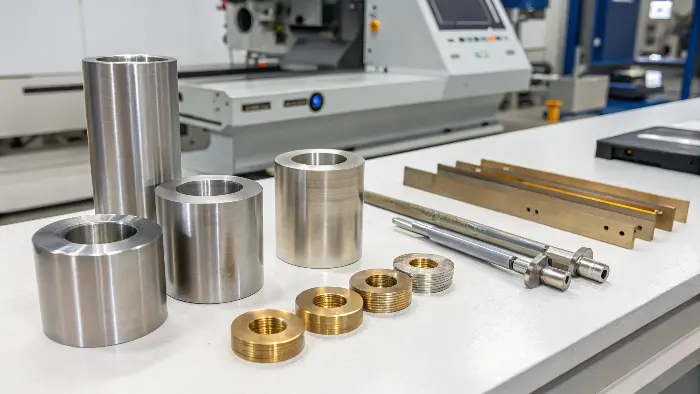
The material you choose is one of the most critical decisions you’ll make as an engineer or product designer. It impacts everything from the final part’s weight and durability to the total manufacturing cost and lead time. Understanding the landscape of available materials is the first step toward making an informed decision that ensures your project’s success. Let’s break down the options to help you choose with confidence.
What Kinds of Materials Can Be Used for CNC Machining?
You might think CNC machining is only for metals. This belief can limit your design possibilities. You could be missing out on the perfect material for your application, forcing you to over-engineer parts with expensive metals when a high-performance plastic would have been lighter, cheaper, and just as effective.
CNC machines can process a vast range of materials far beyond metals. They expertly handle various engineering plastics like ABS, PEEK, and Delrin, along with metals like aluminum, steel, and titanium. They can also machine softer materials like wood, composites such as carbon fiber, and even foam for modeling. The key is matching the material’s properties to the machine’s capabilities and using the right cutting tools.
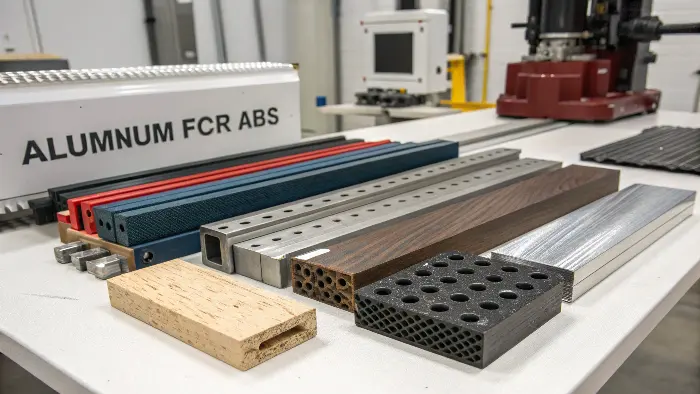
When I first started on the shop floor, I mostly saw aluminum and steel. But today, the range of materials we work with is incredible. The choice depends entirely on the part’s intended function. As an engineer like Alex in Germany knows, every project has unique demands for strength, weight, chemical resistance, and cost. Let’s look at the main categories.
Metals
This is the most traditional category for CNC machining. Metals offer superior strength, thermal conductivity, and a premium feel.
- Aluminum: The go-to choice for many projects. It’s lightweight, easy to machine, and cost-effective.
- Steel: Used when high strength, hardness, and wear resistance are needed.
- Brass: Easy to machine and corrosion-resistant, often used for fittings and electrical components.
- Titanium: Offers an exceptional strength-to-weight ratio and corrosion resistance, but it’s more expensive and difficult to machine. It’s common in aerospace and medical applications.
Engineering Plastics
Plastics are fantastic for many applications and are often a smarter choice than metal. They are lightweight, naturally corrosion-resistant, and can be more cost-effective.
- Delrin (Acetal/POM): Great for parts that need low friction and high stiffness, like gears or bearings.
- PEEK: A high-performance plastic that can handle extreme temperatures and harsh chemicals. It’s strong enough to replace metal in some demanding applications.
- Polycarbonate: Valued for its incredible impact resistance and optical clarity.
- ABS: A common, low-cost plastic perfect for general-purpose prototypes and enclosures.
I remember a client who initially specified an aluminum housing for a robotic sensor. After we discussed the operating environment, we realized a PEEK plastic part would offer better chemical resistance and reduce the robotic arm’s overall weight. This change saved him money and improved the final product’s performance.
| Material Category | Key Advantages | Common Applications |
|---|---|---|
| Metals | Strength, durability, conductivity | Housings, brackets, gears, structural parts |
| Plastics | Lightweight, corrosion resistance, cost-effective | Enclosures, insulators, low-friction components |
| Composites | High strength-to-weight ratio | Aerospace parts, high-performance automotive |
| Wood/Foam | Easy to machine, low cost | Architectural models, prototypes, molds |
What Is the Best Steel for CNC Machining?
You know you need the strength of steel, but the sheer number of alloys is daunting. Choosing the wrong one can make machining slow, expensive, and difficult. A hard-to-machine steel can break tools, ruin surface finishes, and delay your project, frustrating both you and your manufacturing partner.
For general-purpose CNC machining, 12L14 carbon steel is often considered the best due to its outstanding machinability, which allows for faster cutting and a smooth finish. For applications needing more strength and corrosion resistance, 303 stainless steel is an excellent choice. Ultimately, the "best" steel always depends on your specific requirements for strength, hardness, and environment.
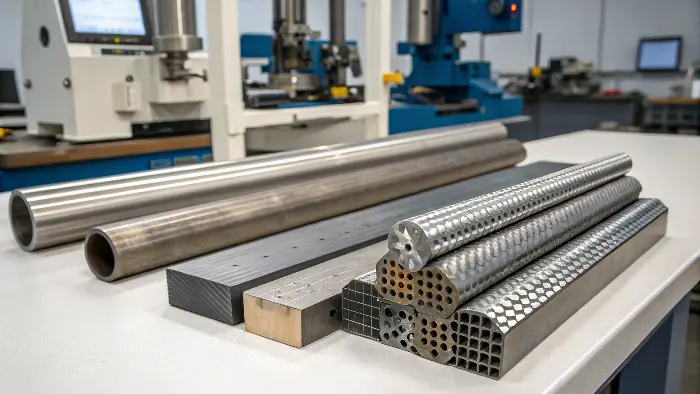
Steel isn’t just one material; it’s a huge family of alloys, each with a different personality. On the shop floor, we learn quickly which ones are cooperative and which ones will fight you every step of the way. The key is finding the right balance between the properties you need for your part and the machinability that keeps production costs down.
Carbon Steels – The Workhorses
These are the most common and affordable steels. Their properties are mainly defined by their carbon content.
- 12L14 Steel: This is a machinist’s dream. The ‘L’ in its name stands for lead, which is added to the alloy. The lead acts as a lubricant and helps the metal chips break off cleanly. This allows us to run the machines faster and achieve a beautiful surface finish with less tool wear. It’s perfect for high-volume parts like screws and fittings.
- 1018 Steel: This is a low-carbon steel that is tough, ductile, and excellent for welding. It’s not as easy to machine as 12L14, but its strength and weldability make it a great choice for structural parts, pins, and shafts.
Stainless Steels – For Corrosion Resistance
When your part will be exposed to moisture or chemicals, you need stainless steel. The chromium in these alloys creates a passive layer that resists rust.
- 303 Stainless Steel: This is the "free-machining" version of stainless steel. Similar to 12L14, it has sulfur added to make it easier to cut. It’s the best choice when you need corrosion resistance and efficient machining.
- 304 Stainless Steel: This is one of the most common stainless steels in the world, used in everything from kitchen sinks to industrial tanks. It has great corrosion resistance but is tougher and "gummier" to machine than 303.
- 316 Stainless Steel: This is the "marine grade" stainless. It has added molybdenum for superior corrosion resistance, especially against chlorides. It’s even more difficult to machine than 304.
Alloy Steels – For High Strength
When you need more strength than carbon steel can offer, you turn to alloy steels.
- 4140 Steel: This is a chromium-molybdenum alloy steel. It has high tensile strength and toughness, making it great for gears, axles, and other high-stress components. It can be heat-treated to become even harder, but it requires more careful machining than standard carbon steels.
| Steel Type | Key Feature | Machinability | Common Use |
|---|---|---|---|
| 12L14 Carbon Steel | Free-machining | Excellent | High-volume screws, fittings |
| 1018 Carbon Steel | Weldable, tough | Good | Shafts, pins, structural parts |
| 303 Stainless | Free-machining, corrosion resistant | Very Good | Nuts, bolts in corrosive environments |
| 304 Stainless | Corrosion resistant, strong | Fair | Food processing equipment, tanks |
| 4140 Alloy Steel | High tensile strength | Fair to Good | Gears, axles, high-stress parts |
How Exactly Do CNC Machines Cut Metal?
You send a CAD file to your supplier and get a perfect metal part back. But what happens in between? The actual cutting process can seem like a mysterious black box. Not understanding this process can lead you to create designs that are difficult or impossible to machine, causing frustrating delays and redesigns.
CNC machines cut metal using a subtractive process. A computer program, called G-code, guides a sharp, rotating cutting tool with extreme precision. The tool spins at high speed and moves into a block of material, carving away chips to reveal the final shape. The entire process relies on a careful balance of cutting speed, tool movement, and a constant flow of coolant.
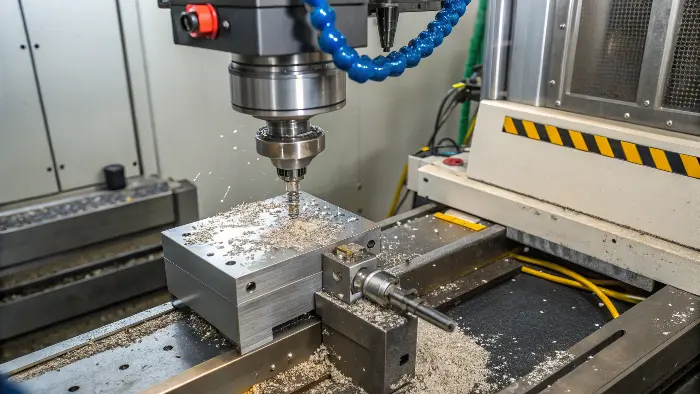
Watching a CNC machine work is still impressive to me, even after all these years. It’s a precise dance of mechanics and code. Let’s break down the three key elements that make it all happen.
The Role of G-Code
The brain of the operation is the G-code. This is the fundamental language of the CNC machine. It’s a long list of coordinates and commands that tell the machine exactly what to do. For example, a line of code might say, "Move the tool to position X, Y, Z," and another will say, "Turn the spindle on at 10,000 RPM." We don’t write this code by hand anymore. We use special CAM (Computer-Aided Manufacturing) software that analyzes your 3D CAD model and automatically generates the thousands of lines of G-code needed to machine the part.
The Cutting Action: Speeds and Feeds
This is where the machinist’s experience really comes into play. We have to define two critical variables:
- Spindle Speed: How fast the cutting tool rotates, measured in revolutions per minute (RPM).
- Feed Rate: How fast the tool moves across or into the workpiece, measured in millimeters or inches per minute.
Getting this balance right is essential. If the feed rate is too fast for the spindle speed, the tool can snap. If it’s too slow, the tool just rubs against the metal instead of cutting it, which generates a lot of heat and dulls the tool quickly. This perfect balance changes for every single material and tool combination. We can cut aluminum very fast, but we have to slow everything down for tough materials like stainless steel or titanium.
The Importance of Coolant
The third critical element is cutting fluid, or coolant. That liquid you see flooding the cutting area in videos serves two vital purposes. First, it lubricates the cutting edge, reducing friction between the tool and the metal. Second, and more importantly, it cools both the tool and the part. The friction of cutting generates immense heat, which can damage the tool and even warp the workpiece. The coolant carries this heat away. It also helps to flush the small metal chips away from the cutting zone, which is crucial for getting a clean cut and a good surface finish.
What Are the Cutting Tools in a CNC Machine Made Of?
The cutting tool does all the hard work, carving through solid metal. How can a small tool cut through steel without breaking instantly? If the tool material isn’t significantly harder and more heat-resistant than the workpiece, it will fail immediately, ruining the part and potentially damaging the machine.
CNC cutting tools are made from materials much harder and more wear-resistant than the metals they cut. The most common materials are High-Speed Steel (HSS), which is tough and affordable, and Solid Carbide (specifically Tungsten Carbide), which is extremely hard and heat-resistant, allowing for much faster cutting. For the most demanding jobs, tools with advanced coatings or diamond tips are used.
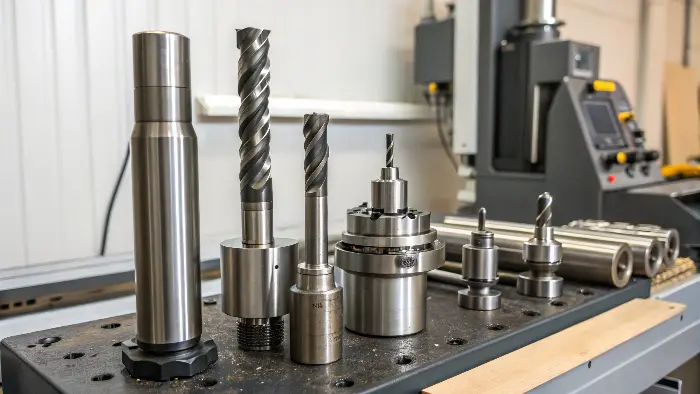
A CNC machine is only as good as the cutting tool at the end of its spindle. The material science behind these tools is fascinating. They have to be incredibly hard to hold a sharp edge, but also tough enough to resist chipping and breaking under pressure. Here are the materials we rely on every day.
High-Speed Steel (HSS)
This is the traditional material for cutting tools. It’s an alloy of steel that includes elements like tungsten and molybdenum, which help it stay hard even when it gets hot. HSS is very tough, meaning it can handle vibrations and resist chipping. This makes it a great, affordable choice for tools like drill bits and taps, where toughness is more important than raw speed.
Solid Carbide (Tungsten Carbide)
This is the modern standard for high-performance CNC machining, especially for milling tools called end mills. Carbide is not a steel; it’s a composite material made from tungsten carbide particles cemented together with cobalt. It is extremely hard and, crucially, it maintains that hardness at the very high temperatures generated during high-speed cutting. This property allows us to run our machines much faster than with HSS tools, leading to shorter cycle times and better productivity. The trade-off is that carbide is more brittle than HSS, so a stable, rigid machine setup is essential.
Advanced Coatings and Materials
To push performance even further, we often use carbide tools that have a microscopic layer of an advanced material coated onto their surface. These coatings, often only a few microns thick, can dramatically improve a tool’s performance.
- Titanium Nitride (TiN): This is the classic, gold-colored coating. It increases surface hardness and provides lubricity.
- Aluminum Titanium Nitride (AlTiN): This dark purple or black coating is a top performer. It forms a layer of aluminum oxide at high temperatures, which acts as a thermal barrier, protecting the carbide underneath. This makes it excellent for machining steels at high speeds, sometimes even without coolant.
- Diamond (PCD): For machining very abrasive non-ferrous materials like high-silicon aluminum or carbon fiber composites, we use tools with tips made of Polycrystalline Diamond (PCD). It’s one of the hardest materials available.
| Tool Material | Key Property | Best For |
|---|---|---|
| HSS | Toughness, low cost | Drilling, tapping, general use |
| Carbide | Hardness, heat resistance | High-speed milling of most materials |
| TiN Coated Carbide | Increased hardness, lubricity | General improvement over uncoated carbide |
| AlTiN Coated Carbide | High-temp hardness | High-speed machining of steels |
| PCD | Extreme hardness | Abrasive non-ferrous materials (aluminum, composites) |
Conclusion
Choosing the right material is fundamental to your project’s success. While aluminum is a fantastic and versatile default, the best material for your part—and the tool to cut it—always depends on your specific needs for strength, cost, and performance. A good manufacturing partner can help guide these decisions.