
Are you setting up a new workshop or trying to understand your manufacturing partner’s operations? The way machines are arranged on the floor seems simple, but it has a huge impact on efficiency, cost, and flexibility. Choosing the wrong layout can create bottlenecks and slow down your entire production schedule.
A process layout primarily uses general-purpose machines that can perform a variety of tasks. Unlike specialized equipment dedicated to one product, these machines—such as CNC mills, lathes, and grinders—are grouped by function. For example, all milling machines are in one area, and all turning machines are in another. This setup provides the flexibility needed for custom, high-mix manufacturing.
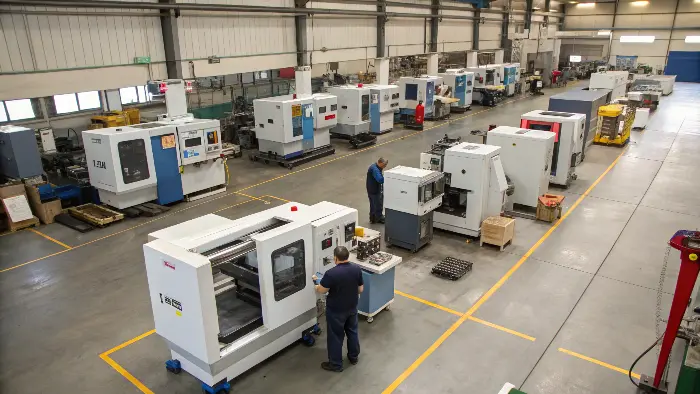
Understanding this concept is crucial for any engineer or product developer. When you send a design to a shop like mine, the layout of our facility directly affects how your part is made, how quickly it can be produced, and its final cost. It’s the operational backbone that allows us to handle diverse and complex projects. Let’s explore this system to see why it’s so powerful for custom work.
What is the process layout system?
Have you ever heard terms like "functional layout" or "job shop layout" and wondered how they apply to your project? This uncertainty can make it difficult to communicate your needs clearly with a manufacturing partner, potentially leading to misunderstandings about production flow and lead times.
A process layout system is a manufacturing strategy where similar machines or processes are grouped together into dedicated departments. For instance, all drilling operations happen in one section, all welding in another, and all milling in a third. A product moves between these departments based on the sequence of operations it requires. This system is built for flexibility.
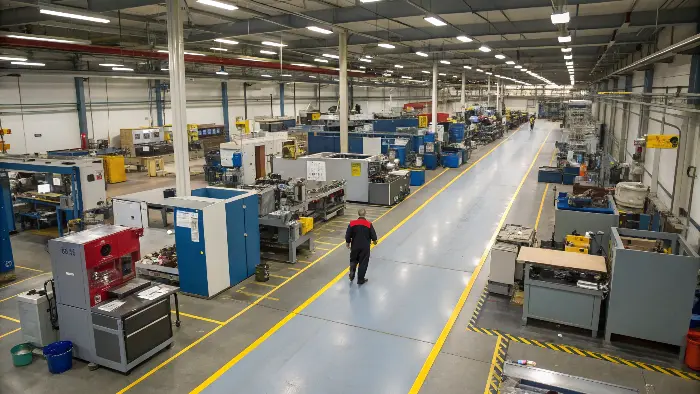
In my own shop, we live and breathe the process layout. It’s the only way we can effectively manage the wide range of projects we receive. One day, we might be machining complex titanium components for an aerospace client. The next, we could be producing a batch of aluminum housings for a robotics company like the one Alex, an engineer in Germany, works for. He needs precision and the ability to order different parts in small quantities. Our process layout is what makes this possible.
Grouping by Function, Not by Product
Think of a process layout like a large public library. All the science books are in one section, and all the history books are in another. If you need to research a topic that spans both subjects, you walk from one section to the other. A process layout works the same way. A part that needs to be milled and then drilled will travel from the milling department to the drilling department. This contrasts sharply with a product layout, which is more like a car assembly line. In a product layout, the machines are arranged in a straight line, in the exact order needed to make one specific product over and over again.
Here is a simple comparison to make it clear:
| Feature | Process Layout (Job Shop) | Product Layout (Assembly Line) |
|---|---|---|
| Machine Type | General-purpose (e.g., CNC Mill) | Specialized (e.g., custom engine block machine) |
| Flexibility | Very High | Very Low |
| Production Volume | Low to Medium | High |
| Product Variety | High | Low |
| Material Handling | Complex, variable paths | Simple, linear path |
| Worker Skill | High, versatile skills needed | Lower, specialized tasks |
The key takeaway is that the path a part takes is determined by its unique requirements, not by a fixed production line. This creates a more complex material flow but offers unmatched adaptability.
Which type of machine is used in a process layout?
You understand the concept of a process layout, but what specific equipment populates these functional departments? Choosing the right machines is a critical investment. The wrong choice can limit your shop’s capabilities, while the right ones can make your facility a powerhouse of versatility.
Process layouts are built around general-purpose machines that are not locked into producing a single item. The most common and essential machines are CNC milling machines, CNC lathes (or turning centers), drill presses, and grinders. Their strength lies in their adaptability; they can be quickly reprogrammed and retooled to make an entirely different part.
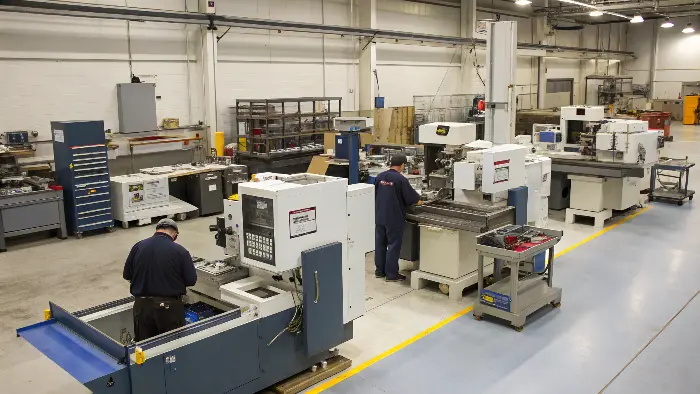
These machines are the workhorses of any custom manufacturing facility, including my own. They are the tools we use to turn our clients’ digital designs into physical reality. The "general-purpose" nature of this equipment is what allows us to say "yes" to a huge variety of projects, from simple brackets to incredibly complex, multi-operation components. Let’s look at what each of these machines does.
The Core Machines of a Functional Department
Each machine type forms the heart of its own department, defined by the function it performs.
- CNC Milling Machines: These are perhaps the most versatile machines in the shop. They use a rotating cutting tool to precisely remove material from a stationary workpiece. Our milling department has 3-axis, 4-axis, and 5-axis machines. This range allows us to create everything from simple slots and holes to complex 3D contours on multiple faces of a part in a single setup.
- CNC Lathes (Turning Centers): While a mill moves the tool, a lathe moves the part. It spins a block of material at high speed while a cutting tool removes material to create cylindrical features. This is how we make parts like shafts, pins, rings, and custom fittings. Modern turning centers can also have "live tooling," which allows them to perform some milling and drilling operations, further increasing their versatility.
- Drill Presses: While CNC machines can drill holes, a dedicated drilling department with various drill presses is essential for secondary operations and simple, high-volume hole-making tasks. They are straightforward, reliable, and a staple of any job shop.
- Grinding Machines: After a part is milled or turned, it may need to go to the grinding department. Grinding uses an abrasive wheel to remove tiny amounts of material. This process isn’t for rough shaping; it’s for achieving extremely tight tolerances and a very smooth surface finish, which is critical for parts like bearing shafts and sealing surfaces.
For an engineer like Alex, whose robotic components require extreme precision, a single part might visit multiple departments. The main housing could start in our 5-axis milling center, while the pivot shafts are made in the turning department. Both might then go to the grinding department for final finishing. The process layout makes this complex, multi-step journey efficient and manageable.
What type of production uses process layout?
You’re developing a production strategy and need to choose the right facility layout. Making the wrong choice can be disastrous. A layout that’s too rigid will kill your ability to innovate and customize, while one that’s too flexible for your product can create chaos and inefficiency for mass production.
A process layout is the ideal solution for high-mix, low-volume (HMLV) production. This environment includes job shops, custom fabrication services, R&D prototyping, and the manufacturing of products that have many different variations. It is the best choice whenever flexibility and customization are more important than the raw speed of making thousands of identical items.
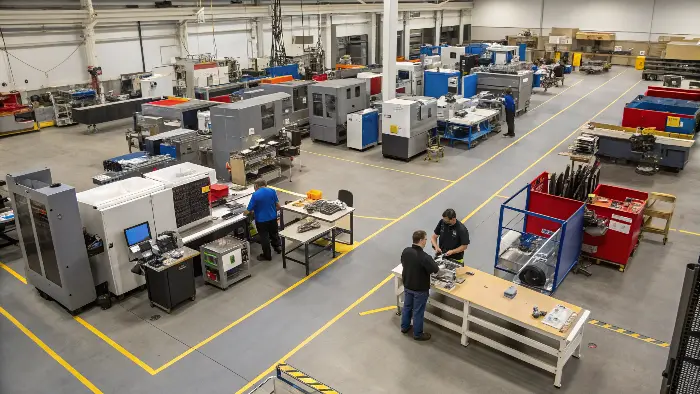
This HMLV model is the core of my business at QuickCNCs. We don’t have an assembly line churning out the same part all day. Instead, our schedule is a dynamic mix of different jobs for different clients. We might be working on an order of 20 unique medical device prototypes, 100 custom brackets for an architectural project, and 5 complex aerospace components all at the same time. A process layout is the only system that can handle this level of variety without constant, costly reconfiguration.
The World of High-Mix, Low-Volume (HMLV)
HMLV is the opposite of mass production. It’s characterized by a large number of different part designs, each ordered in small quantities. This is the reality for many modern industries.
- Prototyping: When you’re developing a new product, you need to make one, two, or maybe ten units for testing. A process layout is perfect for this one-off or very small batch work.
- Custom Machinery: Companies that build specialized factory machines or automation systems need thousands of unique components, but often only one of each.
- Aerospace & Defense: These industries require highly complex parts made from exotic materials, produced in very small, tightly controlled batches.
- Medical Devices: Custom implants, surgical tools, and prototype devices are all produced in low volumes with extremely high-quality standards.
The primary challenge in HMLV is managing complexity. Each job has its own unique routing through the shop, its own tooling requirements, and its own inspection criteria. A process layout excels here because it doesn’t force every part down the same path. It allows for independent, parallel workflows, so a simple job that only needs milling doesn’t have to wait for a complex job that is tying up the turning and grinding departments.
Here’s a guide to matching production volume with the right layout:
| Production Type | Typical Volume | Best Layout Choice | Example |
|---|---|---|---|
| Custom / Jobbing | 1 – 100 units | Process Layout | Custom CNC parts, prototypes |
| Batch Production | 100 – 5,000 units | Process or Cellular Layout | Furniture, industrial equipment |
| Mass Production | 10,000+ units | Product Layout | Automobiles, consumer electronics |
| Continuous Production | Non-stop | Product Layout | Oil refining, chemical processing |
For engineers like Alex, who are constantly iterating on designs and ordering small batches for testing and production, a supplier with a process layout is not just a good choice—it’s a necessity.
Conclusion
In manufacturing, the choice of machine and layout is fundamental. A process layout uses versatile, general-purpose machines like CNC mills and lathes, grouped by function. This creates an incredibly flexible system perfect for the high-mix, low-volume production that defines modern prototyping and custom manufacturing.