
Are your robotic arms failing under load or vibrating excessively? Designing transmission shafts isn’t just about connecting two points; it’s about avoiding catastrophic fatigue failure. Improper design leads to downtime and wasted prototypes. Let’s fix your torque transfer efficiency before your next build cycle begins.
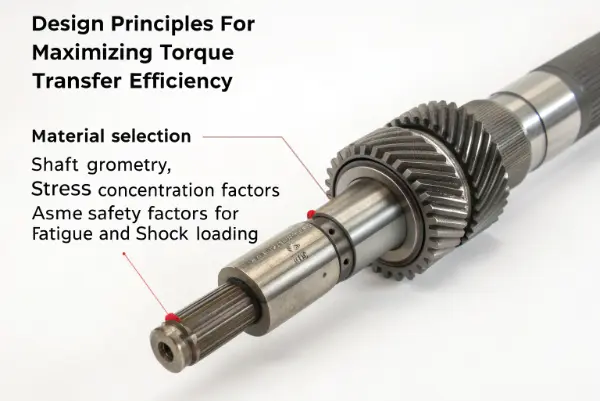
To maximize torque transfer efficiency in transmission shafts, you must balance material selection, shaft geometry, and stress concentration factors. The core principle involves minimizing torsional deflection while maintaining sufficient strength to handle peak loads. You achieve this by selecting high-strength alloys like 4340 steel, optimizing the polar moment of inertia, and strictly adhering to ASME safety factors for fatigue and shock loading.
Transition Paragraph:
Many engineers rush through the shaft design phase because they focus too much on the gears or the motor. However, the shaft is the backbone of the system. If the backbone is weak, the whole machine fails. I have seen this happen too many times in my career. Let’s look at exactly what a transmission shaft does first.
What is the function of the transmission shaft?
Do you view shafts merely as spinning rods? This dangerous oversimplification causes system misalignment. If you don’t fully grasp the dynamic role of the shaft, you will design parts that are either too heavy or too weak. This leads to inefficient robots and frustrated clients.
The primary function of a transmission shaft is to transmit power and torque from a driver (like a motor) to a driven component (like a gearbox or wheel) while supporting transverse loads such as bending moments. Ideally, it does this with zero energy loss. It must rigidly locate rotating parts like gears and pulleys, ensuring they remain perfectly aligned during operation.
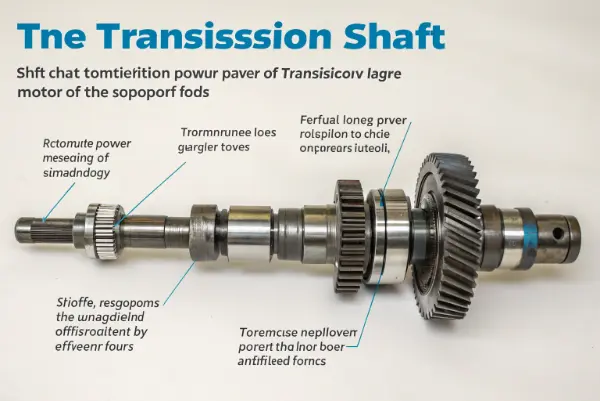
Let’s break this down further. When I was starting in the CNC shop, I often saw drawings where the engineer treated the shaft like a static beam. It is not static. It is a dynamic component subject to complex loading.
For an engineer like you, Alex, working on robotic arms, the function goes beyond just "spinning."
Key Functional Breakdown:
- Torque Transmission: This is the obvious one. The shaft must carry rotational force.
- Bending Support: Gears and pulleys exert radial and axial forces. The shaft must resist bending. If it bends too much, your gear teeth won’t mesh correctly.
- Positioning: Steps and shoulders on the shaft locate the parts axially.
We need to look at the specific loads.
| Load Type | Source | Consequence of Failure |
|---|---|---|
| Torsion | Motor input, Load resistance | Shearing of the shaft, Twisted splines |
| Bending | Gear separation forces, Belt tension | Fatigue cracks, misalignment, vibration |
| Axial (Thrust) | Helical gears, Worm gears | Bearing failure, Buckling (in long shafts) |
| Vibration | Critical speed resonance | Catastrophic shattering of components |
When you design for robotics, "function" also means stiffness. A shaft that twists too much (torsional deflection) acts like a spring. This introduces "wind-up" in your robotic arm. This kills your precision. You might tell the robot to move 10 degrees, but the shaft twists, and the arm only moves 9.8 degrees. This is unacceptable for high-tolerance work.
What is the torque transmission efficiency?
Is your motor working harder than it should? Power loss in a transmission system is often invisible until heat builds up. If you ignore efficiency, you burn through batteries and overheat motors. We need to stop these losses at the source.
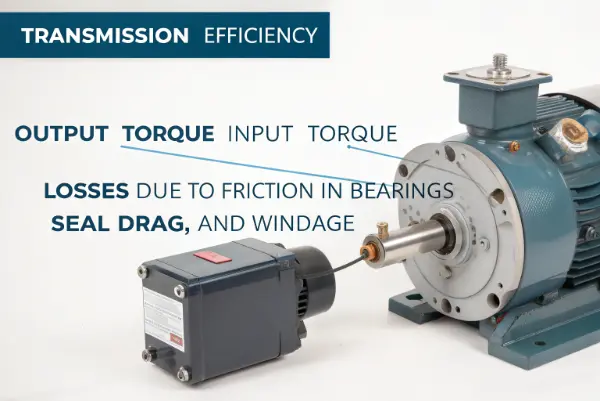
Torque transmission efficiency is the ratio of output torque to input torque, typically expressed as a percentage. It measures how effectively the shaft delivers power to the load after accounting for losses. In a well-designed solid steel shaft, material damping losses are negligible, so efficiency is primarily determined by the friction in bearings, seal drag, and windage losses.
I remember a project where a client blamed our machining for a "sluggish" system. The parts were perfect, within 0.01mm tolerance. The problem was the design concept of efficiency.
Efficiency isn’t just about the material of the shaft itself. A steel rod transmits nearly 100% of the torque applied to it internally. The losses come from the system the shaft lives in.
Where does the torque go?
- Bearing Friction: This is the biggest thief. If your shaft deflects (bends) too much because it is too thin, it puts edge-loading on the bearings. This increases friction significantly.
- Misalignment: If the machining of the shaft shoulders isn’t perpendicular to the centerline, the bearings bind.
- Hysteresis: In very long shafts or composite shafts, the material itself absorbs some energy as it twists and untwists.
Critical Thinking for Robotics:
For your robotic joints, you are likely using short, stiff shafts. Your efficiency concerns should focus on connection interfaces.
- Keys vs. Splines: A loose keyway allows backlash. This isn’t strictly an "efficiency" loss in power, but it is a massive efficiency loss in motion control.
- Interference Fits: Press fits are great for efficiency because there is zero slip. However, they are hard to assemble.
Here is a checklist to maximize system efficiency:
- Surface Finish: We polish bearing journals to Ra 0.4 or better to reduce seal drag.
- Geometric Tolerance: Runout must be minimized. A wobbling shaft wastes energy vibrating the whole machine.
- Stiffness: A stiffer shaft keeps bearings happy. Happy bearings mean high efficiency.
What is the ASME code for shaft design?
Are you guessing your safety factors? Relying on intuition for shaft sizing is a recipe for a lawsuit or a recall. Without a standardized approach, you risk catastrophic fatigue failure. You must follow the proven standard to ensure reliability.
The ASME code for shaft design (specifically the Standard for Design of Transmission Shafting) provides a formula to determine the minimum required shaft diameter. It combines static loads (bending and torsion) with dynamic factors for fatigue and shock. The code ensures the shaft can withstand combined shear and normal stresses efficiently.
When I help clients optimize their designs for CNC production, I often ask, "Did you use the ASME equation?" Sometimes they look blank. The ASME code is not just a suggestion; it is the industry standard for safe design.
The classic ASME equation for a solid shaft considers two main types of stress:
- Bending Moment (M): Tries to snap the shaft.
- Torque (T): Tries to twist the shaft.
But the real magic of the ASME code is how it handles Fatigue and Shock. It introduces factors $K_b$ (for bending) and $K_t$ (for torsion).
The simplified logic looks like this:
$$ Diameter = \left[ \frac{32 \cdot N}{\pi} \sqrt{ (K_b \frac{M}{S_e})^2 + (K_t \frac{T}{S_y})^2 } \right]^{1/3} $$
Where:
- $N$ is the safety factor.
- $S_e$ is the endurance limit (crucial for fatigue!).
- $S_y$ is the yield strength.
Why this matters to you, Alex:
In robotics, movements are jerky. You have sudden stops and starts. This is "Shock Loading."
- If the load is applied gradually, $K_b$ and $K_t$ are near 1.0.
- If the load is applied with heavy shock (like a robot arm hitting a hard stop), these factors can jump to 2.0 or 3.0.
If you ignore these K-factors, your shaft diameter will be too small. It might work for a week, but it will fail from fatigue after 10,000 cycles. We can machine the shaft to any size, but I prefer to machine it once, correctly. By using the ASME code, you essentially "buy insurance" against fatigue failure.
How to calculate the maximum torque of a shaft?
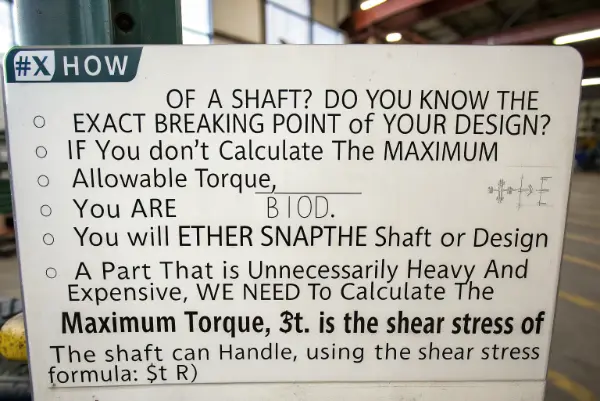
Do you know the exact breaking point of your design? If you don’t calculate the maximum allowable torque, you are flying blind. You will either snap the shaft or design a part that is unnecessarily heavy and expensive. We need to find the limit.
To calculate the maximum torque a shaft can handle, you use the shear stress formula: $T = (\tau \cdot J) / r$. Here, $T$ is torque, $\tau$ is the allowable shear stress of the material, $J$ is the polar moment of inertia, and $r$ is the shaft radius. For hollow shafts, $J$ changes to account for the missing core material.
This is where the rubber meets the road. As a manufacturer, I see designs where the engineer wants a tiny shaft to transmit massive torque. I have to tell them: Physics says no.
Let’s break down the formula $T = (\tau \cdot J) / r$ practically.
-
Allowable Shear Stress ($\tau$): This depends on your material. For a standard steel like 1045, this is lower. For a chromoly steel like 4340 (which I recommend for your robotics), this is much higher. You usually set this as $0.577 \times \text{Yield Strength}$ (based on Von Mises theory) divided by your safety factor.
-
Polar Moment of Inertia ($J$): This represents the geometry’s resistance to twisting.
- Solid Shaft: $J = (\pi \cdot d^4) / 32$
- Hollow Shaft: $J = (\pi \cdot (d_o^4 – d_i^4)) / 32$
The Hollow Shaft Advantage:
Alex, since you work in robotics, weight is your enemy. Notice the $d^4$ in the formula? The material on the outside of the shaft does almost all the work. The material in the center does almost nothing for torque transmission.
By using a hollow shaft, you reduce weight significantly while keeping $J$ almost the same.
Calculation Step-by-Step Table:
| Step | Action | Practical Tip |
|---|---|---|
| 1 | Identify Material | Choose 4140 or 4340 Steel for high torque. |
| 2 | Determine Max Stress | Use Yield Strength / Safety Factor (e.g., 2.0). |
| 3 | Measure Geometry | Get the outer diameter. Since it is to the power of 4, small increases in Diameter = Huge gains in Torque. |
| 4 | Adjust for Keyways | Crucial: A keyway reduces the strength of the shaft. Reduce your calculated max torque by 15-25% if a keyway is present. |
If you calculate this wrong, the shaft shears. It snaps clean off. I always advise my clients to double-check the "Stress Concentration Factors" ($K_t$) at the shoulders where the diameter changes. That is usually where the torque kills the shaft, not in the middle.
Conclusion
To design a high-efficiency transmission shaft, you must use the ASME code to account for fatigue, choose hollow geometries to maximize the torque-to-weight ratio, and ensure precise alignment to minimize system friction.