
You spend weeks perfecting a design, only for the final part to fail prematurely due to corrosion or wear. It is a frustrating reality for many engineers. The right surface finish isn’t just about aesthetics; it is critical for functionality, longevity, and performance in demanding applications like robotics.
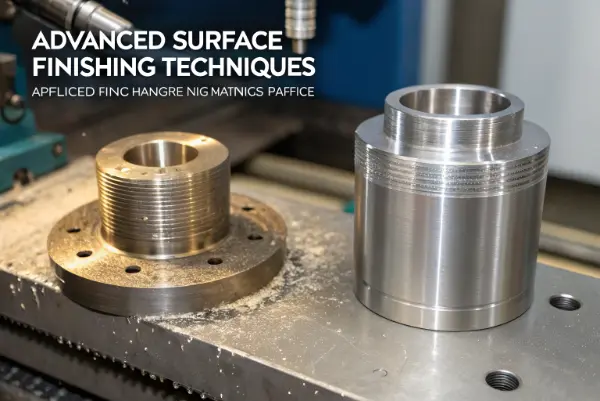
Advanced surface finishing techniques are specialized processes applied after machining to improve surface properties such as hardness, corrosion resistance, and conductivity. Methods like Anodizing Type III, Electropolishing, and DLC (Diamond-Like Carbon) coating significantly enhance a component’s durability and reduce friction. These finishes ensure parts meet tight tolerances and survive harsh operating environments.
Many engineers treat surface finishing as an afterthought. They focus entirely on the geometry and the raw material. However, the skin of the part interacts with the world. If you neglect this step, you risk costly failures. Let’s look at the specific techniques that can transform a good part into a great one.
Is Hard Anodizing (Type III) the Best Choice for Aluminum Wear Resistance?
Standard anodizing looks nice, but it often scratches too easily for industrial use. When you are building robotic arms or moving assemblies, you need a surface that can take a beating. Standard cosmetic finishes simply cannot withstand the constant friction and abrasion of high-cycle machinery.
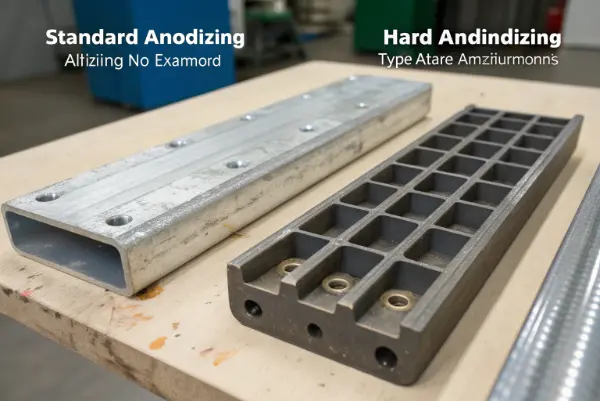
Hard Anodizing, or Type III Anodizing, creates a thick, dense oxide layer on aluminum parts that rivals the hardness of tool steel. It provides exceptional wear resistance and electrical insulation, making it ideal for sliding parts, gears, and heavy-duty housings. This finish penetrates the material as much as it builds up, ensuring a robust bond that won’t flake off.
Breaking Down Hard Anodizing
Let’s dig deeper into why this matters for your projects. In my years at QuickCNCs, I have seen clients switch from steel to aluminum to save weight, only to fail because the surface was too soft. Hard anodizing bridges that gap. It allows you to use lightweight aluminum while maintaining a surface hardness of 60-70 Rockwell C. That is incredibly hard.
However, you must be careful with tolerances. Unlike standard anodizing, Type III adds significant thickness. Typically, the coating thickness ranges from 25 to 50 microns (0.001 to 0.002 inches). The critical detail is that the growth is 50/50. Half of the coating penetrates the aluminum, and half builds up on the surface.
If you have a bore with a tolerance of ±0.01mm, a 50-micron hard coat will make that hole undersized by roughly 50 microns per side. You must account for this "build-up" during the machining stage.
Here is a quick comparison to help you decide:
| Feature | Standard Anodizing (Type II) | Hard Anodizing (Type III) |
|---|---|---|
| Thickness | 5–25 microns | 25–150 microns |
| Primary Use | Cosmetic, mild corrosion protection | Wear resistance, electrical insulation |
| Color | Can be dyed almost any color | Dark Grey to Black (dyes poorly) |
| Hardness | Moderate | Very High (wear resistant) |
| Cost | Lower | Higher |
When I consult with engineers like you, I always ask about the mating parts. If an aluminum shaft slides inside a bushing, Type III is non-negotiable. It prevents "galling," where the aluminum tears itself apart under friction. Just remember to tell us your final dimensional requirements so we can machine the part slightly smaller to accommodate the coating growth.
Can Electropolishing Significantly Improve Corrosion Resistance in Stainless Steel?
Stainless steel is supposed to be rust-proof, but have you ever seen it corrode anyway? This usually happens because microscopic impurities or iron particles get trapped in the surface peaks during machining. In cleanroom environments or medical robotics, even a tiny spot of rust is unacceptable.
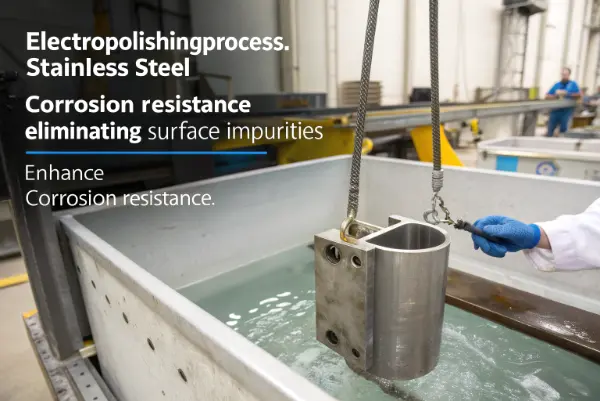
Electropolishing is an electrochemical process that removes surface material from metal parts, effectively smoothing out microscopic peaks and valleys. By removing the outer layer of the metal, it eliminates surface impurities and drastically improves corrosion resistance. It leaves the surface bright, clean, and passivated, making it harder for bacteria or rust to take hold.
The Science of "Reverse Plating"
Think of electropolishing as "reverse plating." Instead of adding material, we remove it. We submerge the part in an electrolyte bath and apply an electric current. The current focuses on the microscopic peaks of the surface roughness. It dissolves these peaks faster than the valleys. This results in a surface that is not just shiny, but chemically clean.
From a practical standpoint, this reduces the surface roughness (Ra) by up to 50%. If you machine a part to Ra 0.8 μm, electropolishing can bring it down to Ra 0.4 μm or better without mechanical grinding. This is crucial for complex shapes where a grinding wheel cannot reach.
I recall a project for a fluid control system. The client had issues with fluid sticking to the inside of a manifold. Mechanical polishing was impossible due to the internal channels. We switched to electropolishing. It smoothed the internal surfaces, improved the flow rate, and stopped the fluid retention.
Here are the key benefits you should consider:
- Passivation: It removes free iron from the surface, which is the main cause of surface rust on stainless steel.
- Stress Relief: It removes the stressed surface layer caused by the cutting tool, which can improve fatigue life.
- Deburring: It acts as a micro-deburring process. It removes fine burrs that are too small to see but big enough to cause mechanical issues.
However, be aware of the material removal. We typically remove about 10 to 20 microns of material. For high-precision threads or press-fit holes, we must mask those areas or machine them slightly oversize. It is not just about making it shiny; it is about changing the chemical stability of the surface.
Why Should You Consider DLC (Diamond-Like Carbon) Coating for High-Friction Applications?
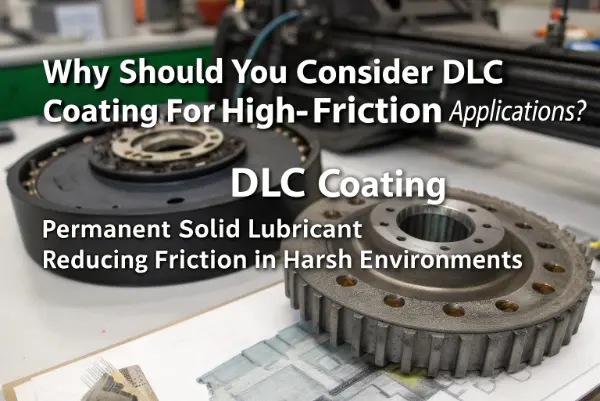
Lubrication failure is a nightmare for mechanical engineers. Sometimes you have parts in a vacuum or a sensitive environment where you simply cannot use grease or oil. Without lubrication, friction destroys the mechanism. You need a coating that acts as a permanent, solid lubricant.
DLC (Diamond-Like Carbon) coating creates a super-hard, low-friction surface that mimics the properties of natural diamond. It creates an extremely thin, chemically inert layer that significantly reduces the coefficient of friction. This coating is perfect for engine components, bearings, and cutting tools that face high contact pressure and sliding speeds.
Understanding the Black Magic of DLC
DLC is one of the most advanced finishes available today. It is applied using a process called Physical Vapor Deposition (PVD) in a vacuum chamber. The result is a sleek, black finish that looks incredible, but its performance is where it truly shines.
The hardness of a good DLC coating can exceed 2,000 Vickers (HV). For context, hard chrome is usually around 1,000 HV. This extreme hardness protects the substrate from abrasive wear. But the real "magic" is the friction coefficient. Steel sliding on steel has a friction coefficient of about 0.8. Steel with DLC sliding on steel can drop that to 0.1 or less. It is almost as slippery as Teflon, but hard as a rock.
In my experience helping clients with high-speed automation, DLC is a problem solver. We had a customer with a packaging machine. A guide rail was wearing out every month because paper dust was soaking up the oil. We applied DLC to the rails and ran them dry. They lasted over a year.
Here is a breakdown of when to use DLC versus other hard coatings:
| Characteristic | DLC Coating | TiN (Titanium Nitride) | Hard Chrome |
|---|---|---|---|
| Color | Black / Dark Grey | Gold | Silver |
| Hardness (HV) | 2000 – 9000 | ~2300 | ~1000 |
| Friction Coeff. | 0.05 – 0.2 (Very Low) | 0.4 – 0.6 | 0.2 – 0.6 |
| Application Temp | < 300°C (typically) | < 500°C | < 400°C |
One critical note: DLC is very thin, usually 2 to 4 microns. It will follow the texture of the surface underneath. If your machined surface is rough, the DLC will be rough. You must polish the part to a high finish before coating to get the full low-friction benefit. Also, because the process happens at around 150-200°C, you must ensure your base material will not temper or warp at those temperatures.
Is Chemical Nickel Plating the Answer for Uniform Coverage on Complex Geometries?
Electroplating has a major flaw: the "dog bone" effect. Electrical current concentrates on corners and edges, making the plating thick on the outside and thin in deep recesses. If you have a complex manifold with internal channels, standard plating won’t protect the inside.
Electroless Nickel Plating (Chemical Nickel) deposits a uniform layer of nickel-phosphorus alloy onto a part without using electrical current. This auto-catalytic process ensures that the plating thickness is perfectly even on every surface the solution touches, including deep holes and internal cavities. It offers excellent corrosion resistance and natural lubricity.
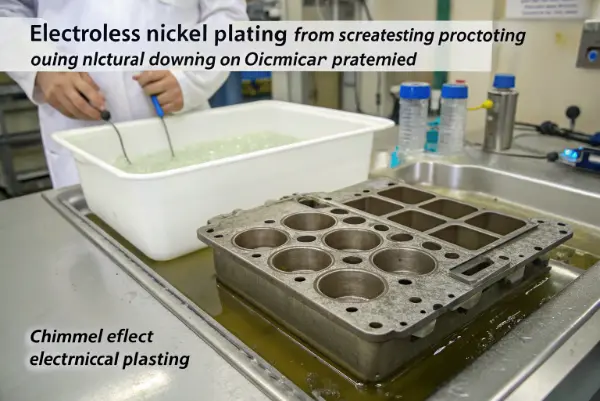
Consistency is Key
This is often the "go-to" finish for complex engineering components. The "Electroless" part means we rely on a chemical reaction, not electricity. Because there are no electric field lines to worry about, the deposition rate is the same everywhere.
If you specify a 10-micron layer, you get 10 microns on the sharp external corner and 10 microns inside a blind hole. This predictability is massive for precision machining. I often recommend this for parts with tight geometric tolerances where you cannot afford the uneven build-up of standard zinc or nickel electroplating.
We can also vary the phosphorus content to change the properties:
- Low Phosphorus (1-4%): Very hard, almost like chrome. Good wear resistance but lower corrosion resistance.
- Medium Phosphorus (5-9%): The industry standard. Good balance of brightness, hardness, and corrosion protection.
- High Phosphorus (10%+): The best corrosion resistance. It is non-magnetic and very ductile.
I worked with a German client designing a sensor housing for a marine environment. They needed corrosion protection but also needed the part to be non-magnetic so it wouldn’t interfere with the sensor. High-phosphorus electroless nickel was the only solution that fit all the criteria.
Another advantage is hardness post-treatment. As plated, the hardness is around 45-50 HRC. However, if we bake the part at 400°C for an hour, the hardness jumps to nearly 70 HRC. This is comparable to hard chrome but with far better uniformity.
Just remember, the surface needs to be chemically clean before plating. Also, because it is an alloy, the color is slightly yellowish-silver, not the blue-bright silver of standard chrome. If color matching is important, keep this in mind. But for pure engineering function on complex shapes, it is hard to beat.
Conclusion
Choosing the right finish—whether it is Hard Anodizing, Electropolishing, DLC, or Electroless Nickel—can determine the success of your project. Each method offers unique strengths for wear, friction, or corrosion. At QuickCNCs, we help you navigate these choices to ensure your precision parts perform perfectly.