
You need strong, corrosion-resistant parts, but machining stainless steel is notoriously difficult. A small mistake can ruin your part, waste expensive material, and delay your entire project. I’ve seen it happen, and it’s frustrating. But you can get it right the first time.
To master stainless steel CNC machining, you must select the correct alloy, use appropriate cutting tools with specific coatings, and optimize machining parameters like speed, feed, and depth of cut. Applying high-pressure coolant is also essential to manage heat and prevent work hardening, ensuring both precision and tool longevity.
Over my years in the industry, I’ve managed thousands of stainless steel projects. I’ve seen engineers struggle when they treat it like any other metal. But it’s a unique material with its own set of rules. Once you understand those rules, you can unlock its full potential for creating incredibly durable and precise components. I want to share what I’ve learned to help you navigate this process smoothly. Let’s dive into the details that make all the difference between a failed part and a successful product launch.
Which Stainless Steel Grade is Best for Your CNC Project?
Choosing a stainless steel grade can feel overwhelming. You know the material needs to be strong and resist rust, but picking the wrong one can lead to poor performance or unnecessary costs. This choice directly impacts your part’s function and your project’s budget, so it’s a critical decision.
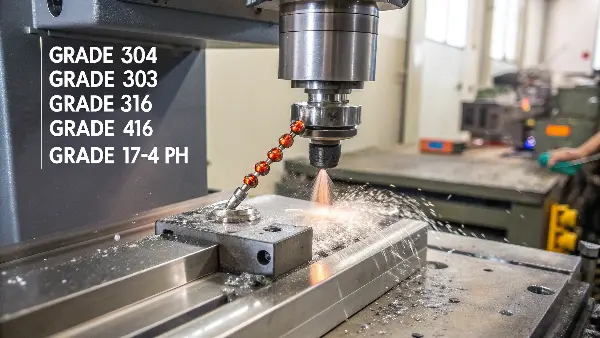
For general-purpose applications, Grade 304 is a cost-effective and versatile choice. If you need superior machinability, choose Grade 303. For parts exposed to harsh, corrosive environments like saltwater, Grade 316 is the best option. And for high-strength requirements where hardness is key, consider martensitic grades like 416 or precipitation-hardening grades like 17-4 PH.
When you get a request for a quote, the material is often the first thing I look at. It tells me so much about the part’s intended use. I remember a client, a German engineer designing a sensor housing for a marine environment. He had specified SS 304 to save on cost. I called him and asked about the application. Once he mentioned saltwater, I strongly recommended switching to SS 316. It was a slightly higher upfront cost, but it saved his product from failing due to corrosion just months after launch. This is why understanding the grades is not just about machinability; it’s about product success. There are a few main families of stainless steel, each with unique properties.
Austenitic Stainless Steels
These are the most common grades, known for their excellent corrosion resistance and formability. They are non-magnetic.
- SS 304: The workhorse of the industry. It offers a great balance of corrosion resistance, strength, and cost. Perfect for kitchen equipment, architectural panels, and general-purpose housings.
- SS 303: This is the "free-machining" version of 304. The addition of sulfur makes it much easier to cut, which can lower machining costs. However, that sulfur slightly reduces its corrosion resistance and makes it unsuitable for welding.
- SS 316: The "marine grade." By adding molybdenum, its resistance to chlorides (like salt and de-icing chemicals) is significantly improved. It’s the go-to for medical implants, marine hardware, and chemical processing equipment.
Martensitic and PH Stainless Steels
These alloys can be heat-treated to achieve very high hardness and strength, similar to carbon steels.
- SS 416: Like 303, this grade has added sulfur for improved machinability. It can be hardened and tempered to create strong, wear-resistant parts like valves, gears, and shafts.
- 17-4 PH: This is a precipitation-hardening (PH) grade. It offers an amazing combination of high strength, good corrosion resistance, and toughness. It’s a favorite in aerospace, defense, and high-performance industries for components that need to withstand extreme stress.
Here is a simple table to help you decide:
| Grade | Key Feature | Best For | Machinability |
|---|---|---|---|
| SS 303 | Best Machinability | High-volume, complex parts | Excellent |
| SS 304 | Balanced & Affordable | General-purpose components | Fair |
| SS 316 | Superior Corrosion Resistance | Marine, medical, chemical apps | Fair to Poor |
| SS 416 | Hardenable & Machinable | Shafts, valves, fasteners | Good |
| 17-4 PH | Ultra-High Strength | Aerospace, high-stress parts | Fair |
What Are the Biggest Challenges When Machining Stainless Steel?
You have a perfect design and the right stainless steel grade, but your machine shop is struggling. Tools are breaking, finishes are poor, and lead times are getting longer. These issues are frustrating and costly, often stemming from the unique properties of stainless steel that make it difficult to machine.
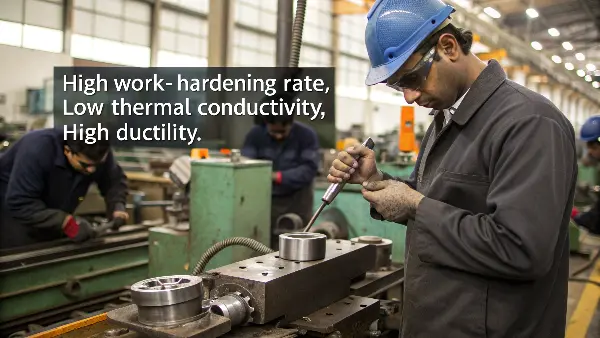
The main challenges in machining stainless steel are its high work-hardening rate, low thermal conductivity, and high ductility. Work hardening makes the material harder as you cut it, low thermal conductivity traps heat at the tool tip, and high ductility creates long, stringy chips that can damage the part and tool.
I’ve spent countless hours on the shop floor troubleshooting these exact problems. One of the classic mistakes I see is a programmer telling the machine to "dwell" or pause a cut midway through. With aluminum, that’s no big deal. With stainless steel, it’s a disaster. The tool spins in place, generating immense heat and instantly work-hardening the surface into a layer that’s nearly impossible to cut. The next time the tool engages, it can snap. Addressing these challenges requires a specific strategy, not just more force. Let’s break down each problem and how we solve it.
The Problem of Work Hardening
Stainless steel, especially the 300-series, hardens very quickly when mechanical stress is applied. As your cutting tool removes material, the layer just beneath the cut becomes significantly harder than the original material.
- Critical Thinking: Why does this happen? The cutting action deforms the crystal structure of the steel, making it more resistant to further deformation. If you use a light depth of cut or your tool isn’t sharp enough, you are rubbing more than cutting, which rapidly hardens the surface.
- Solution: We combat this with an aggressive approach.
- Use Sharp Tools: A sharp edge cuts cleanly without excessive rubbing.
- Maintain Constant Feed: Never stop the tool in the middle of a cut. Keep it moving through the material.
- Sufficient Depth of Cut: Take a deep enough cut to get below the previously hardened layer from the last pass.
Battling Heat Buildup
Stainless steel is a poor conductor of heat. Unlike aluminum, which pulls heat away from the cutting zone, stainless steel traps it right at the tool’s cutting edge. This intense heat is the primary enemy of your cutting tools.
- Critical Thinking: If heat is the problem, how do you remove it effectively? The heat can soften the cutting tool, cause it to wear rapidly, and even alter the properties of the stainless steel part itself.
- Solution: An effective cooling strategy is non-negotiable.
- High-Pressure Coolant: We use systems that blast coolant directly at the cutting zone, not just flood the area. This actively flushes away heat and chips.
- Through-Spindle Coolant: For drilling and deep pockets, coolant is fed through the tool itself for maximum effectiveness.
- Appropriate Speeds: Running too fast generates excessive heat. We often reduce cutting speeds compared to steel while increasing the feed rate to maintain productivity.
Managing Stringy Chips
The high ductility of austenitic stainless steels means they tend to form long, continuous, stringy chips instead of small, manageable ones.
- Critical Thinking: Why are stringy chips bad? They can wrap around the tool and the part (a "bird’s nest"), causing them to break, ruining the surface finish, and potentially stopping the machine.
- Solution: The goal is to break the chip into smaller pieces.
- Chipbreaker Geometries: We use cutting inserts with special molded geometries designed to curl and break the chip.
- Peck Drilling: When drilling, instead of going in one continuous motion, the tool "pecks"—drilling a short distance, retracting to break the chip, and then continuing.
- High Feed Rates: A higher feed rate can also help force the chip to break.
By understanding and planning for these three challenges, we can machine stainless steel efficiently and repeatably, producing high-quality parts every time.
How Can You Control Costs on Stainless Steel CNC Parts?
You need the performance of stainless steel, but the quotes you’re receiving are higher than you budgeted for. The raw material is expensive, and the machining is slow, making every part a significant investment. You’re worried that the cost might make your project unfeasible.
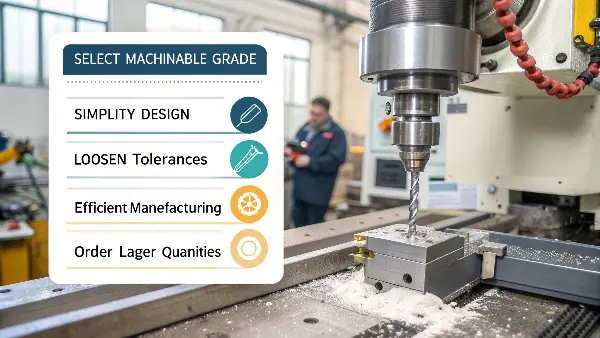
To control costs, select the most machinable grade that meets your requirements (like 303 vs. 316), simplify your design by removing non-critical features, and loosen tolerances wherever possible. Designing for efficient manufacturing and ordering in larger quantities can also significantly reduce the per-part price.
One of the biggest cost drivers I see is over-tolerancing. An engineer, let’s call him Alex, once sent me a drawing for a simple bracket. It was a non-critical part, but every dimension was specified with a tolerance of ±0.01mm. Machining to that level of precision on stainless steel requires special handling, slower speeds, and multiple inspection steps. I contacted Alex and asked if those tight tolerances were truly necessary. After reviewing the assembly, he realized most could be opened up to ±0.1mm. That single change cut the machining time in half and reduced the part cost by nearly 40%. It’s a perfect example of how design decisions directly impact the final price.
Smart Material Selection
The grade you choose has a direct impact on cost. This isn’t just about the price per kilogram of the raw material; it’s about how that material behaves in the machine.
- Machinability is Key: As mentioned earlier, a grade like SS 303 machines much faster than SS 304 or SS 316. If your part doesn’t require the absolute best corrosion resistance, choosing a free-machining grade can lead to huge savings in machine time, which is often more expensive than the material difference.
- Actionable Tip: Always ask yourself: "Do I really need the properties of a difficult-to-machine grade?" Consult your machinist. We can often suggest a more cost-effective alternative that still meets all your functional needs.
Design for Manufacturing (DFM)
How you design your part has the single biggest influence on its cost. A complex design is an expensive design.
- Simplify Geometries: Avoid deep pockets, sharp internal corners, and very thin walls. Deep pockets require long, fragile tools that can break. Sharp internal corners require slow EDM processes or can’t be machined at all (a small radius is always better). Thin walls are prone to vibration and warping.
- Tolerances and Finishes: Be realistic. Only apply tight tolerances and fine surface finishes to the specific surfaces where they are absolutely necessary for function. The rest of the part can have standard, more affordable tolerances.
| Design Choice | High-Cost Version | Lower-Cost Version | Reason for Savings |
|---|---|---|---|
| Internal Corners | Sharp 90° corner | 1mm or larger radius | Avoids slow EDM; allows faster endmill use. |
| Hole Depth | 10x diameter | < 5x diameter | Reduces risk of tool breakage and cycle time. |
| Wall Thickness | < 1mm | > 1.5mm | Minimizes vibration, warping, and special handling. |
| All-Over Tolerance | ±0.02mm | ±0.1mm (except critical features) | Drastically reduces machine time and inspection. |
The Power of Volume
Finally, consider your order quantity. Setting up a CNC machine for a stainless steel job is time-consuming. The operator has to load the program, set up the workholding, and calibrate the tools. This setup cost is the same whether you order 1 part or 100 parts.
- Economies of Scale: When you order a larger batch, that setup cost is divided across more parts, lowering the price of each one. I recently quoted a part that was $150 for a single prototype. At a quantity of 50, the price dropped to $45 per part. If you know you will need more parts later, ordering them all at once can unlock significant savings.
Conclusion
Mastering stainless steel machining is about smart choices in material, design, and process. Understanding these key factors will help you get strong, precise, and cost-effective parts for your projects.