
You’ve designed a perfect metal part, but now you face the uncertainty of manufacturing costs. Quotes from different shops can vary wildly, leaving you confused and making it difficult to budget your project. Understanding the factors that make up the final price is the first step to gaining control.
The total cost to CNC machine a metal part is a sum of several key factors. These include the raw material cost, the machining time required, programming and setup fees, specific tooling expenses, and any post-processing or finishing steps. The part’s complexity, required tolerances, and the order quantity have the biggest impact on the final price you pay.
Getting a clear picture of manufacturing costs isn’t just about finding the cheapest price. It’s about understanding the value you receive and making smart design choices that save you money without sacrificing quality. I’ve worked with hundreds of engineers like Alex from Germany, helping them navigate these details. Let’s break down exactly how these costs are calculated so you can approach your next project with confidence and get the best possible price for your parts.
How is CNC machining cost calculated?
You receive a quote for your part, but the single number on the page doesn’t tell you the whole story. It feels like a black box, making it hard to know if you’re getting a fair deal. Knowing the formula behind the price helps you ask the right questions.
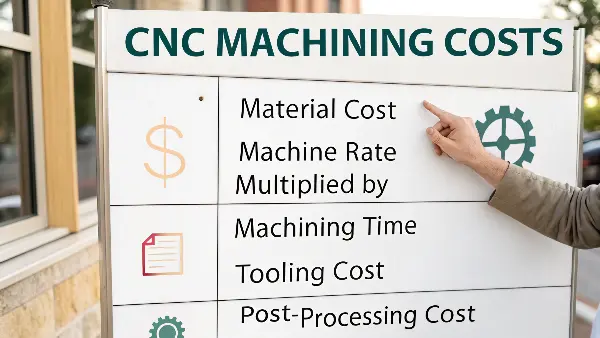
CNC machining cost is calculated by adding these core components: Material Cost + (Machine Rate × Machining Time) + Tooling Cost + Post-Processing Cost. Machining time includes both the initial setup and the actual cutting time for each part. Understanding this breakdown is the key to optimizing your designs for manufacturing and reducing expenses.
I always tell my clients that a good quote is a transparent one. When I was starting out, I learned that explaining the ‘why’ behind the price builds trust. An engineer in Germany, Alex, once sent me a design for a robotic arm joint. His previous supplier gave him a price with no explanation. We walked through my quote line by line, showing him exactly how material choice and a small design tweak to reduce machining time could lower his costs by 15%. This transparency is what builds long-term partnerships. Let’s dive deeper into each part of that cost formula.
Breaking Down the Cost Formula
The price of a CNC machined part isn’t arbitrary. It’s based on a clear formula that we can break down into five main parts. Think of it as Total Cost = Material + Setup + Machining + Tooling + Finishing. Understanding each piece helps you see where your money is going and where you can find potential savings.
1. Material Costs
The first and most obvious cost is the raw material. This isn’t just the weight of the final part; it’s the cost of the entire block of metal (stock material) needed to machine it, including any material that gets cut away. The price of this stock is influenced by:
- Type of Metal: Common materials like Aluminum 6061 are affordable and easy to machine. Harder or more specialized metals like Stainless Steel 316 or Titanium are much more expensive per kilogram.
- Machinability: Some materials are harder on our cutting tools. A tough material like Inconel wears tools down quickly, which adds to the overall cost through tool replacement and slower cutting speeds.
- Stock Size: We buy materials in standard bar or plate sizes. Sometimes, a part’s dimensions require us to buy a much larger piece of stock than necessary, leading to more waste and higher cost.
2. Setup Costs
This is a one-time, fixed cost for each production run. Before a single chip is cut, a skilled machinist has to prepare the CNC machine. This setup process includes:
- Programming: A programmer reviews your CAD file and creates the toolpaths (G-code) that tell the machine exactly how to move.
- Fixturing: Creating or setting up the workholding (vises, clamps, or custom fixtures) that will hold the raw material securely in place during machining.
- Tool Loading & Calibration: Loading the correct cutting tools into the machine and precisely calibrating their positions.
This is why ordering a single prototype is always more expensive per piece. That entire setup cost is applied to just one part. For a run of 100 parts, that same cost is divided by 100, dramatically lowering the per-unit price.
How much does it cost to have a part CNC machined?
You need to set a budget for your project, but getting a straight answer on price can be tough. The "it depends" answer is frustrating when you just need a ballpark figure. So, let’s look at some real-world examples to make the costs more concrete.
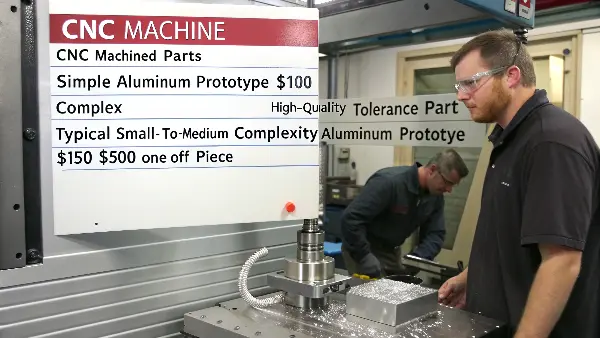
The cost for a single CNC machined part can range from under $100 for a simple aluminum prototype to thousands of dollars for a complex, high-tolerance part made from an exotic alloy. For a typical small-to-medium complexity aluminum prototype, you can expect costs in the range of $150 to $500 for a one-off piece.
The final price depends heavily on a few key variables: the material you choose, the complexity of your design, the tolerances you require, and the quantity you order. A simple bracket is much cheaper than a custom gearbox housing with many features. To give you a better idea, let’s explore some examples. I’ve put together a table below that shows typical price ranges for different types of parts. This will help you estimate where your design might fall on the cost spectrum.
Real-World Cost Examples
To make this practical, let’s look at some typical parts I’ve quoted for clients. Prices can vary based on the specific shop, location, and current material costs, but this should give you a solid reference point. The examples below are for a quantity of one (a single prototype) to show the highest per-unit cost. Remember, the price per part drops significantly with higher quantities.
| Part Description | Material | Key Features | Estimated Cost (Qty: 1) | Estimated Cost (Qty: 100) |
|---|---|---|---|---|
| Simple Rectangular Plate | Aluminum 6061 | 4 through-holes, chamfered edges | $80 – $120 | $15 – $25 per part |
| Custom Mounting Bracket | Stainless Steel 304 | Multiple bends, counterbored holes, a slotted cutout | $250 – $400 | $40 – $60 per part |
| Small Gearbox Housing | Aluminum 7075 | Multiple pockets, threaded holes, tight bearing bores | $600 – $950 | $90 – $140 per part |
| Complex Medical Device Component | Titanium Grade 5 | Organic shape, very thin walls, tight tolerances (±0.01mm) | $1,500 – $2,500+ | $200 – $350 per part |
Factors That Dramatically Increase Cost
Certain design features will always drive your price up. As an engineer, being aware of these can help you make cost-saving decisions early in the design process.
- Tight Tolerances: The difference between a tolerance of ±0.1mm and ±0.01mm is huge in terms of cost. The tighter tolerance requires more precise machines, more careful setup, slower cutting speeds, and in-process inspection, all of which add significant time and expense. Ask yourself if every feature truly needs that level of precision.
- Complex Geometries: Deep pockets are harder and slower to machine than shallow ones because they require longer tools that are less rigid. Thin walls can vibrate during machining, forcing us to use slower cutting speeds to avoid defects.
- Multiple Setups: If a part needs to be flipped over and re-fixtured to machine features on different sides, each new setup adds significant time and potential for error. A design that can be machined from as few sides as possible will always be cheaper. For example, a part requiring 5-axis machining is complex and will cost more than a simple 3-axis part.
- Finishing and Post-Processing: Steps like anodizing, bead blasting, or engraving happen after machining and are quoted as separate line items. Don’t forget to account for these when budgeting. They add both time and direct costs to the final part.
What are all the parts of tooling cost?
You got a quote that includes a "tooling cost," but it’s just a single number. What does that actually pay for? It feels vague, and you wonder if it’s a hidden fee. Understanding what’s inside this cost helps you see its value and necessity.
Tooling cost in CNC machining covers more than just the cutting tools themselves. It primarily includes the design and creation of custom fixtures or jigs needed to hold your specific part securely during machining. It can also cover the cost of specialized cutters or drills that are not part of a shop’s standard inventory.
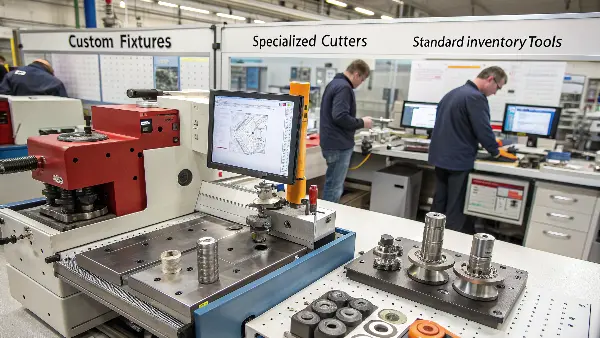
Many engineers I work with are surprised when a tooling cost appears on a quote for a seemingly simple part. A few years ago, a client from the automotive industry sent me a design for a cast aluminum part that needed several holes drilled at odd angles. The part’s shape was irregular, so it couldn’t be held in a standard vise. We had to design and build a custom fixture just to hold it in the right orientation. This fixture was the main driver of the tooling cost, and once I explained it, the client completely understood its importance for part quality and consistency.
Standard vs. Custom Tooling
When we talk about tooling, we are really talking about two different categories. Differentiating between them is key to understanding your quote.
-
Standard Cutting Tools: These are the end mills, drills, and taps that every machine shop has on hand. Things like a 6mm end mill or an M6 tap are considered consumables. Their wear and tear are generally factored into the shop’s hourly machine rate. You typically won’t see a separate line item for these unless your part requires an unusual amount of them or is made from a super-hard material that wears them out very quickly. For 90% of jobs, the cost of these tools is already baked into the machining time cost.
-
Custom Tooling (Fixtures and Jigs): This is where the significant, one-time tooling costs come from. A fixture is a custom workholding device built for one purpose: to hold your specific part securely and repeatably. You need a custom fixture when:
- The part has an irregular shape: If it can’t be clamped flat in a standard vise, it needs a custom solution.
- Features are on multiple, awkward angles: A fixture can be designed to present the part to the cutting tool at the correct angle.
- High-volume production is required: For large runs, custom fixtures allow for much faster loading and unloading of parts, which reduces the per-part cycle time and ultimately saves money over the entire project.
- Tight tolerances between features on different sides: A fixture ensures that when a part is flipped or moved, its position is perfectly maintained relative to the machine’s origin point.
What is included in a custom fixture cost?
The "Tooling Cost" line item for a fixture is not just for a block of metal. It covers:
- Design Time: An engineer or experienced machinist spends hours designing the fixture in CAD software.
- Material: The raw aluminum or steel needed to build the fixture itself.
- Machining the Fixture: The shop uses its own CNC machines to create the custom fixture. This includes machine time and labor.
- Hardware: The cost of clamps, dowel pins, and bolts used to assemble and operate the fixture.
This is a non-recurring engineering (NRE) cost, meaning you pay for it once. The machine shop will then store this fixture for all your future orders of the same part.
Conclusion
Understanding CNC machining costs demystifies the quoting process. It comes down to material, machine time, tooling, and finishing. Knowing this helps you design smarter and budget better for your projects.